The first thing people tend to do when they visit Cappadocia in central Turkey is this… they look up.
And that’s fair enough. This place is home to one of the most famous natural skylines on the planet.
Domed spires of natural rock stretch like jagged teeth towards cloudless azure skies. Colourful hot air balloons float above the horizon… carrying the hordes of tourists who pay top dollar to find the most Instagrammable, TikTokable angle for this unique landscape.
Key Takeaways
- Cappadocia’s underground city of Derinkuyu was inhabited until the early 20th century.
- Derinkuyu’s discovery in 1963 revealed a vast network of rooms and passages.
- The city’s soft volcanic tuff rock made it ideal for carving extensive underground structures.
- Derinkuyu likely served as a refuge for early Christians fleeing Roman persecution.
- The historical consensus suggests the Phrygians built Derinkuyu around the 7th or 8th centuries BC.
Depending on your viewpoint… Cappadocia is a fairytale heaven on earth… or it’s a social-media-hyped honeypot tourist trap. But whatever your own opinion of the place, most would agree… Cappadocia looks pretty good.
But ‘looking up’ at Cappadocia will only give you one small part of the full experience. As you stroll around the countryside of this part of Turkey, 300 kilometres southeast of Ankara, the real mysteries are found only by ‘looking down’…
… down beneath your feet, beneath the earth, and beneath the soft volcanic stone that makes this part of the world so unique.
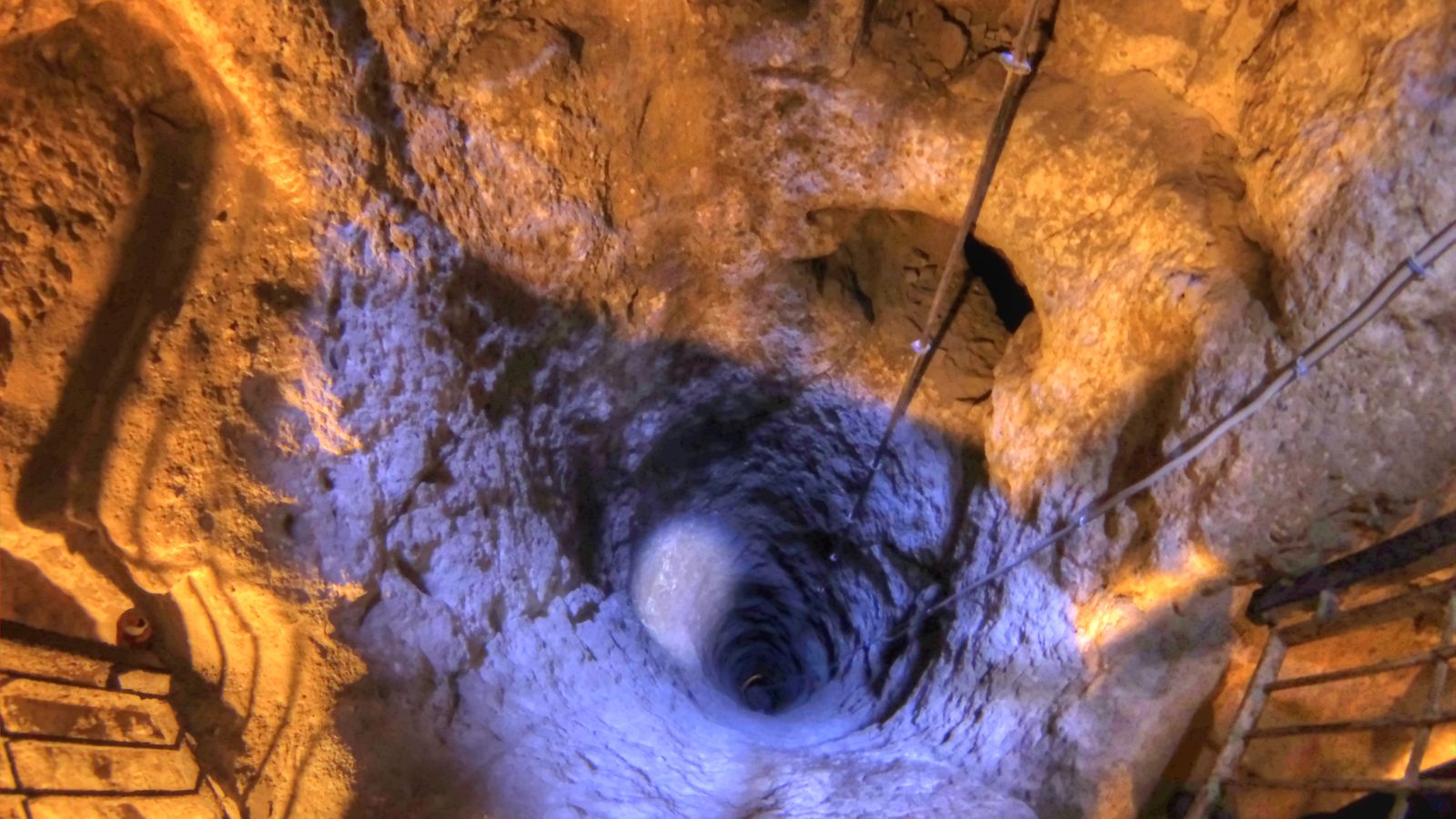
This is where you’ll find Derinkuyu… the sprawling underground city that was inhabited until just over a century ago. This is the real hidden gem of what is rapidly becoming one of the most visited locations on the planet.
Now… you may well be shouting at your phone or your computer screen right now. There’s a good chance you’ve been to Cappadocia yourself. And if you have, there’s a very good chance you’ve been to Derinkuyu.
‘There’s no mystery here’, you might say. ‘You can literally visit the underground city yourself… you just need to pay a guide a few quid to show you around’.
And this is true… but even so, this is still an enigmatic location.
Because… even after years of research and examination by the world’s top archaeologists… still no one is quite certain what this place was for, who built it, and how old it is.
Is it a shelter for refugees escaping persecution above ground at the beginning of the 20th Century?
Is it a hiding place for early Christians, fleeing the spears and swords of their Roman oppressors?
Or is it something much older… a defence against the bitter cold, or even against eruptions of solar energy raining down from above?
These are the questions we’re going to be exploring today, as we take a look beneath the volcanic rock of Cappadocia… and find out the true origins of the sprawling underground city of Derinkuyu.
The Secret Carried Away
May 1st 1923. The Greco-Turkish War has been over for seven months, but it still casts a bloody shadow over the Eastern Mediterranean.
The war has left tens of thousands of dead soldiers on each side… and hundreds of thousands of dead civilians. The conflict forced a revolution in Greece, and even brought down David Lloyd George’s Liberal coalition government, hundreds of miles away in Westminster.
But for more than half a million civilians on the ground, the nightmare is just beginning. Now, eager to avoid a repeat of a costly and harrowing war, Greece and Turkey agree to a population exchange.
350,000 Muslim Turks living in Greece will be sent back to Turkey. And 200,000 Christian Greeks will come back the other way.
Only, they won’t be sent “back”… because most are being sent to places they have never been before.
These communities have existed for centuries. Entire villages and towns are left abandoned… as their people are uprooted, expelled, and sent overseas to start again. And many of these people will never start again… they will retain the lingering trauma for the rest of their lives.
Across Turkey, Greek communities bid farewell to their former homes. In Cappadocia in Central Turkey, southeast of Ankara, it’s no different. The Greek population, who have lived here for generations, must now leave.
And so, the Cappadocian Greeks begin their long trudge towards a new land, and a new home. They leave behind Cappadocia, walking beneath the stunning spires of volcanic tuff that stand proudly by the roadside.
And as they do, the departing Greeks carry with them a secret… a secret that will remain lost for decades.
The Accidental Discovery
Fast forward forty years. It’s now 1963. The Greek population of Cappadocia is long gone, and the area is almost exclusively Turkish now. Life is tough, but life is good. There’s land to be farmed… and the earth provides its bounties to those resourceful enough to take advantage.
Some locals even decide to upgrade their living arrangements, remodelling and renovating their houses to give themselves a bit more space. After all, they’ve earned it.
But for one man in Cappadocia in the early 1960s, this renovation project will not go smoothly.
This man, who unfortunately remains unnamed, was living in one of the many cave-house dwellings that are bored into the rock here in Cappadocia.
While renovating his home, he noticed that a small crevice had opened up at the back of the cave. He didn’t worry too much about this. The soft, pliable rock around here is riddled with holes and caverns, and new fissures and fractures open up all the time. There are more nooks, crannies and crevices than you can shake a stick at.
But this crevice was rather different. It had the rather annoying habit of consuming the man’s chickens. The chickens would wander into the hole, and then disappear… never to be seen again.
Enraged by the chicken-eating fissure that had just opened up on his property, the man decided to work out what the heck was going on.
He dug down into the earth, in search of a resolution to the mystery… and, hopefully, his lost chickens.
But instead, our anonymous friend stumbled upon something much bigger. It was a broad underground passageway, stretching off into the unknown.
He spent a bit of time exploring the passage himself, but soon found he was way out of his depth. Deciding that this job was far too big for him to handle alone… he called in the experts.
Investigators and archaeologists found a sprawling network of passages, rooms, chambers and structures.
There were warehouses and granaries, there were cattle stables, schools, and homes for people to live in. There was a chapel for Christian worship. And there were even wineries, and structures designed for fermenting and brewing. The inhabitants evidently knew how to have a good time.
It cannot be overstated just how huge this place was. In some parts of the complex, multiple levels of chambers sat atop one another, connected by passages wide enough for three people to walk side by side. Some of these passages were up to six miles in length, connecting one subterranean community to another.
And there were plenty more entrances too… 600 in total. It was an entire city, buried 60 metres beneath the earth, with enough room for 20,000 people to live.
By the end of the decade, the underground city of Derinkuyu was open to the public… and this part of Turkey had a new tourist attraction. Since then, the subterranean world has become a UNESCO World Heritage site, and it’s one of the must-see destinations for today’s globetrotters and adventure-seekers.
But this only tells us how Derinkuyu was discovered… and how it took its place on the travel bucket lists of tourists from around the world.
It doesn’t tell us how the city came to be in the first place.
In fact, Derinkuyu wasn’t always known by this name. The Cappadocian Greeks called it Elengubu, before they were driven out at the beginning of the 1920s.
But this only takes us back one century into the fascinating history of this place. The underground city of Derinkuyu is certainly much older than this… and so, we are confronted with a whole host of different questions.
Why was this city built here, in the heart of Cappadocia?
Who built it… and when?
And what were people so afraid of that they had to abandon their world on the surface… and start a whole new life underground?
Why Here? The Geology of Cappadocia
Answering that first question is actually not so difficult. Take one visit to Cappadocia, and take one look at the geology of this place, and you’ll know exactly what I mean.
Cappadocia has become world-famous for its volcanic tuff rock. This rock is formed when a volcano erupts, and spews out vast quantities of ash across the mountainside. When this ash starts to cool, it solidifies, creating the rocks we see today.
But from a geological perspective, volcanic tuff is something of a general term. It relates to any type of rock that forms this way.
Some types of volcanic tuff are incredibly resistant. They are buried beneath the earth after the initial eruption, and are then forged in the pressure and heat until they become bullet-hard. No one is going to whittle an underground city out of this stuff.
But other types of tuff are not buried. They stay on the surface, and remain exposed to the elements. This makes them soft and pliable, but sturdy… the perfect material for a craftsman or an architect.
It’s this other form of tuff that we’re dealing with here. This rock is very easy to manipulate and work with, and is similar to the material used to craft the great heads of Easter Island. The previous inhabitants of Cappadocia would have been able to create vast structures in this medium, using just hand tools and rudimentary instruments.
So, there’s no mystery around the question of “why here”. The local geography makes this the perfect place to build this type of structure. In fact, there are actually around 200 underground villages, towns, and cities across the region.
Tourists can visit the underground settlements at Özkonak [Oz-koh-nak], Mazıköy [Mar-zi-queue], Kaymaklı [Kai-mak-le], and elsewhere. Another underground city was discovered at Gaziemir [Ga-zeer-mish] in 2007, and there may be other structures buried beneath the earth that we have not yet located.
But it is Derinkuyu that is the largest and most extensive of these cities… and so, Derinkuyu is the most famous.
Refuge from Persecution
But other questions are not quite so easy to answer. For example, who built this thing… when did they build it… and what were they hiding from?
The first clue comes from the Cappadocian Christians who were driven out of this land in 1923. The existence of a Chapel and a winery at Derinkuyu tells us that the structure supported the Greek Orthodox religion and culture, rather than its Muslim Ottoman counterpart.
As an enclave in the Ottoman Empire, these Christians would have felt like their way of life… and even their lives themselves… were in danger.
And humans have a habit of fleeing from danger. Across human history, since the very dawn of time, this is something we have done. We build hiding places and easily defensible positions. This is why there are so many castles and forts all over the place.
In fact, we know that those modern Greek Christians used Elengubu in this way.
In April of 1909, an Ottoman pogrom around Adana Vilayet targeted Armenians, Greeks and Assyrians, as part of a program of ethnic cleansing.
The Christian targets of this pogrom were subjected to real horrors, including torture, sexual abuse, and murder. Between 20,000 and 30,000 people lost their lives in an explosion of violence that lasted more than one month.
The Adana Massacres remain a traumatic subject for many communities in the eastern Mediterranean and in the Caucasus… and in fact they have never been officially recognised by the Turkish government.
While most of those who died at Adana were Armenian, there were high casualties among the ethnic Greeks too. This would have struck fear into the hearts of Greek communities elsewhere in the Ottoman Empire.
The linguist Richard MacGillivray Dawkins conducted research in the area in the years following the massacre, and had this to say:
When the news came of the recent massacres at Adana, a great part of the population at Axo took refuge in these underground chambers, and for some nights did not venture to sleep above ground.
But, unfortunately for the Greek community, the massacres of Adana were not the first instances of bloodshed and persecution in Anatolia. Instead, the tunnels of Derinkuyu would have been hiding places long before this.
A Crossroads of Conflict
Watch Now
Open Video
Video Briefing
Why is There a City for 20,000 People Under Turkey?
Just take a look at Anatolia’s position on the map. The term “crossroads” gets thrown around a little too easily in geopolitical discussions, but this place genuinely is a crossroads…
… both in terms of its human geography, and its physical geography.
It lies at the Eastern Edge of the Mediterranean, which has been one of the cradles of global culture, commerce, and combat, for as long as anyone can remember.
It is divided between Europe to the west and Asia to the east, and is close to Africa to the south. So it is something of a confluence of three continents.
It has been, at various times, part of the Christian Byzantine Empire, and the Muslim Ottoman Empire. Its culture, architecture, and general character, reflect both of these spheres of influence.
To put it simply, this is a place that lots of people want to fight over… and lots of people have fought over it.
During the Byzantine era, bitter warfare between Christian Constantinople and the Muslim Arab forces approaching from the south and east laid waste to large parts of this landscape. For four hundred years… between 780 and 1180 AD… the plains of Anatolia were not a safe place to be.
Centuries later, the local population found themselves right in harm’s way yet again. This time, it was the Mongol Invaders from Central Asia who were causing all the strife. Led by the legendary Timur, these 14th-century invasions left thousands dead, and made large sections of land almost uninhabitable.
So… building a fortress beneath the ground seems like a good way to escape this.
It’s also possible that the underground dwellings were designed to resist natural disasters.
Anatolia is a seismologically active part of the world, located between the Eurasian and Arabian tectonic plates.
In the 19th Century alone, there were at least nine major earthquakes that struck Anatolia, and many more in other areas of the Ottoman Empire. These were mass casualty events, that would have devastated entire regions.
Between 1812 and 1819, a plague epidemic also ripped across the region, leaving at least 300,000 dead.
It’s unknown how effective an underground city would be in the face of an earth-shattering quake, or an insidious wave of pestilence, but it makes sense that people would try to hide underground.
Searching for the First Builders
But who were the first people to build this underground labyrinth?
It wasn’t the modern Cappadocian Christians. They simply used it for security and safety when their enclave was under threat.
If you remember the words of MacGillivray Dawkins, people “took refuge” here… for “some nights”. He didn’t say that they lived here permanently.
The city of Derinkuyu is certainly much older than the modern period, or even the early modern period.
Many historians believe it was in use as early as the 2nd Century AD, when Christian communities in the region needed a place to hide in the face of Roman persecution and harassment.
This would certainly make sense. The persecution of Christians in Turkey by Roman forces was certainly ‘a thing’ in the second century. Early Christian histories speak of the massacres at Nicomedia, located in modern-day Izmit in the northwestern part of Turkey.
Accounts suggest that the Nicomedian Christians were put to death on an alarming scale. Some were burned, others drowned, while many had their heads cut off.
According to Byzantine accounts, a large group of Christians took shelter in a church, only to be roasted alive within its walls after refusing to bow down to the Roman gods.
Over the years, this story has coalesced into the tale of the “20,000 Martyrs”. These days, however, historians believe that this figure of 20,000 is greatly exaggerated.
But still… even if there weren’t 20,000 deaths at Nicomedia… Roman persecution and killing of Christians was a very real threat in Anatolia at this time. So it’s not too much of a leap to suggest that other Christians in the region hid themselves in underground cities to escape the wrath of the centurions.
This would explain the chapels carved from the rock, and the Christian iconography etched into the walls. But these are only small parts of a vast set of structures…
… it’s likely that there were subterranean dwellings here long before any Christians arrived… and even before the birth of Jesus Christ himself.
Historians tend to point to the Phrygians as the first builders and tunnellers at Derinkuyu, in around the 7th or 8th centuries BC. This would mean that the underground city was around one thousand years old by the time that Turkish Christians arrived here.
Phrygia itself was to the northwest of Cappadocia, but at its greatest extent, the Phrygian Kingdom covered a huge swathe of Anatolia… including the region around Derinkuyu.
Across the former kingdom, there are plenty of examples of Phrygian architecture for historians to examine. The ancient city of Gordium, in modern-day Ankara province, has been pored over by archaeologists eager to discover more about Ancient Anatolia.
The vast burial mounds and impressive stone carvings show that the Phrygians knew how to handle this sort of stone. Arriving in Cappadocia would have been like stumbling across a treasure trove for these fine stonemasons, and it’s easy to imagine them going nuts with this soft, pliable rock.
It’s almost certain that at least some of the city of Derinkuyu, and other underground cities in the region, was carved by the Phrygians. But some scholars believe that parts of the site may be even older than this…
The Hittite Question
The Hittites are among the forgotten civilisations of the Bronze Age. For more than five hundred years, from around 1700 BC to 1178 BC, the Hittite Empire flourished across much of modern-day Turkey, stretching down into what is now Lebanon and Syria. Their vassal states stretched even further, covering parts of Armenia and the island of Cyprus.
When I say ‘forgotten’, I don’t mean in the historical sense. Ancient historians are well aware of the Hittites. But they are relatively forgotten, when compared to ‘big hitters’ like the Egyptians to the south, and the various Greek polities to the west.
This is partly because the Hittites, and their capital Hattusa, were among the biggest victims of the Bronze Age collapse… when a mixture of natural disaster and warfare brought about one of the biggest cataclysms in human history.
So the Hittites got washed away in time’s flood. This is why your average primary school kid has some idea of who Tutankhamun is… and absolutely no idea who Suppiluliuma the Second is. This is the nature of history.
But before this monumental catastrophe, the Hittites were doing amazing things across what is now Turkey, and beyond.
Hittite art is easily the equal of the great cultural projects of their Bronze Age contemporaries.
And their architecture shows a real ability to tunnel and dig vast structures out of the earth. They certainly would have had the capability to build the cities now found beneath the soil of Cappadocia…
… or at least, they had the ability to build part of them, as this was probably a long-term project that lasted for centuries.
But there’s a problem with this theory. In the tunnels of Derinkuyu, Kaymaklı, and elsewhere, we don’t see the carvings and artwork that Hittite civilisation was famous for. Also, this place has been a real archaeological hotspot for the last 60 years, and yet no one has ever found any concrete evidence to suggest that this was a Hittite site.
The only evidence that supports this theory is the discovery of a single Hittite tool at the site. But this is not definitive proof… tools are designed to be portable, and could easily have been brought here from elsewhere, at a later date.
So where does this leave us? Was Derinkuyu built by the Phrygians… or did they simply expand the site?
Was it the Hittites who made the first excavations here… and just didn’t bother with any of the fine carvings and stonework they left at other sites?
Or was it someone else… working at a time long before the ancient Hittites?
Neolithic Dreams and Ancient Astronauts
In 1963, at almost exactly the same time that our unnamed friend was blundering about in a cave in Cappadocia, surveyors far to the south stumbled across something.
Down near the Syrian border, deep beneath the earth, they encountered something that appeared very much like a settlement. A few tools and implements were discovered, and they looked old… seriously old.
But this is the Middle East… It’s the cradle of civilisation. To the southeast, in Iraq, the ground is practically bubbling over with ancient Babylonian and Sumerian artefacts. The surveyors were impressed with their find in southern Turkey… but didn’t think too much of it.
They thought it was just another ancient site… to add to the growing list of ancient sites in this part of the world.
Three decades went by, and the findings in southern Turkey were largely forgotten. But then, in 1994, the German archaeologist Klaus Schmidt showed up in Cappadocia.
He’d heard about the earlier discovery, and he felt this place was ripe for further exploration.
The following year, in 1995, he began his archaeological dig… and what he discovered was truly astounding.
This discovery was Göbekli Tepe… not a Bronze Age site, not even a Copper Age site, but a Neolithic site. In other words, this was a structure from the late Stone Age.
It’s believed that Göbekli Tepe was founded in 9500 BCE… making it a staggering 11,500 years old.
This means Göbekli Tepe is a relic of the very earliest phases of civilisational development. It is not believed to be a city, but rather something like a temple or a place of worship. Even though it was not a place of permanent settlement, this is still perhaps the oldest holy site in human history.
In fact, Turkey is home to a number of these Neolithic sites. Çatalhöyük [Chat-tal-hoo-k] on the Southern Anatolian plateau was certainly occupied during the late Stone Age and into the Copper Age. The first inhabitants may have lived here as early as 7400 BC, which is two thousand years after the founding of Göbekli Tepe, but is still an extremely long time ago.
So, could these sites provide us with some clues to the origin of Derinkuyu?
Some have suggested that the underground city was also developed around this time… by a lost civilisation that historians have yet to understand.
Robert Schoch, for example has written a book named ‘Forgotten Civilization’. In this book, he outlines his ideas around Derinkuyu, making the rather outlandish claim that Derinkuyu was designed to protect humans from a series of massive solar flares around 9700 BC.
And yes, this would make it even older than the temple complex at Göbekli Tepe.
Schoch’s ideas are not well supported by historians. He is a geologist rather than an archaeologist, and has a habit of making bold claims about ancient structures, based on geological activity rather than historical data.
For example, he has claimed that Egypt’s Great Sphinx is significantly older than its accepted construction date of 2500 BC, due to the erosion patterns on its surface.
But, while Schoch’s claims might be a little wild, he’s not the only one making this kind of assertion.
Some researchers have suggested that Derinkuyu is even older than this. Omer Demir, for example, believes that Derinkuyu was first carved out from the rock during the last ice age, more than 12,000 years ago.
The author Graham Hancock quotes Demir in his own book, ‘Magicians of the Gods’:
Demir suggests that the huge quantities of rock excavated to make the underground city were dumped into local streams and carried off. In one of these streams, 26 kilometres from Derinkuyu, hand-axes, rock-chips and other Palaeolithic artefacts were found.
While Hancock admits that Demir’s evidence is “suggestive at best”, he does agree with some of his findings.
Hancock believes that Derinkuyu may have been constructed to defend early humans from the Younger Dryas effect. This refers to a period of sudden climate cooling in the Northern Hemisphere, which occurred between 11,700 and 12,900 years ago.
Conditions got suddenly colder, destroying biomes, forcing entire species to go extinct, and making it difficult for people to feed themselves and find shelter. So people were forced underground, digging out structures in which to live, and in which to store their dwindling stocks of food.
Over time, as the glaciers failed to recede, and the snow kept on falling, the inhabitants dug further and further into the soft stone… leaving us with a sprawling network of caverns that would be inhabited sporadically for millennia.
In Hancock’s own words:
Stated simply, the cities [were] cut down into the depths of the earth as places of refuge from the horrors of the Younger Dryas.
These are all very exciting theories, and it’s easy to get swept up in the head-spinning timeframes they offer. But we do need to think seriously and logically about this.
The theories of Schoch, Demir, and Hancock are not really part of mainstream historical thinking around Cappadocia. Few people in the archaeological community put much faith in these ideas.
The reason that most historians don’t buy these theories is simple: … stone age tools simply weren’t good enough to construct something on this scale.
Yes, volcanic tuff is a brilliant medium for an early stonemason… but it’s still an absolute nightmare if you’re digging it out with your bare hands, or with a wooden club, or with a stone axe.
Those 12,000-year-old proto-humans certainly had a lot of time on their hands, but would they really have been able to put together something this sophisticated?
The likelihood is… probably not.
The Fork in the Road
So this leaves us at a fork in the road. One route takes us towards the more mainstream archaeological view.
And the other route… well, this takes us into even more controversial territory.
Erich von Däniken was born in Switzerland in 1935, and became interested in astronomy at an early age… particularly the flying saucers that suddenly began to show up in the skies around the middle of the last century.
Von Däniken became borderline obsessed with these extra-terrestrial visitors… and not in the ‘normal’, ‘there’s-something-out-there’ kind of way, either. For this Swiss researcher, aliens became the key that would unlock the secrets of the past, right here on Planet Earth.
In 1968, he published the book that made him famous. This was “Chariots of the Gods?”, which features an enigmatically open-ended question mark at the end of its title.
The book suggested that our forebears did not have the tools, the technology, or the understanding, to build all those ancient wonders of the world themselves… and so ‘ancient astronauts’ must have helped them out.
Of course, a figure like this could not stay away from Cappadocia for too long. In 1982, he arrived here at Derinkuyu, and began the next phase of his research. After some ‘in-depth investigation’, he concluded:
This underground city, which was built to protect from dangers, was originally built against airborne attacks. There is no other explanation for this.
Von Däniken sounds remarkably certain for a man who was not even confident enough to drop the ‘question mark’ from the title of his own book.
But if the theories of Demir, Hancock and Schoch are ‘a tad controversial’… then Von Däniken’s ideas are ‘off the scale’. His work has been discredited by basically everyone in a position to do so.
Simply because an underground city exists, does not mean that an intergalactic army was raining death from the sky. I think this theory is best left where it belongs…
The Historical Consensus
So this leads us to the other fork. This fork takes us back towards the more boring… but far more likely to be true… field of good old-fashioned legitimate historical consensus.
And the historical consensus is this… the Phrygians are the most likely candidates.
We really don’t have much in the way of documentary evidence for the building of Derinkuyu. The earliest mention that historians have found comes from the ‘Anabasis’, written by the Greek soldier and writer Xenophon, around 370 BC.
Xenophon writes:
Their houses were underground, with a mouth like that of a well, but below they spread out widely. Entrance ways were dug for the herd animals, but the people descended by ladder. In the houses, there were goats, sheep, cattle, birds, and their children. Inside, all the animals were kept fed on a diet of fodder.
And this is where the trail goes cold, really. There’s just not enough evidence to suggest that Derinkuyu is any older than the Phrygian Kingdom of the 7th and 8th centuries BC.
The odd Hittite-era tool found here and there… or fairly spurious claims of shelters from ice ages and solar flares… don’t change this.
This is so often the way with Ancient History. Once all the pieces have been put together, and all the available clues considered, the consensus is just… “well, we don’t know for sure… but it’s probably this.”
But that doesn’t stop people from dreaming. Taking a walk through an underground city, scoured out of the rock by ancient hands, is always going to leave something of an impression… It’s always going to set the imagination racing.
But just keep this in mind, before that imagination races a little too far:
It’s likely that those ancient hands were working 3,000 years ago… rather than 12,000.
And they were probably seeking defence from their warring neighbours… rather than solar flares, or an invading army from space.
Simon Whistler
Simon Whistler is one of YouTube's most prolific educational creators. Decoding the Unknown is his methodical investigation into the world's strangest phenomena — examined with rigour, curiosity, and a healthy dose of scepticism.
Frequently Asked Questions
What is the name of the underground city in Turkey?
The underground city is called Derinkuyu.
How many people could the underground city of Derinkuyu accommodate?
The underground city of Derinkuyu could accommodate 20,000 people.
What is the significance of the volcanic tuff rock in Cappadocia?
The volcanic tuff rock in Cappadocia is significant because it is soft and pliable, making it easy to carve into and ideal for constructing underground cities.
What was the original name of Derinkuyu?
The original name of Derinkuyu was Elengubu.
Who were the Cappadocian Greeks and what happened to them?
The Cappadocian Greeks were a community that lived in Cappadocia for generations. In 1923, they were forced to leave their homes as part of a population exchange between Greece and Turkey.
What was the Adana Massacre and how did it affect the Cappadocian Greeks?
The Adana Massacre was a pogrom in 1909 that targeted Armenians, Greeks, and Assyrians. It struck fear into the hearts of Greek communities in the Ottoman Empire, leading them to seek refuge in underground cities like Derinkuyu.
What are some of the theories about who built Derinkuyu?
Some theories suggest that Derinkuyu was built by the Phrygians around the 7th or 8th centuries BC, while others propose it could be even older, possibly built by the Hittites or even a lost civilization from the Stone Age.
What is the significance of the chapel and winery found in Derinkuyu?
The chapel and winery in Derinkuyu indicate that the city supported the Greek Orthodox religion and culture, suggesting it was used by Christian communities seeking refuge from persecution.
What is the historical consensus on the builders of Derinkuyu?
The historical consensus is that the Phrygians are the most likely candidates for building Derinkuyu, around the 7th or 8th centuries BC.
What is the significance of Göbekli Tepe in relation to Derinkuyu?
Göbekli Tepe is a Neolithic site in Turkey that is believed to be around 11,500 years old. Some researchers have suggested that Derinkuyu could be similarly ancient, but this theory is not widely accepted by historians.
Sources
- Original Decoding the Unknown video: Why is There a City for 20,000 People Under Turkey?
- https://www.trtworld.com/article/16789083
- [https://en.wikipedia.org/wiki/Greco-Turkish_War_(1919%E2%80%931922](https://en.wikipedia.org/wiki/Greco-Turkish_War_(1919%E2%80%931922)
- https://en.wikipedia.org/wiki/11_September_1922_Revolution
- https://en.wikipedia.org/wiki/Chanak_crisis
- https://bigthink.com/strange-maps/derinkuyu-underground-city/
- https://www.bbc.co.uk/travel/article/20220810-derinkuyu-turkeys-underground-city-of-20000-people
- https://bldgblog.com/2007/08/derinkuyu-or-the-allure-of-the-underground-city/
- https://www.universetoday.com/articles/volcanic-tuff
- https://rockreaders.com/card/tuff/
- https://cappadociatravelpass.com/underground-cities-of-cappadocia
- https://turkeytravelplanner.com/go/CentralAnatolia/Cappadocia/yeralti/index.html
- https://en.wikipedia.org/wiki/Adana_massacre
- https://www.historyhit.com/locations/derinkuyu-underground-city/
- https://en.wikipedia.org/wiki/Category:19th-century_disasters_in_the_Ottoman_Empire
- https://www.monasticrepublic.com/en/orthodox-synaxarion/december/holy-20000-martyrs-who-were-burned-in-nicomedia
- https://www.alamy.com/stock-photo-early-christian-art-at-the-derinkuyu-underground-city-in-cappadocia-24144996.html
- https://en.wikipedia.org/wiki/Phrygia
- https://en.wikipedia.org/wiki/Hittites
- https://en.wikipedia.org/wiki/Rock-cut_architecture_of_Cappadocia
- https://www.history.com/articles/gobekli-tepe
- https://whc.unesco.org/en/list/1405/
- https://archive.org/stream/magiciansofthegodstheforgottenwisdomofearthslostcivilization_201909/Magicians%20Of%20The%20Gods%20%5BThe%20Forgotten%20Wisdom%20Of%20Earth%27s%20Lost%20Civilization%5D_djvu.txt
- https://en.wikipedia.org/wiki/Erich_von_D%C3%A4niken
- https://turkishmuseums.com/Uploads/M%C3%BCze/Dosya/1e04aa2a-6080-4aaf-9b8d-3d03ffba26e0.pdf
- [https://en.wikipedia.org/wiki/Anabasis_(Xenophon](https://en.wikipedia.org/wiki/Anabasis_(Xenophon)
- Hero image source by Nevit Dilmen (talk) / openverse, by-sa.