
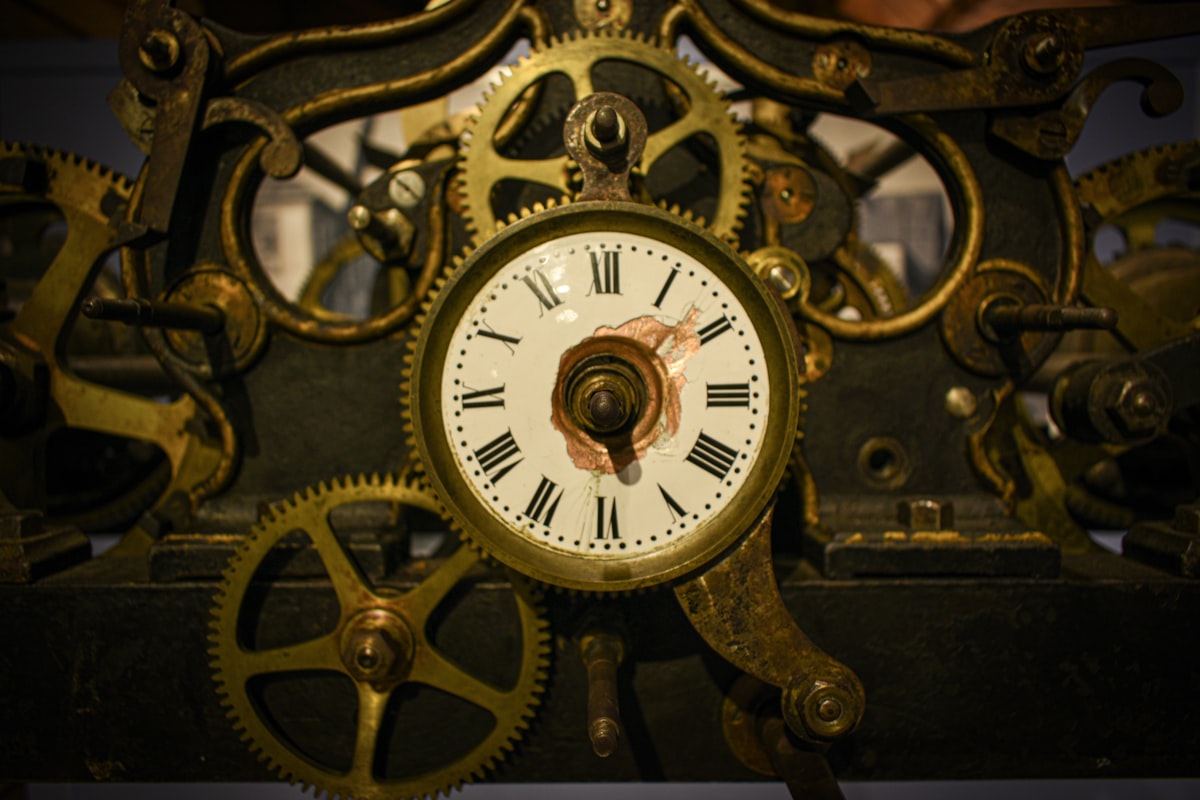
In the spring of 1901, sponge divers working near the Greek island of Antikythera surfaced with fragments of corroded bronze from a Roman-era shipwreck. The ship had sunk around 65 BCE, and most of what it carried — marble statues, glass vessels, amphorae — was immediately recognisable as ancient luxury cargo. The bronze fragments were not. They were covered in gears.
The Antikythera Mechanism, as it came to be known, sat in a glass case in the National Archaeological Museum in Athens for decades. Archaeologists knew it was mechanical. They could see the teeth of interlocking gears. But they did not know what it did, and the assumption — that it was a simple calendar device — satisfied most scholars until the late twentieth century, when imaging technology made it possible to read the text hidden inside the corroded bronze.
What that text described was not simple at all.
Key Takeaways
- The Antikythera Mechanism contains at least 37 hand-cut bronze gears and was built around 100 BCE — roughly the technological complexity of a medieval astronomical clock, but 1,400 years earlier.
- Its front display tracked the Sun and Moon’s positions; its back dials predicted eclipses using both the Metonic and Saros cycles.
- A 2021 UCL reconstruction suggests the device also mechanically modelled the orbits of all five planets known to antiquity.
- The mechanism’s design connects it to the astronomical schools of Rhodes, possibly to a tradition originating with Archimedes.
- No comparable device appears in the archaeological record from any culture before or after it for over a thousand years — a gap that remains one of archaeology’s deepest puzzles.
A Computer for the Sky
The mechanism contains at least 37 gears, all hand-cut with a precision that would not be matched again until the astronomical clocks of medieval Europe. Its front dial displayed the positions of the Sun and Moon against the Greek zodiac and the Egyptian calendar. Its back dials tracked the Metonic cycle — the 19-year period after which the Moon’s phases recur on the same calendar dates — and the Saros cycle, the 18-year pattern governing the recurrence of eclipses.
Turn the hand crank, and the device would tell you where the Sun and Moon would be on any given date, past or future. A second pointer tracked the anomaly of the Moon’s orbit — the fact that the Moon moves faster at certain points in its elliptical path than others. This is a genuinely difficult calculation. Ancient Greek astronomers understood it as a second epicycle, a wheel within a wheel. The mechanism rendered that epicycle in physical bronze.
The Saros dial on the back did something more remarkable still. It predicted eclipses — not just whether they would occur, but whether they would be visible from a given location, and whether the eclipse would be of the Sun or Moon. Small glyphs within the dial cells used a three-letter code that scholars have now partially decoded. The letters specify the hour of the eclipse and the type.
In 2021, researchers from University College London published a reconstruction that added another dimension: the front of the device carried a further display tracking the positions of the five planets known to antiquity — Mercury, Venus, Mars, Jupiter, and Saturn. If this reconstruction is correct, the Antikythera Mechanism was not a calendar. It was a complete model of the known solar system, mechanically operated, portable, and built two thousand years before Isaac Newton formulated the laws of motion that would make such a machine theoretically grounded.
Who Built It, and Why?
The ship that carried the mechanism was probably travelling from the eastern Mediterranean toward Rome, likely as part of a cargo destined for a wealthy Roman patron. The period roughly coincides with Julius Caesar’s campaigns in Greece, and scholars have speculated — without direct evidence — that it may have been intended as a gift for a Roman general or aristocrat.
The mechanism’s design shows strong connections to the astronomical tradition of Rhodes, particularly the school associated with the polymath Posidonius. The Roman statesman Cicero wrote of visiting Rhodes and seeing a device there — made, he believed, by either Posidonius or Archimedes — that could replicate the motions of the Sun, Moon, and planets. Cicero’s description, written around 70 BCE, matches the Antikythera Mechanism closely enough to have prompted serious speculation that the two are related.
Archimedes himself, who lived in the third century BCE, was known to have built mechanical models of the heavens. None have survived. If the Antikythera Mechanism represents a tradition that began with Archimedes and ran through the schools of Rhodes, it implies a sustained culture of precision mechanical engineering that entirely vanished from the historical record — perhaps lost in the destruction of Alexandria, perhaps simply not reproduced because the knowledge was held by too few.
What Was Lost
The most haunting aspect of the Antikythera Mechanism is not what it reveals about ancient capability, but what it implies about everything we are not finding. A device this complex does not appear in isolation. It requires a tradition of craft knowledge, a supply of tools capable of cutting its 0.5-millimetre gear teeth, and a body of theoretical astronomy precise enough to specify its calculations. All of that had to exist, in some form, before the mechanism was built.
Yet we have no other surviving examples. The tradition, whatever it was, did not persist into the medieval period in any recognisable form. When European clockmakers of the thirteenth and fourteenth centuries began building mechanical astronomical instruments, they had to rediscover the gear ratios the Antikythera craftsman had worked out two millennia earlier.
The mechanism is not a curiosity. It is evidence of a discontinuity — a civilisation that knew something we lost, and then found again, without any memory of having known it before.
Mara Chen
Mara Chen is a science journalist and investigative writer who specialises in anomalous phenomena, fringe physics, and the archaeology of the unexplained. She has contributed to publications across the science and culture beat.