Whether you’re a lover of history, a connoisseur of adventure movies in exotic locales, or a keen conspiracy theorist, trusting no-one, odds are, you’ll find something in the deserts of Egypt to make your heart beat just a little bit faster. Ancient pyramids built by mysterious architects, lost tombs containing the truth about human history, mysterious monuments with obscure meanings and mummies, with a South African accent, coming to life, chasing people through the streets of Cairo, Egypt has it all.
The crowning jewel of ancient Egypt, for historians and seekers of truth alike, must be the Great Pyramid resting on the Giza plateau – a vast monument refusing to give up its secrets, keeping archaeologists busy to this day. However, what if I was to tell you that there was another structure, a monument more awe-inspiring than the Great Pyramid itself? A structure that had been lost for thousands of years, delegated to the world of myth and story, only to be discovered again, buried under layers and layers of desert sand at the entrance to an oasis.
I speak of course of the Lost Labyrinth of Egypt, considered a wonder of the ancient world. What do we know about this ancient marvel, and what secrets are tucked away in the buried chambers that would lead to the team who made the discovery being threatened with sanctions if they said a word about what they found?
Key Takeaways
- The Lost Labyrinth of Egypt is an ancient structure mentioned by Herodotus and other historians.
- The labyrinth was located near Lake Moeris, close to Crocodilopolis, and was described as more impressive than the Great Pyramids.
- Modern excavations and geophysical surveys suggest that parts of the labyrinth may still exist beneath the sands of Hawara.
- Conspiracy theories propose that the labyrinth contains hidden knowledge or even extraterrestrial artifacts, but these claims lack scientific evidence.
- Despite claims of cover-ups, ongoing archaeological work at Hawara continues, focusing on preserving and studying the site.
Ancient Sources
The Lost Labyrinth of ancient Egypt is first mentioned by Herodotus, the father of history, the Original Tourist, and probably one of the most prolific travel writers that ever lived. How accurate his histories are is sometimes debated by historians, but we know Herodotus visited Egypt, and considering the detail with which he described this labyrinth, we’re pretty sure he actually visited the labyrinth personally. What he saw totally blew him away.
He had a lot to say, but this passage really stands out: ”… This I have actually seen, a work beyond words. For if anyone put together the buildings of the Greeks and display of their labours, they would seem lesser in both effort and expense to this labyrinth… even the pyramids are beyond words, and each was equal to many and mighty works of the Greeks. Yet the Labyrinth surpasses even the pyramids.”
A building more impressive than the Great Pyramids of Giza; high praise indeed. Herodotus described the labyrinth as having two levels. The upper level consisted of twelve roofed courts with the doors facing each other.
Six of these courts faced north and six faced south. There were 1500 chambers on the upper level and he imaged the lower level as mirroring the upper level so 3000 chambers in total. The passages winding through this labyrinth seemed endless and very confusing, and the walls of the chambers and passages were covered with carved figures, hieroglyphs and paintings.
Around every court were white pillars with the stones fitted together precisely. At one corner of the labyrinth was a pyramid, 40 fathoms high, upon which even more figures were carved and there was an underground passage leading from the pyramid into the labyrinth. He described the rooms as far too great or impressive to have been built by human strength; a little detail some folks interpret as the labyrinth wasn’t built by humans at all, and this being ancient Egypt, the land built by aliens according to some tales, I suppose taking a break from pyramids by building a huge labyrinth only makes sense.
Everybody needs a hobby. Herodotus was shown the upper level but, alas, when he asked to go down and check out the lower level, he was informed that wouldn’t be possible; the lower level was forbidden for it held the sepulchres of the twelve kings who first built the labyrinth and the sacred crocodiles. Remember those crocodiles, we’ll meet them again.
Around 400 years later, another well-known writer and historian pitched up in Egypt in the company of Roman Perfect Aelius Gallus – Strabo. He also compared the Labyrinth to the Great Pyramids and, much like Herodotus, he was awestruck by what he saw; five stars on TripAdvisor for sure. He described the labyrinth as a large palace, composed of many sub-palaces, one for each nome.
A nome was basically an administrative division and, according to Strabo anyway, it was custom for all these nomes to gather together, with their own priests and priestesses, to sacrifice to the gods and make decisions about important matters. This would suggest that the labyrinth was both a temple as well as an administrative complex which would certainly make sense as it is still customary today to build government buildings like ancient mazes. In fact, Strabo stated that no-one would be able to find their way out without a guide, which, once again, is still standard for government buildings today; especially the tax office.
There are a lot of similarities between Herodotus’ description and Strabo’s description; both of them mention the pyramid for a start. However, Strabo does mention the roof, which becomes important later. According to Strabo, each court or sub-palace had a roof made of a single slab of stone of extraordinary size without the use of any other material – no timber, no mud bricks – just one solid slab of stone.
There are a lot of differences as well, for example, Strabo doesn’t mention a lower level and he definitely doesn’t mention 3000 chambers. However, most historians agree that the discrepancies can most likely be explained by translation errors from the original texts since the ancient Greek used by Strabo and Herodotus ain’t quite the Greek spoken these days and a lot of time had passed between Herodotus’ and Strabo’s visits. Herodotus lived between 484 and 425 BCE and Strabo only showed up from 64 BCE to 24 CE.
It’s possible that the labyrinth was already deteriorating by Strabo’s time and perhaps its purpose had changed by then. Herodotus was also trying to describe a novel architectural marvel to his readers. It’s very difficult to describe architectural elements you don’t actually have a word for and, as a well-educated man with an educated audience, I’m guessing ‘that roofed thingy in the desert’ probably wouldn’t have been acceptable.
However, there are enough similarities that we’re pretty sure both these historians actually visited the Labyrinth of Egypt well before it became the Lost Labyrinth of Egypt.
However, Strabo and Herodotus weren’t the only ones who mentioned the labyrinth – the 3rd century BCE priest, Manetho, Diodorus Siculus, a Greek historian from around the 1st century BCE, Pliny the Elder, a Roman writer who lived around 23-79 CE, and who shows up a lot in these ancient mysteries and, finally, the Roman geographer, Pomponius Mela, writing around 43 CE, all talk about this labyrinth in Egypt. Mela specifically mentions the innumerable paths causing great perplexity to whoever happens to be wandering through them.
Pliny was particularly impressed, describing the labyrinth as ‘a bewildering maze of paths’, adding that individuals who entered the temple not only had to try and navigate their way through a very confusing array of ramps, porticoes, rooms and stairs, but they had to do so with ‘a fearful noise of thunder’ as they passed through darkened chambers; very Indiana Jones. Pliny was so impressed with the labyrinth, he even suggested that Daedalus used this Egyptian labyrinth as the model for the labyrinth he built in Crete, the one King Minos used to stash the minotaur; however, old Daedalus couldn’t match the splendour of this original, isn’t that always the case, because he only copied about a hundredth part of this expansive Egyptian labyrinth with its twisting paths and passages, all impossible to negotiate. Manetho, however, was apparently less impressed with the labyrinth as he merely calls it a tomb. Whether all of these writers actually visited the labyrinth themselves is in doubt; they were probably relying on the works of Herodotus and Strabo.
While the ancient writers give detailed descriptions of what the labyrinth looked like, no-one thought to write down what it was actually used for, or they didn’t know so they just made it up. Academic rigour wasn’t quite as strict back then. Strabo described it as an administrative centre, Pliny believed it was a temple, and Diodorus claimed it was a tomb.
Others believed the labyrinth was a temple to the Sun. However, according to one very cynical Greek, Aelius Aristides, who must’ve been a blast at symposiums, the labyrinth was merely a rhetorical device used to illustrate the greatness of Egypt. However, all the ancient writers agree that the structure was made from stone and in ancient Egypt, buildings made of stone were either tombs or temples and since tombs were usually giant 3-D triangles, the complex was most likely a temple, or, at the very least, it was initially built as a temple, but of course it might’ve been used for other things as well.
However, this is not a small temple; this is a construction that rivalled the pyramids, so just where exactly was this grand labyrinth? In this instance, Herodotus was very thorough. He claimed the Labyrinth was located a little way beyond Lake Moeris, near a place called Crocodilopolis, the City of the Crocodiles.
Crocodilopolis was the most important centre for the cult of Sobek, the principle deity of the 12th dynasty kings. In ancient Egyptian mythology, Sobek was the crocodile god, associated with the Nile crocodile, which probably explains the sacred crocodile burials that Herodotus mentioned. Strabo agrees, placing the labyrinth around 30 or 40 stadia from the entrance of the canal that joins the Nile to Lake Moeris.
Thanks to these detailed descriptions, we’ve always had a pretty good idea where to find the labyrinth, so despite what many sensationalist articles, and my own introduction, might claim, the labyrinth was never really lost – we’re pretty sure it was built at Hawara, a site located around 90km south of Cairo, at the entrance to the Faiyum Oasis.
Off to Hawara
Hawara is a fascinating archaeological site for reasons that will become apparent as we go, but, since this is ancient Egypt, probably the first question to pop into anyone’s mind is who built the labyrinth and when? According to Herodotus, the ancient Egyptians divided the land into twelve parts, or nomes, and set a king over each of these nomes. They then agreed to leave a memorial of themselves, and it was Psammetichus, the last of the twelve kings, who actually built the labyrinth.
According to good old Pliny the Elder, the labyrinth was built over 3600 years before he showed up which was around 24 BCE. This would place the pyramid well before the rise of Dynastic Egypt which does present some timeline problems. In fact, according to some theories, the labyrinth itself was much older than the pyramid at Hawara, suggesting that the labyrinth predated the Pharaohs making it a relic of a much earlier civilization – the ancient Egyptians didn’t actually build the labyrinth at all.
They merely found it.
Of course, modern archaeologists, and even some of the classical writers, among them Strabo, disagree stating that the structure at Hawara was built by Amenemhat III, the last king of the 12th dynasty, in the Middle Kingdom, who built a large complex where the king was worshipped as a god after his death, that king being Amenemhat III. If you want to be worshipped, you better plan ahead; a confusing complex no-one can get out of without a guide will no doubt lead to lots of praying and begging for guidance. Strabo specifically said that the labyrinth and the tomb, suggesting the pyramid, were built by the same person, that person being Amenemhat III, not an alien, but not everyone is convinced.
A lot of articles claim that the labyrinth was rediscovered by a man called William Flinders Petrie, but before he rocked up in Hawara in the late 1800s, quite a few earlier visitors and explorers mention Hawara and the extensive ruins at the site. Paul Lucas, an artist and antiquary to Louis XIV of France, wrote a book about his travels to Egypt and told the story of an elderly Arab guide accompanying his party who admitted to having explored the ruins many years earlier, even going into the subterranean passages that led to a large underground chamber. Unfortunately, by the time Lucas’ party came along, these passages were blocked up so they couldn’t retrace the old man’s steps, but it would suggest that the labyrinth survived much longer than believed.
However, it was the French expedition, who arrived in 1799-1800, during Napoleon Bonaparte’s famous expedition to Egypt who first argued that the ruins next to the pyramid of Amenemhat III actually belonged to the legendary labyrinth and was sadly all that remained. This was basically the first time the site was identified, and as the 1800s progressed, many an adventurer and archaeologist, and adventuring archaeologist, would visit Hawara to find the lost labyrinth. In 1843, British explorers Sir John Gardiner-Wilkinson and Sir Howard Weiss both visited the site and reported that the extensive ruins to the south of the pyramid must be part of what remained of the labyrinth.
The first proper excavations at the site were conducted by Karl Lepsius in 1843. Lepsius thought he’d uncovered the site of the labyrinth and the temple of King Amenemhat III but it later turned out what he’d actually discovered were Roman tombs; a fascinating find, but not the labyrinth.
The most detailed work on the site was done by William Matthew Flinders Petrie who visited the site twice – once in 1888 and again in 1911. From what I could find about him, it sounds like Petrie was the original Indiana Jones. I’m pretty sure if there had been Nazis for him to fight, he would’ve thrown himself into it enthusiastically.
Petrie was pretty sure he’d found the site of the actual labyrinth of Egypt; however, his main interest was the pyramid at Hawara, not the labyrinth. He believed that, much like the pyramids at Giza, the pyramid at Hawara had once been cased with stone. Once the stone casings were removed, most likely during Roman times, the interior of the pyramid became exposed to the elements which is why we basically only have a vaguely pyramid-shaped mud brick mountain left at Hawara today.
Petrie was the only one to actually explore the inside of the pyramid, despite it being a little flooded already. The Fayoum is an oasis, so the water table is quite high in this region, and it probably was in antiquity too.
According to conspiracy theorists, the layout of the pyramid is completely different to other pyramids suggesting that the pyramid, and thus the labyrinth, had a different function than your run-of-the-mill Egyptian temple; cue the X-files music. However, according to Egyptologists, while there are one or two odd details, like the entrance being to the south, not the north, the pyramid layout is pretty typical for pyramids of the 12th dynasty. Petrie reported some blind passages, which was probably built to deceive grave robbers, not that it helped, for they came and robbed anyway.
In the burial chamber, Petrie found two sarcophagi, one for Amenemhat III and the other, smaller than his, most likely meant for his daughter though she ended up getting a pyramid of her own. Petrie did find one strange thing. Opening the sarcophagus, he found charred bone and charcoal, along with burnt diorite and granite, suggesting that whatever had been inside had been destroyed deliberately.
When exactly this happened we don’t know and while I’m not willing to jump to the conclusion that the remains were burned to hide their alien origin, I’ll admit, it’s odd. The burial chamber itself was cut from a single piece of stone except for the ceiling slabs. The ceiling slabs were made of very large pieces of hard stone, lowered into position by an ingenious system of props and chimneys and sand.
This may sound very Indiana Jones or UFO, depending on your choice of movie, but it’s actually been seen at other sites, so it’s very Egyptian.
Today, most of the internal compartments of the pyramid are completely flooded and the entrance isn’t just flooded but blocked off by debris, though whether this was intentional or just the passage of time we’re not actually sure. Apparently, many years later, one team even tried using a submersible drone to explore the pyramid, but the debris prevented the drone from getting very far. Point is, getting into the pyramid today, whether it’s to do a spot of grave robbing or look for underground passages into the labyrinth, is sadly impossible even if you’re a good swimmer who holds the world record for holding your breath.
Like I said before, Petrie’s main interest was the pyramid, but just like you’re not going to go to Paris and skip the Eiffel tower, you’re not going to excavate at Hawara and ignore the labyrinth, so our man got to work and started to dig. Unfortunately, in years gone by, the Bahr Wahabi Canal was built across the site because strangely enough the people trying to make a home in the desert really valued water more than giant stone pyramids which does complicate excavation efforts. To the north of the pyramid, Petrie discovered the Roman-era necropolis where he made a great archaeological discovery – the Fayum mummy portraits.
It had absolutely nothing to do with ancient labyrinths, but it’s really cool. To the south and southeast, he found what had most likely been residential quarters during the Ptolemaic period (332-30 BCE). He also made another really cool discovery.
Remember the lower level Herodotus mentioned that he wasn’t allowed into because it was the burial place of kings and sacred crocodiles? Well, during his excavations in 1888 and 1889, Petrie discovered these lower chambers, as described by Herodotus, and he found a small crocodile farm’s worth of crocodile mummies - the creepiest, yet, at the same time, the coolest thing I’ve seen on the internet in a very long time. In total, Petrie found 12 different crocodile vaults on the other side of the pyramid as well as within the area where the labyrinth once stood.
However, the one thing Petrie didn’t find was a labyrinth. He documented a site covering an area of around 244m east to west and 304m north to south, describing it as large enough to comfortably fit all the temples of Karnak and Luxor. That’s pretty big which certainly matches with what both Herodotus and Strabo described.
Petrie had to dig through a couple of layers of debris, including a Roman era settlement, also mentioned by Strabo, to actually get to a thick layer of stone chips and fragments. We know from Pliny that the labyrinth became a stone quarry for the area, leading to a small town basically comprised of masons chipping away the stone for other building projects. Turns out it was most likely still used as a quarry well into the 19th century with the last blocks from the site used to a build a railway.
The very people, or at least the slaves of the people, who had their mummy portraits done - the ones Petrie found in the necropolis – were likely the ones to dismantle the labyrinth, so at least we have some ancient mug shots of the vandals. Unfortunately, all they left behind were the layers of stone chips. Petrie concluded that he’d found the foundation, but the labyrinth, a building greater than the pyramids of Giza, is gone.
Or is it?
The Mataha Expedition
Petrie was the last to do any thorough excavations at Hawara. While some expeditions from the Egyptian Antiquity Service have excavated a little around the Hawara necropolis, no thorough excavations have been done since 1911; however, that changed in 2008 with the Mataha Expedition. It was the findings from the Mataha expedition that put the Lost Labyrinth of Egypt back in the spotlight.
The Mataha expedition was a joint venture between the National Research Institute of Astronomy and Geophysics, or NRIAG, in Egypt, and Ghent University in Belgium, coordinated and led by an artist, Louis De Cordier, who also funded the expedition. It was a little different from most archaeological expeditions as it was a multi-disciplinary team consisting of both scientists and artists. The Mataha expedition theorized that what Petrie discovered wasn’t actually the foundation of the labyrinth but the roof of the labyrinth.
Herodotus, Diodorus and Strabo all mentioned that the roof of the labyrinth was made of stone – in fact, Diodorus stated that the building had a roof made of a single slab of stone. However, breaking through the stone slab would damage the site. After receiving the necessary permissions and permits from the Supreme Council of Antiquities of Egypt, under the leadership of Dr Zahi Hawass, who we’ll meet again, a team of geo-radar specialists from NRIAG conducted a geophysical survey of Hawara, focusing on the area identified by Petrie as the foundation of the labyrinth, and what they found is nothing short of amazing.
The data recovered revealed an extensive underground grid of interconnected walls, some several meters thick and made from a very dense material, like granite, creating what appeared to be closed or nearly closed rooms and courts, to a depth of around 8m to 12m, all matching up with the descriptions from the classical writers, suggesting that the labyrinth hadn’t been quarried away as Petrie had assumed – it still exists, buried deep beneath the sands of Fayum.
Watch Now
Open Video
Video Briefing
The Underground Labyrinth of Egypt: Herodotus' Lost City?
The team’s findings were published in 2008 in the scientific journal of the NRIAG and then again in Near Surface Geophysics in 2010. The results were also presented at a public lecture at Ghent University in October 2008 in the presence of the Belgian Press. However, shortly after this presentation, the Secretary General of the Supreme Council of Antiquities of Egypt, Dr Zahi Hawass, who gave them permission to survey in the first place, put a stop to all communication of their findings, essentially ordering an information blackout.
He claimed it was a matter of national security, but never really explained how disclosing archaeological findings of a site that is thousands of years old will affect national security. Dr. Hawass even denied any further permits, essentially stopping any further research at the site.
There were even claims that the team were intimidated and threatened with Egyptian National Security sanctions, whatever the heck that is, to keep the information to themselves.
De Cordier waited for two years for the Supreme Council to make the findings public but, by June 2010, he realized that it wasn’t going to happen, so he very bravely launched his own website in order to post the results, and what this means, to the general public. The website has since been taken down, I’m not sure by whom, but the information lives on a series of Substack blogs authored by De Cordier himself. However, De Cordier realized that the labyrinth is in danger.
The whole thing is flooded and rising saline groundwater, thanks to modern irrigation techniques, the Aswan Dam and the canal built right across the site, is damaging the underground structure, so the whole thing is deteriorating rapidly. If the Egyptian authorities don’t start with preservations efforts soon, there won’t be anything left to preserve. De Cordier and his merry band desperately tried to get new permits to continue their work but had no luck.
It seemed that the powers that be in Egypt didn’t want them anywhere near the site of the labyrinth.
Merlin Burrows Get Involved
In June 2015, Merlin Burrows finally got on the Lost Labyrinth bandwagon. To those of you who follow unsolved mysteries, the name might sound familiar. This is the same company who apparently found Atlantis back in 2018, but before they went looking for Atlantis, they turned their sights, or I suppose their satellites, on Egypt.
The company was founded by Timothy Akers, an ex-military tech researcher and programmer, who apparently worked with the British Army’s satellite scan security division. Using cutting edge technology, the company runs an ancient lost and found – lost cities, lost labyrinths, lost ships – you lost something, Merlin Burrows can help you find it. Akers became involved in the hunt for the labyrinth after one of De Cordier’s team discovered a blog Akers wrote about using his cutting-edge technology to confirm the presence of two pyramids in a lake close to Hawara. Herodotus actually described a vast, artificially constructed lake which apparently had two pyramids arising from the bed, each supporting a huge seated statue, so this certainly tracks.
I’m no scientist, but as I understand it, what Akers does, or did as he has since passed on to the Great Atlantis in the sky, was buy high-frequency satellite images from private orbital agencies and then, using his own custom software, he would create 3D images based on these scans. According to one of many of De Cordier’s substantial substack writings, Akers was so excited about looking for this labyrinth that he even asked some of his military buddies to run the images through their top of the line systems; the kind of systems that can do things like track down submarines hiding behind tankers, scan for underground bunker complexes in Asia and even locate landmines in the Middle East. Using this tech, Akers was able to map the site of the labyrinth at Hawara down to a depth of 5km, mapping voids and tunnels and even distinguishing between granite, diorite and limestone, picking up items the size of a watch. If you think the Mataha expedition had some extraordinary findings, the Merlin Burrows scans were even better.
The scans showed what appeared to be four distinct layers underground, separated by 20 to 50 meters with a clear separation between the top two layers and the bottom two layers, suggesting that this complex had more than just the two levels Herodotus mentioned. However, the four layers convene in what appears to be an atrium, like the kind you’d find at a shopping mall, you know the place where toddlers can hang over the railing, looking all the way down to the ground floor, to test their parents’ reflexes and find out if their familial line is prone to heart attacks. The space seemed to be about 40m wide and around 100m long, followed by what appeared to be a huge gate leading to a cubic space of around 44m at the heart of the complex.
Another feature on the scans, according to Tim, appeared to be a circular, possibly domed, hall situated around 30m below ground level, approximately the size of the Pantheon in Rome. Further, in-depth analysis of the scans, along with other data collected from other archaeological expeditions, like the Mataha project, seemed to confirm a tunnel leading from the labyrinth into the pyramid as described by Herodotus. This passage appeared to be the most direct entry into the labyrinth.
The scans also showed another interesting thing. The underground structure is not actually submerged under water. An Egyptian-Polish expedition to Hawara round about the same time or shortly after the Mataha expedition, already confirmed that the groundwater doesn’t penetrate that deeply, only going around 8m below the surface, not all the way down to the mother rock which lies at around 18m.
I couldn’t help but notice that the Polish expedition’s numbers look a bit more realistic, 8m and 18m as opposed to 50m, but we’re committed now so let’s press on. The water barrier, it seems, is actually very shallow. The most affected area is the area around the pyramid itself.
Basically, the deeper under structure at Hawara is water free – probably not entirely dry, but at least not flooded. If the labyrinth is lying beneath the water table, preserved by the bedrock, that might mean that the delicate artefacts in those sealed corridors may have been preserved, untouched, since antiquity. This would truly be the find of the century.
Considering the Mataha team’s experience with Big Bad Zahi Hawass in 2008, the team decided to keep these scans, done in 2015, a secret and anyone who saw the scans had to sign an NDA that would stand for ten years, so the scans only hit the Global Conspiracy Network in 2025. The team was hoping to get more permits and permissions to go on more detailed excavations and the best way to get these would be by not upsetting the papyrus cart and keeping this vital information to themselves. People with radical ideas will apparently find themselves on the infamous blacklist, a list of people barred from entering Egypt, with everybody’s favourite, Graham Hancock, being one of the more celebrity entries – Hancock was prevented from entering Egypt for a year.
According to De Cordier, he himself was even on the blacklist briefly after presenting the Mataha expedition findings which, according to Hawass, was a breach of national security protocol. I have no idea if this is a thing, but it really makes for good television doesn’t it. If all the artefacts in the labyrinth have been preserved, we could be looking at a time capsule into ancient Egypt, but that isn’t the only reason De Cordier and his friends want to get down there – Merlin Burrows found something very intriguing.
What is Hidden in the Labyrinth?
Up to this point, I think we can all agree that the story does sound fairly plausible. As a writer, I would adjust one or two of the plot points, but the ruins of a labyrinth, thousands of years old, buried beneath the sands of the Egyptian desert really isn’t that far-fetched. However, the Merlin Burrows scans are where things started going a little UFO-shaped.
According to Tim Akers, the atrium that the scans picked up appeared to be a hall constructed with the sole purpose of housing a freestanding object. The object is around 40m and very dense, and Akers claimed that it seemed to be metallic, not stone or wood as you’d expect to find in an ancient ruin. In fact, Tim stated that the material signature wasn’t like anything he’d ever seen before.
Akers named the object Dippy, after the Diplodocus skeleton in the Hintze Hall of London’s Natural History Museum. The shape of the object has been described as similar to a tic-tac mint, or, a more exciting possibility, an upright Shen Ring. The Shen Ring is the ancient Egyptian symbol for the eternal cycle of creation.
It looks like the Greek Omega symbol for those of you more familiar with ancient Greek than ancient Egyptian. For the rest of you, it looks like a stargate; the one Jack O’Neill and his intrepid team used to go through around once a week back in the late 90s and early 2000s.
This, of course, leads to the obvious question – what the heck is down there, how did it get there, and what is its function? According to Akers, the object is quite possibly a portal, either inter-dimensional or interstellar. Turns out Daniel Jackson had been right all along; however, the stargate isn’t at Abydos but hidden in the labyrinth at Hawara.
Yes, you heard that right. The stargate is real, it’s buried in Egypt and we finally found it; no wonder Dr Zahi Hawass was going on about national security and threatening people with sanctions. No doubt the Egyptian government is well aware that the stargate is down there, and, unlike their US counterparts, they have no intention of running around the galaxy, drawing the attention of aliens with weird voices, glowing eyes, and a fetish for ancient Egyptian culture.
As a devoted fan of Stargate, all three of them, I think this is a good call.
However, not everyone thinks the labyrinth houses a stargate, that’s a bit absurd. Instead, the labyrinth is actually a repository of knowledge, housing the truth about the origins of human civilization, an ancient secret library containing all the history and secrets of Atlantis – a guide for future generations on how to live in harmony with each other, construction tips on the wisdom of building powerful cities on islands with active volcanoes and ideas on how not to annoy your gods. Perhaps even a warning about those cataclysmic cosmic cycles that led to the final downfall of the greatest civilization that probably never existed outside the imagination of Plato.
Edgar Cayce, an American psychic, predicted that a secret library would be uncovered in Egypt, near a water source, which does help to limit the search area a little bit considering that most of Egypt is a desert. Most people assumed that he was referring to the Hall of Records supposedly hidden beneath the Sphinx, but others believe that Cayce was actually referring to the lost labyrinth at Hawara which is right next door to the Bahr Yussef canal. The official story from the Egyptian government is that the underground chambers of the labyrinth are flooded with salt water from the canal, and they won’t allow excavations because it might destroy the ruins.
However, some suspect that they, presumably the Egyptian authorities or if you want to get really wild the Freemasons, the Illuminati or whatever world order you think is in charge, intentionally flooded the area in order to either hide this secret library or destroy it entirely. This rumour is supported by the fact that the canal built across the site which definitely didn’t help the water issue was, apparently, designed and built by a Freemason; coincidence or intentional sabotage?
Of course, there are other theories as well. The labyrinth is a cosmic map, a sacred temple aligned with the stars, like the Great Pyramids of Giza. The labyrinth was laid out in 12 galleries representing the zodiac signs or to represent the 12 kings who supposedly built it; Amenemhat III didn’t actually build the labyrinth, he just found it, did some restoration work, and then claimed it as his own.
It’s possible, some claim, that the 12 kings Herodotus mentioned weren’t actually from Egypt at all, but came from somewhere else. Herodotus also claimed that there were underground chambers he wasn’t allowed to see as it was supposedly the final destination of the sacred crocodiles and divine kings, but was it perhaps a tomb for hybrid beings, aliens, or entities older than even Egypt itself? For that matter, the labyrinth wasn’t quarried away, it was intentionally buried to protect whatever the ancients, whomever they might be, decided to hide under the dunes of Egypt.
The stories just get wilder, but they all agree on one thing; something amazing is hidden beneath Hawara, and the Egyptian authorities aren’t letting anyone get near it.
Is it Real?
A UFO, a stargate, the lost library of Atlantis - it seems that the labyrinth in Egypt isn’t just another archaeological marvel, lost for centuries; it’s a real-life Warehouse 13. It could answer any question anyone has about the true origin of human civilization; however, before we break out the champagne, how much of this is actually verifiable?
The boldest claims come from Merlin Burrows; according to their scans, there’s like an entire stargate or UFO down there. However, there’s a huge problem with these scans. According to Merlin Burrows, the findings were made with proprietary technology.
That’s a fancy way of saying we’re not going to tell you how we got to this conclusion. Without knowing the method used, the data sets used, and how exactly the technology works, peer review becomes impossible. Since no-one can replicate the findings, it’s impossible to prove whether these scans actually show anything at all.
This is not how science works; if you want to prove something, other people need to be able to get the same result using the same methods. You can find these scans on every conspiracy YouTube channel and blog eagerly spouting the news of these great finds in Egypt but if you don’t know how to read geological scans, which I don’t, they’re nothing more than pretty but meaningless pictures. A few articles even mention that Tim Akers asked some of his buddies still working in military intelligence to take a look using their technology, but this is about as helpful as me asking my cat to give her opinion.
Military intelligence operatives aren’t really the types to step forward and admit to anything at all. On top of that, according to my admittedly limited research, there is currently no known remote satellite sensing technology or methods than can map underground structures, or differentiate between stone and metal, deeper than a few meters, so whatever method Merlin Burrows used to find a metallic object 40m underground would definitely need to be tested. Besides, if we had a way of finding iron and metal and gold deep underground, you can bet the mining industry would be right on that.
Reading these geological scans takes training and even then, it’s very easy to misinterpret what you’re looking at and seeing things that just aren’t there, especially if you go into it looking for UFOs or stargates. For that matter, there’s no precedent for a four storey Egyptian temple. The Merlin Burrows scans are very exciting, but, sadly, from a scientific and research point of view, they’re about as useful as a freezer in Antarctica.
But what about the Mataha expedition, I hear you ask. It was this expedition, under the leadership of Louis De Cordier, that started making noise in the first place, so what about their findings? Being the thorough researcher that I am, I went and found the actual report written by the NRIAG scientists who worked on this project to figure out what exactly they were trying to do out there.
The goal of the original expedition was to test the feasibility of using the very low frequency electromagnetic method, or the VLF-EM for short, for doing archaeological prospecting. Basically, it would make archaeological excavations more efficient and cost-effective if you know that there’s something worth digging for before you fly out a team of archaeologists and their supplies to the middle of a desert or a jungle or wherever ancient ruins can be found. The team went to Hawara because it is the known site of the mortuary temple of Amenemhat III known as the labyrinth, so, to clarify, they didn’t go to Hawara to find the labyrinth.
They went to Hawara because they knew the labyrinth was there making it a good site to test this technology because they have a good idea of what they would find. It’s what is known as good science. Their findings are interesting – the survey found a group of elongated and square subsurface anomalies, connected in some parts but separated in others.
The distribution of these anomalies turned out to be a pretty good match to Herodotus’ description of the labyrinth. Whether these anomalies are man-made walls and chambers or natural formations, we sadly won’t know until we do further research and further excavations. This may not be a UFO, but archaeologically, this is a pretty good find.
As for the tales of magnificent finds being covered up by Dr Zahi Hawass and the Egyptian authorities, all of that comes from Louis De Cordier, an artist who by his own admission had been fascinated, perhaps a bit obsessed, with finding the labyrinth, and his cohorts, not from the scientific team. The article written by the NRIAG scientists have been published in more than one publication, and were already published by the time Hawass apparently ordered the information blackout which doesn’t make a lot of sense. If they wanted to keep everything quiet, I’m guessing they wouldn’t have allowed the Mataha team to publish anything.
I’m also still a bit unclear on what kind of security sanctions Egyptian authorities could impose on a team in Belgium. For that matter, De Cordier has an entire substack dedicated to the labyrinth where he makes all kinds of claims and presents all kinds of evidence. If the Egyptian authorities really tried to threaten and intimidate him, even imposing sanctions on him, I’m pretty sure they would’ve acted the minute he started that substack.
But what about Dr Zahi Hawass denying the labyrinth’s existence, downplaying the satellite scans and dismissing any findings he doesn’t agree with, while actively blocking access to the site to prevent any further research? Well, unsurprisingly, that’s not entirely true. The Mataha project is still going strong.
The team published another article about their work in the Delta Journal of Science in 2024. The Mataha team, I suspect without Louis De Cordier in its ranks, is also working with a team from Nottingham Trent University on a project called Virtual Hawara which is all about preserving the pyramid and labyrinth at Hawara. Nothing is being hushed up or kept secret; the work continues and all the research is freely available online, the results just aren’t as spectacular as I suppose De Cordier and his merry band hoped for.
Conclusion
Isn’t it strange that, according to conspiracy theorists anyway, the ancients went out of their way to hide things? They hid the lost library of Atlantis under the Sphinx or inside the labyrinth, the pyramids are secret maps, or launch pads, or vaults containing the knowledge of a vanished civilization. Some even theorize that the labyrinth at Hawara was built with the sole intent of hiding this knowledge.
However, no-one really explains why the ancients would do that. Quite frankly, the only people who seem to have anything to gain from all our sneaky ancient ancestors hiding their valuable insight in places no-one can get to are the ones writing and selling the books about all these secrets.
However, as far as Hawara and the labyrinth are concerned, the good news is that perhaps the labyrinth wasn’t entirely demolished as Petrie assumed; if those anomalies picked up by the Mataha expedition actually turn out to be man-made walls, the labyrinth, or at least parts of it, may still survive. Of course, the likelihood of Hawara being a parking lot for alien spacecraft or the location of an inter-dimensional, or interstellar portal, is sadly, highly unlikely. However, Hawara is a fascinating archaeological site, I mean, crocodile mummies.
Enough said. Today, Hawara is still heavily guarded because they believe there is a generous collection of untouched tombs, human mummies and more of those spectacular mummy portraits initially discovered by Petrie in the late 1800s waiting to be found.
Whether the labyrinth was designed as a maze or whether it was just so huge and complex that those not familiar with it would easily get lost in it, we’ll probably never know. Personally, I believe that it was the Original Government Building and all government buildings since then have been built using the same principles – confuse any who enter and only guide them out once they break and submit to their benevolent overlords, begging for mercy.
Simon Whistler
Simon Whistler is one of YouTube's most prolific educational creators. Decoding the Unknown is his methodical investigation into the world's strangest phenomena — examined with rigour, curiosity, and a healthy dose of scepticism.
Frequently Asked Questions
What is the Lost Labyrinth of Egypt?
The Lost Labyrinth of Egypt is an ancient structure mentioned by Herodotus, described as a wonder of the ancient world. It is believed to have been located near Lake Moeris, close to Crocodilopolis, and was said to be more impressive than the Great Pyramids of Giza.
Who first described the Lost Labyrinth of Egypt?
Herodotus, often referred to as the father of history, was the first to describe the Lost Labyrinth of Egypt. He visited the labyrinth personally and was awestruck by its grandeur.
What did Herodotus say about the Lost Labyrinth?
Herodotus described the labyrinth as having two levels with 1500 chambers on the upper level and an imagined 1500 chambers on the lower level. He mentioned that the passages were endless and confusing, and the walls were covered with carved figures, hieroglyphs, and paintings.
What did Strabo, another ancient historian, say about the labyrinth?
Strabo described the labyrinth as a large palace composed of many sub-palaces, one for each nome. He mentioned that the roof of each court was made of a single slab of stone and that the labyrinth was both a temple and an administrative complex.
Where is the Lost Labyrinth of Egypt believed to be located?
The Lost Labyrinth of Egypt is believed to be located at Hawara, a site around 90km south of Cairo, at the entrance to the Faiyum Oasis. This location is supported by detailed descriptions from Herodotus and Strabo.
Who built the Lost Labyrinth of Egypt?
According to Herodotus, the labyrinth was built by Psammetichus, the last of the twelve kings who divided Egypt into twelve nomes. However, modern archaeologists and some classical writers attribute its construction to Amenemhat III, the last king of the 12th dynasty.
What did the Mataha Expedition discover about the Lost Labyrinth?
The Mataha Expedition conducted a geophysical survey of Hawara and discovered an extensive underground grid of interconnected walls, suggesting that the labyrinth still exists, buried deep beneath the sands of Fayum.
What challenges did the Mataha Expedition face?
The Mataha Expedition faced an information blackout imposed by Dr. Zahi Hawass, the Secretary General of the Supreme Council of Antiquities of Egypt, who claimed it was a matter of national security. The team was threatened with sanctions if they disclosed their findings.
What did Merlin Burrows claim to have found in the Lost Labyrinth?
Merlin Burrows claimed to have found a metallic object, possibly a portal or a repository of knowledge, buried deep within the labyrinth. They used high-frequency satellite images and custom software to make these discoveries.
What is the current status of the Lost Labyrinth of Egypt?
The Lost Labyrinth of Egypt is still a subject of archaeological interest and speculation. While some believe it was entirely demolished, others, like the Mataha Expedition, suggest that parts of it may still survive. The site is heavily guarded due to the potential for significant archaeological finds.
Sources
- Original Decoding the Unknown video: The Underground Labyrinth of Egypt: Herodotus’ Lost City?
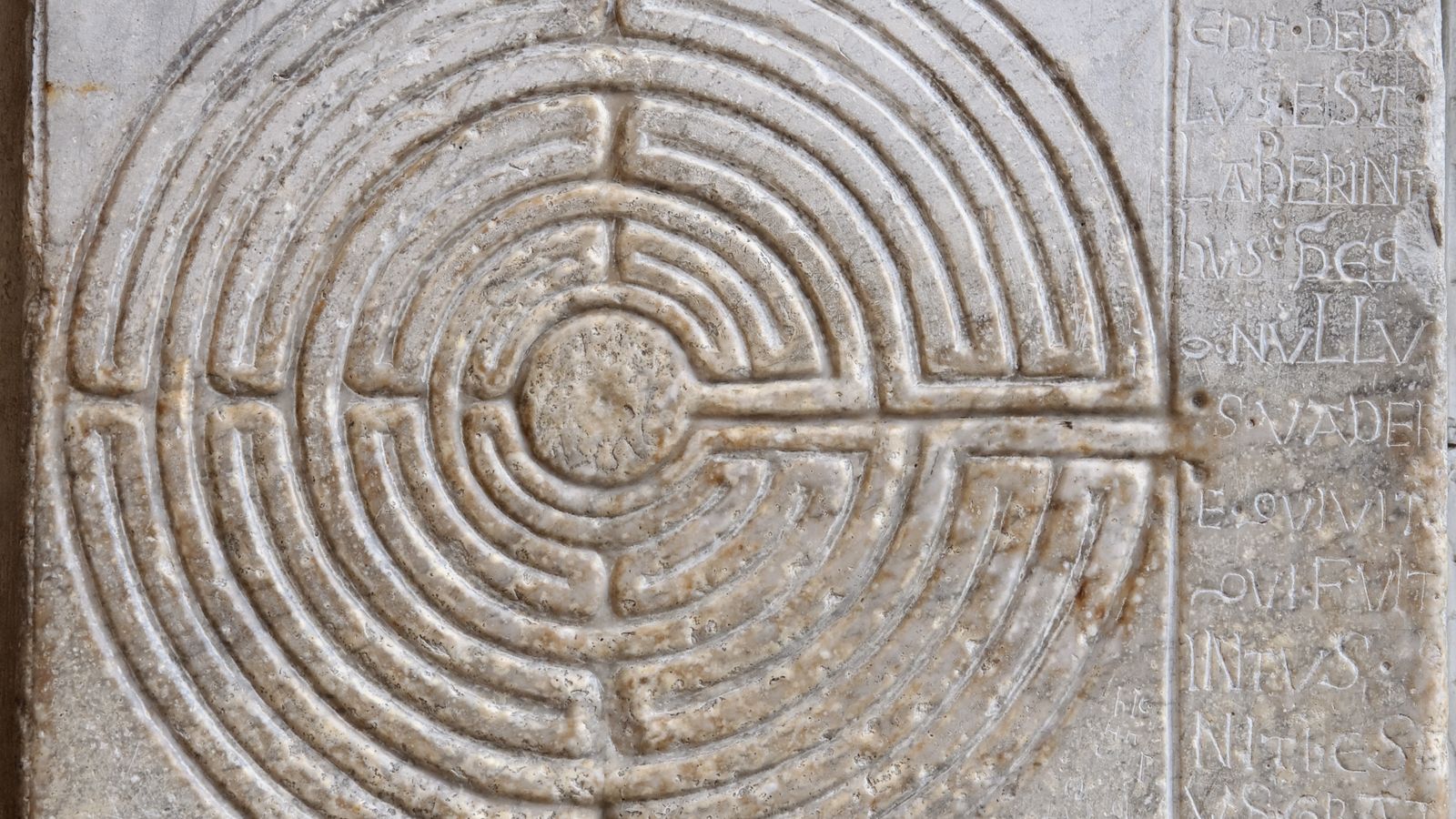
- Hero image source by Myrabella / openverse, by-sa.