In India, there is a large city called Delhi. In South Delhi there is a neighbourhood called Mehrauli. In Mehrauli, you will find the Qutb Minar complex, where you can see the eponymous highest tower in India, as well as the remains of many archways, monuments, mosques and other buildings, dating back to the early 13th century.
And within this rich historical and architectural complex, you will find an iron pillar standing on its own in a courtyard, surrounded by nothing but a low, slightly shonky looking security gate. And what’s so great about this pillar, you may ask? Well, it appears to be a Hindu artefact in the middle of a Muslim complex, it’s been dated to the 5th century CE, nothing close to its size was made out of iron until many centuries later and despite standing in the elements for over 1600 years, it has not rusted.
The Pillar Itself
The iron pillar is 7.21 m (23 ft 8 in) tall, although just over a metre or 3ft 8 inches of this is buried in the ground. It’s not particularly thick and tapers slightly as it goes up, meaning that the base has a diameter of about 17 inches or 43 cm, and the top has a diameter of around 12 inches or 30 cm. It is noticeably less smooth at the base than it is up the rest of the shaft. The pillar weighs approximately 6 tonnes.
Key Takeaways
- The Iron Pillar of Delhi, located in the Qutb Minar complex, is a 7.21-meter tall iron structure dating back to the 5th century CE.
- Despite over 1600 years of exposure to the elements, the pillar has resisted significant rusting due to its unique composition and protective layers.
- The pillar was originally erected in Udayagiri, Madhya Pradesh, and later moved to Delhi by King Anangpal the Second around 1052 CE.
- The pillar’s inscriptions praise King Chandragupta the Second and mention its original location on a hill called Vishnupada.
- The pillar’s rust resistance is attributed to a high phosphorus content and the formation of a protective layer called misawite.
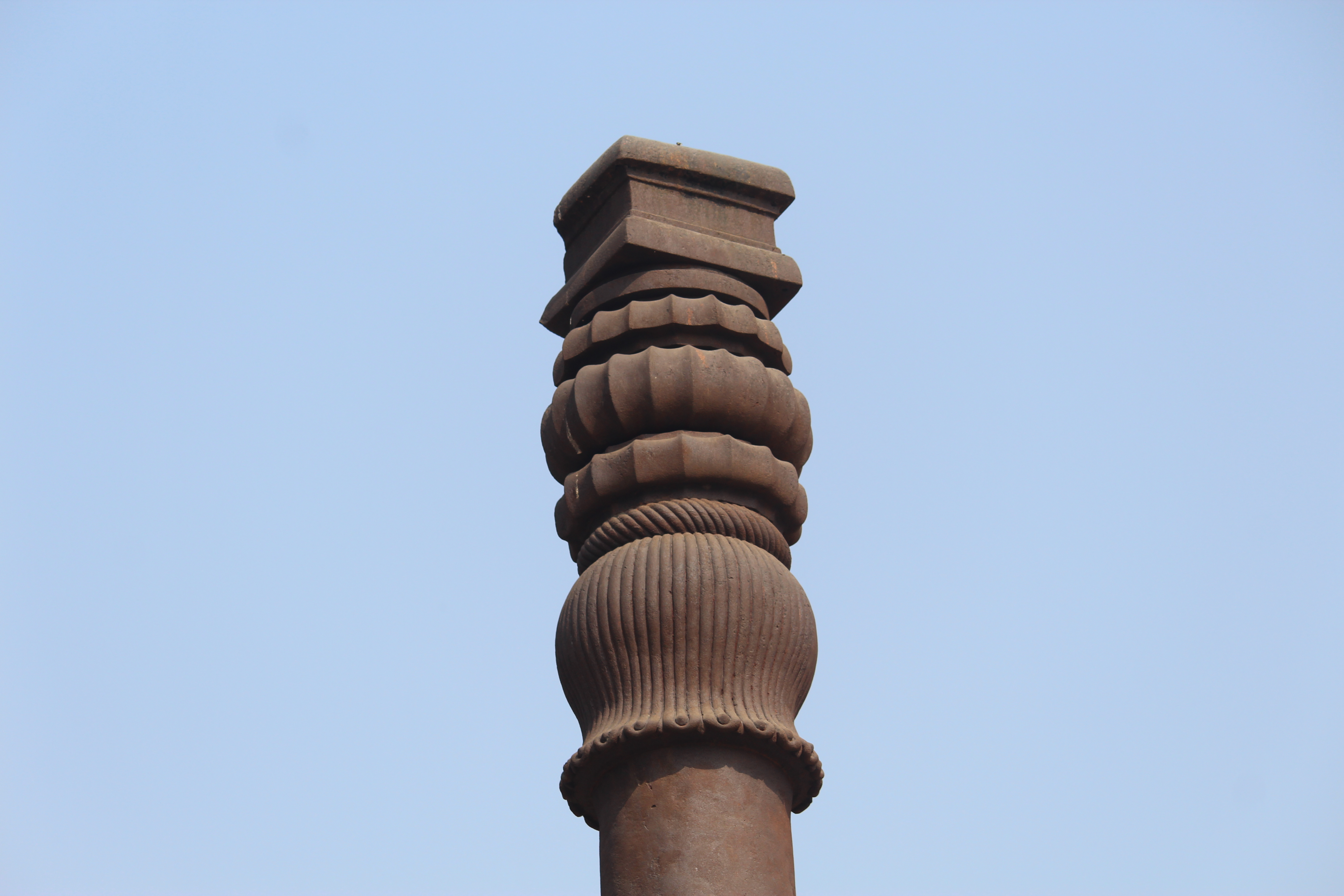
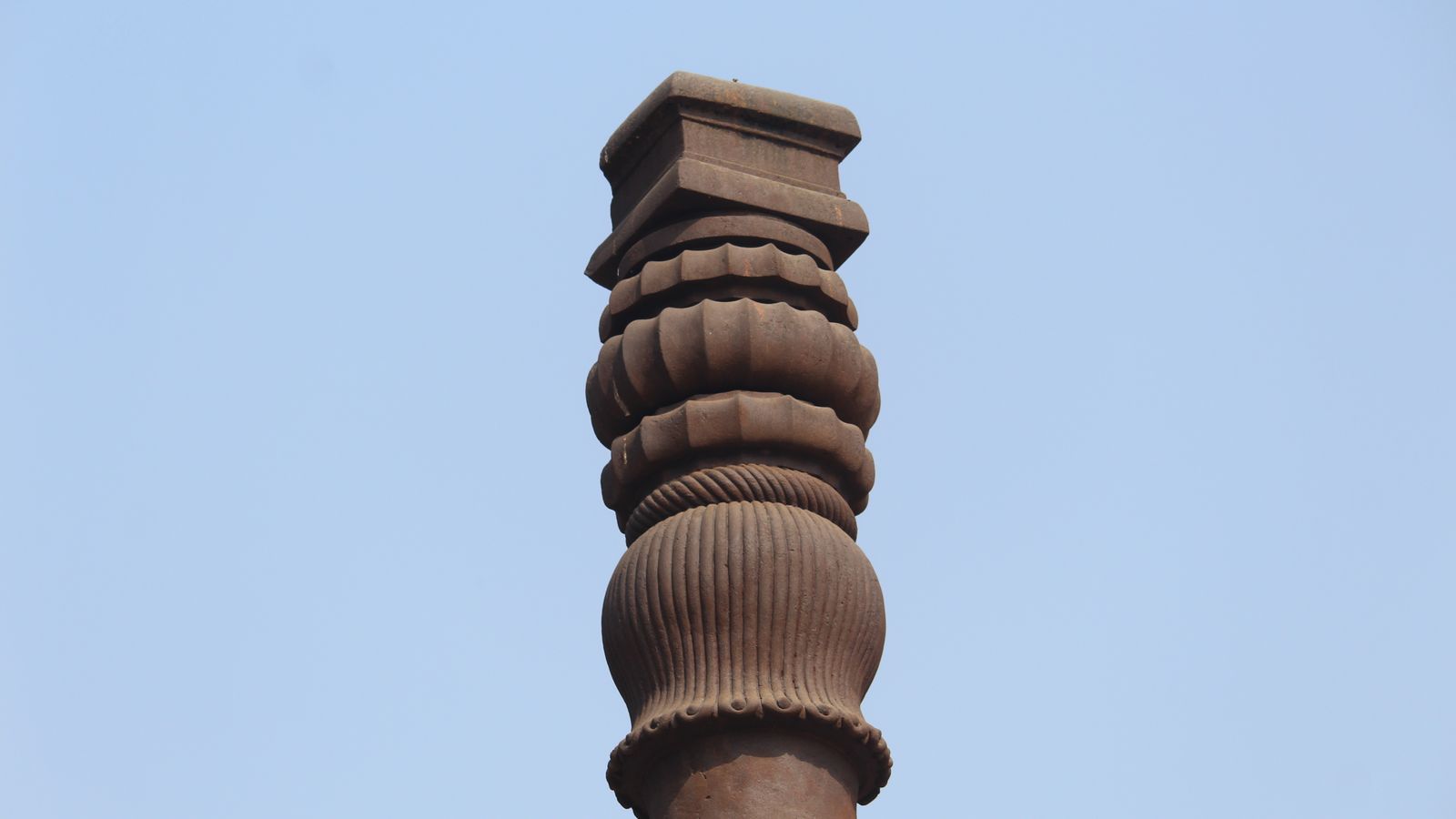
At the top of the pillar are a series of ornate stacks, collectively called a decorative bell capital—the “capital” being the top, or upper end of a column or pillar that’s usually distinctively decorated. There is also a groove or socket in the top of this iron pillar, which means that it previously had another piece or topper to finish it off, likely a figure of some sort.
There are other things of note on the pillar itself, for example, some inscriptions. The oldest is just under halfway up and is made up of three verses of Sanskrit in what may be the Brahmi script, deeply engraved into the pillar, covering an area of about 65 by 27 cm.
There is also another, much shorter inscription dated a few centuries later which seems to reference Anangpal the Second founding Delhi.
The other thing of note is that the iron pillar has sustained damage maybe two thirds of the way up. There’s a large dent and a crack where it was apparently hit by a cannonball.
If you just happen to be in the area, you’re probably there to look at the Qutb Minar, India’s tallest tower and a Unesco World Heritage Site. You might not think much of a random, incomplete iron pillar stuck in the middle of a courtyard but if you knew anything at all about this pillar, you would actually have quite a few questions, such as: How was it made? How did it get to where it is now? Why hasn’t it rusted? Can it really bring you luck? Is there really some extraterrestrial angle to this?
The History of the Iron Pillar
While there is no actual date inscribed on the main inscription on the pillar, it can be dated to the 5th century CE with some certainty. Using paleography, or the study of historical writing systems, the longer inscription on the side in Sanskrit has been matched with a script used during a certain period in Indian history covered by the Gupta Empire. There is also a king namechecked in the inscription who matches this time period, King Chandragupta the second.
Some of the characters are not quite complete due to the iron having closed back over some parts and earlier transcriptions of the original text were also not as accurate as later ones. Translations into English of the Sanskrit inscription have been made, and one done in 1888 by John Faithfull Fleet is on a tablet that was hung for posterity in 1903 on a wall near the pillar. Other translations have been carried out since and do vary slightly but these variations do not affect the names of persons mentioned or the estimated timeframe that the inscription was made.
Basically, the overall gist is that the verses sing the praises of King Chandra, saying things like “he, by whom, having crossed in warfare the seven mouths of the (river) Sindhu, the Vahlikas were conquered; – he, by the breezes of whose prowess the southern ocean is even still perfumed” and “who, having the name of Chandra, carried a beauty of countenance like (the beauty of) the full-moon”.
These translations are from the first and third verses. A later translation takes a bit of issue with the second verse but they both agree that it seems to refer to the King leaving or quitting the earth, i.e. dying. This piece is commonly read as a eulogy, although it has also been posited that the King hadn’t literally died at the time, but had merely abdicated and was still alive living his best old-man life somewhere else. It doesn’t really matter now as it was some 16 centuries ago but what we can surmise is that this pillar was created as a monument to the King and was probably made in the early 400s as Chandragupta the Second’s reign ended in 415 CE.
We can also deduce that this pillar was not originally installed in Delhi as the last part of the inscription has been translated to say: “this lofty standard of the divine Vishnu was set up on the hill (called) Vishnupada.” The pillar being the “lofty standard”, obviously. The name “Vishnupada” clearly comes from the Hindu god “Vishnu” and translates as something like “the footprint of Vishnu” so we know there’s a big hill involved.
It’s been theorised that because of its known links with Chandragupta the Second and its proximity to other known mining and metal work activities of the time, that the pillar was originally erected in Udayagiri in what is now Vidishia in the state of Madhya Pradesh. That is hundreds of miles from its current location in Delhi.
Pillars were not an uncommon thing in India or elsewhere in the world during this period. They would have been made as symbols of victory or devotion. There are at least two other examples of old iron pillars in India, the Kodachadri and Dhar pillars, but the one in Delhi has a few centuries on them at least and is also taller and in far better condition than these other two.
Folklore and the Move to Delhi
There is also some folklore surrounding the Delhi pillar, although there are slightly differing versions. One is that the iron pillar was set up as a dedication to the king and fixed so deep into the earth that it pierced the hood of a serpent god, possibly Shesha. It was said that it was bad luck to mess with the pillar but centuries later, another king, Anangpal the Second from the Tomara dynasty, wanted to check into it so he had the pillar dug up. Sure enough, the base was covered in blood and a curse fell on Anangpal Tomar.
The other version is that Anangpal Tomar was already in possession of the pillar and had it moved to what eventually became Delhi, which he is historically credited for founding. He was the one who hit the poor snake on the head with it and was told that as long as the pillar stood firm, his legacy would be protected. He then promptly had it removed to check it had been inserted deep enough. The blood on the end proved it had and the curse then fell upon him.
Anangpal Tomar doesn’t appear to have been afflicted with any bad luck in particular, although his dynasty died out shortly after his reign so perhaps the curse went for his descendants rather than him.
Anangpal Tomar was linked to the serpent in other, later, writings too, with one 18th century inscription being translated as saying: “He even caused the great Sheshnaag (on which earth is stable) to shake”.
As he founded and ruled over the Delhi area, that explains why the pillar is there and also the approximate time it got there, which was, according to the short inscription on it, 1109. This equates to 1052 CE as calendars were, and are still not, universal, but this ties in with the beginning of Anangpal Tomar’s reign.
The actual transcription and translation of this shorter engraving have been disputed but all agree on the name Anangpal, the word “Samvat” which relates to the Hindu calendar and on the date 1109 of that calendar.
There have also been a few suggestions for how Delhi got its name that are related to the iron pillar, one even includes a play on the word that was recorded in an old song. According to ex-local tour guide, Tanvi Bikhchandani, there’s a verse that translates to “the pillar was loosened, and the Tomar lost his head.” The Hindi word for “loose” is “dheele” which sounds like “Dilli” which is how many people pronounce the city’s name.
Anangpal Tomar built Lal Kot, which was Delhi’s first fort and had his prize iron pillar erected inside it. Once his dynasty was overthrown by a Muslim army, the first mosque in India was built on the site which explains why a Hindu monument is standing in the middle of a Muslim area but maybe not why they decided to leave it standing. Maybe they just thought it looked cool or were also in awe of its rust-proof status.
It was thought to have been hit by a cannonball in the 1730s in an attempt to destroy it or knock it down to see if there was anything more valuable inside. There was only one hit from close range, and it’s been posited that the cannons could potentially have caused too much damage to surrounding buildings at the time so the pillar was left as it was.
As a side note, there are another series of pillars throughout India known as “pillars of Ashoka” which were all linked with an emperor called Ashoka the Great. They are made of stone and have decorated capitals which were usually topped with something like a lion. The iron pillar of Delhi has sometimes been referred to as a pillar of Ashoka but it was made later and out of a different material so this connection is incorrect.
Watch Now
Open Video
Video Briefing
The Mystery of the Iron Pillar of Delhi
There’s no particular mystery in how the iron pillar got from Udayagiri to Delhi—yes it weighs about 6 tons but it’s not like India didn’t have the wheel. They were actually using wheels centuries before Europeans were. They also had things like horses and camels to act as working and hauling animals, never mind elephants. This pillar was moved and re-erected in one piece.
Ancient Aliens and the Non-Rusting Pillar
This brings us to the question of how this thing was actually made. In his blockbuster book Chariots of the Gods, Erich von Däniken makes a brief mention of the iron pillar in chapter 6 where he says: “In the courtyard of a temple in Delhi there exists, as I have already mentioned, a column made of welded iron parts that has been exposed to weathering for more than 4,000 years without showing a trace of rust for it contains neither sulphur nor phosphorus. Here we have an unknown alloy from antiquity staring us in the face. Perhaps the column was cast by a group of far-sighted engineers who did not have the resources for colossal building, but wanted to bequeath to posterity a visible, time-defying monument to their culture?”
So here he’s introducing the idea that ancient aliens created this magic non-rusting pillar that was far beyond the skill of man at the time. The pillar even made the list as an out-of-place artifact (OOPArt), joining the ranks of the Antikythera Mechanism, the Turin Shroud and the Piri Reis map as things that appear to be out of historical context.
Rust-Free Since the 5th Century CE?
Iron goes rusty, this is a fact. And the quickest way to make iron rust is to expose it to water and air, both of which are in plentiful supply in Delhi. So how is this thing even still standing after over a millennium and a half? Did ancient Indians possess knowledge that was centuries ahead of its time? The answer is yes and no.
First things first: the iron pillar is not actually free of rust. The bottom third is actually quite rusty looking and also noticeably rougher and more pitted than the rest of the pillar. This has led some people to speculate that this whole portion was supposed to be buried in the ground but then the pillar would be kind of short, not really an impressive tribute to a king.
The rest of the pillar is still in excellent shape, however, definitely worthy of the question of how it has withstood the test of time.
As for ancient Indian people having secret or advanced knowledge, this is not how the pillar came to be so rust resistant. And yes, it isn’t that it is magically impervious to rust, it’s just that it has great rust or corrosion-resistant properties. What happened was a combination of the real life metalwork skills of these people, plus the circumstances surrounding how it was made, plus just a little bit of random happenstance.
How the Pillar Was Made
The iron pillar of Delhi is the product of expert forge welding. Basically, large lumps of iron were heated to such a degree that they could be fused together by hammering or rolling—think of every blacksmith scene you’ve ever seen where they’re hammering a sword into shape. But this was on a much larger scale, using coal heated furnaces.
The pillar was created horizontally and just the size of the thing in itself was a pretty good demonstration of the 5th century craftsmen’s talents but then they also added the decorative capital on the top. This is made from seven separate pieces, which were all shrunk-fit around a cylinder which was then inserted into the top end of the pillar.
But where does the non-rusting thing come into it? The pillar is about 98% iron with the remaining 2% being made up of trace amounts of other things like copper, nickel, nitrogen etc. but notably, it contains about 0.25% phosphorus which is much higher than would normally be expected. This is because the ancient Indian forge welding process didn’t use lime or limestone which would usually aid in the removal of phosphorus, and the types of wood used to fire the furnaces also contained higher amounts of phosphorus than wood from trees in other parts of the world. This higher level of the chemical increased the pillar’s resistance to corrosion but that’s not the only reason why it’s still in such good shape.
There is, in fact, rust all over this thing but the very thin layer of it has also protected the main body of the pillar. An article on the Penn Museum website states: “there is a natural tendency for a piece of iron to rust at an ever diminishing rate as corrosion products form on its surface and seal it.” This layer, the amount of phosphorus and the Delhi weather itself have all come together to create another fine coating over the iron which has preserved it in excellent condition all these centuries.
Professor R. Balasubramaniam has studied this thing extensively and says:
Added benefits accrue when the phosphate forms as a continuous layer next to the metal. In the case of alternate wetting and drying cycles [such as those present in atmospheric corrosion], the amorphous phosphates can transform to crystalline modifications, and in this process there is a large reduction in porosity in the phosphate. This transformation results in further excellent corrosion resistance properties.
This continuous layer is also known as “misawite” and an article on Atlas Obscura called “The Iron Pillar of Delhi” states: “Misawite is a compound of iron, oxygen and hydrogen which does not rust.”
There is also a suggestion that clarified butter or “ghee” might have been rubbed on it a lot in the first 500 years or so of its life which might have also formed some sort of protective film, but this probably would have been done more on the lower bits than the top and that’s where the rusting is worse so either it didn’t help at all or it actually hastened the corroding process.
Von Däniken’s Retraction
Let’s quickly circle back to Erich von Däniken and his published claims about the pillar. Originally he said the pillar had stood “for more than 4,000 years without showing a trace of rust for it contains neither sulphur nor phosphorus.” Well, we know that while it’s old, it isn’t that old and also it shows loads of rust, has traces of sulphur and a comparatively high level of phosphorus.
To give the man his due, though, he did retract this one artifact as having been created by ancient aliens in an interview he did with Playboy in 1974. When the interviewer, Timothy Ferris, brings up the fact that the pillar does have rust and we all know how it was made and asks von Däniken if he still thinks it’s mysterious, von Däniken replies: “No, not anymore. But when I wrote ‘Chariots of the Gods?’ The information I had concerning this iron column was as I presented it. Since then, I have found that investigations were made and they came to quite different results, so we can forget about this iron thing.”
In the same article, Ferris brings up something that Astronomer Carl Sagan had to say about Erich von Däniken: “The kindest thing I can say about Von Däniken is that he ignores the science of archaeology. Every time he sees something he can’t understand, he attributes it to extraterrestrial intelligence and since he understands almost nothing, he sees evidence of extraterrestrial intelligence all over the planet.”
Modern Day
The pillar has also been said to grant wishes if you put your arms around it but you have to do this with your back to it, making it a bit harder. This is moot now anyway as you’re not allowed to touch the pillar and there’s a gate all the way around it stopping anyone from getting too close.
It has received decent reviews on Trip Advisor with no-one giving it below a 3 which seems quite good for what is, to the layperson, just a slightly rusty iron pillar with the top part missing.
So there you go, mystery solved. The non-rusting pillar does, in fact, have rust on it and it’s common knowledge now how the thing was made. You would probably get much more out of looking at it if you know the backstory, so check it out the next time you’re in Delhi. The ancient Indian craftsmen really created a long-lasting monument and, presumably because of the misawite coating, the pillar will continue to stand for centuries to come.
Simon Whistler
Simon Whistler is one of YouTube's most prolific educational creators. Decoding the Unknown is his methodical investigation into the world's strangest phenomena — examined with rigour, curiosity, and a healthy dose of scepticism.
Frequently Asked Questions
What is the Iron Pillar of Delhi?
The Iron Pillar of Delhi is a 7.21-meter tall iron pillar located in the Qutb Minar complex in South Delhi. It is notable for its age, dating back to the 5th century CE, and its resistance to rust despite being exposed to the elements for over 1600 years.
Where is the Iron Pillar of Delhi located?
The Iron Pillar of Delhi is located in the Qutb Minar complex in the Mehrauli neighborhood of South Delhi.
How old is the Iron Pillar of Delhi?
The Iron Pillar of Delhi is dated to the 5th century CE, making it over 1600 years old.
Why hasn’t the Iron Pillar of Delhi rusted?
The Iron Pillar of Delhi has resisted rust due to a combination of its high phosphorus content, a thin protective layer of rust, and the Delhi weather. The phosphorus increases its corrosion resistance, and the rust layer seals the iron, protecting it from further corrosion.
Who is credited with moving the Iron Pillar to Delhi?
Anangpal the Second from the Tomara dynasty is credited with moving the Iron Pillar to Delhi around 1052 CE.
What is the significance of the inscriptions on the Iron Pillar?
The inscriptions on the Iron Pillar include a Sanskrit eulogy to King Chandragupta the Second and a later inscription referencing Anangpal the Second founding Delhi. These inscriptions help date the pillar and provide historical context.
What is the legend associated with Anangpal Tomar and the Iron Pillar?
According to folklore, Anangpal Tomar moved the Iron Pillar to Delhi and hit a serpent god with it. He then removed the pillar to check its depth, finding blood on the base, which supposedly brought a curse upon him or his descendants.
How was the Iron Pillar of Delhi made?
The Iron Pillar of Delhi was made using expert forge welding, where large lumps of iron were heated and fused together. The pillar was created horizontally and features a decorative capital made from seven separate pieces.
What is the significance of the decorative capital on the Iron Pillar?
The decorative capital on the Iron Pillar is made from seven separate pieces that were shrunk-fit around a cylinder and inserted into the top end of the pillar. It showcases the advanced metalworking skills of the 5th-century craftsmen.
What is the misawite coating mentioned in relation to the Iron Pillar?
Misawite is a compound of iron, oxygen, and hydrogen that forms a protective layer on the Iron Pillar, preventing further rusting. This layer, along with the high phosphorus content, contributes to the pillar’s remarkable resistance to corrosion.
Sources
- Original Decoding the Unknown video: The Mystery of the Iron Pillar of Delhi
- Hero image source by Ysirzamiu / openverse, by-sa.