Resting on the Giza plateau, with three majestic pyramids rising in the background, the Great Sphinx lies, gazing east, towards the rising sun; an eternal guardian as ancient as the desert that surrounds it. It’s been part of the landscape for thousands of years, patiently watching empires rise and fall. It has withstood floods, earthquakes, industrialization and multiple wars. Great men have come and gone, and have long been forgotten, and the Great Sphinx saw it all.
When the Romans first arrived in Egypt, the Sphinx was already considered ancient and visitors came from all over the Roman Empire to see this great statue sitting in the desert. Scholars since the time of Pliny the Elder have poked and prodded the Sphinx, trying to answer questions the great lion has no use for. Who made you? How old are you? Why does it matter, the Great Sphinx wonders, I just am.
Centuries passed, and today visitors come from across the globe to gaze on the ancient statue sitting quietly, unperturbed by the small creatures scurrying around, taking selfies and living their short hurried lives. Archaeologists are still poking and prodding, though these days the focus is more on preserving the great lion rather than understanding it. Despite the best attempts of archaeologists, Egyptologists, and conspiracy theorists, we actually know very little about the enigmatic guardian of the Giza Plateau.
Key Takeaways
- The Great Sphinx of Giza is an ancient statue with a lion’s body and a human head, carved from a single limestone formation.
- The Sphinx has endured for thousands of years, witnessing the rise and fall of empires and surviving natural disasters and wars.
- The exact age and builder of the Sphinx remain uncertain, with theories suggesting it was constructed during the Old Kingdom by either Pharaoh Khafre or his father Khufu.
- The Sphinx’s nose was destroyed between the 3rd and 10th centuries CE, likely by a Sufi Muslim named Muhammad Sa’im al-Dahr.
- Despite numerous theories and explorations, no hidden chambers or treasures have been definitively found within or beneath the Sphinx.
Whoever built it didn’t think it necessary to leave any records explaining why they made it or what it was for. Perhaps the meaning was blatantly obvious back then and it never occurred to them that, one day, their statue would become one of the most mysterious, and possibly most photographed, monuments on the Giza plateau.
Meet the Great Sphinx
For those of you who’ve never seen the Great Sphinx, though how you managed that is definitely worthy of a video on this channel, the Sphinx is a statue with the body of a recumbent lion and the head of a man wearing a royal headdress. It stands around 20 m (66 feet) tall and is around 72 m (240 feet) long – hence the name The Great Sphinx as opposed to the So-so Sphinx. The statue was carved from a single, solid limestone formation found by workers digging a horseshoe-shaped quarry, today known as the Sphinx Enclosure, in the Giza plateau, and is one of the largest, and oldest, monolithic statues in the world.
The sphinx is a creature from Greek mythology; however, Egyptian sphinxes probably predate the Greek sphinxes and are usually male. Unlike the Greek sphinxes, the Egyptian sphinx is a fierce but benevolent guardian. We don’t know what ancient Egyptians called the statue as they definitely didn’t call it a sphinx. The first name we have on record only appears in the 18th dynasty, on the dream stele of Thutmose IV, long after the Sphinx was built.
The Dream Stele of Thutmose IV is a pink granite slab located between the Sphinx’s front paws and has been precisely dated to Year One, Month Three of Inundation, Day Nineteen of his reign in the New Kingdom, 18th dynasty (1401 BCE). According to the stele, in around 1400 BCE, future Pharaoh Thutmose IV, only a prince at the time, fell asleep in the shade of the big head in the desert while out hunting. In a dream the Sphinx, calling itself Horem-Akhet, or “Horus of the Horizon”, visited him. It was very unhappy about being buried up to its neck in sand.
If the young prince was willing to help a statue out, the Sphinx would make sure that he became king. Thutmose, wisely deciding not to ignore a statue calling itself Horus, a god associated with the sun, did as the Sphinx asked. The Sphinx kept its word and Thutmose eventually became Pharaoh Thutmose IV.
The Sphinx isn’t just lounging around the desert all by its lonesome self – it’s part of Khafre’s burial complex consisting of Khafre’s pyramid, temples and everything else a departing pharaoh would need. A smaller temple to the Sphinx built by Amenhotep II during the New Kingdom was later added to the complex, and in front of the dream stele is a free-standing altar, all that remains of a small temple built by Ramesses II. However, it’s possible that the Sphinx was never actually finished.
In 1978, archaeologists found three stone blocks that appears to have been abandoned on their way towards the Sphinx Temple. Segments of the bedrock on the northern edge of the Sphinx enclosure was only partially quarried, and the remains of a workman’s lunch and toolkit – a container probably holding water or beer and some stone hammers – suggest that the workmen just got up and left. Why the construction stopped so abruptly we’ll probably never know.
Perhaps they had a problem with this particular pharaoh being resurrected and having a happy afterlife – the crowds can be so fickle.
We don’t actually know why the Sphinx was built. The body probably represents the power of a lion while the head represents the wisdom of a King. Considering its size and location – resting on the Giza plateau along with the royal pyramids of Khufu, Khafre, and Menkaure, of the Old Kingdom’s 4th Dynasty (2560 BCE – 2450 BCE), as well as other minor burial chambers and a number of temples, the best guess at this point is that the Sphinx was probably a divine figure built to guard the necropolis.
Others theorize that the Sphinx was a symbol for the sun god Ra, or, more likely, Ruti, a double lion god sitting at the entrance of the underworld, guarding the horizon. It was the biggest statue built by the ancient Egyptians, so we can be fairly sure that whoever had it built was making a very clear statement and had every intention of being remembered for a really long time!
Throughout the years, probably starting with Thutmose IV, many attempts at renovation had been made. The Romans, upon discovering the imposing statue, added a viewing platform that was later dismantled. Modern excavations and renovations started in the 1800s, and if you look at photos of the Sphinx today, you can see a whole lot of loose blocks and masonry piled on top of the Sphinx. This wasn’t part of the original design, and was added over the centuries by people trying to protect what was left of the Sphinx since it was eroding away rapidly.
Today, the Sphinx is probably the destination appearing on most travel bucket lists, and for good reason. Interestingly, local Egyptians only call the statue the Sphinx when talking to tourists. In Egyptian Arabic, the Sphinx is known as Abu al-Hawl, The Father of Terror. Some extreme factions of Islam consider the Sphinx to be an idolatrous abomination that should be destroyed. For the sake of history, may they never control Egypt!
Who built the Great Sphinx?
Ancient Egypt loved keeping records – they documented everything, with one exception: a really large Sphinx chilling on the Giza Plateau. There’s no mention of the Sphinx construction in any hieroglyphs or other records from ancient Egypt. This is actually very odd considering the size and location of the Sphinx – it’s clearly significant.
Obviously, Thutmose IV didn’t just dig into the dunes hoping to find a Sphinx because a dream told him to. Thutmose, like other New Kingdom rulers, knew exactly what the Sphinx was despite it being buried in the sand, so there must’ve been records of it somewhere; however, these records are sadly lost to us. This means that we can only theorize about who was the man, because in ancient Egypt it probably was a man, responsible for the Great Sphinx.
According to Dr Zahi Hawass, Egyptologist and former Minister of State for Antiquities Affairs, the style of the Sphinx is very particular to Egypt’s Old Kingdom. The Old Kingdom began around 2600 BCE and lasted around 500 years before ending due to all-time favorites: civil war and famine. The face is broad, almost square, with a broad chin and the Sphinx is wearing a royal headdress, called a Nemes, and might once have boasted the royal Uraeus cobra on its head.
These are all characteristics typical to 4th Dynasty art and can be seen in carvings of Khafre, Menkaure and other pharaohs dating to the Old Kingdom. At one point, the Sphinx probably had a beard, and fragments of this beard were found lying between the front paws in the 19th century. However, based on how it broke, it was most likely a New Kingdom addition and not part of the original design.
Today these fragments can be found in the British Museum, because where else would you go and look for ancient Egyptian artefacts, as well as the Cairo Museum.
Most archaeologists believe that our Sphinx-builder extraordinaire was none other than Pharaoh Khafre, a 4th Dynasty ruler of the Old Kingdom. Khafre’s father, Khufu, built the Great Pyramid at Giza and Khafre built his pyramid next door, but his pyramid is ten feet shorter than dear old dad’s. Apparently, he decided to make up for this 10 feet discrepancy with a massive sphinx.
The Great Sphinx and the Sphinx Temple, right in front of it, is next to Khafre’s Valley Temple and the lower part of the causeway leading to Khafre’s mortuary temple and pyramid. In 1980, archaeologist Mark Lehner and geologist Tom Aigner compared rock samples taken from the limestone of the Sphinx, the Sphinx Temple and the Valley Temple. Limestone consists of mud, coral, and shells all compressed together over millions of years so by identifying fossils within the limestone, the researchers found that the core blocks of the Valley Temple and Sphinx Temple were quarried from the Sphinx enclosure.
The plans for the Valley Temple and the Sphinx Temple are also very similar, and we know Khafre built the Valley Temple, so it’s entirely plausible that the Sphinx and the Sphinx Temple was built at the same time as Khafre’s Valley Temple – one big happy construction.
Whether the Sphinx was planned from the start or whether it was carved when the workers uncovered a large solid rock formation while building the pyramid and temples is something we’ll never know, but based on other statues of Khafre, his stone masons certainly had the skills necessary to carve the Sphinx. The statue was probably meant to show Khafre’s power and influence, making sure that his name would live on thus ensuring him a free ticket to the afterlife. In fact, based on the position of the Sphinx and Khafre’s pyramid, Mark Lehner theorized that the entire complex was supposed to be a cosmic engine of sorts, harnessing the power of the sun to resurrect the soul of the pharaoh and so guaranteeing eternal life.
However, not everyone is sold on the Khafre theory. Some scholars feel that the causeway leading to the Valley Temple was built at an angle because there was something in the way – that something being a very big sphinx. So, if the Sphinx was already there when Khafre started building his complex, perhaps the Sphinx was the work of his father, Khufu.
While the link to Khufu is tenuous at best, we don’t have any definitive proof that Khafre built the Sphinx, so the Khufu angle is worth exploring. Khufu had a bit of a thing for lions and was associated with images of lions. Four terracotta statues of a lion goddess, and two recumbent lions, were recovered at Saqqara, and one of the lions had an inscription: King of Upper and Lower Egypt, Khufu.
Khufu’s Horus name also appeared on the back pillar of a standing statue and, at the feet of the statue, was a small figurine of Khufu, so it’s possible that the whole set of lion statues were commissioned for Khufu. Work gangs working on Khufu’s pyramid also left some graffiti behind at Khufu’s port at Wadi el-Jarf, to show that they were there, much like people today carve their names on trees. However, the name they used to show that they were Khufu’s men is a reference to a metaphorical king and lion mix.
If this was how Khufu actually saw himself, a Sphinx, the ultimate man and lion combo, certainly seems like something he would commission. I’m no specialist, but I looked at a lot of photos while writing this and, in my humble opinion, the Sphinx looks more like Khufu than Khafre.
Another theory suggests that the Sphinx bears the likeness of Khufu not because he built it but because it was built in honor of him by his other son, Djedefre, who briefly ruled before he died and Khafre took over. There is some speculation that he was helped along to the afterlife by Khafre, but that’s just rumor. A small sphinx was found in Djedefre’s Abu Rawash tomb, so it’s possible that the idea and imagery of the sphinx originated with Djedefre.
In 1992, a team of archaeologists decided to think out of the box and hired a facial recognition expert, Detective Frank Domingo from the NYPD. With 20 years of experience, the good detective was charged with determining once and for all whether the Sphinx has the face of Khafre or not. Detective Domingo and photographer Caroline Davies visited the Cairo Museum to photograph and measure the official, if somewhat controversial, statue of Khafre to get an idea of the proportions of the face.
The theory was that if the Sphinx is indeed Khafre, it should resemble the statue. However, experts have pointed out that the statue doesn’t actually resemble other statues from the same period, so there’s some debate about whether this statue is actually an accurate depiction of Khafre.
After carefully studying the Sphinx, Domingo concluded that, based on pronounced differences in facial features, the statue of Khafre and the Sphinx were definitely based on two different people. So either the statue of Khafre is a fake, and the Sphinx is Khafre, or the statue is the real deal and the Sphinx isn’t Khafre. While this is certainly an interesting idea, using a statue that many scholars consider a possible fake for comparison when we have over 300 statues of Khafre recovered from the Valley Temple alone seems to me like someone was looking for a very specific outcome and intentionally set up the study accordingly.
It would be very interesting if this same study was done using a composite of Khafre’s features from the 300 statues in the Valley Temple. The results might be very different.
Of course, some believe that the Sphinx predates all these Pharaohs and was built by someone else entirely. In 1858, archaeologist Auguste Mariette discovered the Inventory Stele near the pyramid of Khufu. The stele lists the 22 statues of the Temple of Isis at Giza and apparently states that Khufu built a monument near the Sphinx suggesting that the Sphinx already existed in Khufu’s time.
Conspiracy theorists love the Inventory Stele. However, the stele wasn’t created during the reign of Khufu in the 4th Dynasty, but during the 26th Dynasty which is a few years down the line. During this time, the Egyptians would often invoke the names of earlier kings, especially the great pyramid builders, to recall past glory.
The Inventory Stele probably refers to Khufu in an attempt to make the statues at the Temple of Isis appear older than they actually were. However, the Temple of Isis only dates to the Middle Kingdom, long after Khufu took up residence in his tomb, so I don’t think the Inventory Stele is much help in figuring out who built the Sphinx.
The Sphinx has been exposed to the elements for thousands of years. The features are so eroded by now, it’s impossible to say for certain whose face we’re looking at. On top of that, a lot of renovation has been done on the statue, and some pharaohs, we’re looking at you Ramesses, had a bad habit of defacing or re-carving the statues of previous rulers, so the face could’ve been changed more than once. So, while our best guess is Khafre, this is one secret the Sphinx might keep to itself.
How old is the Sphinx?
To most of us, the answer to this is obvious. If the Sphinx was carved during the reign of Khafre, it’s around 4500 years old. However, many feel that the Sphinx is much older and had been carved in pre-dynastic Egypt. So, how old is the Sphinx really?
In 1990, science-fiction writer, John Anthony West, visited the Sphinx with his team which included geologist Dr Robert Schoch from Boston University. According to Schoch, during that first visit, he immediately realized that the Sphinx was much older than 4500 years. Based on the erosion he was seeing, the Sphinx survived intensely wet conditions with a whole lot of rainfall, not something you see a lot in the Sahara desert these days.
According to Schoch, other structures dated to the Old Kingdom show clear signs of wind erosion and sand blasting which are very different from the marks seen on the Sphinx and Sphinx enclosure which is clearly water erosion caused by heavy rainfall and water runoff. However, the last Neolithic Wet Phase was around 7000 – 10 000 years ago, so Schoch theorized that the Sphinx must be at least 7000 years old.
However, two scientists from Ukraine propose a much older Sphinx. Their research shows erosion patterns similar to those found on the coast. These patterns are formed by waves washing over layers of rock for thousands of years.
This suggests that the Sphinx might’ve been underwater at some point. They theorize that the Sphinx could be as much as 800 000 years old, suggesting it was carved back when the Mediterranean Sea extended all the way to the Giza Plateau. This would mean that the Sphinx was carved well before there was any human civilization around to carve it which has some serious implications for the whole timeline of human civilization.
But, before we start rewriting the history of humanity, there could be a much simpler explanation. While the rock formation could easily be 800,000 years old and might’ve spent a considerable amount of time underwater, that doesn’t mean the statue is 800,000 years old. The age of the rock has nothing to do with the age of the statue.
Those who don’t put any stock in this science business have turned their gaze to the stars to prove the Sphinx is much older. Currently, we find ourselves in the Age of Pisces. Before Pisces, it was the Age of Aries, the Ram, and during this time, there was apparently a lot of Ram-orientated iconography all over Egypt.
Before that, it was the Age of Taurus which saw the rise of the Bull-cult in Minoan Crete. Before that, it was the Age of Leo, the lion, which lasted from around 10 970 – 8810 BCE. Proponents of this theory believe that the builders of the Sphinx were inspired by the constellation of Leo.
Computer programs generating pictures of what the night sky would’ve looked like thousands of years ago apparently show that the Sphinx, if it was built 10 000 years ago, was looking right at the constellation of Leo. However, I think the theory that the Sphinx is facing the direction of the rising sun makes more sense considering what we know about ancient Egyptian beliefs.
While these theories are interesting, none of these experts are archaeologists. The rock formation from which the Sphinx is carved can tell us a lot, but the statue is a man-made object, so artistic style influenced by human culture can’t be ignored. Egypt is a well excavated country and its early civilization is well-documented.
However, there’s no evidence of an advanced civilization, capable of carving a statue like the Sphinx, in Egypt before the ancient Egyptians. Any civilization with that level of technology would leave something behind. Evidence of advanced civilizations pre-dating ancient Egypt has shown up in other parts of the world, like Gobleki Tepe in south-eastern Turkey.
However, an advanced civilization in Turkey doesn’t prove an advanced civilization in Egypt. Besides, stylistically, the statue is similar to other monuments from the Old Kingdom period. Why would a civilization 5000 years before the Old Kingdom use the same artistic style?
5000 years seems a long time to go without any kind of progress or change.
However, Dr Schoch isn’t wrong about the erosion. Weathered channels, around three feet deep, is clearly visible on the wall of the Sphinx enclosure behind the Sphinx, and he’s correct – the Sahara wasn’t always a desert. Around 8500 BCE, the monsoon rains around the tropics decided to go north for a change of scenery.
The desert became grasslands with fertile valleys so people settled in around 7000 BCE. This didn’t last, but climate change takes time. Around 3500 – 1500 BCE, the rains returned to the tropics and, not long after that, the desert was back in all its sandy glory.
A study by geologist Judith Bunbury suggests that the climate change in Giza began early in the Old Kingdom period with the desert back in full swing by the late Old Kingdom era. The wetter periods provided the Old Kingdom rulers with the resources they needed to feed the workforce building the pyramids and carving the Sphinx. However, once the dry period arrived, resources dwindled and the pharaoh’s authority weakened, leading to civil war.
Watch Now
Open Video
Video Briefing
The Mysterious Sphinx of Giza
Most geologists agree that the pattern of erosion is determined by the characteristics of the rock being eroded, not the medium doing the eroding, and one geologist pointed out that Schoch’s claim that erosion caused by rain produces different patterns than erosion caused by wind isn’t generally accepted by academia. It’s not actually possible to tell whether the eroded limestone on the Sphinx is the result of water or wind. Other geologists have also pointed out that the channels could’ve been formed by underground water.
Excavations of the Sphinx and the Sphinx enclosure exposed these channels which would explain why the erosion is so much more pronounced on the back wall of the enclosure. Finally, whenever it rains, water runs downhill so all the water-runoff from the Giza Plateau would come spilling over the back walls of the Sphinx enclosure deepening the channels observed by Schoch.
The limestone the Sphinx is carved from isn’t the best quality which might explain the extreme weathering. Since it’s carved from the bedrock, it’s also close to the water table, and the limestone is sucking up water like a sponge. Along with other environmental factors, the statue is rapidly eroding and maintaining what’s left of it is a full-time job. We don’t need to invent ancient cultures to explain the Sphinx - considering its rapid deterioration, if it was much older than 4500 years, and if it hadn’t been buried in sand most of its life, there would be nothing left by now.
Was the Sphinx always a Sphinx?
Even the casual observer will notice that the proportions of the Sphinx are wrong. The head is much too small for the body. One theory, and even mainstream academics consider it a possibility, is that the Sphinx initially had a different head which was re-carved as ruling pharaohs put their own face on the Sphinx.
Ancient Egyptian craftsmen were highly skilled and had a lot of experience carving smaller lion statues, so it seems odd that they would get the proportions that wrong – this was a statue of great significance after all. The head also looks pretty good for something that’s been exposed to the elements for over 4000 years while the body, despite being buried, has eroded quite badly. So, if it wasn’t initially a Sphinx, what was it?
Writers Robert and Olivia Temple believe that the Sphinx was originally a statue of the jackal god Anubis and built long before the reign of Khafre. Anubis was the god of the dead and the god of embalming, as ancient gods had to multi-task, so some argue that the Sphinx temple was actually where the pharaoh was embalmed. With Anubis being associated with death and the afterlife, he was a more likely figure to guard a necropolis than a Sphinx. According to the Temples, the statue was later re-carved to depict a lion with the head of Pharaoh Amenemhat II, a ruler from the Middle Kingdom era.
However, the Anubis theory has never been considered very seriously. With its long snout and tall ears, the head of a jackal would’ve been very unstable if the statue had been carved with the head in proportion to the body. There’s also some indication that the Sphinx was painted with a yellow body, a pale reddish face, and blue and red pigments for the headdress. While yellow would look a little odd on a jackal, it would certainly work for a lion.
Besides, Anubis was usually painted black. On top of that, none of the writings that survived from ancient Egypt describe the Sphinx as Anubis; it’s always described as a lion with the head of a king.
So, if the Sphinx wasn’t Anubis, perhaps it was initially a lion. In the early days of Egypt, lions still roamed the land, so ancient Egyptians would’ve been familiar with lions which became a symbol of power. At some point in early dynastic times, a pharaoh came along and either decided to leave his mark on this powerful statue, or during one of the renovation attempts, perhaps the one carried out by Thutmose IV, the head was re-carved because it had become so badly eroded that no-one could figure out what it was supposed to be in the first place. So, those doing the renovating re-carved it based on their beliefs at the time.
Independent researcher and artist, Robert S. Neyland theorized that, if the Great Sphinx as we see it today was re-carved from the head of a lioness, everything that was sculpted later, like the headdress, beard, nose, and breast lappets, would need to fit into the original head of a lioness. After all, we know that every part of the current head was carved from the same stone as the rest of the Sphinx.
Neyland studied photos of lionesses and ancient Egyptian iconography found in temples depicting lions as well as photos of the Great Sphinx and even visited the Sphinx in person. Using clay, he first recreated the statue as it looks today with the smaller head. Once that was done, he sculpted the head of a lioness, in proportion to the body of the Sphinx, sliced it in half and hollowed it out so that it could fit over the existing head.
The biggest trick, Neyland found, was figuring out where the neck landed on the back of the Sphinx. On the actual Sphinx, there is a faintly defined hump and the remnant of eroded rock. Based on his sculpture, he found that the shape and position of this hump is a good match for the spot where the lioness’s neck probably landed on the back of the Sphinx.
The hump is barely visible from the ground, but the rise is detailed in Lehner’s topographic drawing of the Sphinx.
There’s also some precedent for lions being re-carved into sphinxes. The sphinx depicting what could be Hetepheres II, sister-wife to Djedefre found at Abu Rawash, clearly had ears that were hacked off, and the remnants of the mane of a lion that was turned into the face of a person can still be seen. Neyland also have a theory to explain why there’s no mention of the Sphinx construction in any records.
Initially, the Sphinx was just a statue of a lioness, an extra symbol of power, but without any particular cultural or religious importance. It only became significant once it had the face of a pharaoh. Other than the head of Djedefre, no sphinxes wearing the Nemes headdress predates the Great Sphinx.
So, the design of the sphinx, a lion body and a human head with royal features, wasn’t a well-known concept in Khafre’s time. It only became a thing later. However, the lion, lion goddesses and recumbent lions are quite common in Egyptian iconography dating all the way back to pre-dynastic times.
So, who knows, perhaps Khafre, or even Khufu, just wanted a nice big lion which, eventually, became a sphinx.
What happened to the nose?
We’ve all heard the story of Napoleon marching into Egypt with a bunch of bored soldiers who used the Sphinx for target practice and destroyed the nose with a cannon ball. However, Napoleon only arrived into Egypt in 1798. Illustrations from Travels in Egypt and Nubia by Frederik Louis Norden, published in 1755, clearly show the Great Sphinx without its nose. Norden even made a note about how impressive the statue was and his indignation at the disfigurement.
This means the nose was long gone by the time the French arrived. So, we can blame the French for a lot of things, like making revolutions popular, but when it comes to the nose of the Sphinx, they’re innocent.
Chisel marks on the face of the Sphinx suggest that the nose was pried off with chisels and rods sometime between the 3rd and 10th century CE. The nose was probably around a meter wide, but so far, nothing even slightly resembling the lost nose has ever been found. So, if not the French, then who?
According to al-Marqrizi, a 15th century historian, a Sufi Muslim, named Muhammad Sa’im al-Dahr is the man to blame. Apparently, in 1378, Sa’im al-Dahr came across local peasants making offerings to the Sphinx asking for a good harvest. Enraged by this idolatry worship, he defaced the Sphinx by destroying the nose.
However, the Sphinx isn’t the only ancient Egyptian statue without a nose – a lot of statues have broken or missing noses. For many years, it was assumed that this was just normal wear and tear; however, according to Edward Bleiberg, a curator of the Brooklyn Museum’s Egyptian art galleries, it’s possible that the ancient Egyptian statues were destroyed deliberately by other ancient Egyptians. The belief in ancient Egypt was that the essence of a person, or deity, could inhabit any image or statue of said person or deity.
By intentionally destroying the statue, or image, you could diminish the person’s power in the after-life. The very precise chisel work, and the fact that it would be a specific person or even just the name of a specific person that was targeted, suggest that the vandals were skilled laborers who could read and were probably on the payroll of someone in power. Of course, if we believe Disney, the Sphinx lost its nose because of some irresponsible carpet flying and, without any proof, it’s as good a theory as any.
Hidden chambers filled with treasure
Tales of secret tunnels and chambers filled with treasure hidden inside and beneath the Sphinx have been doing the rounds for years. The origin of these treasures run the gambit from reasonable, like grave goods in burial chambers, to the ridiculous Hall of Records built by the survivors of Atlantis. Apparently, the academic community knows about all these wonderful treasures but they’re keeping it a secret though why they’d be doing this is a little unclear.
Several attempts have been made to explore the Sphinx using non-invasive techniques to find any tunnels and chambers as the Sphinx is in no condition to withstand extensive drilling. Studies by the Florida State University, the Waseda University in Japan and the Boston University have all found anomalies. Before anyone gets too excited though, an anomaly isn’t proof of a hidden room – it could be natural faults in the rock or just a change in rock density.
Old photos of the Sphinx show pretty deep fissures on the rock face so there are probably more faults within the rock that we can’t see. However, like most millennials, the poor lion is falling apart, so understandably, Egyptian archaeologists aren’t willing to risk drilling or digging into the statue to satisfy the curiosity of conspiracy theorists.
In 1991, John Anthony West and his team insisted that they found two rectangular chambers underneath the paws of the Sphinx which might very well be the elusive Hall of Records. West firmly believes that the Sphinx and the two temples in front of it, the Valley Temple, accepted to be the work of Khafre, and the Sphinx Temple, were all built around 10 000 to 15 000 years ago – the same time that Atlantis disappeared according to Plato. The Egyptians didn’t build the monuments on the Giza plateau; they simply found and renovated them.
To absolutely no-one’s surprise, they were kicked off the site for making ridiculous claims, and followers of the Atlantis theory are quick to use this as proof that the team was onto something that the academic community doesn’t want exposed. I think they were kicked off the site because claims like these will lead to people vandalizing the Sphinx, as happened in 2020 when a couple of YouTubers were jailed for vandalizing the Sphinx in order to prove a theory of theirs.
Atlantis wasn’t real, but let’s put this theory to rest - the Sphinx lies close to the rising water table and, in ancient times when the Nile flooded quite regularly, the Sphinx stood with its paws in the water quite often. Any kind of chamber underneath the Sphinx would’ve been flooded and any documents or artifacts would’ve been destroyed a long time ago.
So, the Hall of Records doesn’t exist, but what about the story of a chamber inside the Sphinx’s head? There’s obviously a hole with a little trap door on top of the Sphinx’s head. Some of the New Kingdom steles, so after Thutmose had his dream, depict the Sphinx wearing what might be a crown.
It’s not clear whether this crown was part of the original design, or if it was added later, and we don’t know what happened to it, but the hole in the top of the head might’ve been used to anchor the crown to the head. The hole wasn’t initially that deep, but people looking for burial chambers and lost treasure dug into the head hoping to strike it rich. During subsequent renovations, the hole was filled up, but later it was cleared out again and fitted with a little door.
All other passages in and around the Sphinx, and there are a few, archaeologists aren’t hiding them, are all dead-ends. One passage going underneath the Sphinx might’ve been a burial chamber that was never finished, but the other passages were most likely dug by grave robbers looking for treasure and, unfortunately, lead nowhere. In 2009, Lehner and Hawass drilled under the Sphinx to relieve the pressure of the rising water table in an attempt to slow the damage to the statue.
They decided to include the area under the left paw where the seismic surveys revealed anomalies to see if there was any kind of hidden chamber. However, they found nothing.
The Sphinx was carved from a solid rock formation, and not built from loose blocks, so instead of building a room into the statue in the way chambers were built into the pyramids, any chambers or tunnels would’ve been carved into the Sphinx from the outside. The builders would then have used masonry to hide the entrances once the chambers were completed. Considering all the excavations and renovations happening since the time of Thutmose, if any chambers were carved into the Sphinx intentionally, they would’ve been found by now.
Did the Sphinx have a companion?
Sphinxes were usually guardians, flanking the entrance to a temple, or even a whole road, like the Avenue of Sphinxes at Karnak and Luxor. Some avenues would have up to 100 sphinxes just to make sure the dead remains deeply undisturbed. However, sphinxes are usually found in pairs making the solitary Sphinx on the Giza plateau a bit of an oddity. So, is there a second sphinx still lying under the desert sands?
One of the arguments in support of a much older sphinx built by an advanced civilization that predates the ancient Egyptians is the fact that there doesn’t seem to be any evolution of sphinx building. The pyramids went through a clear process of development starting as step-pyramids, with a few not-quite-pyramid shaped pyramids - the Bent pyramid comes to mind - all the way to the Great Pyramid at Giza. There are a few sphinxes that might predate the Great Sphinx, but they are nowhere near the Great Sphinx in terms of size. Most mainstream archaeologists scoff at the idea of a second sphinx; however, in my humble opinion, a second sphinx, especially if it was the first and the Great Sphinx is actually the second, would solve the problem of Sphinx building evolution.
The Sphinx was mostly covered in sand for large parts of its existence, and if a statue that size could be buried, it’s entirely plausible that more statues are buried under the dunes of Egypt. After all, it’s not like we’ve had a chance to thoroughly excavate all of the Sahara. However, I also agree with the mainstream researchers that, considering the size of the Great Sphinx, if there is, in fact, a second sphinx buried on the Giza Plateau, we would’ve seen it by now as the Giza Plateau has been excavated quite thoroughly. Thus, if a second sphinx ever existed, it probably eroded away or was destroyed a good long time ago.
In 2007, Egyptologist Bassam El Shammaa published a study claiming that there were, in fact, two sphinxes. El Shammaa believes that two sphinxes are more in line with the ancient Egyptian beliefs based on duality. The pyramid texts recovered at Saqqara explain how the universe was created.
Atum, the creator god in ancient Egypt, created his son, Shu, and daughter, Tefnut, in the shape of a lion and a lioness, placing each on the one extreme tip of the universe. Shu would take the solar disc and pass it to his sister thus achieving the full cycle of the sun. So, basically, there was a lion at either end of the sun’s journey protecting it.
Whenever the solar cult is mentioned in Egyptian writings, it’s often accompanied by one lion and one lioness, facing each other, posing parallel to each other, or sitting back to back. The dream stele of Thutmose clearly shows two sphinxes sitting back to back.
Another archaeologist in favour of a second sphinx is Michael Poe. According to Poe, there are two ancient Egyptian references, dating from the Middle Kingdom, that claim Khafre found the Sphinx and changed the face. The second reference refers to another sphinx, facing the Great Sphinx, on the other side of the Nile and, apparently, the two statues were built to represent the dividing line between Northern and Southern Egypt. A second sphinx also shows up in the work of later writers.
Al-I’Drisi (1099-1166), a geographer and cartographer, mentions a second sphinx in his Geographical Encyclopedia on Asia and Africa. He describes a second sphinx across the Nile to be in a state of disrepair with the Nile ‘lapping at its feet’. Another writer, Musabbihi, mentions a smaller Sphinx across the Nile in a ruined state in the Annals of Rabi II, written around 1024.
Unlike the Great Sphinx on the Giza Plateau, this second sphinx wasn’t carved from a single rock but was made out of mud brick and faced with stone. Around 1200, Cairo experienced a large earthquake, and people used stone from the Great Pyramids to rebuild the town and their homes. It would make sense that a second sphinx would’ve received the same treatment, and a mud brick structure wouldn’t survive long without its cover stones. The Nile also gradually moved east after 1166, away from the pyramids, and may have engulfed and finally destroyed what was left of a second sphinx.
To his credit, Poe, being an archaeologist, is the first to admit that this is just a theory, not fact – tales of a second sphinx could simply be exaggerations. It’s also possible that this second sphinx existed but had nothing to do with the Great Sphinx. It could simply have been a larger than usual sphinx and the last sphinx standing in an avenue of sphinxes guarding a temple that was lost when the Nile changed course.
If Poe’s theory is correct, there wouldn’t be anything left of a second sphinx as the eastern bank of the Nile is part of a city these days. Any sign of a companion to our odd Sphinx out on the Giza plateau would, sadly, be long gone.
Conclusion
The Great Sphinx has been around for thousands of years, but it’s unlikely to stand for a thousand years more. The fact that it was buried is quite possibly the only reason it survived as long as it has. With the high levels of pollution in Cairo, and the rising water table, the future of the Sphinx is a bit bleak. At this point, just maintaining what is left is a full-time job and archaeologists with the help of students, what we wouldn’t do for extra credit, spend all their days just patching the holes and fighting off the desert.
Like the great pyramids, the Sphinx is a reminder that our ancestors were every bit as sophisticated as we are. They were perfectly capable of carving the impressive statue without the help of Atlantis or previously undiscovered advanced civilizations buried under the sands of Egypt. We don’t know what the future holds for the solitary Sphinx, but perhaps it will outlast us all, holding its lonely vigil over the tombs and temples of the Giza Necropolis with only the dead for company.
Simon Whistler
Simon Whistler is one of YouTube's most prolific educational creators. Decoding the Unknown is his methodical investigation into the world's strangest phenomena — examined with rigour, curiosity, and a healthy dose of scepticism.
Frequently Asked Questions
What is the Great Sphinx of Giza?
The Great Sphinx is a statue with the body of a recumbent lion and the head of a man wearing a royal headdress. It stands around 20 meters (66 feet) tall and is around 72 meters (240 feet) long. It is carved from a single, solid limestone formation found on the Giza plateau.
How old is the Great Sphinx of Giza?
The Great Sphinx is believed to be around 4500 years old, dating back to the Old Kingdom of ancient Egypt. However, some theories suggest it could be much older, with estimates ranging from 7000 to 800,000 years, though these are not widely accepted.
Who built the Great Sphinx of Giza?
The most widely accepted theory is that Pharaoh Khafre, a 4th Dynasty ruler of the Old Kingdom, built the Great Sphinx. However, some scholars suggest it could have been built by his father, Khufu, or even an earlier civilization.
What is the significance of the Dream Stele of Thutmose IV?
The Dream Stele of Thutmose IV is a pink granite slab located between the Sphinx’s front paws. It dates to around 1400 BCE and recounts a dream in which the Sphinx, calling itself Horem-Akhet, promised Thutmose IV the throne if he cleared the sand from the Sphinx.
What is the current condition of the Great Sphinx of Giza?
The Great Sphinx is rapidly eroding due to environmental factors and pollution. Archaeologists are focused on preserving what remains of the statue, as it is in a fragile state.
What happened to the nose of the Great Sphinx?
The nose of the Great Sphinx was destroyed sometime between the 3rd and 10th century CE, likely by a Sufi Muslim named Muhammad Sa’im al-Dahr who was enraged by the idolatrous worship of the Sphinx.
Are there any hidden chambers or treasures within the Great Sphinx?
There is no evidence of hidden chambers or treasures within the Great Sphinx. Several studies have found anomalies, but these could be natural faults or changes in rock density. The Sphinx is too fragile to withstand extensive drilling or digging.
Did the Great Sphinx have a companion?
There is no definitive evidence of a companion sphinx. Some theories suggest there might have been a second sphinx, but the Giza Plateau has been thoroughly excavated, and no such statue has been found.
What is the cultural significance of the Great Sphinx?
The Great Sphinx is a symbol of ancient Egyptian civilization and is believed to represent the power of a lion and the wisdom of a king. It is part of Khafre’s burial complex and is likely a divine figure built to guard the necropolis.
Sources
- Original Decoding the Unknown video: The Mysterious Sphinx of Giza
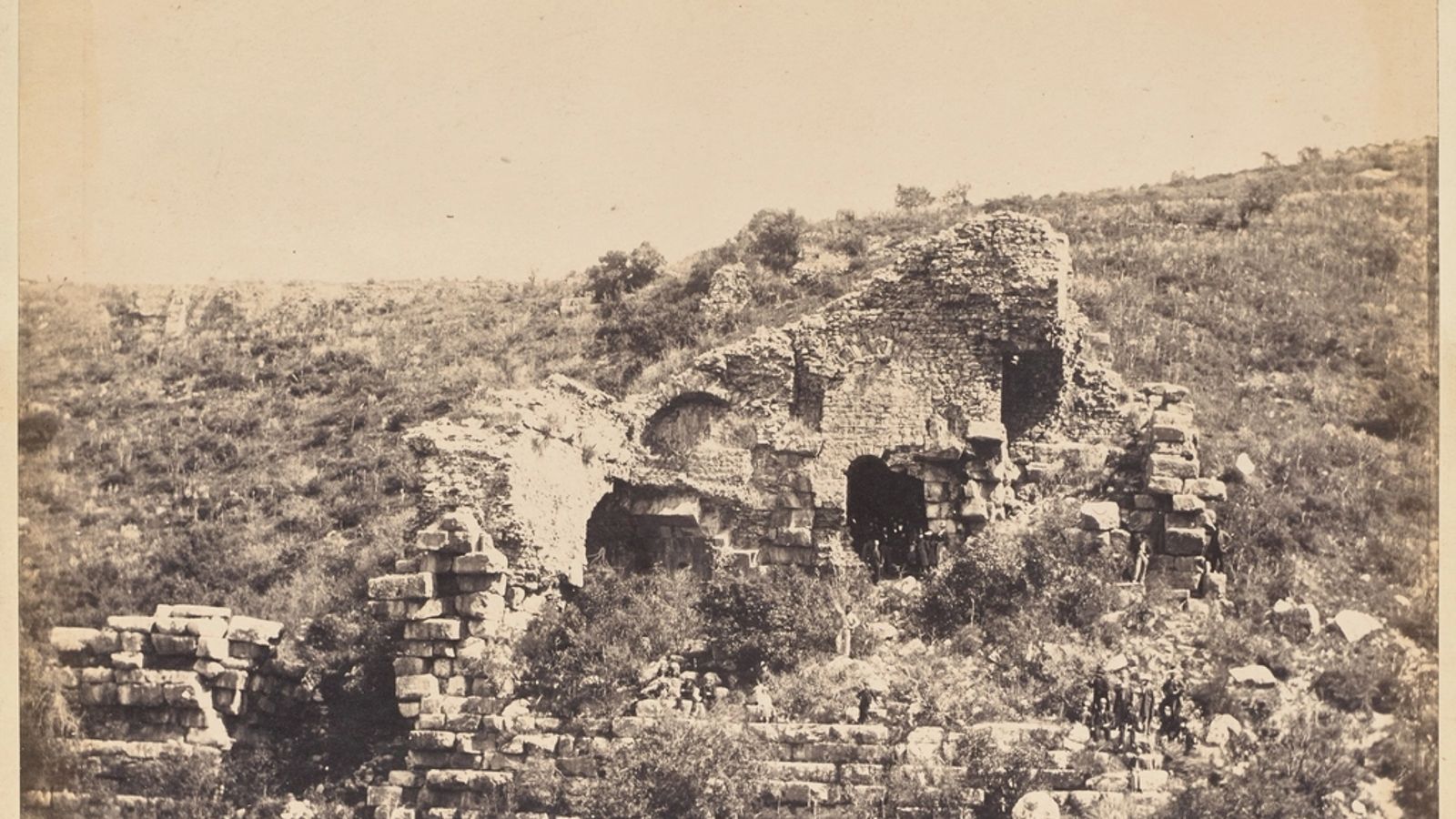
- Hero image source by thegetty / openverse, cc0.