Once upon a time, a little goat was frolicking around the dry Judean desert. This particular little goat was part of the herd travelling with a local Bedouin tribe. However, unlike the other goats, it wasn’t content with its life in the scorching desert. Rather, it dreamed of climbing high mountains defying the laws of gravity, or whatever goats dream about, that’s a bit of a mystery right there.
So, one day, it wandered into a dark cave, presumably looking for the entrance to the mysterious Agartha. The shepherds weren’t willing to give up on their lost little goat and went searching the local cliffs and caves. One shepherd tossed a rock into a cave, possibly hoping to startle the goat into revealing itself.
However, instead of hearing a startled goat, he heard the sound of pottery breaking. Curious, he entered the cave to see what was hidden in the depths and made the greatest archaeological discovery of the 20th century. Some stories claim that he didn’t care about the pottery, he was hot and focused on finding the cursed goat, and a different shepherd went back a day or two later, but the end result is the same.
Key Takeaways
- The Dead Sea Scrolls, discovered in 1947, are over 900 ancient manuscripts found in caves near Khirbet Qumran.
- The scrolls include biblical texts, apocryphal texts, and sectarian writings unique to a Jewish community living in Qumran.
- The Copper Scroll, one of the Dead Sea Scrolls, is a treasure map listing hidden gold and silver locations.
- The origin of the Dead Sea Scrolls is debated, with theories suggesting they were written by the Essenes or scribes from Jerusalem.
- The Dead Sea Scrolls provide valuable historical insights into Judaism and Christianity during the Second Temple period.
The shepherd, whichever one it was, discovered 7 fairly intact scrolls – the first of over 900 scrolls that would eventually be recovered. Today, we know them as the Dead Sea Scrolls.
As for the goat, we’ll never know if it found Agartha or made its way back to the herd. For some reason, dusty old scrolls turned out to be more important than missing goats, so the story of the goat will end here. Instead, this article will be all about the find of the century and the mysterious Copper Scroll.
What are the Dead Sea Scrolls?
The Dead Sea Scrolls is a collection of over 900 ancient manuscripts discovered in 11 different caves near Khirbet Qumran, on the northwestern shores of the Dead Sea. When I say ancient, I’m not exaggerating – some of the scrolls are over 2000 years old. Using a combination of techniques including carbon-14 dating, archaeologists were able to date the scrolls from around the third century BCE to around 68 CE. The scrolls were probably hidden in the caves between 66 CE and 70 CE when the Romans occupied Qumran during the First Jewish revolt.
Only a handful of the scrolls were in one piece. The rest of the scrolls were piles of tiny fragments, some as small as a fingernail, which had to be reassembled by researchers with oodles of patience who probably no longer enjoy doing jigsaw puzzles in their spare time. Most of the scrolls are written on vellum or papyrus in Hebrew, but some are in Aramaic or Greek.
A few of the scrolls are also written in cryptic scripts, creatively labeled Cryptic A, Cryptic B and Cryptic C, that haven’t been cracked yet, so those of you who like ciphers, feel free to give it a go and write a book about what you find. Who knows, you might be the next Dan Brown.
The scrolls can be divided into three groups: biblical texts that became the Hebrew Bible or Old Testament of the Christian Bible, religious texts that never made it into the Hebrew biblical canon, considered the apocryphal texts, and the sectarian texts - writings unique to the sect of Jews living in Qumran and copying the scrolls.
The Biblical texts contain the oldest existing manuscript of the Hebrew Bible, and it’s remarkably similar to what we have today, so the scribes copying the Bible throughout history did a pretty good job. So far, copies of every book from the Hebrew Bible, except Esther, have been identified. Not all the books are complete, some are only fragments, and not all are represented equally.
Among the 900 or so scrolls puzzled together thus far, there’s only one manuscript each of Chronicles, Ezra and Nehemiah and portions of only two manuscripts for Joshua, Proverbs and Ecclesiastes. In contrast, there are thirty-six copies of Psalms, thirty copies of Deuteronomy, twenty-two of Isaiah, twenty of Genesis and seventeen of Exodus. As for the book of Esther, it was possibly excluded because those preserving the scrolls didn’t agree with the story of a Jewish woman marrying the Persian King, or perhaps the book just hasn’t been found yet.
The apocryphal manuscripts are texts that weren’t included in the Jewish Biblical canon. Some of these manuscripts were already known to us as they had been translated into Greek, Ge’ez, Syriac and Armenian in the distant past and preserved by different churches. Interestingly, the book of Jubilees, while not being part of the Hebrew Bible, were spread across five of the eleven caves and so far fifteen copies have been identified.
The Book of Enoch, included in the Ethiopian Orthodox Bible, showed up eleven times, putting Jubilees and Enoch just behind Exodus in popularity. It’s possible that the Qumran community considered these books to be part of scripture and studied them as such.
The sectarian writings were unknown until their discovery in 1947. These writings reveal the beliefs, customs and religious practices of a pious community, probably residing at Qumran. The sectarian texts include the War Scroll, the Temple Scroll, and The Rule of the Community scroll which gives us more information into how the community was organized, how they viewed their world and how they fit into it.
Discovery of the Scrolls
It’s amazing that the scrolls remained hidden as long as they did. After 2000 years in dark caves, seven scrolls were discovered in 1947 by a shepherd and taken back to his tribe who sold them to an antiquities dealer in Bethlehem. It took some time, but, eventually, the scrolls made their way into the hands of people who realized their true value.
Three of the original seven scrolls were bought by Professor E. L. Sukenik of the Hebrew University from, presumably the same, antiquities dealer in Bethlehem.
The remaining four was sold to Mar Athanasius Yeshue Samuel, the Metropolitan of the Syriac Orthodox Church in Jerusalem. Samuel took the scrolls to the United States where he tried to sell them, offering them to a number of universities, including Yale, but no-one was interested. I’m pretty sure the people who turned down the Dead Sea Scrolls are still kicking themselves.
Eventually, in 1954, he placed an advertisement in the Wall Street Journal, in the ‘Miscellaneous Items for Sale’ stating that he had Biblical manuscripts dating back to at least 200 BCE for sale. Not something you see in the classifieds every day. Archaeologist Yigael Yadin, the son of Professor Sukenik, learned of this and after rustling up some backers to help provide the funds, the scrolls were finally sold for $250,000 to Yadin and returned to Israel in 1954.
While the scrolls were initially discovered in 1947, the 1948 Arab-Israeli War made any further examination of the Qumran ruins or expeditions to search the caves impossible. Serious archaeological expeditions only began in 1949 under G. Lankester Harding and Pere Roland de Vaux. The first excavations turned up around 70 fragments, some of them bits of the original seven scrolls found in 1947.
When Bedouin traders started turning up with more scraps of scrolls, the archaeologists realized that there was more than one cave containing precious manuscripts, and the race was on!
1951-1956 saw a flurry of activity around the caves with archaeologists and Bedouins eagerly searching for more scroll fragments and other artifacts. Of the 11 caves that finally yielded manuscript fragments, five were discovered by Bedouins looking for easy cash and six were discovered by archaeologists. At the same time, excavations were started at nearby Khirbet Qumran in the hopes to learn more about where the scrolls came from in the first place, but we’ll get back to Qumran in a bit.
Exploration of the caves is still ongoing, and in 2021, for the first time in nearly 60 years, new Dead Sea Scroll fragments turned up in the ‘Cave of Horror’, around 40 km (25 miles) from Jerusalem. The cave got its name from the 40 skeletons, some of them children, found inside the cave along with personal documents, a prayer written in Hebrew and the scroll to which the fragments belong. The ‘Cave of Horror’ was one of eight caves used by refugees during the Bar Kokhba revolt of 132 – 135 CE during the reign of Emperor Hadrian.
When he wasn’t building walls in England he was fighting Jews in Jerusalem – the busy life of a Roman conqueror. The cave is remote and difficult to get to which made it a very good hiding place. Sadly, in the case of the refugees, it was also a good place to die.
Some caves, like the Cave of Horror, are very difficult to reach today which might be why the scrolls went undiscovered for so long. That they remained in relatively good condition for around 2000 years is thanks to the arid conditions of the Judean desert. Since the latest discovery was only made in 2021, it’s possible that there are more scrolls still waiting to be found – an exciting prospect!
Qumran
After finding ancient scrolls in dusty old caves, archaeologists turned to the nearby ruins of Qumran, a settlement close to the Dead Sea Caves where the scrolls were found in order to answer some pressing questions like who wrote the scrolls and who hid them. Being the closest settlement, Qumran seemed like a good place to start.
The Qumran ruins lies between the limestone cliffs of the Judean Desert and the shores of the Dead Sea and consists of a number of walled rooms, a fortified tower, several cisterns and ritual bathing pools. The site might’ve been inhabited briefly in the 8th to 7th centuries BCE, but was abandoned until a Jewish community made Qumran their home between 150 BCE and 100 BCE. The community appears to have been doing well until 68 CE when Roman soldiers camped at Qumran as part of the Roman invasion to suppress the First Jewish Revolt.
It was most likely a small community, researchers estimate only around 100 – 200 people, who mostly lived in tents and caves since the structures don’t appear to be either military or living quarters but rather seem to be communal in character. Ritual baths point to a Jewish sect and rooms that could be a refectory, for communal meals, and a scriptorium for copying scrolls, complete with a plastered writing table and three inkwells, certainly support the idea of scribes spending their days copying precious scrolls. All of this paints a picture of Qumran as a religious community center.
Pottery shards found at Qumran is also identical to shards found in Cave 1, suggesting some connection to the scrolls hidden in the caves. However, no scrolls or scroll fragments have ever been at Khirbet Qumran. However, not everyone’s convinced that Qumran was the humble abode of a strict Jewish sect.
Qumran wasn’t always a remote settlement in a big desert. Two millennia ago, the area was a thriving commercial trade region. There were a number of settlements on the shores of the Dead Sea with trading ships doing the rounds. Springs provided fresh water for drinking and agriculture with date palms and other plants producing valuable resins used in perfume.
There’s no fish in the Dead Sea, it’s too salty, but it did provide salt and bitumen used to seal boats and mortar bricks. Jerusalem was about a day away by donkey and a two-hour walk would get you to Jericho – Qumran was apparently the place to be!
One of the first archaeologists at the site, Roland de Vaux, also discovered more than 1200 coins, half of which were silver, as well as evidence of hewn stone columns, glass vessels and glass beads, among other fine goods, which don’t really fit the picture of a strictly religious community shunning earthly wealth. Some of these goods probably came along with the Roman occupation, but some theorize that much of this wealth was accumulated when Qumran was an estate, possibly owned by a rich Jerusalem entrepreneur in the perfume business. In 1988, a small round bottle found by researchers was tested and contained the remains of resin, so there might be something to this theory. With both Jericho and Ein Gedi, around 20 miles south of Qumran, known as producers of balsam resin used in perfume throughout the Roman world, a villa at Qumran would’ve been a sound investment!
The most likely theory is that Qumran went through several distinct stages. The massive tower suggests that it was a military outpost, possibly around 100 BCE. It’s a day from Jerusalem and fortified the northeast shore of the Dead Sea.
The tower isn’t the only one – other forts from this time are scattered among the rocky crags and cliffs above the sea. During this time, the Nabateans, the eastern rivals of Rome, threatened Judea. However, when the Romans finally conquered the region in 65 BCE, the fortifications were no longer necessary.
Unemployed soldiers and other local families then turned Qumran into a peaceful settlement, building the aqueduct emptying into deep rectangular pools to create fine clay for making pots. This peaceful settlement possibly became a producer of pottery, dates, and perfume for markets in Ein Gedi and Jericho. All this continued happily until the Romans came around and leveled Qumran during the Jewish Revolt.
The most popular theory is that Qumran was home to a small Jewish sect who spent their days writing scrolls, but the truth is that Khirbet Qumran is an ancient site and the older a place is, the harder it becomes to figure out who lived there and what the site was used for, so does Qumran have any connection to the Dead Sea Scrolls? Once the academics agree on that, I’ll let you know.
Who wrote the Dead Sea scrolls?
The short answer is, we don’t know. Most researchers believe that the scrolls are part of the library of a religious sect that lived at Qumran. So, who were these avid scroll scribblers?
The Essenes
The Essenes was a Jewish sect that opposed the Greek influence in Judea that started when Alexander the Great defeated Persia and conquered Judea in 332 BCE. By the mid-second century BCE, the small sect, offended by the materialism and opulence of Jerusalem, and the merging of the aristocracy and priestly class, left Jerusalem for the Judean desert to live in isolation and, many believe, they finally settled in Qumran. Based on some of the sectarian writings, the Qumran Essenes believed they were living in the last days. They were the ‘sons of light’ and would fight alongside the soon-to-return messiah against the ‘sons of darkness’, so not the most cheery bunch.
Roman-Jewish historian, Flavius Josephus, wrote about the Essenes in his book, The History of the Jews. Comparing the sectarian writings describing the practices of the sect in Qumran with the work of Josephus reveals some similarities, such as communal living and ritual bathing. Josephus also mentioned that the Essenes invested a lot of their time and energy into studying the writings of the ancients and there happened to be 11 caves with over 900 scrolls nearby.
Pliny the elder was the first to refer to the community as the Essenes and described a community of celibate men shunning earthly pleasures and wealth. The discovery of a cemetery with the remains of mainly men suggests that the community at Qumran were celibate. Pliny also mentions that the Essenes lived along the western shore of the Dead Sea, so Qumran fits geographically as well.
However, not everyone agrees that the Essenes were responsible for the scrolls or even lived at Qumran. The practice of ritual bathing isn’t exactly limited to the Essenes. Both the Jewish philosopher Philo and Josephus also describe the Essenes as an urban community living in cities and villages, not as a community of hermits living in the desert.
The word Essene is also never mentioned in the scrolls, most likely because it was a name given to the community by outsiders and not what they called themselves. The truth is that while there’s nothing to prove that the community at Khirbet Qumran was Essenes, there’s also nothing to prove that they weren’t.
Watch Now
Open Video
Video Briefing
The Mysterious Dead Sea Scrolls
Of course, the scrolls could still have been written by a community living at Qumran even if they weren’t Essenes. The community was much too small to write over 900 scrolls, but researchers have found bookmaking materials such as inkwells and straps for tying scrolls. Handwriting analysis also proves that while there were hundreds of writers working on the scrolls, at least some of the scrolls were written by the same scribes, so there was probably a community of scribes at work.
The earliest texts date to around 300 BCE – a century before the settlement at Qumran even existed – so most of the scrolls didn’t originate in Qumran. However, scribes didn’t write original work – they simply copied existing documents, so they needed something to copy. If our scroll scribblers were merely scribes, where did the originals come from?
Jerusalem Origin Theory
Some researchers argue that it’s far more likely that many of the scrolls were written and copied by professional scribes working in the Temple in Jerusalem and was part of an extensive library maintained at the Temple. American scholar Norman Golb believes that once Galilee fell during the Jewish revolt, the citizens of Jerusalem realized that their city would be conquered eventually. They collected important texts from libraries and personal collections and hid them in caves throughout the Judean wilderness, including the caves near the Dead Sea, to keep the scrolls safe when the Romans, under General Titus, started pushing towards Jerusalem in 70 CE.
This theory would explain why the scrolls are written in Hebrew, Aramaic and Greek; it’s unlikely that a small sect living in isolation in the wilderness would know sophisticated Greek. It would also explain why there are so many duplicates of some of the books. If the scrolls were only being copied for local use, why would you need more than one or two copies?
When the Roman siege was destroying their city, many Jews escaped Jerusalem through the sewers, and artifacts, like pottery and coins, dating from the time of the siege, have been found in sewers that lead to the Valley of Kidron, not too far away from the Dead Sea and Qumran. It’s possible that some of the scrolls came with the refugees. By that point, Qumran had most likely already been destroyed by the Romans, but if the refugees were aware of the existing library hidden in the caves before the Roman occupation, it’s possible that they decided to hide their scrolls in the same place.
A treasure map in copper
The most mysterious of the Dead Sea Scrolls must be the Copper Scroll, found in Cave 3, about a mile north of Qumran by French archaeologist Henri de Contenson, in March of 1952. Unlike the other Dead Sea Scrolls, the Copper Scroll isn’t written on vellum or papyrus – it’s hammered into actual copper. Clearly, it was made to last.
The scroll was broken in two but intact otherwise. However, spending 2000 years in a cave had left the copper heavily oxidized and too brittle to unroll without causing irreparable damage. After a few years of scratching their heads, trying to figure out how to go about reading this thing, one researcher came up with the idea of cutting the scroll into sections from the outside using a small saw. In 1955 – 1956, Henry Wright Baker at the Manchester Institute of Science and Technology, presumably working very carefully, cut the scroll into 23 smaller strips.
Finally, the mysteries of the scroll could be revealed.
Written like a catalogue, the scroll contained twelve columns describing 64 locations of hidden treasure, suggesting that vast quantities of gold and silver have been hidden around Judea. The haul is currently estimated in the billions or even trillions by optimistic treasure hunters. Many people have gone looking, but, so far, no treasure has been found – at least, not that anyone is willing to admit!
A big obstacle to the treasure hunt is language. The scroll is written mostly in Mishnaic Hebrew, with a few Greek loanwords and cryptic annotations in the form of a series of Greek letters at the end of some of the short entries. So far, no-one has been able to decipher these notations. Unfortunately, most Hebrew texts we have access to today are religious in nature with a distinct vocabulary.
The Copper Scroll is anything but making it hard to translate – we simply don’t know what many of the words mean. The fact that the scroll uses unconventional phrases and odd spelling also doesn’t help.
The first person to translate the scroll from ancient Hebrew into English was John Marco Allegro. The original team working on the scrolls didn’t want him to publish this translation, rightly concerned that publishing a treasure map would lead to treasure hunters trampling all over archaeological sites looking for treasure. Allegro tried to find some of the treasure himself, launching two expeditions in Jordan, first in December 1959 and another in March 1960, but he came back empty-handed.
Finally, he published his translation in 1960, titled The Treasure of the Copper Scroll. His fellow scholars were quick to denounce Allegro’s translation as rushed and faulty. In 1962, the original team’s translation, ‘Les Petite Grottes de Qumran’, saw the light of day, and it’s still considered to be the definitive translation; however, other editions have been published with varying degrees of accuracy.
The language isn’t the only hurdle. The scroll refers to actual places, like Kohlit or the Vale of Achor, and actual treasure, like a chest of silver weighing 17 talents or 8 golden bars. Many of the names appear in the Hebrew Bible, so they existed at some point; however, we have no idea where these places were.
To confuse matters further, some place names have changed, or old names have been attached to new places. Many descriptions direct the reader to deserted buildings, tombs, cisterns, water installations, and underground caves. Unfortunately, a building deserted or already in ruins 2000 years ago is most likely gone by now.
Many scholars working on the scroll have come to the conclusion that whoever the scroll was aimed at was probably familiar with all these locations and would be able to find the specific cistern under the specific building in a town no-one remembers anymore. The current theory, based on interpretation, is that these locations are situated mainly in or near Jerusalem, as it was the Jewish capital, as well as around Qumran, where the scrolls were found, and Jericho, an important city at the time. However, some clues point to other locations in northern Palestine.
However, where did this treasure come from and why was it hidden? The scroll is written on high-quality copper making it incredibly valuable and definitely worth more than your average Jewish citizen could afford at the time. The scroll is basically a treasure itself. The treasure is also vast, so it’s unlikely that it belonged to a single person or even a group, unless it was an incredibly wealthy and powerful group.
A list of treasure written on copper is meant to last. One author described it as a time capsule, made for the future. Whoever wrote it didn’t consider their odds of survival to be very high. Using such a valuable material could also suggest that the treasure is worth more than money – are we talking about the Ark of the Covenant and the Holy Grail here?
The only organization powerful enough to have a treasure that size was the Temple in Jerusalem. The scroll refers to things like tithes and priestly vestments, and the mention of a specific name also links the treasure to the Temple as one entry states:
In the cave next to the fountain belonging to the House of Hakkoz, dig six cubits. There are six bars of gold.
We don’t know where the House of Hakkoz was, but we do know that the Hakkoz family was involved in rebuilding the Temple and was a priestly family tracing their lineage to the time of King David. Eventually, they were disqualified from priestly duties, but it’s possible the family was given another job – one theory suggests they were the Temple treasurers. This certainly links the contents of the Copper Scroll to the Temple.
Of course, nothing is ever simple: there were two Temples – the First Temple built by Solomon and the Second Temple. It’s generally accepted that the scroll was only written 500 years after the destruction of the First Temple, so if the treasure is the Temple treasure, it was probably the Second Temple treasure.
The Second Temple was destroyed when Roman forces sacked Jerusalem in 70 CE during the First Jewish Revolt. However, according to the historian Josephus, all the treasure was still in the Temple when it was destroyed. We also know that the Romans helped themselves to a large portion of the Temple treasure – some of these treasures are depicted on the Arch of Titus in Rome.
Then there’s the question of logistics. By 68 CE, the Romans had already taken Qumran, where parts of the treasure are supposedly hidden, and was using it as a garrison, and by 70 CE, Jerusalem was under siege. Hiding the treasure with Romans swarming your lands is going to be incredibly difficult.
If some of the Temple treasure was hidden before the Romans arrived in Jerusalem, it would imply that refugees fleeing before the Roman army was carrying heavy loads of gold, silver, coins and vessels, on very dangerous roads, only to hide these valuables in the path of an oncoming army making it unlikely that they would be able to recover these goods in the foreseeable future. I’ve never been in a situation like this and, gods willing, I never will be, but I doubt that people fleeing for their lives are going to carrying off gold bars – they’re going to take food, water, clothes and weapons. Also, knowing human nature, I can’t imagine that this would’ve remained a secret.
Someone would’ve bragged to their grandchildren about carrying off loads of gold and silver.
A more likely theory place the creation of the scroll at a later date, closer to the mid-first century CE, suggesting that the scroll and its treasure might be connected to Temple activities between 70 CE and 135 CE, so before and during the Bar-Kokhba revolt. By this time, the Second Temple had been destroyed, but you don’t need a place of worship to continue your religious practices. If Temple culture continued after the destruction of the Second Temple in Jerusalem, the treasure, in the form of tax and donations, had to be kept somewhere.
Those collecting the tithes had nowhere to send it, so they buried it. It’s also possible that an enterprising priest, seeing the writing on the wall and realizing the Romans would be marching on Judea any time now to put down the Bar-Kokhba revolt, took it upon himself to see to it that the treasure was divided up and dispersed, hidden throughout Judea, and then wrote down the locations, finally having a metal worker hammer the list into a sheet of copper. If only he included an actual map, that would’ve been grand.
Another, less popular, theory claims that the treasure belonged to the Essenes living at Qumran. Upon joining the sect, new members would hand over any property and belongings to the community. However, the Essenes was a small sect, and it’s mostly believed they shunned material wealth so it’s unlikely that they would’ve accumulated and hidden a treasure of that size.
Another theory suggests that we need to look towards Egypt to find the answer. While the scroll was dated to between 150 BCE and 70 CE, it apparently contains passages corresponding to Biblical Hebrew dating back to 700 or 800 BCE and unique word constructions that weren’t used in mainstream Judaism at the time. Is it possible that the Copper Scroll is a copy of a much older document? One researcher, Robert Feather, believes this to be the case.
According to Feather, the numbering system used in the scroll is Egyptian, dating to around 1300 BCE. However, if our treasure map is using an Egyptian numbering system never used outside of Egypt, are we still looking for the Temple treasure? Feather believes we are - just not the Temple in Jerusalem.
Egypt had an armed force in Judea between 3000 BCE and 1200 BCE, and many of the Old Testament characters, like Moses and Joseph, had strong connections to Egypt. If the Bible is as old as people claim, it would mean those writing the Bible were most likely influenced by Egyptian culture, customs, and ideas. This brings us to Pharaoh Akhenaten, a bit of a controversial figure in his time. Akhenaten ruled around the second half of the 14th century BCE for 17 years.
He was a monotheistic ruler – he got rid of the Egyptian pantheon and introduced a single deity. He also built a holy city with a temple to this deity in modern-day Amarna, in Egypt.
In the Old Testament, Ezekiel describes a Temple that many considered to be a visionary Temple that would be built one day. However, Ezekiel’s descriptions are apparently very similar to the Great Temple in the Holy City of Akhenaten, suggesting Ezekiel was, in fact, describing an existing Temple in Egypt. One of the Dead Sea Scroll also gives the dimensions for the longest wall at the Temple as 1600 cubits – so around 800m. However, there’s nowhere in Jerusalem big enough to build a temple of that size.
Most assume that the scroll is talking about a fictitious temple. However, the Great Temple at Amarna measures 800m. That’s quite the coincidence.
With no pyramids to engage adventurers, thorough excavations at Amarna only happened after World War I, and it was during these excavations, lasting from 1921 to 1936, that Dr Henri Frankfort recovered a jug containing 23 gold bars, silver ingots, rings and other precious items. Apparently, this is similar to an entry in the Copper Scroll. So, are we looking in the wrong place? After all, writing in copper had never been done in Judea, but it was a known practice in Egypt – it was rare, but there are a few Egyptian scrolls written on copper.
Is the treasure in Egypt?
While I find this theory very intriguing, there’s one big hole that hasn’t been explained to my satisfaction – why would a small Jewish sect in Qumran go through the effort of copying a list of treasures buried in Egypt onto an incredibly expensive piece of copper? There doesn’t seem to be any clear link between the community at Qumran and Egypt. However, the fact is that the treasure hasn’t been found in Judea, despite many searching for it, so perhaps it’s worth looking elsewhere, and Egypt seems as likely a place as any.
The last, and most unlikely theory in my opinion, is that the Copper Scroll simply contains a piece of fiction or, alternatively, it was meant to be a hoax. As a writer myself, I can say with conviction that any story needs a character and a plot and the Copper Scroll doesn’t make for a very engaging read. As for a hoax – Romans were roaming the land, killing people and destroying their homes. I think they had more important things to do than write fake treasure maps on copper and then hiding it so well that it’s only found 2000 years later.
I think the treasure is real but, as some researchers have suggested, the translations aren’t entirely accurate. The weights of the treasure are given in Talents, but we’re not really sure what the modern equivalent of a Talent is. It’s estimated to be around 76lbs or 34 kg which means the treasure consists of 25 tonnes of gold, which would’ve been around 25% of gold mined in the world at that time, and 65 tonnes of silver, which would’ve been all the silver mined in the world.
The odds of that much gold and silver lying around Judea, or even Egypt, is unlikely. However, we don’t use kilogram to measure gold and silver today, and we know the ancient Egyptians also had a different system to measure precious metals called the Kite, around 10 g, so it’s very likely that the writers of the scroll also used a different system to measure gold and silver. If we’re looking at a smaller unit of measurement, the treasure could be significantly smaller.
This means the treasure could still be hidden somewhere or parts of it might’ve been found by archaeologists and treasure hunters over the last 2000 years without anyone realizing they found one of the treasures listed in the Copper Scroll.
Like any good 1980s TV show, the Copper Scroll ends on a bit of cliffhanger. The final entry reads as follows:
In the pit which is situated to the north of Kohlit, its opening to the north with tombs at its opening – a duplicate of this document, with its explanation and their measurements and the inventory of everything, item by item.
One of the many conspiracy theories around the Templars suggest that the treasure the Templars discovered while excavating the Temple Mount looking for holy relics is a second scroll. Hunting down all the treasure is what ensured their sudden wealth. Based on this final entry, the Copper Scroll itself states that there is a second scroll that, to date, has not been found.
We have no idea where Kohlit is or was, and I generally don’t believe any of the Templar conspiracy theories, but even I have to wonder – the Templars only arrived in the Holy Land a thousand years after the Copper Scroll was supposedly written and hidden away. I suppose it’s not outside the realm of possibility that this second scroll made its way from Kohlit back to Jerusalem in that time. However, I’m too much of a sceptic; I would need some more proof.
But, let’s be honest, it’s a tantalizing idea.
Conspiracies!
For many decades, conspiracy theories did the rounds claiming that the Dead Sea Scrolls revealed some information that could turn religion on its head. These supposed secrets included everything from proving the Bible to be unreliable to Jesus being married. Many of these rumors were born from the lack of information about the scrolls.
In 1953, an international group of scholars, consisting of seven men, mostly Catholic Priests and not including any Jews, were formed in Jerusalem to catalogue and translate the scrolls. Since the Catholic Church is a favorite for conspiracy theorists, we’re not off to a very good start. The team was fairly effective – by 1960, they had managed to identify and arrange the pieces of around 800 documents as well as deciphered and transcribed them to make them easier to read.
However, instead of just publishing the work as they finished it, they kept it to themselves, so when Israeli and American scholars published the initial 7 intact scrolls, rumors started flying about the Catholic Church keeping secrets. Reconstructing 800 scrolls from fragments and then translating these incomplete scrolls where large parts of text was illegible or just missing was a far greater challenge than publishing seven mostly intact scrolls, and getting that done in 7 years was actually quite remarkable. Unfortunately, the unnecessary secrecy meant their achievement went unrecognized and, instead, became a conspiracy.
The scrolls became available to all other interested scholars by 1991. Today anyone who can read Hebrew has access to the scrolls via the online archive of the Leon Levy Dead Sea Scrolls Digital Library, so ‘the church is hiding something’ conspiracy has been thoroughly debunked. You’d think that would be the end of it, but you’d be wrong.
Now that everyone can see the scrolls, new rumors are flying around. According to one rumor, a scroll fragment found in cave 7 contains some passages from Mark 6:25. Many religions, like the Latter Day Saints, have tried using the scrolls to prove the validity of the New Testament.
However, the scrolls were written before the New Testament and while some were written in the days of Jesus, there’s no mention of Jesus or any passages from the New Testament in the Dead Sea Scrolls. Other theories claim that the scrolls state that there was an Essene temple on Mt Carmel, or that not only Jesus but also John the Baptist makes an appearance in the scrolls but the scrolls are written in code to protect their identities.
It’s possible that John the Baptist was aware of the community at Qumran, and might even have had contact with them. He was actively ministering in the southern Jordan River valley, not too far away from Qumran. However, John’s approach to the Jewish practices are very different from those practiced by the Essene community, so there’s no real proof that John had anything to do with the Essenes at Qumran.
Some also try to link the scrolls with the New Testament by suggesting that the Teacher of Righteousness mentioned in the scrolls is Jesus. The Bible never mentions Jesus interacting with the Essenes. Not only that, Jesus’ teachings at times are the exact opposite of the Essenes as they believed in loving thy neighbor and hating thine enemy while Jesus preached love for everyone, be it neighbor, enemy or tax collector.
Another crazy theory, based on a ‘secret code’ claims that the Dead Sea Scrolls tell the story that Jesus was born at Qumran, became a priest of the Essene sect and was later crucified at Qumran. He didn’t die on the cross though – he ingested snake venom that made him appear dead. My personal favorite is the claim that the scrolls prove that Joseph and Mary were married which would put a bit of a damper on the whole virgin birth theory. And for the treasure hunters among you – none of the Dead Sea Scrolls, including the Copper Scroll, mentions the Ark of the Covenant.
That golden box is gone.
At the end of the day, you can make any piece of writing prove anything you want if you do enough mental gymnastics, but scroll experts and academics all agree that none of these rumors are true.
Conclusion
What is very interesting about the scrolls is that, unlike many other biblical archaeological finds – look at our videos on Noah’s Ark and the Holy Grail – there’s no doubt that these texts are authentic. Personally, I think this is because, with the exception of the Copper Scroll, the Dead Sea Scrolls don’t have anything to do with treasure or artifacts supposed to have supernatural powers, so just what makes them so remarkable?
The scrolls give us an insight into the history of both Judaism and Christianity, and show us how the faiths evolved and how people lived back then. Many of the texts were written during the time the Second Temple was still standing in Jerusalem, a time when the Jewish sects, among them the Pharisees, Sadducees and Essenes were arguing about the correct interpretation of the law, and a time when the Greeks, Hasmoneans and finally the Romans, with King Herod as a puppet king, ruled the region. As historical documents, they’re invaluable.
While it’s unlikely that we’ll ever solve the riddles of who wrote the scrolls or where the treasure of the Copper Scroll lies buried, unless someone invents a time machine, I have one lingering question that will, alas, remain unanswered until the end of time. What happened to the damn goat?
Simon Whistler
Simon Whistler is one of YouTube's most prolific educational creators. Decoding the Unknown is his methodical investigation into the world's strangest phenomena — examined with rigour, curiosity, and a healthy dose of scepticism.
Frequently Asked Questions
What are the Dead Sea Scrolls?
The Dead Sea Scrolls is a collection of over 900 ancient manuscripts discovered in 11 different caves near Khirbet Qumran, on the northwestern shores of the Dead Sea. They date from around the third century BCE to around 68 CE and include biblical texts, religious texts not in the Hebrew biblical canon, and sectarian texts unique to the Jews living in Qumran.
How were the Dead Sea Scrolls discovered?
The Dead Sea Scrolls were discovered by a shepherd who was searching for a lost goat in a cave near Khirbet Qumran. He tossed a rock into the cave and heard the sound of breaking pottery, leading to the discovery of the first seven scrolls in 1947.
What is the significance of the Dead Sea Scrolls?
The Dead Sea Scrolls provide valuable insights into the history of Judaism and Christianity, showing how these faiths evolved and how people lived during the time the Second Temple was standing in Jerusalem. They include the oldest existing manuscripts of the Hebrew Bible and other religious texts.
What is the Copper Scroll?
The Copper Scroll is one of the Dead Sea Scrolls found in Cave 3. Unlike the others, it is written on copper and contains a list of 64 locations of hidden treasure. The scroll is written in Mishnaic Hebrew with some Greek loanwords and cryptic annotations, making it difficult to translate and decipher.
Who is believed to have written the Dead Sea Scrolls?
Most researchers believe that the Dead Sea Scrolls were written by a religious sect living at Qumran, possibly the Essenes. However, some argue that the scrolls were written and copied by professional scribes working in the Temple in Jerusalem and hidden during the Jewish revolt.
What is the Jerusalem Origin Theory?
The Jerusalem Origin Theory suggests that many of the Dead Sea Scrolls were written and copied by professional scribes working in the Temple in Jerusalem. During the Jewish revolt, these scrolls were collected from libraries and personal collections and hidden in caves throughout the Judean wilderness to keep them safe from the Romans.
What is the significance of Qumran in relation to the Dead Sea Scrolls?
Qumran is a settlement near the Dead Sea where the scrolls were found. It is believed to have been home to a small Jewish sect who spent their days writing scrolls. The site includes walled rooms, a fortified tower, cisterns, and ritual bathing pools, suggesting a religious community center.
What are some of the conspiracy theories surrounding the Dead Sea Scrolls?
Some conspiracy theories suggest that the Dead Sea Scrolls reveal information that could turn religion on its head, such as proving the Bible to be unreliable or Jesus being married. However, these theories have been debunked by scholars who have access to the scrolls and have found no evidence to support them.
What is the current status of the Dead Sea Scrolls?
The Dead Sea Scrolls are available to scholars and the public through the online archive of the Leon Levy Dead Sea Scrolls Digital Library. Exploration of the caves is still ongoing, and new fragments were discovered in 2021, suggesting that more scrolls may still be waiting to be found.
Sources
- Original Decoding the Unknown video: The Mysterious Dead Sea Scrolls
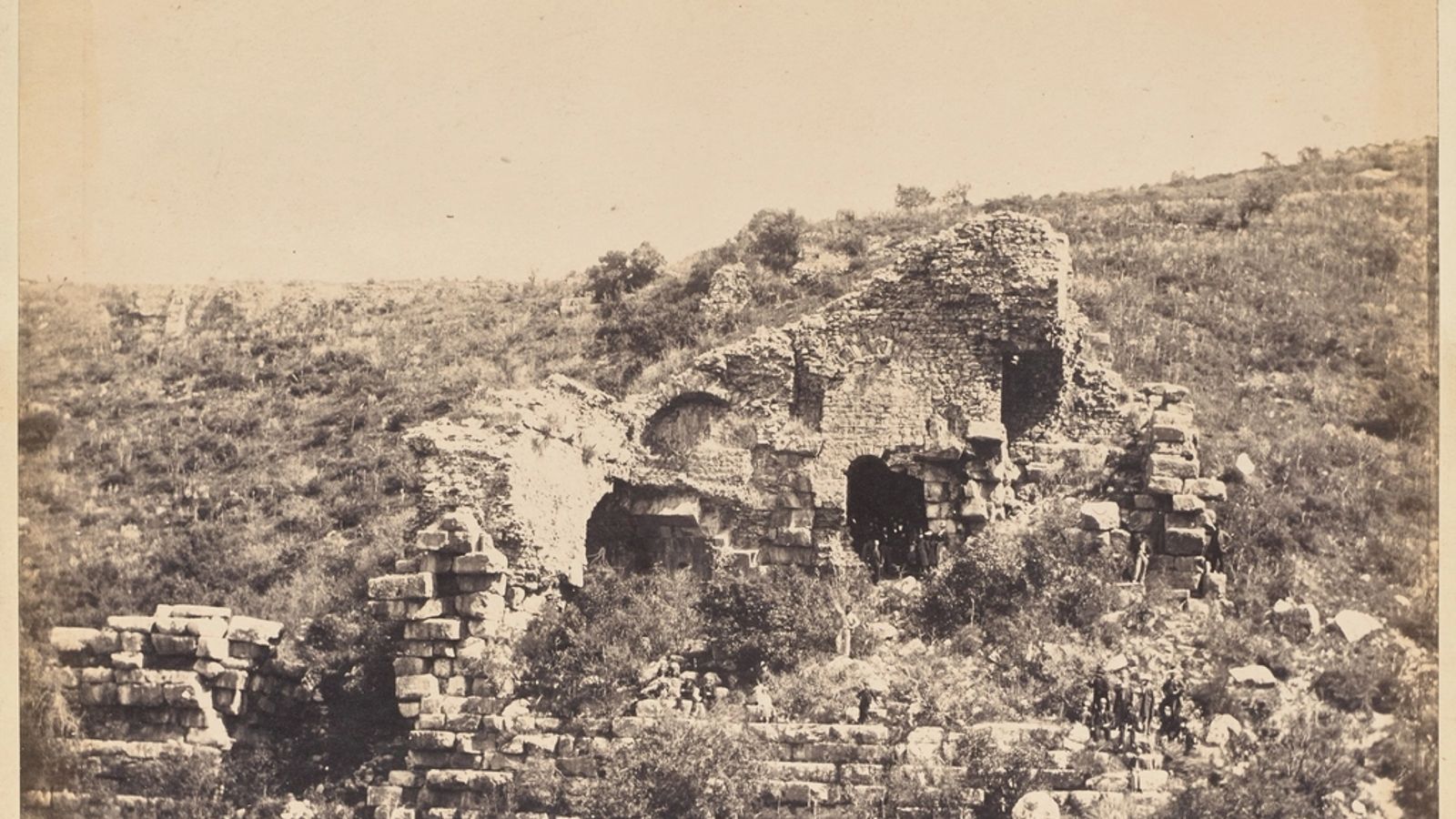
- Hero image source by thegetty / openverse, cc0.