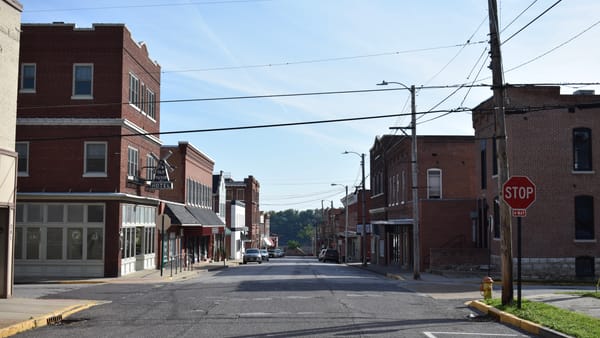
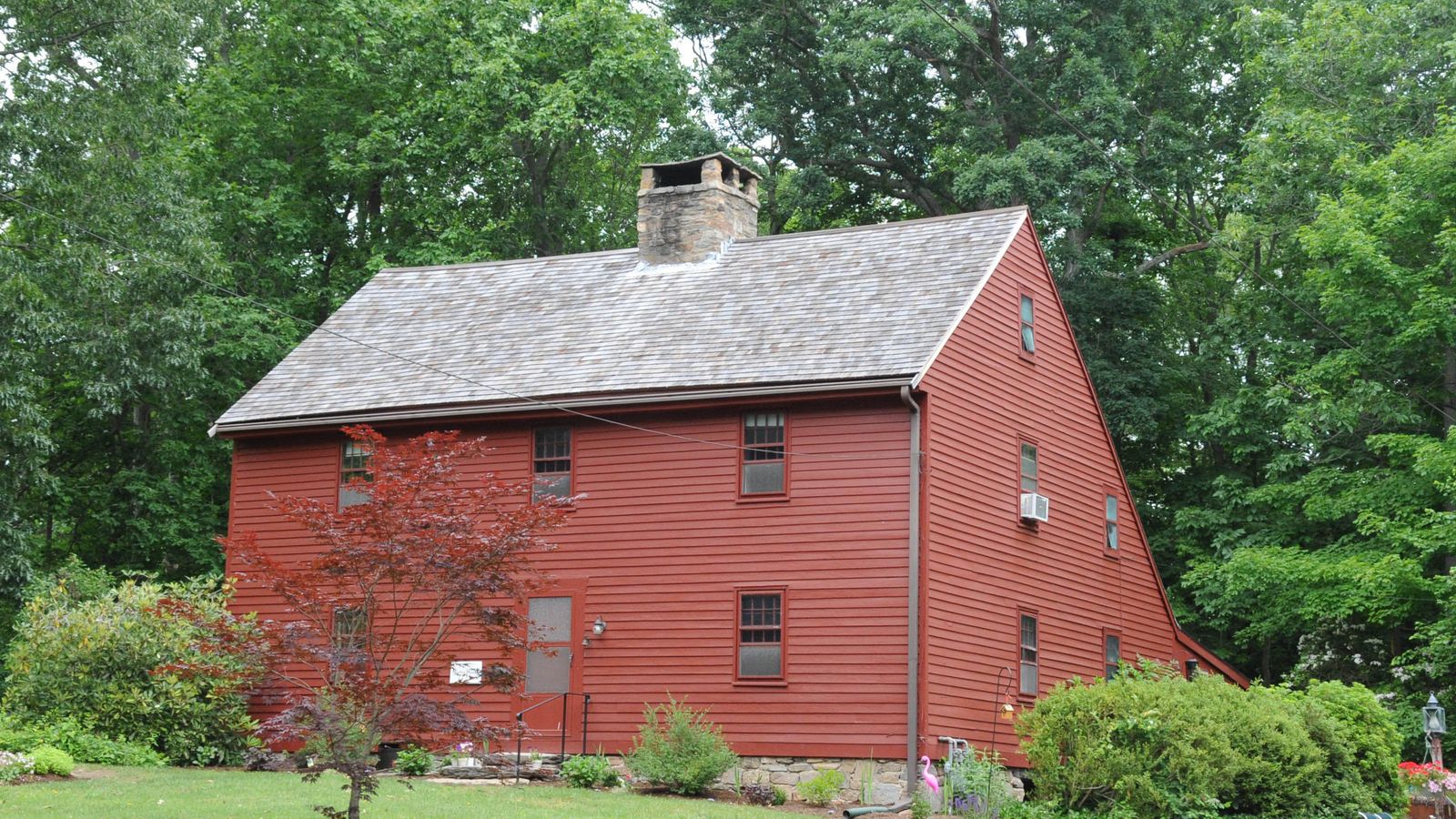
The long yawning chasm of another dreary school day in the summer of 1885 drifts all too slowly into the late morning. But a welcome tingle of anticipation begins to slowly bubble to the surface in a stuffy old classroom in the shoreline town of Branford in New Haven County, Connecticut. If today was a typical day, there would be another full torturous hour to endure before Miss Hawthorne called the next recess. But everyone in the classroom this morning knows that they’re going to be briefly given the freedom to run outside and gulp the fresh air in just ten minutes.
And that’s not because Miss Hawthorne is a high-functioning alcoholic who desperately needs to get to the liquor store before the owner shuts early to go fishing. That’s just a coincidence. It’s because today is Leatherman Day.
It’s a special occasion which only swings around at a very specific time every 34 days. Weighed down by his heavy patchwork suit stitched together from bits of old leather, the mysterious homeless traveller known as The Old Leatherman will briefly wander into view and be greeted like a celebrity as he silently accepts food offerings from the kind-hearted souls he meets along his path – including the excited schoolchildren of Branford. Then he will resume his endless journey – a journey which takes him on a long circuit between the Hudson and Connecticut rivers consisting of 365 miles or 587 km in total before he loops back again. A journey which some say he took for over thirty years, always passing through each destination as regular as clockwork to mingle with his fans before moving back onto the same well-trodden path.
Key Takeaways
- Leatherman was a 19th-century homeless man who walked a 365-mile circuit.
- He was known for his leather suit and strict schedule, appearing regularly.
- Leatherman’s identity and origins remain mysterious despite extensive research.
- He was well-liked by locals and had a network of caves for shelter.
- Leatherman’s grave marker was corrected after decades of misinformation.
But how did a nameless vagabond become quite so famous in life and death, and manage to generate quite so many local headlines whilst barely speaking a word? Where exactly was he from and why did he stick so rigidly to a strict timetable on his epic circular trudge through eternity? If his identity was supposed to be such a great mystery, then why did his gravestone marker clearly display his full name for the best part of six decades – the name of a man with a tragic past? And how did Leatherman continue to conjure up even more baffling puzzles to solve from beyond the grave, well over a century after his death?
A Well-Documented Enigma
Before we take our first tentative steps into the wilderness, it’s worth dispelling a couple of myths right away. If you’re not familiar with the tale, you might be bracing yourself for the anti-climactic revelation that Leatherman never existed at all. Or that even if he did, he was just some bloke called Derek who wore quite a big coat and was once spotted walking past the same tree twice. But the main gist of the story is completely true and well-documented – there was indeed a quiet 19th-century homeless man dressed in a bizarre outfit who spent years wandering around a sprawling 365-mile circuit with quite staggering precision for unfathomable reasons which he kept to himself.
It was speculated in recent times that Leatherman was a mentally-scarred veteran from the American Civil War who had escaped death on the battlefield but had lost his mind in the fight. But that theory doesn’t make an awful lot of sense, as he was first spotted in the 1850s, a few years before The American Civil War kicked off in 1861.
And Leatherman was a pretty unmistakable figure to spot. He was approximately 5 feet 7 inches tall with grey-blue eyes and a mop of dark hair which was usually covered with a hat. His naturally weather-beaten and often grimy face offered little clue as to his age. You could have understandably assumed from the crags and grooves in his face that he was well into his sixties or seventies – and this seemed to be the general assumption based on his not entirely polite contemporary nickname The Old Leatherman of Connecticut.
But it was difficult to know for sure. Considering the arduous journey and lifestyle he had undertaken, he had more than a tough paper round to blame for possibly looking old beyond his years.
He obviously wasn’t the most well-groomed man in the area – in fact, it was often said that you could smell him coming before you actually saw him coming – but some eyewitnesses have suggested that he was a lot cleaner than you might imagine, and he spent at least some time freshening up by rivers and streams, even if he might not have gone so far as to actually take off his signature leather suit. And of course it was these distinctive clothes by which most people recognised Leatherman. He certainly had his own thing going on.
The Leather Suit and the 365-Mile Circuit
His coat, trousers, scarf, hat, and backpack were all sewn together from old bits of leather, and this costume was very much an ongoing project which he would regularly patch up and improve at every opportunity, often accepting handouts of leather scraps and cut-offs from tanneries. The whole bulky suit weighed in at 60 pounds – and that’s not just a guess, it was weighed during a coroner’s inquest – and he was clad from head to toe in this stuff even on the most sweltering hot summer’s day as he continued his long relentless clockwise shuffle across western Connecticut and eastern New York.
He passed through no less than 41 towns on this circular route along the Connecticut and Hudson rivers, covering roughly ten miles or just over 16 km every day, always ensuring that he was in the exact same spot at the exact right moment throughout all 34 days of the long cycle. So, pausing to figure out the maths, he would have completed the whole circuit eleven times every year – which means, casting aside the days on which he would have rolled into town on weekends and school holidays, the kids of Branford school would still have enjoyed a fair few Leatherman Days and early breaks for recess throughout the year.
A Network of Caves and Shelters
Of course, Leatherman didn’t just march relentlessly without ever stopping, like some kind of hobo zombie. He obviously needed somewhere to kip for the night. But he’d got all this sorted, and had found himself evening lodgings for every single stop on his journey. Admittedly, he wasn’t ever going to get access to spa facilities, a soup vending machine, plush bath robes, room service, and free wi-fi.
But he did have access to his own sprawling network of different caves and rock overhangs and makeshift huts scattered all across his route, which provided all the shelter he needed.
Many of the caves are now known as ‘Leatherman Caves’ and still attract interest today from visitors who are interested in picking up the scent of the 19th century hiker and getting a flavour of how he lived – even if in truth there’s not an awful lot to see. But whilst such lodgings might seem thoroughly one-star, Leatherman considered them all to be his homes, and he often kept carefully-tended little gardens nearby in which he would grow his own produce. As the evening drew, he’d get a good fire going and cook up whatever he’d grown, foraged, or received from the locals of the day, before retiring for the night on a makeshift bed constructed from hemlock branches.
And he was pretty well organised too. Before leaving his dwelling the next morning, he was often observed from afar scraping out his fire pit and setting up fresh firewood so that when he rolled by again in exactly 34 days’ time, he’d be all set to get down to business with minimal fuss.
Refusing Civilised Comforts
Now, you might be thinking: If Leatherman was so well-known and treated so kindly by locals, why did nobody bother to offer him a proper bed for the night instead of watching the poor guy skulk back to that night’s cave or rock shelter? Well, they did. Frequently. He just wasn’t having any of it.
I would say that he politely declined, but Leatherman was a man of very few words, speaking largely in grunts and gestures and incomprehensible mumbles. But despite what may be interpreted as a slightly fierce stare – or perhaps it was just general bewilderment of the world around him – he was widely regarded as an amiable soul who meant no harm or offence to anyone. He just didn’t want to be indoors.
Any offer of accommodation was swiftly refused, even during the most treacherous weather conditions. He very rarely even stepped inside anyone’s house at all, and if he did, it was only to quickly accept food offerings before bidding a hasty and somewhat grunty farewell.
He had a routine of knocking on the doors of specific farmhouses belonging to people that he’d come to trust and who were expecting his arrival. He would make it clear that he was feeling a bit peckish by either pointing to his mouth or occasionally saying the word “Eat.” Whilst he would reluctantly step inside for a moment when invited, he usually just either popped the food in his leather pouch – of course it was a leather pouch – or he’d just wolf it all down on the doorstep before moving onto his next stop to top up on further supplies.
One contemporary reporter from The New Haven Evening Register who had observed this for himself, noted how Leatherman seemed to have the most voracious appetite, writing: “Slice after slice of bread disappeared. Huge blocks of meat went after them in rapid succession, and the manner in which he consumed his pie and cake reminded me of an expert magician disposing of his cards.”
What Leatherman Would and Wouldn’t Accept
But there were only three types of gift that he would ever accept as donations: food, tobacco, and scraps of leather. Aside from turning down any offer of a comfy bed for the night, he would also decline clothes, money, and pretty much anything else that couldn’t be digested, smoked, or stitched onto his leather suit.
The money thing was interesting, as he did very occasionally accept rusty old coins given to him by generous farmers’ wives or young children – but there was a twist. The next time Leatherman returned to town, he would give the coins back, all nicely polished and looking brand spanking new. It’s not clear if Leatherman was just being playful, or if he had considered the gift to be a short-term loan, or if he just thought he had been given a job to do. But he clearly didn’t feel the need to hang onto money.
However, there has been a lot of speculation over how he must have been spending money at some point, following the discovery of records from a local store which provided evidence of what exactly Leatherman was ordering and picking up whenever he passed by. For the record, Leatherman’s regular order consisted of one loaf of bread, a can of sardines, one pound of fancy crackers, a pie, two quarts of coffee, one gill of brandy, and a bottle of beer. Note the fancy crackers. It sounds as if Leatherman had quite expensive tastes for a vagabond.
But where did he find the money to pay for all this stuff?
Some of the sillier theories suggest that he was actually incredibly rich, and stashed away all his money and pots of gold at a secret spot on his epic route. Every 34 days, he would reach this spot and discreetly withdraw the cash he would need for the next cycle. Following his death, there were even several serious attempts to track down his buried treasure. But I’m not convinced that Leatherman was an eccentric billionaire.
Although we don’t know for sure, it’s quite possible that he did odd jobs for certain people on his route in return for cash. The only problem with that theory is that after he’d been paid for his services, he would probably have just put all the money through a washing machine and brought it back with him on his next visit. Bearing in mind that we only have evidence from a single store, it’s perhaps just as likely that Leatherman had struck a deal with this particular store owner to do a few odd jobs in return for the items on his shopping list, or perhaps the store owner just had a soft spot for him and gave him the stuff for free.
On the whole, it seems that Leatherman didn’t have much interest in earning or receiving or spending money. All he ever really asked from anyone was something to shove in his gob, something to shove onto his leather suit, or something to shove in his tin pipe.
Popularity Against the Odds
It’s maybe a little surprising how Leatherman managed to become quite so popular during his lifetime. Yes, he was a mysterious figure from nowhere dressed in strange clothes who had some very unusual habits. But there was an increasingly unsympathetic attitude to all homeless people at the time, as the local press began to ponder over new ways of dealing with what was perceived to be a growing “tramp menace.”
Some of their proposed methods included asking all decent middle-class citizens to offer passing tramps poisoned food in a bid to slowly and slyly kill them all off under the guise of kindness. If that failed, the press put forward the idea of just shooting all homeless people on sight.
Whilst the Connecticut lawmakers didn’t agree with employing quite such drastic measures, they did go ahead and pass The Connecticut Tramp Law of 1879 which demanded the immediate imprisonment of “All vagrants living without labour, or visible means of support, who stroll over the country without lawful occasion.” There’s never a particularly great time to be a vagrant, but I imagine this period was one of the worst – and you’d think it might create a bit of a problem for someone like Leatherman who appeared to spend his whole life strolling over the country without lawful occasion.
But much like a UK politician during a pandemic, it seems that the laws didn’t apply to Leatherman. It’s even reported that ten towns in Connecticut went as far as to pass ordinances which specifically excluded Leatherman from the brutal state-wide anti-tramp law. Whilst anyone who spotted him for the first time may have understandably felt a bit perturbed by the sight of a lonesome figure entirely clad in leather emerging from the woods whilst mumbling nonsensical words to himself, he was seen by locals as a harmless and shy figure who endeared himself to the community.
In many ways, he was probably one of the most famous and well-documented characters in the whole region. He was hugely popular with children, whilst it was considered to be something of an honour to own one of the farmhouses at which the celebrity Leatherman had chosen to grace with his presence in search of food. And nearly everyone looked forward to Leatherman Day so much that it probably should have been declared a public holiday. As the clock ticked down to the uncannily accurate time of his celebrated arrival, crowds of fans would line the streets as they waited first for the aroma to hit their noses, then for the distinctive sounds of his creaking leather suit in the distance, before the man himself shambled slowly into view.
Press Coverage and the Paparazzi of the 1880s
And it’s only right that the comings and goings of a 19th century anti-socialite should make it to the pages of the local press. The first newspaper reports began to crop up sporadically in the 1850s, but one of the first in-depth profiles of Leatherman emerged in 1870 from the pages of The Burlington Free Press who preferred to call him The Leather-Clad Man back in those relatively early days of fame. The paper observed how he only seemed to communicate in monosyllables, and commented on his fashion sense, noting that he wore “An outlandish costume, which consists wholly of leather, and is made apparently from strips and remnants of old boots, fastened together by means of an awk and twine.”
By the 1880s, Leatherman’s movements had become as regular a fixture in some local papers as the horoscopes, the comic strips, and the pull-out glossy TV Guide. For example, The New Haven Daily Palladium took the time to break the shocking news in 1886 that “The Leather Man passed westward Tuesday, an hour and one half later than usual time.” I’ve no idea what caused such an inexplicable delay, but I can only assume he was held up by traffic.
This media attention obviously meant that Leatherman occasionally had to put up with being hounded by the paparazzi. Well, not quite. But seven photographs do exist of Leatherman, all of which were taken by Branford artist and amateur photographer James Francis Rodgers who had apparently struck up a sort of friendship with the backtracker idol.
It’s not clear if Leatherman was entirely happy with the idea. In at least a couple of the photographs, he does seem to be making some kind of attempt to strike a pose for the camera, whilst in others he just comes across as if he’s impatiently waiting for James to finish messing about so that he can get back to his busy schedule.
However, some quarters of the press weren’t always quite so gushing in their appraisal of Leatherman. In 1884, The Hartford Courant opined: “Nothing can be more pitiful than to see this poor, miserable, broken-hearted creature wandering around in cold and wet weather without even the common comforts of life, brooding over his terrible sorrow which has cost him his happiness and prosperity. Treat him kindly, dear reader, wherever you meet him and lighten his heavy heart with acts and words of kindness.” Meanwhile, The New York Times – which usually adopted a sympathetic stance to the wandering pedestrian – was clearly in a foul mood in 1884 when it published an article that described him as “uncouth, repulsive, and wholly inexplicable.” I suppose that Leatherman was bound to get up at least one or two people’s noses.
Incidents Along the Road
And even though the vast majority of his footsteps were planted without incident, there were always going to be a few ruffled feathers along the journey. It wasn’t impossible to get on the wrong side of Leatherman, even if you were just trying to be nice. If you started asking him too many personal questions about his background or his lifestyle, he would get visibly irritated and walk away in a mini-huff.
And this even applied to the owners of some of the farmhouses which he may have been frequenting for years. If they ever got a bit too nosey or a bit too pushy with their offers of accommodation, it would be the last time Leatherman would ever come knocking on their door. It’s not like he was being openly hostile or aggressive or anything, but I guess it was a bit like the 19th-century equivalent of being silently blocked on Twitter.
Whilst most of the children loved and respected him, you’re always going to bump into the odd little troublemaker here and there. He was once spotted waving his cane and shouting indecipherable words at a group of young ne’er-do-wells who were throwing stones at him for a laugh, but you can’t blame him for getting upset about that.
He occasionally had slightly more upsetting problems with the grown-ups. In April 1877, The Waterbury Daily American published reports on an incident which took place in the village of Forestville in Bristol, Hartford County. Leatherman had been plodding along on his usual route – where else would he be? – when he was set upon by a small group of drunken idiots who began taunting him. They initially tried to get him to take off his hat and cross himself against his wishes, before attempting to force him to drink from their liquor bottle. The paper reckoned that this amounted to assault, although there’s no record of Leatherman being physically attacked. However, several eyewitnesses reported that the incident was enough to drive the shaken Old Leatherman to tears. And The Waterbury Daily American made it very clear that they weren’t going to tolerate this behaviour, rounding off one of their reports with: “ill fares the pusillanimous rascal who dares harm him and is proven guilty.” It’s believed that Leatherman slightly adjusted his route to avoid that stretch of Forestville on future travels. It may not have been the only time that he took a small change in direction to avoid a spot in which he had previously encountered trouble.
But such incidents seemed thankfully rare for Leatherman. This was partly because he tended to avoid walking along the main roads or through the busier areas of town where strangers may be looking for a fight. But as those defiant final words from The Waterbury Daily American indicate, it was also because Leatherman was largely protected by the communities, and only a fool would risk messing with the local eccentric. It would be like rugby-tackling Father Christmas and expecting to get away with it. Leatherman may have been a curious figure, but in the eyes of the residents of the towns and villages he passed through, he was their curious figure. And if you wanted to keep hold of your kneecaps, you didn’t crack this leather.
The Unanswered Questions
Yet considering that he was probably the most familiar face in the region at the time, it feels odd that so little was known about this man who threw up so many unanswered questions. What was his name and where did he come from? Why was he dressed from head to toe in leather? Why did he so rarely speak to anyone?
How on Earth did he manage to survive so many brutal winters and live to presumably a ripe old age? Why was he undertaking the same 365-mile circular loop for years on end? How did he usually arrive at each and every location with such incredible punctuality that some people were said to set their watches by his appearance?
It was rumoured at the time that Leatherman may have originally hailed from Picardy, France. This was based on the fact that whilst he appeared to have a very limited grasp of English, some witnesses claim to have heard him speaking a little more fluently in French. It’s possible that Leatherman wasn’t being deliberately incommunicative, it’s just that he didn’t speak the language of the natives on his new route. But this then throws up more questions on why a man from Picardy would end up trudging relentlessly across the same circuit across western Connecticut and eastern New York for the majority of his life.
I should point out now that we don’t have any definitive answers for most of the mysteries surrounding Leatherman, but we’ll chew over some of the more compelling theories and debunked myths in a little while. In the meantime, we can at least answer one of those questions right now with a reasonable amount of confidence: How did he manage to survive for so long sleeping rough in the freezing cold?
A Born Survivor
It’s because he clearly knew what he was doing. He was a born survivor armed with a pretty impressive set of outdoor skills which were not to be sniffed at. Yes, it also helped that he received regular free donations of food from warm-hearted locals throughout his travels, but he was more than capable of looking after himself in the evenings when he was left to fend for himself. He grew his own food, smoked his own fish, fashioned his own tools, tanned his own leather, made his own clothes, and changed his own batteries in the carbon monoxide detector.
Watch Now
Open Video
Video Briefing
The Strange Mystery of The Leatherman
Whilst so many other tramps of the era were frequently known to lose their fingers or toes to frostbite, Leatherman was happily toasting his digits next to a roaring fire in his caves and shelters. During particularly cold spells, he would also create a makeshift “soapstone” bed by heating up a hearth with burning coals which were then swept away before he settled down to sleep on the still-warm hearth which now served like the ultimate 19th-century electric blanket. It may not have been the most comfortable bed in the world, but he was probably warmer than most, and borderline on fire.
Leatherman even managed to get through the Great Blizzard of ‘88 without too many problems. Over 400 people lost their lives to one of the most devastating blizzards in American history when it raged across the East Coasts of the US and Canada between March 11th to March 14th 1888. But to Leatherman – always wrapped up in his ultra-insulative suit – it wasn’t such a big deal.
Aside from a touch of frostbite in his face, the most inconvenient element of the Great Blizzard was the fact that it delayed his schedule by a whole four days and therefore quite possibly tilted the whole fragile balance of the universe into a new era of chaos and calamity. Not many people would have noticed this uncharacteristic decline in punctuality though, as most citizens had bolted down the hatches to save their own lives. Nobody was going to be lining the streets to greet Leatherman that week.
Yet whilst he may have been as tough as old boots, Leatherman was obviously not completely invincible.
Decline and Death
By early 1889, it was noted by many observers that Leatherman wasn’t quite as steady on his feet as he used to be, and he was sporting a nasty sore which was beginning to spread across his face and produce a small cavity in his neck. He was also beginning to accept invitations to eat meals indoors more frequently, although it was clear that he was struggling with the pain of chewing, and he continued to refuse any offers of a bed for the night or any help in getting medical assistance.
A concerned report from The Bristol Herald observed during these darker days: “He refuses to stay in any civilised situation. He breaks away and tramps off for the woods and ledges, be these far or near. Death will be his only release and it is probably not far off.” Some newspapers were calling for a dramatic intervention, but interventions with Leatherman didn’t usually pan out very well.
A year earlier, not long after The Great Blizzard, The Connecticut Humane Society had taken it upon themselves to secure a warrant for his arrest so that he could be given medical treatment against his will. They had him bundled into a carriage destined for a hospital in Hartford, and during the journey a disgruntled Leatherman made several unsuccessful attempts to escape the clutches of Connecticut humanity. It’s often reported that Leatherman did eventually make his escape from the hospital at the earliest possible opportunity before he had even been given a medical examination.
But that’s not true – he got his examination and a diagnosis. This was almost a year before he had fallen visibly ill, and the doctor found Leatherman to be “sane except for an emotional affliction” which was not a strong enough reason to forcibly detain him. Leatherman was swiftly set free back into the wild, and The Connecticut Humane Society had to go and find somebody else to arrest.
However, as Leatherman’s health declined over the course of the following year, he was destined to make only a few more trips around his long circuit before he finally reached the finish line. On 24th March 1889, a carpenter by the name of Henry Miller was enjoying a Sunday morning walk around the countryside of Mount Pleasant with his unnamed wife. His wife expressed a desire to visit a hut widely known to be frequented by Leatherman, situated in Saw Mill Woods on the property of farmer George Dell. And the Sunday morning ramblers were in for an unexpected bonus when they got there.
They weren’t just going to be pootling around an empty hut. Leatherman himself was at home! Oh, wait a sec though, this wasn’t going to be much of a meet and greet. Leatherman had been dead for several days.
According to carpenter Henry Miller: “As we entered the hut, we thought the man was asleep, but a second glance saw that he was dead. His hair and beard were mottled with blood, his face swollen and distorted.” The subsequent coroner’s inquest conducted by George H.
Sutton in Sing Sing, New York, concluded that the immediate cause of death was blood poisoning, brought about by cancer of the mouth which had pretty much destroyed his lower jaw. Leatherman’s final days on Earth would have been far from pleasant as he was wracked with pain and would have found it impossible to eat anything. He may have survived decades of living and sleeping in the brutal conditions of the great outdoors, and he may have breezed through a Great Blizzard without too much difficulty, but he was likely brought down in the end by a chronic addiction to chewing tobacco.
Revelations from the Inquest
The coroner’s inquest yielded a couple more interesting revelations about the life of Leatherman. The autopsy had concluded that he was only in his fifties, significantly younger than many would have assumed. This means that during the earliest recorded sightings of Leatherman in the 1850s, he would have still been in his sprightly twenties and probably up for popping down the disco had anyone bothered to invite him.
Although Leatherman didn’t have too many possessions to his name, the coroner also went rifling through his leather pouch and came across various tools, a pipe, a frying pan, and most intriguing of all, a well-thumbed copy of a Roman Catholic prayer book written in French. Along with the small crucifix found around Leatherman’s neck, this appears to indicate that Leatherman was a deeply religious soul. He was often reported to have turned down any meat offered to him on a Friday, and the prayer book would seem to confirm that he was a practising Roman Catholic. But more than that, the language of the prayer book would also seem to confirm that he was more familiar with French than English.
The farmer George Dell – upon whose land the body of Leatherman was found – had been one of the very few to have identified some of the so-called ‘incomprehensible mumbling’ as words muttered in French. During testimony given during the coroner’s inquest, George Dell revealed: “He frequently stopped on my farm for a little over five years last past, in a rude structure he made in the woods for a shanty or a hut. He never asked my permission to build the hut on my land, and I didn’t object.
He never came to my home to beg, nor did I ever give him any food. I had a conversation with him once. I could not hold him long in conversation.
I thought he was a Frenchman. I asked him a few words in French and he answered promptly in French.” As we hinted at earlier, it now seems likely that Leatherman wasn’t just necessarily being ignorant or purposefully monosyllabic; he could have been a fluent French speaker faced with a challenging language barrier.
Sadly, it had been left a little too late to get any further answers from the man himself.
The death of Leatherman made the front pages of the local press, and it’s reported that hundreds of people came to view the body at the undertaking rooms. His original leather suit was briefly put on display at a nearby cigar store, but was later sold to a carnival sideshow in Coney Island where it was draped over a lifesize dummy of Leatherman for a while before the whole thing was destroyed in a fire in 1928. His body was buried in an unmarked pauper’s grave in Sparta Cemetery in Ossining, New York. But the grave wasn’t destined to remain unmarked forever.
The Tombstone of Lies
Sixty years later in 1953, a man by the name of LeRoy Foote spearheaded a campaign to have a new grave marker installed which would bear the true name of Leatherman. LeRoy Foote knew all about it, you see. He knew that Leatherman’s real full name was Jules Bourglay and that he originally hailed from Lyons in France. In fact, there was quite a detailed background story to tell if you’re interested in hearing it.
Sorry, it’s just occurred to me that I’ve been completely wasting your time by trying to build up this alleged mystery. It’s a mystery which had been completely solved by 1953. And yet there was something not quite right about this Frenchman by the name of Jules Bourglay. And even after all this time, Leatherman still had a few final tricks left up his sleeve…
In the years following Leatherman’s death, he was still the talk of the town even if he was no longer plodding along the paths. The local press – including The New York Daily News – were printing bizarre stories of treasure seekers who had embarked upon quests to hunt down Leatherman’s secret stash of gold in his most widely-known caves and huts, only to be scared away by his enraged ghost. Rather more sensible people were doing something a little more productive than seeking imaginary treasure guarded by grumpy ghosts. People like Chauncey L. Hotchkiss of Bristol in New Haven, for example. It turns out that during his lifetime, nobody apart from the quiet man himself had ever known the full extent of his circular route. They knew the exact date and time that he would be shuffling into their part of town, but they didn’t know exactly where he’d been for the previous 34 days.
It wasn’t until the backend of the 19th century that writer Chauncey L. Hotchkiss began reaching out to as many people as he could find who had ever met Leatherman. And after several years, it was Hotchkiss who became the first person to have mapped out the entire 365-mile route. Several other researchers followed in the footsteps of Hotchkiss over the next few decades to try and find out more about Leatherman, and by the time we get to the 1940s, it was Middlebury writer LeRoy Foote and his wife Sarah who had picked up the trail in search of fresh clues.
It’s fair to say that LeRoy and Sarah were pretty big fans of Leatherman. As well as conducting countless interviews with people who had seen and smelt him in the flesh back in the day, they also travelled around the region giving Leatherman lectures with slideshows depicting the full route they had personally explored many times, along with images of the most famous caves in which he had slept. But LeRoy Foote felt troubled by the pauper’s grave in Sparta Cemetery in Ossining. During his and Sarah’s noble research, they believed that they had uncovered the full background story of Leatherman and felt it was time that some of this was reflected on the blank nameless grave.
In collaboration with the Ossining Historical Society, LeRoy Foote oversaw the installation of a fancy new tombstone which bore the following inscription: “Final Resting Place of Jules Bourglay of Lyons, France - ‘The Leather Man’ - who regularly walked a 365-mile route through Westchester and Connecticut from the Connecticut River to the Hudson living in caves in the years 1858–1889.” Quite a mouthful. Probably needed a good edit. But that wasn’t the only thing wrong with it.
It’s worth pointing out straight away that LeRoy and Sarah Foote weren’t being deliberately misleading here. They were enchanted by the legends of Leatherman and they were acting with the absolute best of intentions based on what evidence they had uncovered at the time. They had found an article originally printed in The Waterbury Daily American during Leatherman’s lifetime in 1884, which was later used as a source for subsequent obituaries in other publications after his death in 1889. The original article entitled “The Mystery Solved!” was written by reporter W.A. Sailson who stressed within the text that every detail of this backstory of Leatherman was completely true.
According to this report, Jules Bourglay of Lyons had been a young French woodcarver living in poverty who happened to have fallen in love with Margaret Laron, the daughter of an incredibly wealthy leather merchant. Jules Bourglay sought Margaret’s hand in marriage, but the prospective father-in-law wasn’t immediately taken by the idea that his daughter planned to get hitched with some low-life woodcarver who didn’t have a pot to piss in. Still, he was a fairly reasonable man and he agreed to give Jules a shot at working in one of his leather factories to prove his worth.
The arrangement worked fine for a while, as lovestruck Jules worked his way up the leathery ladder and gained increasing responsibility in Mr Laron’s leather empire. Jules and Margaret even set a date for the wedding.
But then disaster struck. Some versions of the story tell of how Jules invested a fortune of the company’s money on new stock just as the price of leather fell by nearly half. Another version tells of how clumsy Jules knocked over a lantern late one evening and ended up burning down the main factory.
But either way, the story goes that he practically destroyed the Laron leather empire in the space of a single day, after which Mr Laron really got the hump with him and forbade him from ever seeing his daughter Margaret ever again – although one variation of the tale suggests that Margaret actually died in the fire. A broken-hearted Jules Bourglay completely lost the plot and spent some time in an asylum before he fled to America and became Leatherman, doomed to roam the same loop over and over again as penance for his foolish actions, whilst dressed from head to toe in the substance of his ruin.
Now, some might think that this sounds like a tragic true story of ill-fated romance and regret. Others might think that it clearly all sounds like complete bollocks. It does seem as if a comic strip writer was given the task of coming up with an origins story for the superhero Leatherman, which he had to tie in with the scant information available about him – he spoke a bit of French and he liked to wear leather. And you’d be right to think it was complete bollocks. The Waterbury Daily American published a retraction the very next day which admitted that the whole story wasn’t true. They printed several more retractions over the next few days, just to make sure that everyone got the message. That didn’t stop the story getting recycled by other publications after Leatherman’s death, but most of these papers quickly realised their mistake afterwards and printed multiple retractions which apologised for the error. The story was probably retracted more times than it was published as fact.
Unfortunately whilst an over-enthusiastic LeRoy Foote had uncovered the original articles, he had failed to unearth any of the retractions and so had assumed that the story was true. LeRoy had also maybe become just a little too fixated on the tragic love story angle. Over the years, he and Sarah had written to officials in Lyons asking for more information on Jules Bourglay and had been told in no uncertain terms that no such person ever existed. But still they clung to the story and believed it to be true, and it wasn’t until many years later that LeRoy Foote finally admitted they’d got it all wrong.
But in the meantime, the installation of that 1953 tombstone of lies had led to a long dead end for the Leatherman saga. For decades to follow, the fake story became widely accepted as fact. Leatherman was no longer the subject of speculation or investigation because it was believed that the old mystery had been definitively solved. But one person who still wasn’t quite convinced was the retired Connecticut schoolteacher Dan DeLuca.
And sixty years after the erroneous tombstone was erected, he was determined to get rid of it.
Dan DeLuca’s Investigation
Dan DeLuca first began researching the Leatherman saga in the 1980s. He would end up spending the next twenty five years conducting perhaps the most comprehensive probe into the life of Leatherman ever undertaken, eventually resulting in the publication of his 2008 book The Old Leather Man: Historical Accounts of a Connecticut and New York Legend. DeLuca had spent all that time hooking up with historical societies to unearth vintage newspaper clippings, and meticulously examining vast archives of microfilm to try and pick out the tiniest fruitful clues buried deep within the reels.
Before we get too excited, he certainly didn’t come up with all the answers. But he did at least manage to debunk a few long-running myths. It was DeLuca who uncovered the multiple press retractions regarding the story of Jules Bourglay. In fact, he even managed to hunt down internal correspondence between the writer of the original article – W.A. Sailson – and the then editor of The Waterbury Daily American in which the reporter openly admits that he just made the whole thing up.
It also transpired that the idea of ten towns in Connecticut passing ordinances which officially exempted Leatherman from The Connecticut Tramp Law of 1879 was fake news. Whilst he certainly didn’t seem to get pestered by the law, this was nothing to do with any exemptions. He was possibly just considered popular and harmless enough to be allowed to continue living without labour or visible support as he strolled over the country without lawful occasion.
But more significantly, Dan DeLuca also reckons that we may have vastly overestimated the total number of years over which Leatherman had been repetitively venturing across his impressively punctual route. It was often reported in the press at the time that Leatherman had been going around in circles for the best part of thirty years, whilst some articles suggested that it was actually a bit longer, as he had been taking the same journey between 1852 to his death in 1889. However, Dan DeLuca’s investigations have revealed that the earliest documentation and evidence relating to the Leatherman’s famous circular route only stretches back to 1883.
Whilst he had certainly been spotted in random local places at random local times long before this, DeLuca believes that it was only for the last six years of his life that he got stuck on the patterns and schedules of his most famous long walk. Still a pretty long time to be going around in circles, but not quite the three decades we’d been led to believe.
The Exhumation Controversy
Dan DeLuca had long wanted to do something about that darn misleading tombstone. The life of Leatherman had first been honoured with an unmarked pauper’s grave for well over 60 years, and since then he had been honoured with a tombstone engraved with the name of a fictitious character for the next 60 years. Surely it was time to do something about that.
An opportunity arose in 2010. When Leatherman was originally buried in the Sparta Cemetery in Ossining in 1889, the chosen spot would probably have been considered a fairly quiet spot to rest one’s bones. But by 2010, Leatherman’s grave was now only a few steps away from the bustling Route 9, and there were growing safety concerns over the increasing number of visitors to the grave.
The last thing you’d want to do is get mowed down by a car when you were just trying to pay your respects at the inaccurate tombstone of a man who never even existed. Apparently, one man had already been recently struck by a car although he wasn’t seriously hurt. The Ossining Historical Society decided that it would be much less risky if the grave was moved to a better spot further up the cemetery hill, as this would cut down on the number of fresh graves they’d have to dig for all the visitors who weren’t paying close attention to the road.
When Dan DeLuca got wind of this, he persuaded the society to take the opportunity to finally ditch the dodgy tombstone and replace it with a new grave marker that was more fitting. But he also had something else in mind. Whilst they were busy exhuming the grave anyway, he figured they may as well conduct DNA testing on the buried remains to see if they could perhaps shed any new light on the real origins of Leatherman.
This wasn’t an idea that went down well with everyone. In fact, fellow Leatherman enthusiast and North Haven schoolteacher Don Johnson (no, not that one) was so opposed to the whole idea of the exhumation that he launched the website LeaveLeathermanAlone.com in a passionate attempt to stop the grave from being disturbed. Johnson felt that the proposed plans were nothing short of a ruthless invasion of privacy.
Across various different public statements, he said: “I believe that the Leatherman’s DNA is his property, and he went to unimaginable lengths to guard his identity during his life. He spent 100,000 miles never telling anybody who he was. That legacy to me should speak to us.
Never in his wildest dreams or in his final moments, could he have imagined that someday, some stranger would be pulling his wisdom teeth from his jaw to force him to talk! Do we want to respect him and memorialise him properly? Then leave him alone.
Leave his bones alone.”
Over the course of several months, Dan DeLuca responded to this criticism by claiming that they weren’t trying to identify Leatherman. That admittedly would be quite tricky as they were unlikely to find him still clutching onto his passport or his driving licence. They were simply hoping that DNA testing might be able to shed new light on where he might have come from. DeLuca also noted that the inevitable expansion of Route 9 would mean that many of the graves near the road would have to be dug up and moved anyway.
And he disagreed with Johnson’s assertion that Leatherman was an intensely private person, noting: “I wouldn’t say he was a private person, because he depended on people almost every day. Besides, you don’t walk around in a 60-pound leather suit if you’re trying to be anonymous.” He’s got a point.
It was refreshing to see that the debate between Dan DeLuca and Don Johnson never turned nasty. They always shared a strong mutual respect, it’s just that they strongly disagreed over the proposal to exhume the body. Johnson claimed to have gathered thousands of signatures demanding that Leatherman should be allowed to rest in peace, but the protest was in vain. Permission was granted to exhume the remains by Westchester County Supreme Court, and the excavation took place over three days in March 2011, overseen by experienced forensic archaeologist Dr Nicholas Bellantoni.
The Vanishing Body
But it appeared that Leatherman was still in no mood to talk and in no mood to give up his secrets. All they found buried in the soil was a few old rusty coffin nails. There was absolutely no trace whatsoever of Leatherman’s body. Don Johnson was said to be pleased that no remains were found for potential DNA testing, but he didn’t take the opportunity to gloat. I bet he was punching the air in the privacy of his own classroom, though.
But how could the body have simply vanished without trace? The obvious answer that instinctively springs to mind is that Leatherman was a vampire who had done a runner as soon as he had been tipped off that those buffoons from The Ossining Historical Society were intent on ripping up his bedroom. Other potential answers involve the body getting discarded after looters dug up the grave to find the lost Leatherman treasure, or that the body was deliberately stolen by graverobbers who were trying to earn a few dollars from the mad scientist who had just moved into Castle Bloodfang.
A rather more mundane answer was provided by Dr Nicholas Bellantoni who reckoned that the passage of time and the effect of bustling traffic from the nearby Route 9 had combined to destroy all the hard and soft tissue buried within the cemetery’s unusually acidic soil which would itself have quickly speeded up the natural process of decomposition. All that was left of Leatherman had long since disintegrated and become part of the soil. He also believed that a historic road-grading project may have scraped away some of the original gravesite. The disappointed archaeologist was of the opinion that Leatherman was very much having the last laugh.
Still, although the DNA testing proposal had gone a bit tits up, at least Leatherman was moved to a safer location in the cemetery and given a new grave marker, whilst the previous inaccurate tombstone was shifted to the Ossining Historical Society’s museum. The rusty coffin nails and some of the soil were placed in a new pine coffin and lowered into the ground during a packed ceremony attended by Dan DeLuca who placed four old rusty pennies on the casket in tribute. I’m hoping he doesn’t propose another exhumation in sixty years’ time to see if Leatherman ever got round to cleaning them up. Don Johnson would go hopping mad.
The new grave marker is a granite boulder with a small plaque attached to it. It’s not quite as wordy as the previous effort, but it speaks more truthfully of the remains – well, the remains of the remains – buried beneath. It simply reads “The Leatherman.”
Where Does That Leave Us Today?
So where does that leave us today? Leatherman certainly hasn’t been forgotten. Hikers and historians still enjoy revisiting the original route and exploring some of the more famous caves at which the original backpacker was known to quietly retire in the evenings.
The annual Leatherman’s Loop trail race – a 10k cross-country race held in Westchester – still attracts over a thousand competitors every year as it celebrates its 35th year. And the man was immortalised in a 1998 B-side from Seattle grunge plodders Pearl Jam which was named after him and contained such insightful lyrics as: “Comes out of the caves once a day to be fed/He wasn’t known to say much but, ‘Thanks for the bread’/Shame he’s dead, I saw his bed/It’s all that’s left of Leatherman.”
But are we any closer to digging up the whole story? Dan DeLuca concedes that whilst he’s comprehensively debunked a few myths, it often feels more like he’s just wiped away fake facts rather than come up with any new ones. He’s not so much solving mysteries as unsolving them. Whilst we now know that Leatherman certainly wasn’t Jules Bourglay, we’re still none the wiser as to his real identity and his real story – and we’re unlikely to ever learn the whole truth.
Theories and Speculation
Several other groundless theories have been put forward over the years. It’s been suggested that he was a French fugitive who committed some heinous crime and then fled his country to go into hiding in America. Whilst that might explain why he was never keen to discuss his background, it seems a bit unlikely that a fugitive in hiding would walk along the same predictable route for years whilst dressed in a bonkers leather suit.
It was believed by many for a while that Leatherman’s true identity was the French shoemaker Rudolph Mossey whose wife ran off to America with another lover. A broken-hearted Rudolph swiftly followed in pursuit, only to find that she had gone and died, leaving him to roam around in circles of despair. This one’s actually a bit weird, because there are multiple accounts of a French guy called Rudolph Mossey who did indeed roam around the same rough locations and ask for food donations whilst dressed up from head to foot in leather. But according to LeRoy and Sarah Foote, whilst Rudolph may have been a Leatherman, he wasn’t the Leatherman. The sources seem to point to Rudolph beginning his travels shortly after the original Leatherman had died. He was also a lot chattier, was known to regularly do odd jobs for cash or meals, and apparently got into occasional brawls which sounds nothing like our guy. It’s not known for certain whether he ever really existed at all, but even if he did, he was more of a copycat or a Leatherman tribute act trying to cash in on the death of the original.
The most credible first name we have to go on for the real Leatherman is “Isaac”, as this was reportedly the name he gave when asked on more than one occasion, although there’s not much solid evidence to back that up. And even if somebody comes across his birth certificate one day in the far future, I reckon he’ll still always be known as Leatherman.
The French-Canadian Theory
But where are we most likely to find his roots? There’s a popular assumption that because Leatherman appeared to be more fluent in French than English, he must therefore have hailed from France. But of course that’s not necessarily the case. Dan DeLuca has his own theory which he freely admits he can’t support in any way, but bearing in mind that he’s studied the story of Leatherman in closer detail than anybody else in history, I’d be pretty happy to trust his instincts on this for now.
DeLuca is of the opinion that Leatherman didn’t travel quite as far as we may think to reach Connecticut and New York, as he took his first steps in life somewhere in Canada. DeLuca thinks that Leatherman was most probably a French-Canadian with Native American ancestry. He may have picked up his Roman Catholic convictions from his French-Canadian parents, but there may also have been a Native American grandpa knocking around the scene who taught a young Leatherman all the survival skills that he would rely upon later in life when he set off to explore the big wide world.
It’s now believed that during Leatherman’s earlier wanderings in the 1850s and 1860s, he may have been sighted in Montreal and Vermont as well as on his more familiar route across the Connecticut and Hudson rivers. This could potentially have been because he was still returning to his family home during the early years, but these trips back home dropped off in later life – possibly following the death of his last family member – and so he settled down into a shorter circuit on which he’d built up a regular supply of food donations from the kind locals. Perhaps the locals got a bit stingier with their freebies as he got closer to Canada, so he cut them off the map altogether after the family dinner table fell silent.
A French-Canadian with Native American heritage might help to explain the intriguing characteristics of a practising Roman Catholic who also knew how to take care of himself in the wild whilst maintaining impressive herb and vegetable gardens outside his caves. It’s all just speculation of course, but it sounds more plausible than the story about a Frenchman accidentally destroying a leather empire and then running away in disgrace.
The Leather Suit and the Pilgrimage Theory
His choice of outfit may have been considered unusual to say the least, and not something that most people would choose to pull out of the wardrobe on a baking hot summer day. But it kept him warm and dry in winter, and he clearly had no truck with the concepts of changing his clothes to suit the seasons or even getting undressed when bathing. This was his outfit for life and he was sticking to it. Probably quite literally.
It also would have been easy to repair and upgrade along his travels, as he had no problem in regularly sourcing free new bits from the various tanneries spread across his route. I suppose he might also have just really liked leather.
But that still leaves us with the questions of why Leatherman chose to stick to such a remarkably long circular loop for the last six years of his life instead of just picking one or two of his favourite caves and taking some of the weight off his aching feet. And why did he adhere so closely to such a strict schedule that would put Britain’s rail service to shame? Actually, putting Britain’s rail service to shame wouldn’t be too difficult, but you get what I mean.
A lingering theory is that because Leatherman appeared to be a devoted Roman Catholic, he was undertaking some kind of dark pilgrimage as penance for his sins. Perhaps the leather suit was actually his best attempt at emulating the robes that the Romans gave to Jesus just before they packed him off for crucifixion. And the reason that he point-blank refused any offers of accommodation was because he felt he couldn’t be dragged away from the long penance that he was serving.
Another theory to throw into the mix is based on the idea that Leatherman may have been suffering from some kind of severe mental disorder or learning difficulties which went some way to explain his deeply eccentric behaviour. But I don’t really buy that as he was clearly an intelligent and highly-skilled man who had his wits about him and was literate enough to regularly peruse a prayer book. The very fact that he was able to keep to such a tight schedule without even the need for a Casio digital watch seems to work against the idea that he had some kind of intellectual disability.
It’s not out of the question that if Leatherman had been alive today, he would be diagnosed as being somewhere on the autism spectrum, which might explain his desire to stick so rigidly to such an ordered and precise routine. Again, we’ll never know for sure what exactly was going on inside his head.
A Free Spirit
I just feel more attracted to the theory that maybe, just maybe, Leatherman was a free spirit who preferred to live outside the boundaries and do his own thing and keep on moving every day whilst minding his own goddamn business. He’s often depicted as a homeless man who relied on the kindness of strangers, but he may have just figured out that he wasn’t on a bad number here, really. He had no less than 33 different homes to fussily attend to on his later travels, and he was probably a lot warmer in winter than most of the people around him. And as he merrily strolled over the country without labour or visible support or lawful occasion, he would usually receive the most enthusiastic of welcomes and get treated to regular free gifts of tobacco, pies, and cake.
Leatherman Day may only have come round once every 34 days for the schoolchildren of Branford, but for the man himself, every day was Leatherman Day. Some might have considered him to be a lost soul in the wilderness, but I would say quite the opposite – Leatherman always knew exactly where he was going.
Simon Whistler
Simon Whistler is one of YouTube's most prolific educational creators. Decoding the Unknown is his methodical investigation into the world's strangest phenomena — examined with rigour, curiosity, and a healthy dose of scepticism.
Frequently Asked Questions
What was the Old Leatherman’s route?
The Old Leatherman’s route was a 365-mile (587 km) circuit between the Hudson and Connecticut rivers, passing through 41 towns. He covered roughly ten miles (16 km) every day, completing the circuit every 34 days.
What did the Old Leatherman wear?
The Old Leatherman wore a patchwork suit made entirely from bits of old leather, including a coat, trousers, scarf, hat, and backpack. The entire suit weighed 60 pounds.
What did the Old Leatherman eat?
The Old Leatherman’s diet consisted of food donations from locals, which included bread, meat, pie, cake, and sometimes fancy crackers. He also grew his own produce and smoked his own fish.
How did the Old Leatherman survive the winters?
The Old Leatherman survived the winters by wearing his heavy leather suit, which kept him warm and dry. He also created a makeshift ‘soapstone’ bed by heating up a hearth with burning coals, which served as an electric blanket.
What was the Old Leatherman’s schedule like?
The Old Leatherman followed a strict schedule, completing his 365-mile circuit every 34 days. He was known for his punctuality, often arriving at specific locations at the exact same time each cycle.
What happened to the Old Leatherman’s body after his death?
The Old Leatherman’s body was buried in an unmarked pauper’s grave in Sparta Cemetery in Ossining, New York. In 2011, an attempt to exhume his remains for DNA testing was unsuccessful, as no trace of his body was found.
What was the Old Leatherman’s real name?
The Old Leatherman’s real name remains unknown. A tombstone erected in 1953 claimed his name was Jules Bourglay, but this was later debunked as a fabricated story.
What was the Old Leatherman’s religious affiliation?
The Old Leatherman was a practicing Roman Catholic. He was often reported to turn down meat on Fridays and was found with a French Catholic prayer book and a crucifix.
How did the Old Leatherman communicate?
The Old Leatherman communicated primarily through grunts, gestures, and incomprehensible mumbles. He spoke very little English but was more fluent in French.
What was the Old Leatherman’s cause of death?
The Old Leatherman died from blood poisoning brought about by cancer of the mouth, which had destroyed his lower jaw. His final days were likely marked by severe pain and an inability to eat.
Sources
- Original Decoding the Unknown video: The Strange Mystery of The Leatherman
- Hero image source by JERRYE & ROY KLOTZ, M.D. / openverse, by-sa.