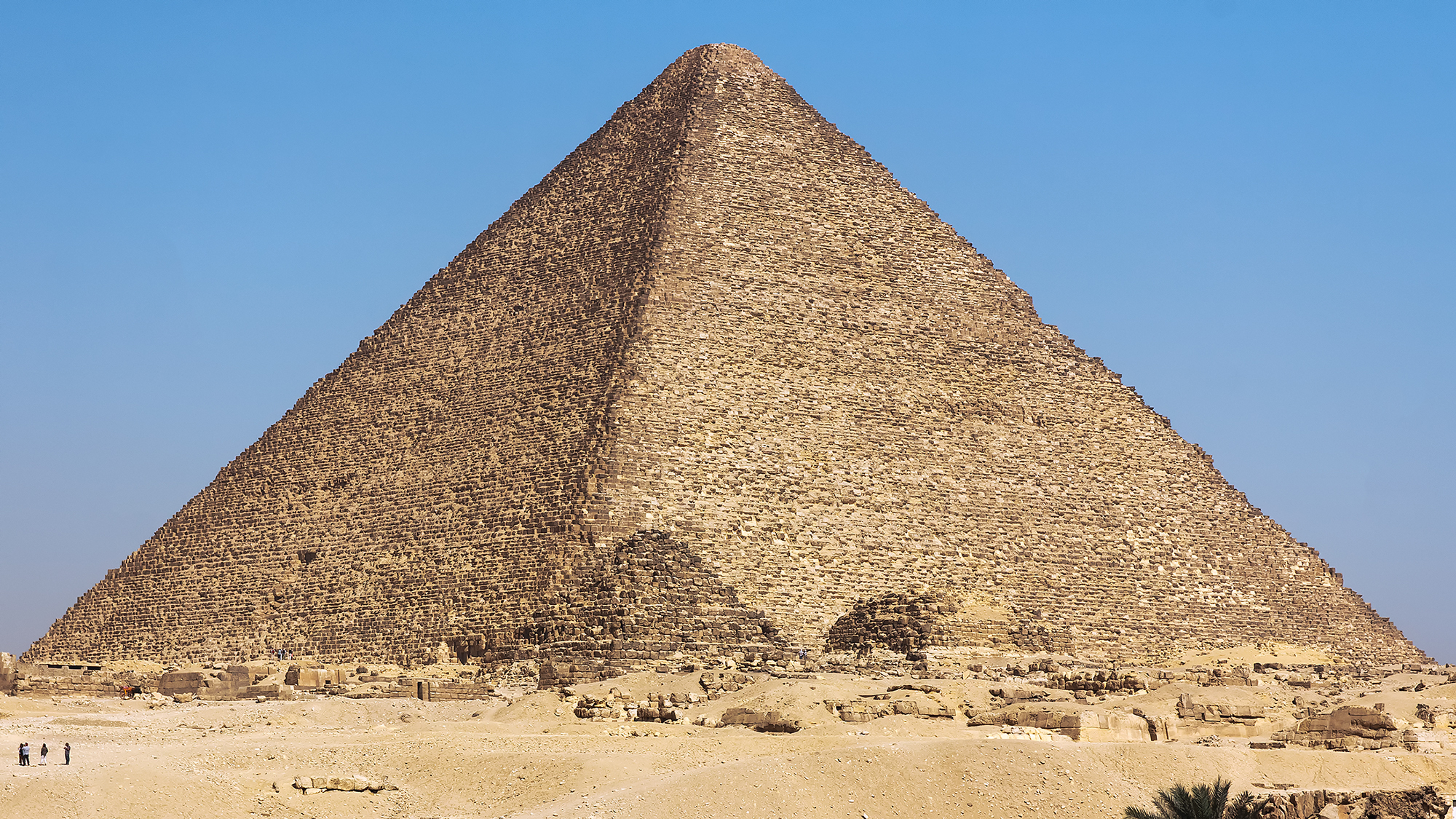
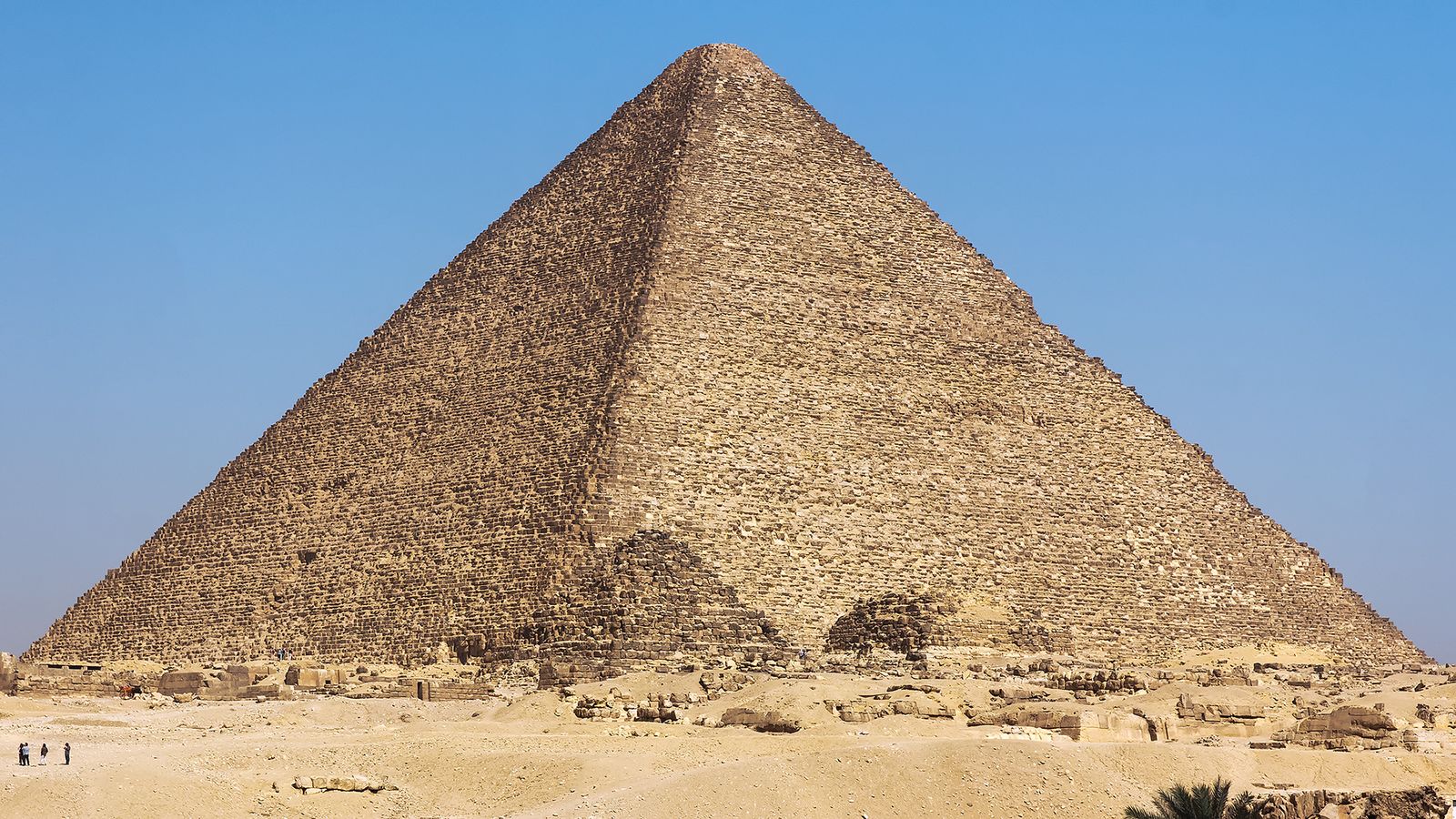
Egypt. A land of mystery, of enchantment, of sand; so much sand. Also home of the greatest mathematicians to ever exist, I’m referring to the camels of course, and, finally, the land of the pyramids. Because, let’s be honest, while Egypt may have a lot to offer the world, the first thing most people think about when Egypt comes to mind is pyramids: more specifically, the pyramids at Giza. And there’s a good reason for this; they are impressive!
For many, the civilization of ancient Egypt is synonymous with the pyramid-builders. However, there are only 118 pyramids in Egypt and while they did build pyramids for around 1000 years, the ancient Egyptian civilization lasted for over 3000 years. To put this into some perspective, Cleopatra, the last Egyptian Pharaoh ending 5000 years of dynastic rule, lived closer to the moon landing than she did to the building of the pyramids at Giza.
Did Cleopatra take a trip out to the desert to gaze in wonder at the grand monuments to her ancestors; was she as captivated with the pyramids as later generations would be? Or was it just another feature of Egypt, a looming monument at first revered but later used as shade by Bedouin merchants and, eventually, building material?
Key Takeaways
- The pyramids at Giza are the most famous, but there are 118 pyramids in Egypt.
- Pyramid-building was an evolving process, with early designs like the Step Pyramid.
- The Great Pyramid of Giza was built using around 2.3 million stone blocks.
- The workforce consisted of skilled builders and seasonal agricultural workers.
- Theories on pyramid construction include ramps, cranes, and even concrete casting.
The discovery and subsequent deciphering of the Rosetta stone in 1822 went a long way to solve some of the mysteries of ancient Egypt, but there’s still a lot we don’t know about the pyramids. One of the greatest mysteries is a fairly simple question: how were these majestic monuments built?
The story of the pyramids
A pyramid is not a lone-standing massive tomb honouring cat-lovers; it forms part of a larger burial complex. In ancient Egypt, pharaohs were considered to become gods after death so they had tombs, befitting future gods, filled with everything a pharaoh would need in the afterlife. Depending on the pharaoh in question, and when the complex was built, it might include a place, temples, and solar boat pits because every pharaoh worth his salt needed at least one solar boat to join Ra on his sunset cruise. Unfortunately, we don’t have a lot of records left to tell us what many of the buildings in the complex, and the chambers inside the pyramids themselves, were used for; just one of the many, many mysteries of the pyramids.
Considering how long it took to build a pyramid, it’s believed that a pharaoh would get started on this project as soon as he, or she, was sitting on that throne. Building a pyramid is quite an undertaking, so the pharaoh would create a team consisting of an overseer, a chief engineer, and architects, supported by a well-fed work force, to actually build whatever the engineer and architect came up with; much like construction companies today. Since the pharaoh was basically a god on earth, they had access to almost infinite resources in both manpower and building materials so no dream was too big for the pharaoh.
The pyramids at Giza are probably the best known and most impressive of the pyramids, but they weren’t the first. Much like the Sistine Chapel wasn’t Michelangelo’s first painting, the pyramids at Giza wasn’t the ancient Egyptians’ first rodeo. If we look at the older pyramids, we can see how the ancient Egyptians experimented with both the design and construction techniques and, through trial and error, learned what worked and what really didn’t. Like many worth-while pursuits, pyramid building was an evolving art.
The Step Pyramid of Saqqara was the first pyramid ever built. Imohtep, or The Mummy as I know him, created the step pyramid for King Djoser during the Third Dynasty by stacking six mastabas on top of each other, getting progressively smaller towards the top. A mastaba is a rectangular burial mound with sloping walls and a flat roof in which earlier kings had been buried. They were mostly made from mud bricks but some were made of stone.
The next step in the evolution of the pyramid was Sneferu’s pyramid, also known as the Bent Pyramid, built at Dashur, south of Cairo. This was the second pyramid built for Sneferu after the first attempt at Meidum was abandoned before completion. The lower part of the Bent Pyramid was built at an angle of 54 to 55 degrees.
However, the upper section was built at an angle of 43 degrees which gives the pyramid its recognizable shape. The Bent Pyramid faced a number of difficulties. Firstly, the site for the Bent Pyramid consisted of loose, sandy soil which didn’t provide a solid foundation for what would become a very heavy building.
On top of that, the earliest pyramids were built with layers of stone sloping inwards to form the body of the pyramid. This was already a very unstable design and, along with the less-than-adequate foundation, the whole thing started sinking. In an attempt to prevent further problems, the architects reduced the slope towards the top giving the pyramid its very recognizable ‘bent’ look.
However, Sneferu wasn’t a pharaoh to give up on his dream of a proper pyramid to loom over his subjects after he passed on to the next realm and commissioned a third pyramid. This third, and final, pyramid, the Red Pyramid, was built a short distance away from the bent one and used what would become the blueprint for future pyramids. It took a while, but they got there in the end.
The Red Pyramid, according to some, served as a prototype for the Great Pyramid as it incorporated some of the valuable lessons the builders have learned by this point. Future pyramids were built on solid rock to ensure a proper foundation and support. Instead of attempting inward-sloping stones, the ancient pyramid-builders realized that stacking stones on top of each other horizontally would make for a far more stable construction so they used large blocks at the bottom to better distribute the load with smaller blocks towards the top.
Squares and plumbs were used to take precise measurements to maintain the right shape. After all, the Bent Pyramid wasn’t exactly the gold-standard in pyramid building. The burial chamber would be placed inside the pyramid itself instead of in the ground underneath the pyramid.
Corbelled ceilings were used to create the spacious rooms within the pyramid without sacrificing the structural integrity of the pyramid. Pyramids were also built on natural hills to give them a little bit of extra height without extra layers of stone and, finally, pyramids would be finished off with fine white limestone.
The Great Pyramid of Giza could be considered the pinnacle of pyramid building and much of what we know of pyramid construction is based on the pyramids at Giza. The Great Pyramid was constructed during the reign of Pharaoh Khufu around 2550 BCE. It’s the largest of the three pyramids towering over the Giza plateau and stand at around 438 feet.
When it was first finished, it stood at an impressive 478 feet. It was built using around 2.3 million stone blocks weighing on average 2.5 to 15 tons each. The second pyramid at Giza was built during the reign of Pharaoh Khafre, the son of Khufu, around 2520 BCE.
His pyramid may have been a little smaller, but he made up for that by including the Sphinx in his necropolis as well. Finally, the third of the pyramids is quite a bit smaller than the first two and was built during the reign of Pharaoh Menkaure around 2490 BCE. What he lacks in the height of his pyramid, he made up for in the complexity of the mortuary temple found in his burial complex.
Initially, the pyramids were encased in smooth white limestone which made them highly visible because a huge pyramid in the middle of a desert is not visible enough; however, over the centuries, the pyramids have been plundered by grave robbers and the casings were removed to use in other construction projects.
When the New Kingdom period, from around 1550 BCE – 1070 BCE, arrived, the pharaohs had a change of heart and address and opted to be buried in the Valley of the Kings, located around 300 miles (483km) south of Giza instead. Pyramid building as a hobby declined in popularity and, today, Khufu is still the man with the biggest burial tomb ever. It didn’t do him much good however as, while we’ve found his tomb, the actual remains of Khufu has never been found. I guess size doesn’t necessarily mean security.
Who built the pyramids?
When we look at how the pyramids were built, an important question to ask is who built the pyramids. There are a lot of wonderful theories involving aliens and Atlantis, but I’m sure aliens have far more important things to do than build pyramids in a desert and Atlantis only ever lived in the imagination of Plato. The people responsible for the marvels of ancient Egypt were the people who lived there – the ancient Egyptians.
A popular notion is that the pyramids were built by slaves. However, the discovery of the Lost City of the Pyramid builders by Egyptologist Mark Lehner proves otherwise. The city was found close to Menkaure’s pyramid – the last to be built on the Giza plateau.
Lehner and his team made quite a few important discoveries such as the oldest bakery ever found in Egypt containing a cache of bread pots and an adjacent chamber which turned out to be the oldest pillared hall ever discovered in Egypt, filled with low benches. It could’ve been a dining hall, but we don’t really know. The team also uncovered 170 m, that’s around 550 feet, long blocks of modern-looking nondomestic galleries, most likely used as barrack housing for the more permanent labour force consisting of around 1600 – 2000 workers.
A building containing hundreds of seals dating back to the time of Khafre and Menkaure, probably used by officials to keep track of the sizable operation of feeding and housing the workers, prove that bureaucracy was alive and well in ancient Egypt and another building, a storehouse, contained circular bins most likely used to store grain. On top of all that, the remains of animal bones show that the inhabitants feasted on sheep and goat and even beef – the best meat available in Ancient Egypt. Tombs discovered at the foot of the pyramids indicate that the workers were buried in a place of honour, and the bodies showed healed fractures which means access to solid healthcare.
Slaves these people were not.
The workforce most likely consisted of a core group of highly-skilled and specialized builders and craftsmen that were employed on a permanent basis. This smaller group would’ve spent the year cutting stones and doing the survey and preparation work. This group of specialists was then supported by a rotating labour force, most likely agricultural workers who would spend around three months of the year working on the pyramids when things on the farms slowed down for the season.
This labour force might’ve included as much as 25 000 men and they would’ve been the ones hauling the stone from the quarries and putting them into place on the actual pyramids themselves. The permanent workforce most likely lived in the pyramid builders’ town while the seasonal workforce probably lived in a temporary camp closer to the site.
The workmen hauling, setting and casing the stones were divided into gangs, and each gang probably consisted of around 200 people. Graffiti uncovered in the early 20th century shows that the gangs even had names such as ‘Friends of Khufu’ and ‘Drunkards of Menkaure’. Apparently, the workers under Menkaure had a bit more fun.
How were they actually built?
It’s estimated that between 20 000 and 30 000 people built the Great Pyramid of Giza in around 23 years. In contrast, the Notre Dame Cathedral took around 200 years to build. So, just how exactly did the ancient Egyptians manage to build such impressive monuments in such a relatively short period of time? Did they use some advanced technology that has since been lost to humankind?
Nope, they didn’t. While we don’t know for certain exactly how they were built, we do know that the pyramids were built with a combination of patience, time, and a near infinite supply of willing workers.
Pyramid-building 101
So, how do you go about building a pyramid? First off, you need a rectangular base. When laying out this base, it’s vital to take correct measurements to make sure your pyramid is going to look like a proper pyramid and, of course, to make sure it’s not going to fall down.
Ancient Egyptians didn’t have access to all the amazing tools we do today, but if there’s one thing we can say for our ancestors is that they didn’t lack in the department of creativity and ingenuity. To keep things as accurate as possible, the Egyptians developed and used the cubit measuring rod, which looks like a ruler marked with hieroglyphics, to measure the dimensions and layout of their pyramids as well as the square level, basically a triangle with a plumb bob attached, to level horizontal surfaces. Some also suggest that they used water filled trenches to make sure the perimeter was perfectly level.
Once you have this base, you start adding layers with each layer being smaller than the last. The core of the pyramid was usually built using local limestone. It’s not the good quality stuff yet because no-one is going to see this core for a few thousand years at which point everyone associated with this thing is dead and gone so no embarrassment will be had.
The outer layer of stone, or casing stone, is the good quality limestone which will give your pyramid that lovely white sheen that’ll really make it stand out against the landscape. The casing stone needed to be cut to ensure that nice, smooth inclined surface. To do this, the workers used copper chisels and saws that had to be sharpened regularly as copper is a pretty soft metal.
Some of the stones actually show markings where work had to stop for a chisel to be sharpened before work on said stone could continue.
Finally, the capstone of your pyramid is going to be a really hard stone, usually granite or basalt. This capstone was then plated with gold, silver or an alloy of gold and silver to really make it pop.
So, we have the plan, we have the foundation, now we need stone - lots and lots and lots of stone.
Quarrying the stone
A lot of your more alternative historians claim that the ancient Egyptians couldn’t have built the pyramids because they had no way of cutting the stone. However, it’s amazing what you can do when you have a workforce of 20 000 people. What the Egyptians may have lacked in technology, they simply made up for with sheer numbers.
Stone was quarried using copper chisels and saws, along with an abrasive like quartz sand, to cut soft stone like sandstone and limestone. For harder stone, like granite, diorite and basalt, something a little stronger was needed so the workers turned to another stone, dolerite, to make dolerite pounders – basically a round ball of the hard black rock.
Watch Now
Open Video
Video Briefing
Do we Really Not Know How the Pyramids Were Built?
Most of the stone used in the building of the pyramids at Giza were quarried on the Giza plateau. The stone used for Khufu’s pyramid was quarried from a horseshoe-shaped quarry just south of the pyramid while the blocks for Menkaure’s pyramid probably came from a quarry located south-southeast of the pyramid itself. Higher quality limestone for the casings probably came from the quarry at Tura, around 10 miles south of Cairo on the Nile River.
In order to cut the limestone blocks, workers would first chisel out a slot along three sides of the block. Once that was done, they would drill holes along the bottom edge of the block and insert levers into the holes to break the stone loose from the quarry wall.
While the outside of the pyramids was limestone, granite was used for some of the other elements like the walls and roofs of the burial chambers inside the pyramid. This granite came all the way from the quarries of Aswan where the massive dolerite ‘pounders’ were used to crush the stone around the edges of the granite block being quarried for building. It would take around 60 to 70 men to pound out one stone. At the bottom of the block, the workers would cut slots and then force wooden pegs into the slots.
The pegs would be filled with water and expand, splitting the stone. Once the stone was broken free, the block of granite would be slid down into a waiting boat. No fancy machinery was needed – just human creativity.
Transporting the stone
The pyramids were built well before the ancient Egyptians started using the wheel, so how they moved the stones from the quarry to the actual building site are one of the many mysteries of the pyramids; however, we have a few theories. Two of those theories involve water.
According to one theory, the blocks were levered onto wooden sleds and then hauled along by teams of workers. However, if you’ve ever tried dragging anything over sand you’ll know that dry sand will pile up in front of the thing you’re dragging, in the case of the pyramid builders a sled, until it becomes almost impossible to move. However, scientists have found that wet sand would reduce the friction and eliminate the sand piles making it much easier for a team of people or animals to move something like a heavy block of stone.
The water-to-sand ratio is important though. Too much water and you’ll end up with mud which will just bog down whatever you’re trying to move while the correct ratio will create capillary bridges connecting grains of sand to each other making it easy to slide something heavy over the wet sand. Artwork in tombs also supports this theory.
The tomb of Djehutihotep which dates to around 1900 BCE contains a depiction of a team of around 170 men dragging a statue around 20 feet high with one person walking in front of it moistening the sand. Originally, Egyptologists thought this had some religious significance but perhaps the purpose of this was scientific rather than religious.
This would be fine for blocks quarried on the Giza plateau but what about the blocks coming all the way from Tura and Aswan? To move these blocks, our ingenious Egyptians harnessed the power of the Nile. Today, the Nile River doesn’t come anywhere near the Giza Plateau – it’s miles away.
However, this might not always have been the case. Using fossilized pollen particles, a multinational team of researchers have proven that a now lost branch of the Nile River once linked the Nile to the Giza plateau meaning the blocks coming from afar could be shipped to the pyramids instead of being dragged overland. Some theorize that the Egyptians built a complex of canals that led right up to the base of the Giza plateau, making the transportation even more efficient.
Excavations have also uncovered what could be a port at Giza near the worker’s town built for Menkaure’s pyramid which would’ve been used to bring in not only the blocks but also supplies for the workers.
Much like our first water theory, there is some historical record to back it up. In 2013, archaeologist Pierre Tallet made an astonishing discovery. While excavating caves determined to be some kind of boat storage depot used around 4600 years ago, a few miles inland from the Red Sea, in Wadi al-Jarf, he came across rolls of papyrus, some a few feet long and relatively intact, written in hieroglyphics as well as hieratic, a cursive writing system used in ancient Egypt. As it turned out, he had discovered some of the oldest known papyri in the world.
Among the papyri was the journal of an official named Merer, who led a crew of around 200 men who travelled from one end of Egypt to the other picking up and delivering goods, like an ancient UPS. One of these trips included stopping at Tura, a town along the Nile known for its limestone quarry, picking up some limestone, and shipping it up the Nile River to the Giza plateau, a journey of around 10 miles. Both Mark Lehner, the man who found the workers’ village, and Tallet feel that the harbour at Wadi al-Jarf was an important harbour for the pyramid project.
Other than stone from Tura, the Egyptians needed vast amounts of copper for their tools. Their main source of copper was the mines in the Sinai desert just opposite Wadi al-Jarf. Of course, there were also few food sources in the Sinai and surrounds so it would’ve been up to teams, like Merer and his men, to not only get the copper and quarried blocks to Giza, but also to get food from the rich agricultural lands along the Nile to the men working at the mines in Sinai, extracting the copper.
Early Egyptians loved their bureaucracy and team leaders, like Merer, would’ve travelled with most, if not all, of their written records because they had to account for their time – apparently we can blame the ancient Egyptians for the concept of time sheets. It’s possible that the records were buried at Wadi al-Jarf simply because it was the last trip the team made. Regardless, the journal definitely supports the theory that the Nile River was used to transport blocks and that the ancient Egyptians built canals, redirecting the Nile to go where they wanted it to go.
An older theory that I remember from my childhood is still considered as a plausible means of transportation but it has lost some ground to the whole river theory. This theory states that the stone blocks were put on a sledge. Wooden logs, also called rollers, were then placed underneath the sledge.
Using a path paved with gypsum or hardened clay to prevent the blocks from sinking into the loose desert sand, the sledge would be dragged to the construction site. One group of workers would pull the block with ropes while another would move the rollers from the back of the sledge to the front to keep the whole business moving forward. While this is a good theory, there is one problem.
Egypt is not exactly covered in forests, so wood was not an abundant, infinite resource. It was relatively scarce in ancient Egypt and much of it was imported. Unlike the first two theories, there also hasn’t been any proof in the archaeological record to back this up.
Placing the stone
Hopefully future research will prove once and for all how exactly the blocks were moved from quarry to construction site, but, for now, the blocks have finally arrived at the pyramid. Now you need to start stacking them. However, how exactly this was done might be the biggest mystery of all.
In 450 BCE, Greek historian Herodotus visited the pyramids and speculated that machines were used to build these awe-inspiring monuments. Today, scholars assume that these ‘machines’ he was referring to were probably cranes. Back in ancient times, Egyptian farmers used a shaduf, a wooden, crane-like device, to raise water from the Nile to irrigate their lands, so this contraption would’ve been available to the pyramid builders.
According to this theory, hundreds of these crane-like contraptions were used to lift the blocks from one level to the next. This is a promising theory, but once again, we run into the wood problem. Wood wasn’t that plentiful in ancient Egypt.
Timber strong enough for shipbuilding, which is roundabout the strength you would probably need for a crane that’s going to lift blocks weighing 2.5 tonnes was imported from Lebanon at great cost. Whether that’s something an almighty and powerful pharaoh would even take note of is unclear, but I’m sure the poor guy trying to balance the books might’ve had something to say about it. However, a bigger problem to the theory is the question of where you would put these cranes.
The higher you went, the less space you would have. Closer to the top of the pyramid, you would have as little as 18 inches of standing room which certainly wasn’t big enough for a crane large enough to lift heavy blocks of stone.
300 years later, Diodorus of Sicily had a different idea. He suggested that ramps were used to build the pyramids, and the ramp theory is still a pretty solid contender today. In order to get the blocks into position on the higher tiers of the pyramids, the workers probably used ramps to haul the blocks to where they needed to go.
The ramps were most likely built along with the pyramids. For each tier added to the pyramid, another layer would be added to the ramps. The ramps were then dismantled once the pyramid was completed which is why no archaeological trace of ramps around the pyramids have ever been found.
However, the question arises – what was the configuration of these ramps. Were they straight-on, perpendicular to the pyramid, zig-zagging along one of the sides of the pyramid or spiralling around the pyramid? Your ramp couldn’t be too steep.
Researchers is of the opinion that an 8 percent slope would’ve been the maximum – anything steeper and it would be impossible for workers to haul stone blocks up the ramp. However, with such a gentle slope, by the time you reach the top of your pyramid, the ramp is going to be almost a mile long if it’s just a straight-on ramp. This would’ve been a sizable construction and there’s no proof of a construction of that size at Giza.
The spiral ramp would solve this problem, but creates a few new problems. If a ramp was running around the pyramid, the body of your pyramid would essentially be buried under a ramp. This would make it impossible for the surveyors to take the frequent measurements of the angles at the corners that would be necessary to make sure all your corners meet at the right place at the top.
So, not an ideal configuration for ramps either. Eventually, however, someone asked a very interesting question. What if the ramp was on the inside?
In 2003, Jean-Pierre Houdin, a French architect, proposed the internal ramp theory after spending years making detailed computer models of the Great Pyramid at Giza. According to Houdin, the internal ramp used to build the pyramid probably still exists inside the pyramid today.
According to Houdin’s theory, the lower third of the pyramid was built using a straight, external ramp to haul the blocks into position. This ramp was made using limestone blocks, similar to those being used in the construction of the pyramid only smaller. While the bottom part of the pyramid was being built by one group of workers, a second group was building a second ramp inside the pyramid.
Houdin reckons that this second ramp begins at the bottom of the pyramid and is around 6 feet wide running at a grade of around 7 percent. Once the lower half of the pyramid was finished, our intrepid builders switched to the internal ramp to move the blocks to their place for the remaining two thirds of the pyramid.
The huge granite and limestone blocks used for the roof beams and rafters of the Queen’s and King’s chambers inside the pyramid weighed up to 60 tons and would’ve been too big to fit through the internal ramp. This meant that the outer ramp probably remained in place until these were put in position at which point the outer ramp was dismantled and the smaller blocks of limestone used for the ramp were hauled up via the internal ramp and used for the top two thirds of the pyramid. Some theorize that the blocks in the upper part of the pyramid are smaller because they had to fit up a smaller internal ramp – I’m no builder, but this does make sense to be.
However, designing this internal ramp would’ve been tricky. It needed to circumvent any internal chambers and passages, and you would also need to figure out how to turn a corner while hauling heavy stone blocks up a narrow ramp. Houdin suggested that the internal ramp had openings where a simple crane could be used to turn the blocks. This theory was given a little extra credit by a fox.
In 1986, a member of a French team surveying the pyramid spotted a desert fox enter through a hole next to what appeared to be an opening around two thirds up the northeast corner of the pyramid. This hole could’ve been used to turn heavy blocks and was right where Houdin much later predicted it would be. Now unless it was one dedicated fox, it probably didn’t climb up two thirds of a pyramid.
Rather, it might’ve found an entrance through a crevice closer to the bottom of the pyramid and then used the internal ramp like any well-bred fox would. The French team also used microgravimetry to survey the pyramid. This is a technique were small differences in the strength of a gravitational field are measured and it allowed the team to measure the density of different sections of the pyramid to find any hidden chambers and passages.
They couldn’t find any large, hidden chambers but their computer analysis did provide one image that they couldn’t interpret at the time. However, if you consider the internal ramp theory, the image could very well show a ramp spiralling up through the pyramid. An internal ramp would certainly explain why no ramps or the remains of ramps have ever been found.
The concrete theory
A more controversial theory in archaeological circles suggests that the pyramids weren’t built by stacking blocks on top of each other. Rather, they were cast from an early form of concrete made with limestone, clay, lime and water. The claim was first made in the 1970s by chemist and director of the Geopolymer Institute in St Quentin, France, Joseph Davidovits.
Professor Gilles Hug and Professor Michel Barsoum, a respected researcher in the field of ceramics, further investigated this theory. After extensive testing using an electron microscope, the team discovered small structures within the inner and outer casing stone that’s consistent with reconstituted limestone. The stones also had a high water content which is unusual for the dry, natural limestone found on the Giza Plateau.
In order to make this concrete, quarried limestone from the Giza plateau was dissolved in large pools of water fed from the Nile River until it reached a thin, watery consistency. Lime found in cooking fire ash and natron, a mineral salt used in the mummification process, were mixed in. The pools were left to dry until a mixture resembling moist clay was left behind. Presumably using buckets, the clay would be carried up the pyramid to where the block needed to be and cast into reusable wooden moulds.
The wet ‘concrete’ would be left for a few days and undergo a chemical reaction similar to curing concrete.
According to this theory, the concrete method was only used for stones on the higher levels of the pyramids. The pyramids being cast versus the pyramids being cut and build would explain why, according to some, the stones at the bottom of the pyramids have a higher mass than the stones near the top of the pyramid. Barsoum also claims that some of the blocks fit together so closely that not even a human hair can be inserted between them and, considering the tools at the time, it’s far more likely that the stones were cast tightly next to each other rather than moved into position up ramps. It would also be easier to carry buckets of cement up a pyramid than it would be dragging a two ton block of stone.
However, there are some problems with this cast rather than cut theory; the obvious being wood. A huge amount of limestone chalk and burnt wood would’ve been needed to make the concrete, and as we’ve mentioned before, wood was in short supply in Egypt. Manpower, however, was not.
There’s also the fact that there’s no mention of the wooden moulds in archaeological record. The wood most certainly would’ve been used for fuel or for other construction projects, but the concept of using moulds to cast the blocks for the pyramids has not been found anywhere in ancient writings. On top of that, concrete left to cure outside is going to trap whatever the breeze blows its way so you’d expect to find traces of all kinds of things you wouldn’t normally find in limestone.
Of course, if you just look at the pyramids, you can see that they look like thousands of individual blocks stacked on top of each other; they don’t look like concrete blocks poured against concrete blocks where one side would be shared.
Another problem with this argument is that Davidovits claimed that the Egyptians poured their pyramids because moving pre-cut quarried stone would be too much work. However, dragging the stone to pools to crush and mix to make the concrete means that you’re still quarrying and moving the same mass of stone just in smaller chunks. Also, you would need a lot of water which would actually make the amount of material you’re moving up the pyramid even more, not less.
Now, on top of quarrying and hauling the stone to the site, the workers had to crush the stone, mix the cement, and then carry it by the bucket up the pyramid to cast hoping that it doesn’t dry out too much before reaching the spot where it should be poured. All in all, this sounds like a lot more effort, not less.
While there are some that firmly believe the cast versus cut and build theory, my research suggests that most archaeologists and Egyptologists have their doubts. Of course, it’s plausible that the builders used a combination of methods. It would probably be easier to cast the last top layers simply because there wouldn’t be that much room to manoeuvre cut blocks of stone without losing a couple of workers over the side, and it’s a long way down.
As for the ramp, I think I side with the fox on this one. The internal ramp theory is still being researched but recent updates are promising, so perhaps we’ve solved at least one of the mysteries of the pyramids of Giza.
Conclusion
The pyramids have withstood natural and man-made disasters for thousands of years – the Great Pyramid of Giza is the last of the Seven Wonders of the World still standing. They are an impressive reminder never to underestimate the dedication and ingenuity of our ancient ancestors; if you really want to do something and put your mind to it, you’ll find a way! However, more than just a monument to our ancestors, the inscriptions, decorations, and artefacts found within the pyramids and their accompanying burial complexes around Egypt have given modern researchers a good understanding of Egyptian society and religion.
However, despite all we’ve discovered about them, the pyramids are still jealously guarding their biggest secret. Maybe one day we’ll discover that “pyramids for dummies” pyramid, the one with the step-by-step instructions with pictures and everything, but until it is found, the mystery of how exactly the pyramids were built will sadly remain a mystery.
Simon Whistler
Simon Whistler is one of YouTube's most prolific educational creators. Decoding the Unknown is his methodical investigation into the world's strangest phenomena — examined with rigour, curiosity, and a healthy dose of scepticism.
Frequently Asked Questions
How many pyramids are there in Egypt?
There are 118 pyramids in Egypt.
What is the significance of the pyramids in ancient Egyptian culture?
The pyramids were built as part of a larger burial complex for pharaohs, who were considered to become gods after death. They were filled with everything a pharaoh would need in the afterlife.
Who built the pyramids?
The pyramids were built by the ancient Egyptians, specifically a workforce consisting of a core group of highly-skilled builders and craftsmen, supported by a rotating labour force of agricultural workers.
How long did it take to build the Great Pyramid of Giza?
It is estimated that the Great Pyramid of Giza was built in around 23 years by a workforce of between 20,000 and 30,000 people.
What materials were used to build the pyramids?
The pyramids were built using a combination of local limestone for the core and higher-quality limestone for the casing. Granite was used for some internal elements like the burial chambers.
How were the stone blocks moved from the quarry to the pyramid site?
The stone blocks were likely moved using a combination of sleds on wet sand for local transport and the Nile River for longer distances. Some theories also suggest the use of ramps and rollers.
What is the internal ramp theory proposed by Jean-Pierre Houdin?
The internal ramp theory suggests that an internal ramp was used to move blocks to the higher tiers of the pyramid. This ramp would have been built within the pyramid itself, circumventing internal chambers and passages.
What is the cast versus cut and build theory for pyramid construction?
This theory proposes that the pyramids were not built by stacking cut stone blocks but were instead cast from an early form of concrete made with limestone, clay, lime, and water.
What is the significance of the Bent Pyramid?
The Bent Pyramid is significant because it shows the evolution of pyramid-building techniques. The change in angle partway up the pyramid was due to structural issues encountered during construction.
What was the role of the Nile River in pyramid construction?
The Nile River was used to transport stone blocks from quarries to the pyramid sites. A now-lost branch of the Nile connected to the Giza plateau, and canals may have been built to facilitate transportation.
Sources
- Original Decoding the Unknown video: Do we Really Not Know How the Pyramids Were Built?
- Hero image source by Douwe C. van der Zee / openverse, by-sa.