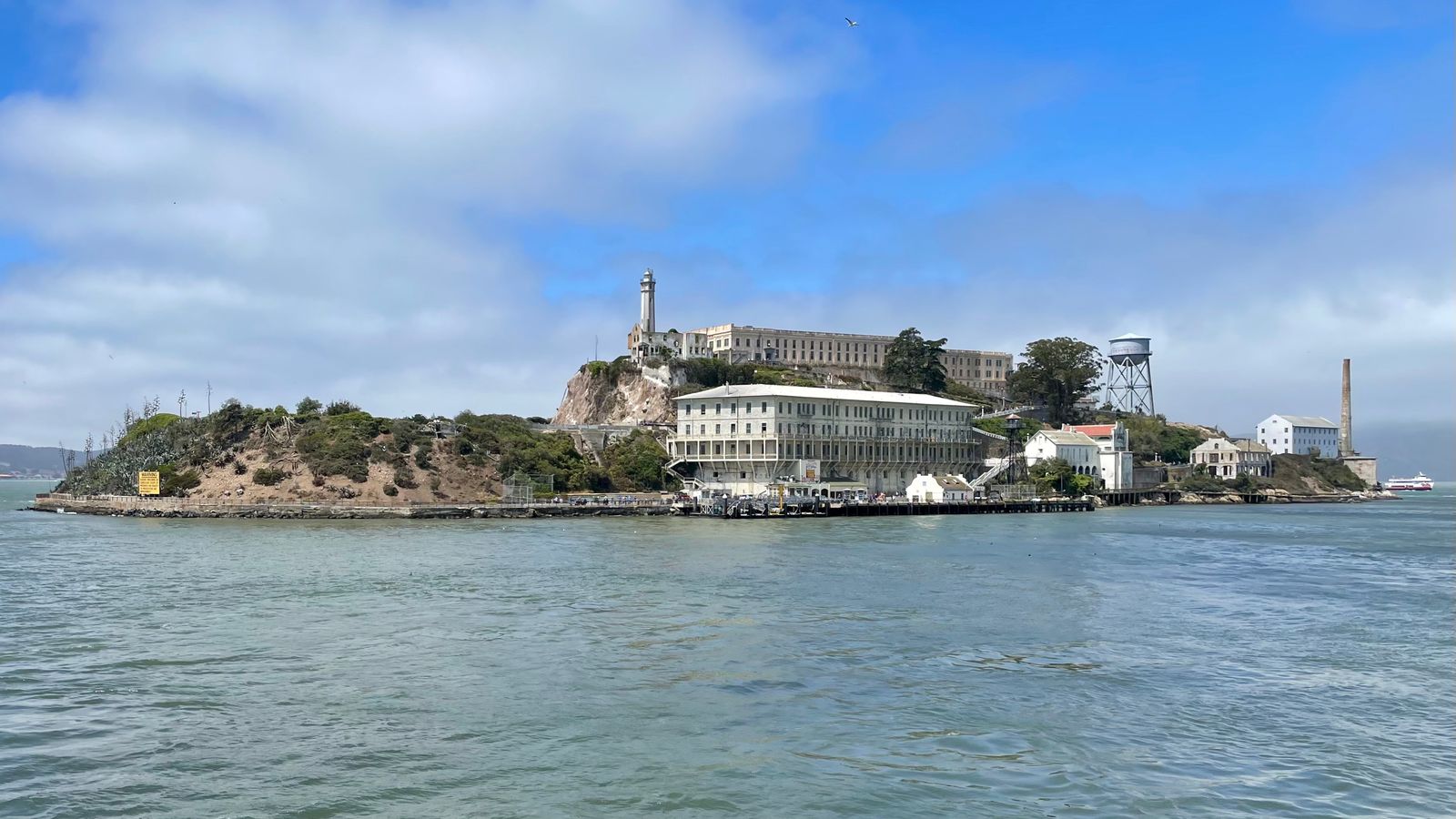
Prison cells, an isolated, rocky island, freezing cold waters and man-eating sharks. It’s no surprise that Alcatraz Federal Penitentiary was where the troublemakers, the bad apples, the worst of the worst were sent. Al Capone, Whitey Bulger and Machine Gun Kelly—no, not that one, the original one—all served time on the small island.
With a reputation as America’s strongest prison to uphold, the guards made sure that the inmates served their sentences in barren cells or solitary confinement. No-one would be smart or, maybe, stupid enough to try and escape as if they managed to get out of their cells, they would still have to escape the heavily guarded prison and reckon with over a mile of the rough waters of the San Francisco Bay. To this day, nobody has officially been given the title of having escaped from Alcatraz but is that really the case?
Alcatraz
Here’s a brief history of Alcatraz Federal Penitentiary, or “The Rock” if you prefer although please note, I am not going to be referring to it as “The Rock” going forward as I don’t want to sound like a total douchebag.
Key Takeaways
- Alcatraz, known as America’s strongest prison, housed notorious criminals like Al Capone.
- The prison had a strict rule of silence in the 1930s, leading to mental health issues among inmates.
- There were 14 escape attempts from Alcatraz, with the most famous involving Frank Morris and the Anglin brothers.
- The waters around Alcatraz are cold and have strong currents, making escape attempts dangerous.
- The mystery of the Anglin brothers’ escape from Alcatraz remains unsolved, with evidence suggesting they may have survived.
The name “Alcatraz” came from European explorers mapping the San Francisco Bay area in the late 1700s and is believed to be derived from the old Spanish word for “pelican” as presumably it used to have loads of pelicans on it. It doesn’t any more. The United States officially got their hands on it in 1846 when John C.
Frémont bought it for $5000, or about $150,000 today, adjusted for inflation. I don’t really know if that’s a good deal for a 22 hectare (9 acre) rocky island covered in pelican poop but it certainly didn’t turn out to be a good deal for Frémont who got totally screwed over by the US Government when they decided it would make a good place to put a military fort. They paid him zero dollars for it and even after decades of legal wranglings, his family was never able to claim a penny from the sale.
The West Coast’s first lighthouse was built on Alcatraz Island in 1854 and the first soldiers arrived at the fort in 1858. Not long after, military prisoners and civil war POWs started being held on the island and by 1868, Alcatraz had officially switched from being a military defence outpost to being a detention centre for military prisoners. In 1909 the main, recognizable cell block was built as well as a new lighthouse tall enough to be seen over the new buildings.
In 1934, Alcatraz was designated as a general federal prison and in the following 29 years that it was open, it was home to over 1,550 prisoners as well as all the prison staff who lived with their families on the island too.
Alcatraz seemed to be a weird mixture of ultimate punishment and relative comfort with men sent there who were considered too much trouble at other prisons but once there, they had the luxury of individual cells and pretty good food compared with the rest of the prison system. It had a capacity of 336 but the most prisoners it ever held at one time was 302. That’s not to say that it was a fun place to be, of course.
Although the practice was only used in the 1930s under Warden James A. Johnston, inmates were routinely subjected to a rule of total silence and only allowed to talk to each other during recreation periods and to order food at mealtimes. This did nothing for their mental health and many prisoners ended up using their cell’s plumbing pipes as rudimentary telephones when the oppressive atmosphere got too bad.
The rule was said to have driven men insane and one inmate supposedly chopped off some of his fingers to get a transfer. Anyone caught breaking the rule was punished with solitary confinement in one of the prison’s notorious D-block cells or what was known as the Dungeon, the underground remains of earlier buildings. Once tales of this treatment eventually started filtering out, this simple rule of silence was considered so inhumane that the US Attorney General wanted to shut the whole prison down.
Warden Johnston agreed to relax the rule and by 1940, prisoners were allowed to hold conversations whenever they wanted, albeit quietly.
The cells in Alcatraz were small, but as we said previously, single occupancy. In the main block they measured 5 feet by 9 feet or 1.5 by 2.7 metres and were only about 7 feet or 2.1 metres high. They consisted of 3 solid walls with the front wall being the cell door.
As these were made of bars, there was no privacy in the cells which also had a toilet, small basin, desk and bed squeezed in. There wasn’t a way for inmates to individually pick the locks on their cell doors because there weren’t any locks. The doors were operated by levers at the end of the row of cells that the prisoners couldn’t reach.
All the cells were enclosed inside the prison itself meaning that none of them had a back wall leading to the open air. There were gun galleries at each end of the rows of cells and guards regularly patrolled the main corridors which were ironically named after famous streets such as Broadway and Park Avenue. Outside too there was a strong guard presence with lookouts for both the prisoners and also to make sure that unidentified craft on the water didn’t come within 300 yards (274 metres) of the island.
And what about the man-eating sharks patrolling the waves just waiting for someone to try their luck? There are sharks in the San Francisco Bay with the most common being the not at all dangerous Leopard Shark. The rest are small and generally stay at the bottom of the water.
Great whites don’t venture into the bay that often although they have been documented passing through. Salmon sharks, which look pretty similar to great whites, are more common in the area but do not have a history of attacking humans. Either way, it seems that any tales of “shark infested waters” around Alcatraz have just been hugely exaggerated to add to the mythos of the inescapable prison.
The water by itself is a far more dangerous proposition than meeting a shark. It’s cold and has strong currents that would quickly tire out inexperienced swimmers. If any of the inmates did attempt to swim to freedom, they’d have over a mile to go.
Escaping The Rock
If many people, some known to be habitual jailbreakers, are sequestered away on an apparently inescapable island prison in the middle of the sea, you can bet your life some of them are going to try and escape, even if it’s just for the kudos. Officially, nobody has ever escaped from Alcatraz. I would argue that this is semantics. What does “escape” actually mean?
We’ll go over some of the attempts in a minute but surely if a prisoner managed to leave the island that counts as escaping even if they were recaptured or died. Those authorities are sticking by it, though, and just concluded that in the most contentious escape attempt, the men merely drowned. Don’t worry, we’ll be coming back to that one, it’s kind of the whole point of this story. First, let’s look at a few of those other escape attempts.
In all, 14 attempts were made over the course of Alcatraz’s 29 years as a federal penitentiary. That’s almost 2 a year which is pretty good going for a place with such a fearsome reputation. The first escape attempt happened in 1936 when Joe Bowers just decided he’d had enough one day and started climbing the prison’s chain link fence. After ignoring warnings from the guards, he was shot and fell down to the shore below, dying from his injuries.
He made it over the fence, though, and even with his totally low-rent approach, it counts as an escape in my book. Although admittedly my book does have pretty low standards.
The first people to brave the waters were Theodore Cole and Ralph Roe who succeeded, in 1937, in breaking out through a window of a building they’d been working in. Unfortunately they picked a bad day to do it as there was a storm happening at the time and the waters would have been treacherous. Their bodies were never recovered and they are presumed dead which I think I agree with in the circumstances.
The award for my favourite escape attempt goes to John Giles in 1945. For his prison job he worked at the loading dock and one of his tasks involved unloading army laundry that was sent for cleaning on Alcatraz. Eventually Giles managed to steal enough pieces of clothing to make up a full Army uniform and one day he got all dressed up and stowed away into the Army boat heading back to the mainland. Or so he thought.
Unfortunately, the boat didn’t go to San Francisco but rather to Angel Island, another small island in the Bay. Because Giles’s disappearance had already been flagged, a speedboat had been despatched to bring him back. He managed to disembark the Army boat but his uniform wasn’t quite right so his cover was quickly blown. He was recaptured and returned to Alcatraz.
Boo!
The final escape attempt before the prison was closed was in December 1962. John Paul Scott, who made up half the Beatles on his own, and Darl Parker climbed out of a basement window and headed for the water. Parker managed to break his ankle during the escape and was quickly apprehended on some rocks nearby but Scott tried to swim to freedom.
He had fashioned some rudimentary buoyancy aids by blowing up some washing up gloves but that was about as prepared as he had got. He was at the mercy of the currents and the cold water and wasn’t found for about 2 hours when some teenagers found him washed up and unconscious under the Golden Gate Bridge. Again, this sounds like a successful escape to me.
He made it out of the prison, off the island and to the mainland, whether by swimming or by sheer luck, he still made it. He was taken to hospital and, once recovered, was sent straight back to Alcatraz. Nowadays there are regular swim events to and from Alcatraz with the youngest person to swim there and back being 9 years old.
The oldest person to make the swim from Alcatraz did it on his 87th birthday so it doesn’t seem like that much of a big deal after all.
The Great Escape
OK, now we’ll move on to the most audacious escape of them all and the mystery surrounding the outcome. It’s time for Frank Morris and the Anglin Brothers.
I don’t know if you’ve seen the 1979 movie “Escape From Alcatraz” starring Clint Eastwood. I have not but it’s worth pointing out that while it’s based on this escape attempt, it’s also dramatised so is not a totally accurate version of events. It is also worth saying that there is no 100% totally accurate version of events.
While it’s been possible to work out various aspects of the escape, once the inmates reached a certain point, nobody can say for sure what happened next. Indeed, much of the detail was provided by only one man, Allen West, who might have been hyping up his own level of importance in the plan or just telling people what they wanted to hear to gain some sort of respect or leniency on his sentence. With that being said, let’s get into what probably happened.
This escape, number 13 out of the 14 attempts, was by far the most well-thought out and well planned. Serial ne’er-do-well and actually very intelligent person Frank Morris was the leader of the group, along with brothers John and Clarence Anglin who were known for previous escape attempts at other prisons, and the aforementioned Allen West. Frank Morris and the Anglins did already know each other from previous jail stints so were familiar with each other’s very particular set of skills.
The Anglins were in adjacent cells which was not an unusual arrangement for the sake of keeping the peace, and Morris and West were also next to each other. Over the course of several months starting in December 1961, the group used things such as old saw blades they’d found and other makeshift tools and managed to dig out and enlarge the vents in the back wall of their cells. They worked on these every evening from about 5.30 to 9pm with one sawing away and the other on lookout.
As the holes got bigger they covered them over with painted cardboard. If you remember from earlier, I said that all the cells were housed inside the main walls so chipping through wouldn’t lead you to the outside of the prison. That’s true but what the cells DID back on to were narrow utility corridors which were closed at both ends and not patrolled.
Once they had successfully broken through to the corridor, Morris and the Anglins—who now sound like a 70s music group—started work on breaking through a vent that led to the roof. To help their work go faster, the men came up with all sorts of ingenious tools such as drills made from electric hair clippers and vacuum cleaner motors but these ended up either not being effective enough or just a bit too loud to use.
In another strand to this plan, the group had also managed to amass a large number of prison raincoats, either as donations by other inmates or just by nicking them. They had over 50 raincoats which, by also using purloined glue and hot air vents to seal them, they managed to make into a 6 ft by 14 ft or 1.8 metre by 4 metre raft. There was even enough left over to make some pretty sweet life jackets.
They were working on and stashing all this stuff above their cells, by the way, in an empty area accessible from the utility corridor. But how were they working on these things without their absence being noted? Well, in yet another strand to the plan, they also constructed dummy heads out of anything they could get their hands on including toilet paper, toothpaste, soap and cement powder.
They used paint from prison supplies to give them a slightly more lifelike colour and even managed to snag hair clippings from the prison barber to stick on to the tops. While these dummy heads have been described as “crude”, I’m pretty impressed and doubt I’d be able to do much better with actual real art materials, let alone random bits and bobs I’d managed to cadge from bathrooms and barbershop floors. They also obviously worked as they weren’t discovered to be dummies until after—spoiler alert!—the men had escaped.
At 9.30 pm on the 11th of June, 1962 after 6 months of preparation, it was decided that the time was right to make the escape attempt. Morris and the Anglins planted their trusty dummy heads in their beds, crawled into the utility corridor and covered up their escape holes with the painted cardboard. Unfortunately for Allen West, he hadn’t needed to leave his cell to make the rafts and stuff as he’d been tasked with smaller items such as the paddles and life preservers.
I’ve seen a photo of a recovered life preserver or jacket and West did some really neat work. Because of this, however, he hadn’t spent as much time trying to break through the back wall of his cell so he couldn’t get out. Clarence Anglin did try and kick the vent out from the corridor side but couldn’t manage it so poor old Allen West was left behind as his three friends climbed into the night, and the history books, and disappeared.
Because the only witness to the events so far was now stuck in his cell, we can only speculate on what happened next. Gathering their raft and supplies, Frank Morris and Clarence and John Anglin climbed on to the roof of Alcatraz prison and made their way across and eventually over the fence and down to the shore. Using some bellows made from a modified concertina which was similar to an accordion, they inflated their raft and pushed out into the water.
According to West, the original plan was to paddle the raft to Angel Island first which was about 2.4 miles (3.8 km) north of Alcatraz. From there they would head to Marin County via the Racoon Straits, steal a car and some clothes and head off into the sunset. So did they make it?
Therein lies the mystery. Allen West did eventually manage to bust out of his cell later that night but without anyone to help him climb up to the roof and with no raft, his chances were totally blown so he sheepishly tiptoed back to his cell and went back to bed. In his future reports to the authorities, on the condition he wasn’t punished for the escape attempt, West painted himself as the mastermind of the whole operation although I think it’s even more embarrassing that he was the only one not to make it out of his cell if he was so smart.
In the movie, Escape from Alcatraz, the main characters use the real names of Frank Morris, John Anglin and Clarence Anglin. Allen West is represented but out of all the names in the world they could have given him, his character is called Charley Butts which seems like a pretty disparaging burn.
Watch Now
Open Video
Video Briefing
Did Anyone Escape Alcatraz?
The dummy heads and therefore the missing men weren’t discovered until 7.15am on the 12th of June, giving them about 10 hours headstart. The FBI were called in almost immediately and although in the first two days they found some sealed-up personal letters relating to the Anglins and some debris from a home-made paddle, no substantial evidence or any bodies were found. On June 21st, what is believed to be the tattered remains of the raft were found and a life preserver also washed up the day after but these could have been discarded after the men had already landed somewhere.
The FBI worked on the case for 17 years until the 31st of December, 1979, when they officially closed their investigation and turned it over to the US Marshals Service. The FBI thought the men had probably drowned in the waters of the Bay and never made it to shore as no trace was found of them over the years. They also decided that the packet of family info the Anglins had made was so valuable to them that “the men would have drowned before leaving them behind.”
Erm, really? That’s what you base the case they died on? Maybe the package just fell out of someone’s pocket or it wasn’t really that valuable and the Anglins left it behind intentionally as a red herring or just thought “sod it” and kept on with the more important task of rowing to freedom.
The US Marshals Service still lists Frank Morris, Clarence Anglin and John Anglin as wanted fugitives and their case is still open despite the escape happening almost 60 years ago. Apparently the case will close in 2030 when all the fugitives will be over 100. What a birthday present, maybe they’ve been hanging on and will finally all pop out of the woodwork to enjoy some very limited time as free men.
So did they all drown before even making it to their first stop at Angel Island as the FBI thought? This is by no means conclusive. As proved by 9 year olds and 87 year olds, it is more than possible to swim all around the islands in the Bay area.
These men were in decent shape, were no strangers to swimming, had inflated life jackets and a raft with paddles. They were also hell-bent on escaping which tends to give impetus to whatever you happen to be doing. According to recent digital recreations of current patterns and virtual raft-launchings, if the trio had got into the water at about 11.30pm which definitely meshed with their known timeline, they would have had a fairly easy ride up past the Golden Gate Bridge and what’s more, if they’d abandoned everything in the water when they made land, the currents would have washed it all up back on Angel Island which is where it was found.
Just as compellingly though, the computer model also showed that if the raft had been launched prior to 11pm, again within the probable timeframe, they probably wouldn’t have been able to handle the current and would have been carried out to sea. There have been many reports of a raft found on Angel Island with footprints leading away from it but that is literally all the information we have about it. It was in a typed FBI report with no follow up, pictures or actual evidence to go with it.
The raft wasn’t actually there, only shreds of it were found. If the men had followed the original plan and made it to Angel Island, this would prove they landed there. If they caught a different current they could have bypassed Angel Island altogether and gone straight for the mainland, meaning that the footprints were not theirs and were just coincidentally close to where their debris washed up.
The lack of bodies is also kind of a point in their favour although at least two other escapees drowned without their bodies being recovered. People known to have jumped from the Golden Gate Bridge have also never been found, despite recovery operations being quickly launched. The currents really can be treacherous and if you’re caught in one and end up being pulled out to sea, the chance of rescue or recovery are very slim.
There was a body found floating after the escape in what was apparently the prison garb of shirt and denim trousers although it wasn’t spotted until over a month later and the boat that spotted it didn’t get that close and didn’t even report it until October. What a lead. By the time it was recovered, it had deteriorated to the point of no longer being identifiable, if it was even the same body at all.
While some people thought it must be one of the three, others thought it might be the body of a much more recently deceased man, and that it was unlikely that a body would still be floating 4 months later. The jury’s out on that one.
It’s also unlikely that the men had any outside help, like a boat picking them up or a rendezvous with a friend or family member. For one thing, it would be almost impossible to arrange anything like this being stuck on a rock and all. Also, they seem to have decided on the spur of the moment to make their escape that night, meaning that if anyone was enlisted to help them, they would have been hanging around every night for a long time waiting for the men to make their move.
Unknown boats weren’t allowed anywhere near the island and the Anglin family who were farm workers based in Florida didn’t have the ways or means to help their brothers out. Morris was an orphan with no other family to call on and even if they did have associates willing to help out, the three had been moved to California, far away from their previous networks.
So what other evidence do we have for their survival apart from just hoping that these scrappy underdogs managed to stick it to the man? Yes, I know they were all pretty hardened criminals but after all that effort you’ve got to root for them a little bit.
There were several sightings over the years, including a tip that Clarence Anglin was living it large in Brazil in the mid 60s. The FBI did even go and check this out, or maybe it was just a thin excuse for a holiday, but nothing came of the sighting.
The Anglin family was extensive, with Clarence and John being two of 13 or 14 children. Their mother played down their place in her affections by bemoaning their criminal activities but it may just have been a facade to keep their whereabouts a secret. At the beginning of the search, the Anglin family was, understandably, under huge scrutiny and pressure from the FBI.
They probably didn’t have anything to do with the escape attempt or much knowledge of where the men were but if they did, they certainly didn’t spill it. As the years have gone by, however, it seems that they are more amenable to getting the record set straight. A few members have said that Clarence and John’s mother received roses and signed cards from her missing sons over the years and that as a family, they all believed the brothers had successfully escaped.
There was even a Christmas card sent to their mother the first year they escaped, signed by John. There were rumours of a suspiciously disguised pair turning up at the funerals of both their mother and father but presumably nobody snitched on them at the time. One of their other brothers, Robert, apparently admitted on his deathbed that he had been in touch with both Clarence and John a few times when they were on the run and John’s nephew, David Widner, has been quoted as saying “We have a lot inside the family that we haven’t shared.”
How infuriating! But it does give a spark of hope to the survival theory.
The FBI tried to pour more cold water over the escape by saying that no cars had been reported stolen in a 12 day period after the escape in the area they were looking in but a documentary made by National Geographic in 2011 said that a car was reported as stolen the morning the escape was discovered and this was backed up by reports in at least two newspapers at the time.
Another tick in the “survived” column is that a friend of the Anglin family, Fred Brizzi, claimed that he had met up with the Anglin brothers in Brazil in 1975 and had a photo to prove it. In the picture, which from the shirts they were wearing could only have been taken in the 70s, two men wearing sunglasses are standing on either side of a termite mound. A bit odd.
But these were apparently Clarence and John Anglin in the flesh and expert photo analysis carried out since has confirmed that the photo is a genuine one from the 1970s. As recently as 2020, advanced facial recognition technology was used on known photos of the Anglins and compared with the men in the photo. The result?
The company that ran the project, Rothco, has said that as far as they are concerned, the men in the picture were most definitely the Anglins. So why hasn’t this been settled once and for all? Well, old Fred Brizzi had form as a con man and was well known to tell tall tales.
His own wife had never heard the story of when he met up with the famous escapees in Rio so maybe he was just making it all up although the photo for me at least is quite strong evidence. It didn’t even surface until 2015 as Brizzi may not have wanted to cause trouble for his friends so didn’t send it on to their family for many years. Also, while photographic evidence may be enough in some cases, it could still be two men who just bear very strong resemblances to future versions of the Anglins.
Stranger things happen all the time. They are wearing sunglasses in the photo which might throw off the facial recognition software a bit and the picture is not the clearest it could be. And of course the company carrying out the project would be courting as much publicity as it possibly could.
Also, the picture is all there is. There’s no conclusive DNA evidence or written confessions to go with it.
In 2013, the police in San Francisco received a letter, purportedly from John Anglin himself. In the letter he says that when they made the escape, they all barely made it to shore and that Frank Morris had died in 2005 and Clarence had died in 2008. He also said he was 83, had cancer and needed treatment so threw a deal out there of turning himself in, in exchange for a maximum of one year in jail and medical treatment.
The letter was not made public for years and the US Marshals sent it to the FBI for forensic and handwriting analysis. The results were not conclusive but John could have had someone else write it for him and also, a person’s handwriting probably changes a bit over the course of 5 decades. If it wasn’t him but just some canny old cove trying to get healthcare in exchange for a year of free living and three square meals a day, well, more power to him.
It really says something about the US healthcare system that people are prepared to spend a year in jail in exchange for getting treated for an increasingly common illness. The claim wasn’t investigated any further and nobody, John Anglin or fake John Anglin got taken up on the offer.
Several people have confessed to helping the trio carry out their escape over the years but they have all been dismissed as just lies, basically. With no concrete evidence for or against the three having made it, it’s all just extra noise at this point.
While it does seem at least possible that the group could have made land and driven off into the sunset, what does make it slightly less probable is that they were just never heard from again. They were wanted men, their faces were everywhere and they had all been lawbreakers from a very young age. Sure, they had the best reason to stay under the radar for a while but would they really be able to keep their noses totally clean for the rest of their lives?
Maybe heading to another country would have afforded them the extra layer of anonymity they needed. While they may have been familiar faces in the US, laying low in Brazil in a time before everyone had a camera and phone in their pocket would definitely have been a simpler proposition than it would be today.
There haven’t really been any leads or credible sightings regarding Frank Morris but if the letter is to be believed, he also survived and kept in touch with the brothers until his death in 2005.
Officially, Frank Morris, Clarence Anglin and John Anglin are recorded as “missing and presumed drowned” by Alcatraz records but I think there’s more than enough stray threads to cast doubt on the official version. And it does seem that the Feds were just a bit useless in this instance, especially if the photo of the brothers in Brazil is actually them. They got the Brazil tip years earlier but failed to find any trace of the escapees. So maybe they chalked the whole thing up to a presumed drowning to save face rather than admit they were outwitted by three men and a bunch of raincoats.
In 1964, shortly after the amazing escape and John Paul Scott’s swim to almost freedom, Alcatraz was closed due to high running costs and crumbling infrastructure. In 1969, in a rare show of unity, protest group Indians of All Tribes occupied Alcatraz for over a year and a half, bringing attention to Native American issues, sparking activism movements and calling for the island to be returned to the Native Americans now that it was no longer being used. As time went on, accidental deaths and in-fighting spelled the end for the protest as well as the government cutting off power to the island. It officially ended in June 1971.
Alcatraz became part of the Golden Gate National Recreation Area in 1972 and opened to the public as a tourist attraction in 1973. Thanks to its rich history, it became a National Historic Landmark in 1986. Now you can visit the Island by ferry and see for yourself where John Anglin cut his way out of his cell and possibly into a new life. I have to say that while it started off as wishful thinking that the men might have made it after all their careful and ingenious planning, with the new evidence that’s been trickling out from the Anglin family and the discovery of that photo, Alcatraz may have to grit its teeth and finally mark a “3” in the escaped column after all.
Simon Whistler
Simon Whistler is one of YouTube's most prolific educational creators. Decoding the Unknown is his methodical investigation into the world's strangest phenomena — examined with rigour, curiosity, and a healthy dose of scepticism.
Frequently Asked Questions
What was the name of the prison on Alcatraz Island?
The prison on Alcatraz Island was called Alcatraz Federal Penitentiary.
How many escape attempts were made from Alcatraz?
There were 14 escape attempts made from Alcatraz over the course of its 29 years as a federal penitentiary.
Who were the most famous inmates of Alcatraz?
Some of the most famous inmates of Alcatraz included Al Capone, Whitey Bulger, and Machine Gun Kelly.
What was the most well-planned escape attempt from Alcatraz?
The most well-planned escape attempt from Alcatraz was led by Frank Morris and the Anglin brothers, John and Clarence, in 1962.
What happened to the inmates who tried to escape Alcatraz?
Officially, nobody has ever escaped from Alcatraz. The authorities concluded that the inmates who attempted to escape either drowned or were recaptured.
What was the rule of total silence in Alcatraz?
The rule of total silence was a practice used in the 1930s under Warden James A. Johnston, where inmates were only allowed to talk during recreation periods and to order food at mealtimes. This rule was considered inhumane and was eventually relaxed.
What was the capacity of Alcatraz Federal Penitentiary?
Alcatraz Federal Penitentiary had a capacity of 336 inmates, but the most prisoners it ever held at one time was 302.
What was the size of the cells in Alcatraz?
The cells in Alcatraz measured 5 feet by 9 feet (1.5 by 2.7 metres) and were about 7 feet (2.1 metres) high.
What happened to Alcatraz after it was closed as a prison?
After Alcatraz was closed in 1964, it was occupied by the protest group Indians of All Tribes in 1969. It became part of the Golden Gate National Recreation Area in 1972 and opened to the public as a tourist attraction in 1973.
What was the significance of the 1962 escape attempt from Alcatraz?
The 1962 escape attempt led by Frank Morris and the Anglin brothers is considered the most audacious and well-planned escape from Alcatraz. The mystery surrounding their fate has led to speculation that they may have successfully escaped.
Sources
- Original Decoding the Unknown video: Did Anyone Escape Alcatraz?
- Hero image source by Chris6d / openverse, by-sa.