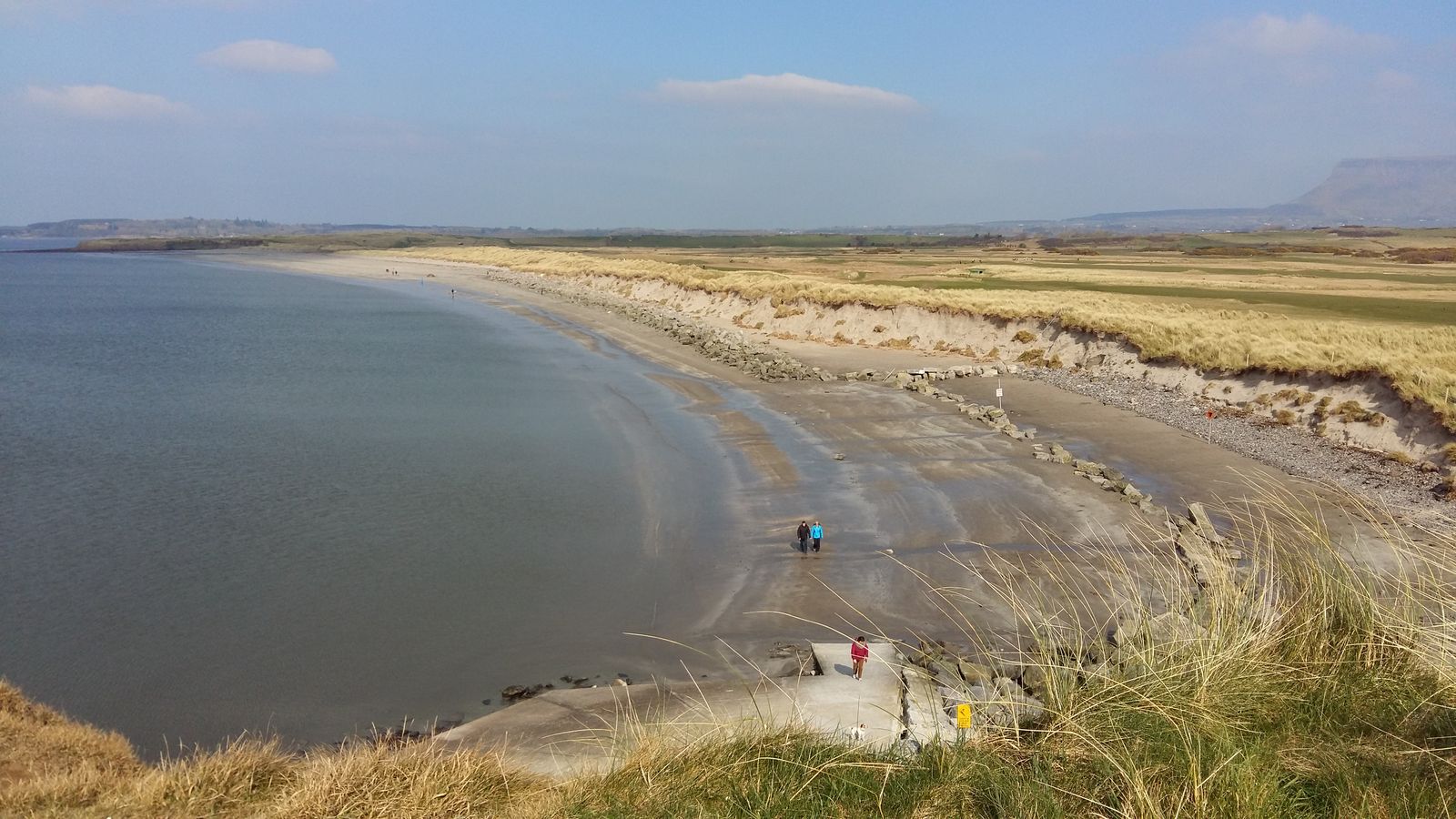
On the morning of the 16th of June 2009, a father and son out for an early morning swim found the body of a middle aged man washed up on the beach at Rosses Point in County Sligo, Ireland. After being pronounced dead at the scene at about 8.10am, the man’s body was taken to the Sligo University Hospital morgue where an autopsy was performed the following day. No identification was found on or near the body and the man was later buried in an unmarked grave in Sligo. Thanks to CCTV footage, we have copious amounts of video evidence of this man and his last few days alive but they just serve to provide more questions than answers.
Who was he? How could he leave no trace of himself? And what was in his mysterious purple plastic bag?
Yes, it’s a tale that’s highly reminiscent of the Tamam Shud / Somerton Man case. In this article, let’s try and decode the modern day mystery of the man who called himself Peter Bergmann.
Key Takeaways
- A man known as Peter Bergmann was found dead on a beach in Sligo, Ireland, in 2009.
- Bergmann’s identity remains unknown despite extensive CCTV footage and investigations.
- He had advanced prostate cancer and died from acute cardiac arrest.
- Bergmann’s actions suggest he intended to disappear and end his life.
- His case highlights the challenges in identifying individuals who go to great lengths to remain anonymous.
The Strange and Sorry Tale
If you’re not familiar with this story, there will be lots of talk about suicide later in this article so just a heads-up if you need one.
The first confirmed sighting of our mystery man is when he arrived in Derry by bus on Friday the 12th of June, 2009. He then caught another bus to Sligo, a large and popular beachside town in the Northwest region of Ireland. From there, he got into a taxi and asked to be taken to a cheap hotel. When the first option was found to be full, he carried on to the driver’s next suggestion, the Sligo City Hotel. You can see him coming in on the hotel’s CCTV.
The man entered with a black shoulder bag, carrying another black bag in his hand. Here he paid in cash for a three-night stay and gave his name as “Peter Bergmann” in the hotel register. He put his address as “Ainstettersn 15, Wien, 4472”. “Wien” is “Vienna” in English, the capital city of Austria. The taxi driver and hotel staff confirmed that Bergmann had a thick German or Austrian accent. Importantly, and apparently against policy, the hotel did not ask him for any confirmation of ID.
On Saturday the 13th of June, Bergmann was seen on CCTV coming and going from the hotel 13 times. Each time he left, he carried with him a purple plastic bag that had things inside it, although you can’t see what they are. Every time he came back, there was no bag to be seen.
He was also seen going to the post office on Saturday where he bought some stamps priced for overseas postage and a corresponding amount of airmail stickers. Sligo has multiple CCTV cameras covering the town and Bergmann is visible walking around the streets, however, he was never caught on camera disposing of the contents of the bag so what they were and where he left them remains a mystery.
On Sunday, June the 14th, Bergmann got in a taxi and asked the driver to recommend a quiet beach for a swim. The driver took him to Rosses Point, about 8km / 5 miles away, where Bergmann got out and took a look around but then got back in the cab and they drove back to Sligo. The taxi driver later confirmed that Bergmann had mentioned he was from Austria.
On Monday, June the 15th, Bergmann requested a late check-out from the hotel. He then went out with the full purple plastic bag again for one last emptying. When he checked out later on, you can see on the CCTV footage that he has the black shoulder bag and the full purple plastic bag again but he doesn’t seem to have the larger black bag he was carrying before, only a smaller one that looks more like a wash bag. He walked to the bus station and by the time he got there and appeared on CCTV again, the smaller black bag had disappeared.
He was next captured inside the bus station, where he ordered the classic “hanging-around-in-a-station fare” of a cappuccino and toasted ham and cheese sandwich. He then took a piece of paper out of his pocket, wrote notes on it and folded it up and ripped it to pieces, throwing the bits of paper into a nearby bin. He eventually got on a bus for Rosses Point, the beach he had briefly scouted out the day before. When asked by the bus driver if he wanted a single or a return ticket, he asked for a single.
The bus arrived at Rosses Point some time in the mid-afternoon and Bergmann got off, taking his bags with him. Several people confirmed having seen him on the beach over the course of Sunday afternoon and evening. He stuck out to them, as most remember him as being quite smartly dressed for the beach in his dark trousers, shirt and leather jacket.
One witness says on the short documentary film “The Last Days of Peter Bergmann”: “He looked almost out of place and out of time”. He was seen walking parallel to the water with his trousers rolled up, pacing up and down. He did respond to brief greetings from fellow beachgoers but according to a different eyewitness, “he did seem to be kind of stooped, hands behind his back as if he was in another world.”
The last confirmed sighting was after 10.30pm with some sources putting it as late as 11.50pm. By this point it was only the fact that it was so late that made anyone remember seeing him.
Peter Bergmann was not seen again until 6.45 the following morning when his lifeless body was found washed up on the beach. He was wearing Speedo-type swimming bottoms but had underwear and a t-shirt on over them. His other clothes, including his leather jacket were found in a folded pile further along the beach. There was no form of ID on the body, just a few coins, some aspirin and a bar of soap from a hotel.
Strangely, every item of clothing had the tag cut off. Bergmann was pronounced dead at the scene and transferred to the Sligo University Hospital morgue.
The Mystery Deepens
You might surmise that a person dressed in swimming gear, albeit with clothes on over the top, and who was found washed up on the sand, probably drowned. In most cases you’d be correct but not in this one. The medical examiner confirmed in the documentary that there was no sign of foul play and “no evidence of, at least externally, of salt water drowning.”
It was found on further examination of Bergmann’s body that he had very advanced prostate cancer and tumors that had spread into his bones and other parts of his body. He had had previous heart attacks too but the toxicology report brought back no trace of any sort of painkiller in his system. The examiner thought this was odd as, due to the cancer, Bergmann was probably in some amount of pain.
He also thought that because of the advanced stage of his cancer, Bergmann probably only had weeks left to live. Bergmann’s official cause of death was given as acute cardiac arrest.
After this sad end, the Gardai (pronounced Gar-dee), the Irish police force, set about trying to identify him. His name was found at the hotel but it was then discovered that no confirmation of his identity had been made. A subsequent search of his name through European and eventually North and South American passport databases brought back no matches to this apparent Peter Bergmann. This led the Gardai to assume he was using a false name.
The Austrian address he’d given at the hotel did not exist. No phone, wallet or any other personal item was ever found. Stills from CCTV footage and artist renderings from his autopsy circulated throughout Ireland and Europe but no family member or friend has ever come forward to ID the man. None of his bags or any of the items he seemed to hide away throughout Sligo were found.
Peter Bergmann, it seems, is a ghost.
The Aim of the Trip
One of the few things we do know about Bergmann, as I’ll have to keep calling him, is that he was not from Sligo. One of the few other things we can probably surmise from his behaviour is that he went to Sligo with the intention of ending his life there. We know he was not from Sligo as he was seen traveling there from Derry and didn’t seem familiar with the layout of the town.
One of the many dead ends to his trail is that nobody seems to have worked out where he came to Derry from. If he came from outside of Ireland, which seems likely given his accent and assertions that he was Austrian, surely he would have needed to show some ID to get there from anywhere else in Europe. He may have been in Ireland for longer than people realized, though, and just went to Derry and then on to Sligo in June.
I have no idea how far back authorities looked for incoming travelers but maybe it just wasn’t quite far enough.
And why was he in Sligo in the first place? Basically everything I say from now on is almost total speculation but everyone who interacted with him and the police investigators afterward concluded that it was likely he had gone there with the intention of killing himself. Knowing what we know from his autopsy report, there is no way that he wouldn’t have been aware that he was very sick.
He had had at least two heart attacks previously and a worker at the bus depot who Bergmann asked about a bus to Rosses Point did say that he looked like he was in pain or some sort of stress. Having scouted out the beach the day before, Bergmann checked out of the hotel and, after ditching another bag somewhere, spent all day wandering up and down the beach, perhaps waiting for high tide and for no-one to be around. Having taken the care of not leaving any identifying features anywhere in the hotel, town or even his own clothes, he set out to disappear into the Atlantic.
There are branching theories for what happened next. First, he meant to be swept out to sea, never to be recovered. This could have been a whim or maybe, as many people have speculated, it was to do with insurance or tax reasons. No medications were found in his toxicology report, meaning that he wasn’t taking anything for his cancer.
With potentially only a few weeks left to live, he took the matter into his own hands and went out in a peaceful way in a beautiful place. Maybe he had visited Sligo before or maybe he had picked a random coastal town on a map but maybe the thought of enduring a few more weeks or months of pain was too much. There might be pay-out implications for life or health insurance in some countries in the event of suicide, so going missing to be declared legally dead in the future might have been one way round it for Bergmann.
Another theory is that he did actually die coincidentally when he was trying to kill himself. His cause of death was not drowning but cardiac arrest or a heart attack. He was wearing a swimsuit, albeit with underwear and a tshirt when he was found so maybe he was venturing out or coming back in, had a heart attack and died. Due to the tides, he was found close to where he started.
If this was the case, he left everyone with a mystery for no real reason. Unless, and this is the third theory, he wanted to go out with some sort of a bang and intentionally create a mystery for people to solve, whether he meant for his body to be found or not. There are so many threads that could lead to his identification but, as we’ll discuss a bit later, does this mean that we should pull them?
The Name and Address
We’ve been calling this man “Peter Bergmann” as that’s how he registered at the hotel. No apparent match to a Peter Bergmann of his description or age was found in passport databases or whatever the police searched at the time. It seems very odd that the hotel did not ask him for any confirmation of identification. This isn’t really addressed by the hotel in the documentary, they just say they would have asked him for some details.
I guess if he was paying cash in advance it may not have been necessary? He had no reservation and just walked in, ready to pay for his three nights. Is it even necessary to give a name at all? How do celebrities do it?
They’re always checking in under false names so who’s providing the corroboration there?
And this leads on to the address he wrote. It’s been given as “Ainstettersn 15, Wien, 4472”. This is not the correct postal code for Vienna or indeed anywhere in Austria and the street name also doesn’t make sense. I wasn’t able to find an image of the original entry he wrote but handwriting and possible variations on the word aside, there is no such place.
Did Bergmann just write any old crap down or was there a clue in there somewhere? He mentioned to at least 2 people that he was Austrian which obviously matches the address but that could have been a red herring. How many Austrians do you know, if you’re not from Austria? Would you be able to tell the difference between a German and Austrian accent in isolation from each other after just a brief conversation?
My point being, we only think Bergmann was Austrian because he said he was.
The Purple Plastic Bag
Watch Now
Open Video
Video Briefing
The Mystery of the Peter Bergmann Case
A lot has been made of the fact that Bergmann is never once caught on camera disposing of any of his possessions, yet we know he went out with full bags and came back with none. The Gardai are of the opinion that he was getting rid of all of his personal possessions around town, making it more or less impossible to find out any more about him. Is this true, though?
When Bergmann arrived in Sligo, he had 2 bags, neither of which were that large. If he was only staying for 3 nights, he probably had a few changes of clothes, some toiletries, etc. He was seen leaving with a full purple plastic bag at least 13 times over the course of Saturday and Sunday.
To me, that seems like more than enough times to get rid of whatever he might have had in his luggage. And why would he have waited until checking into a hotel at his final destination to start dumping all his stuff? Why hadn’t he done it sooner in the trip?
Maybe he had and these bags were all that were left.
It seems a bit odd that he would go around town throwing away or hiding whatever was in the bag to hide his identity. If I were doing the same thing, I’d maybe still have a passport or drivers licence for emergency purposes and that would be about it. None of my clothes have my name stitched in them and anything else, I would have ditched before leaving or just left in my house. We don’t know who he is so his last place of residence has never been found.
So what could all that stuff have been? Why would you go around throwing away clothes or toiletries that couldn’t identify you anyway?
There is a pretty depressing theory that Bergmann was carrying out things that might be considered embarrassing, such as adult diapers. Remember, he was in the advanced stages of prostate cancer and this can render people incontinent. I know he made a lot of trips out but I really don’t know how often you’d need to change these and to me, it does actually make sense.
He didn’t want hotel staff to see them so he took them out in his purple plastic bag and disposed of them elsewhere such as a public bathroom. Of course the Gardai did search through the trash, public areas, car parks and gardens of properties Bergmann was seen near in Sligo but if you have no idea what you’re looking for, how are you going to know if you see it?
Because Bergmann was never seen emptying the bags, people have theorized that he had police or spy training or some sort of knowledge of the cameras around. According to Detective Superintendent John O’Reilly, “CCTV cameras are highly visible all over Sligo town”. Well, to me, this means that if you can see where the cameras are, you can also see where they are not. As previously mentioned, he may have been popping into a bathroom to dispose of sanitary products and the police aren’t going to take any notice of that if they find it in the appropriate waste container.
If we subscribe to the theory that Bergmann was intentionally creating a mystery, the bag does come into play here as it’s very distinctive. Seeing him carrying a purple bag is a very easy way to pick him out in surveillance footage so as soon as he gets rid of it, it makes him harder to find. Maybe there’s more footage of him that hasn’t been found because he lost the distinctive marker.
He’s never seen carrying an empty bag, it’s either full or it’s not visible. He probably stuffed it in his pocket as at least one of 13 purple plastic bags would definitely turn up at some point during the police search. Or maybe he had a bag full of weird junk and was compulsively strewing it around a foreign town for no other reason than he was having a mental breakdown brought on by stress and illness.
Nobody connected to the investigation seems to think he was suffering from any kind of mental illness, though.
The one thing he was seen throwing away was a note or piece of paper he had at the bus station. We see Bergmann opening it, and then refolding and tearing it up. Unfortunately, by the time this footage was found, it was several days after the investigation began so the contents of the bus station bin were long gone.
The Trip to the Post Office
Bergmann went to the post office and purchased stamps and airmail stickers on Saturday. It has since been confirmed that he did in fact post some letters but apparently the footage from the post office was accidentally corrupted so there is no current video proof of this. Him mailing letters, though, adds a whole other dimension to the case. Who were these letters to?
Were they to family and friends explaining his decision and asking them to keep his identity secret to further the mystery or for the insurance or just very personal reasons? If so it is still a pretty sad ending as he was buried in an unmarked grave that can hold 3 bodies and he’s currently the second occupant. His funeral was attended by 4 members of the Gardai and the 2 funeral officiants.
If they were personal letters rather than, say, charitable donations or boring admin stuff, he still may not have given enough information for the recipients to have put two and two together to recognise him from the police campaign. The letters may have gone to people in countries where this story got little or no coverage. While it was big news in Ireland, it didn’t seem to cause much of a wave outside the country.
Irish police say they contacted Austria and German authorities over the unidentified man, but Austrian officials later claimed that they had not been aware of any official information requested by the Irish police force. It may be that family and friends just never saw the appeals. This was in 2009 though, with the images available freely online.
It seems strange that nobody at all came forward to claim they knew Bergmann. If the letters were mailed, there may be one or potentially several people out there who know exactly who this man was. Or maybe he was just one of those people with no family left who led a quiet and lonely life.
He didn’t interact with anyone in a sociable way in Sligo and was always pictured walking alone. Maybe he truly had no-one who could put a name to the face. The post office can’t trace where these letters were going so this line of investigation also hits an infuriating dead end.
The Autopsy Report
No traces of medication or painkillers were found in Bergmann’s body which seemed odd given the advanced stage of cancer he had. There was some aspirin found in his pocket but he didn’t seem to have taken any. It should be noted, however, that the toxicology report was just a general one which did not cover some of the more exotic drugs and poisons that some people theorize he had taken. Had he purposefully taken something that caused his heart attack?
Was he under some sort of duress? It seems unlikely that other people were involved as he was always seen alone in town, at the hotel and on the beach.
The fact that he was wearing a swimming costume is a bit odd, unless he went for a swim, was getting changed and putting his underwear on over his trunks for modesty, had a heart attack and fell back into the sea. If he was thinking of intentionally drowning himself, might he not have put all his clothes on? This is what some people think, although if I was planning on swimming into oblivion, I’d give myself a shot at the swimming part first and maybe it was just a bit too cold for the Speedo-style trunks alone.
I had heard from multiple sources that he only had one kidney which again might make him easier to trace. Watching the documentary though, the medical examiner did not mention this so maybe it wasn’t true.
A Couple of Clues
Given that nothing was left in his room and no trace of his other possessions or bags were found, we’ve only got the remaining clothes and contents of Bergmann’s pockets for clues. While he had cut the labels off his clothes, they were still identifiable by brand so either he had his name on the labels or they were just super itchy. His shoes were made by a German company and his jacket and trousers were from C&A, a Dutch clothing store that’s popular across Europe.
He had almost 150 euros in notes and coins, some tissues, aspirin, sticking plaster or band-aids, and a small bar of hotel soap. Might not seem like a lot, but there are a couple of possible clues in there.
The plasters were the Hansaplast brand, which, while widely available throughout Europe under that name, are based in Germany. The aspirin was also distributed in Germany and the soap was not from the Sligo City Hotel. On the wrapper it said “Mild Soap, Hotel Care”.
This is not a brand of soap available in Ireland. It appears to be a kind of generic hotel soap probably used in European hotels, given the multitude of translations of “mild soap” on the back of the wrapper. Again, nothing seems to have come of these links, apart from maybe he was actually German after all.
He was seen wearing a long-sleeve light blue shirt when he checked out of the hotel but this was never seen again, nor were his glasses, one of his black bags or the purple plastic bag. The only other clue we had was the note he was seen writing and tearing up but due to the length of time it took to find him throwing it away, it was already too late.
A Solvable Mystery
On the face of it, this seems like an eminently solvable case. Bergmann had to have got to Ireland somehow which seems difficult to do without any formal ID. Maybe he used his real ID to get there, then got rid of it somewhere else. Apparently you don’t need to show ID if taking a ferry from Britain to Ireland although I’m not sure how he would have got to the British isles without it. 2009 was pre-Brexit but I don’t know if it would be possible to get from Germany to Ireland without having to show any identification at all.
Maybe he had been in the UK for a while before traveling to Ireland. I’m sure the Irish authorities checked passenger lists for flights and ferries but would they have cross-checked every male passenger to see if it was our mystery man using a name other than Bergmann? And if no ID is required on the ferry, how could you even check a list?
How else could this man be identified? According to the medical examiner, he had had quite a lot of dental work done and also had a gold tooth. I guess it’s just a needle in a haystack type of situation though, are you going to contact every dentist in Europe to see if they can recognise the work he had done? If he had been previously treated for his cancer, there must surely be a register of patients somewhere but again, where do you start to look without a real name?
Also, Germany has improved its database of registering cases of cancer across the country but it started systematically doing it with new cases in 2009. Bergmann would have already had it for years by then so might not have been in the database. Again, assuming he was even from Germany at all.
So what about the obvious - fingerprints and DNA? Irish police took his fingerprints and samples of his DNA but no matches came back from the databases they ran them against. I think this just means that he never committed a crime.
And what about running it through an online ancestor DNA thing? Surely that would be the best way to get some sort of match for him? Well, apparently the Gardai aren’t big fans of this sort of thing and they do not do it.
Their official response to reporter Rosita Boland’s question about this was “We don’t send DNA to Ancestry or other sites. While it might advance an area where Peter might have come from, it doesn’t advance his identification.” Yes, it would tell you his genetic make-up but it can also link you to other people sharing your familial DNA, that’s one of the main reasons people use it.
Nobody matching Bergmann’s description has been listed as a missing person and he wasn’t murdered so his case is not eligible for inclusion with Interpol for example, which might give it more exposure.
Conclusions
The wackiest theory I found when looking into this was that Bergmann was the son of Nazi party big cheese, Martin Bormann, whose family apparently changed their name to Bergmann after the second world war. If this was the case, then Peter Bergmann would have been his official name and there wouldn’t have been any need for all this hoo-hah.
Another path we can go down is whether, after having apparently gone to so much trouble to remain anonymous, we should be trying to find out who he was at all. There have been cases in the past of people dying by suicide under false names, only to eventually be identified by their DNA. There was a man who used the name “Lyle Stevik”, for example, before hanging himself in a motel room.
Many years later he was identified through a not-for-profit DNA program but after his family were contacted, they asked for his real identity never to be released. Some people theorize that Bergmann has been identified and that his identity is being withheld. If this was the case, wouldn’t the easiest response to that be to confirm the situation and not carry on with the whole mystery-man charade?
It might also be a question of ethics or just common decency. If he’s gone to so much trouble to keep his name out of the papers, who are we to try and dig it up again? There might be legal reasons to disclose or withhold his name if it ever does come to light but just because we can identify him, does it mean we should?
I guess this is a moot point though as clearly we haven’t been able to identify him and it’s been over 12 years already.
The most probable conclusion we can draw from this is that this man just wanted to go out quietly. I think the fact that he posted several letters seems to suggest he made his plans known to a few people and asked them to respect his wishes, which they have. The heart attack might have been unplanned but the end result was the same and the man known as Peter Bergmann created something that few would have thought would be possible in the 21st century.
He gave himself a name, then disappeared. It seems that all it really takes to disguise who you are is to use a fake name and make sure nobody reports you missing. With the full force of international and electronic communication at our command, photos, videos, medical records, fingerprints, DNA; he still remains a total enigma.
Simon Whistler
Simon Whistler is one of YouTube's most prolific educational creators. Decoding the Unknown is his methodical investigation into the world's strangest phenomena — examined with rigour, curiosity, and a healthy dose of scepticism.
Frequently Asked Questions
When and where was the body of the unidentified man found?
The body was found on the morning of June 16, 2009, washed up on the beach at Rosses Point in County Sligo, Ireland.
What name did the unidentified man use when he checked into the Sligo City Hotel?
The man used the name ‘Peter Bergmann’ and gave an address as ‘Ainstettersn 15, Wien, 4472’.
What was the cause of death for the unidentified man?
The official cause of death was given as acute cardiac arrest. There was no evidence of foul play or saltwater drowning.
What significant medical condition did the unidentified man have?
The man had very advanced prostate cancer with tumors that had spread into his bones and other parts of his body. He had also had previous heart attacks.
What distinctive item did the man carry during his time in Sligo?
The man was often seen carrying a purple plastic bag, the contents of which remain unknown.
What actions did the man take at the post office in Sligo?
The man bought stamps and airmail stickers and posted some letters, but the footage from the post office was accidentally corrupted, so there is no video proof of this.
What items were found in the man’s pockets when his body was discovered?
The man had almost 150 euros in notes and coins, some tissues, aspirin, sticking plaster or band-aids, and a small bar of hotel soap.
What was the man’s final destination before his body was found?
The man took a bus to Rosses Point, a beach he had scouted out the day before, and was seen walking along the beach before his body was found the next morning.
What was the man’s apparent intention when he went to Sligo?
It is speculated that the man went to Sligo with the intention of ending his life there, possibly due to his advanced cancer and the pain it caused.
What efforts were made to identify the man?
The Gardai searched European and North and South American passport databases, circulated stills from CCTV footage and artist renderings, but no family member or friend has ever come forward to identify the man.
Sources
- Original Decoding the Unknown video: The Mystery of the Peter Bergmann Case
- Hero image source by Nonamemaynooth / openverse, by-sa.