Today, we’re grappling with one of the most puzzling questions in the entire universe—and I mean that quite literally:
If us human beings are not alone in this universe… and if our civilisation is just one of many out there in the cosmos… then where the heck is everyone? Why have we never met anyone else?
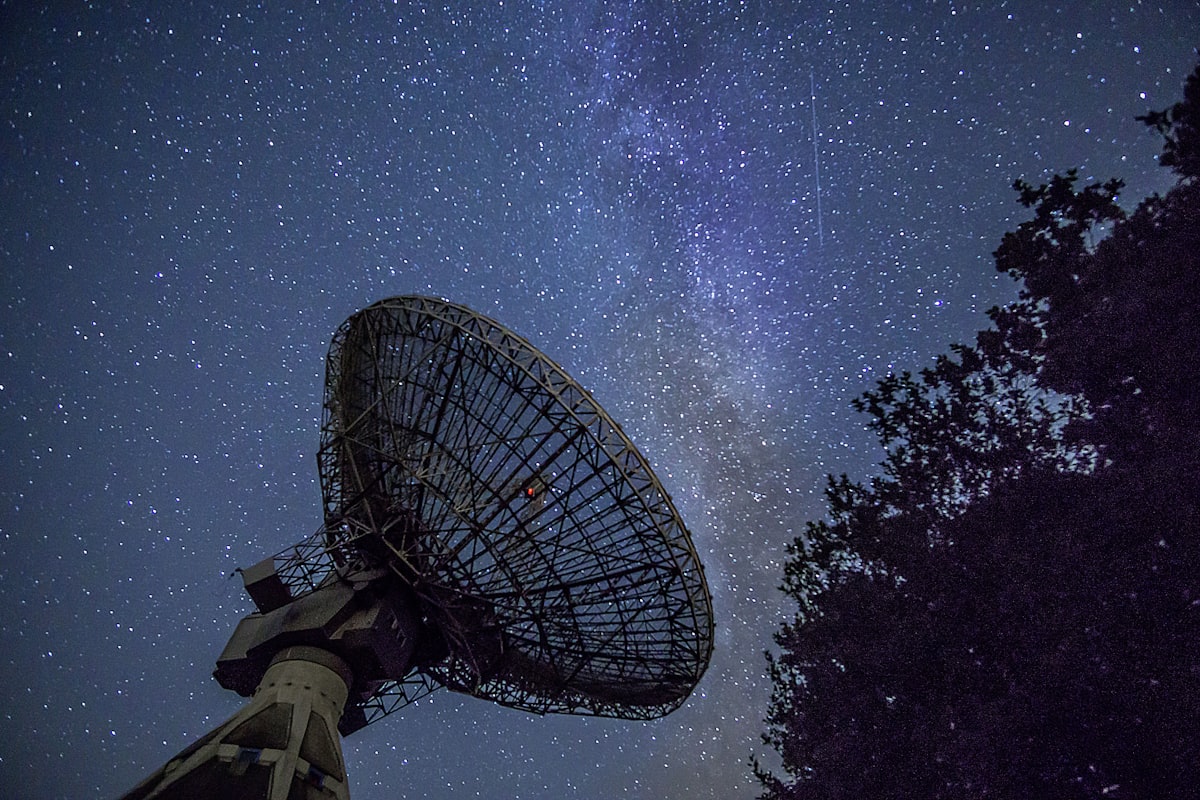
Because it’s not like we haven’t tried. The SETI program has been analysing signals from space since the early 1960s. For decades METI projects have been going a step further, actively reaching out to all the civilisations that are surely out there… just beyond the limits of our puny telescopes.
Key Takeaways
- The Zoo Hypothesis suggests that advanced alien civilizations intentionally avoid contact with humans.
- Humans have been actively searching for extraterrestrial life since the 1960s through programs like SETI and METI.
- The hypothesis proposes that aliens are observing us but choose not to interfere with our development.
- Variations of the Zoo Hypothesis include theories where aliens avoid contact to protect us or themselves.
- The Dark Forest theory posits that civilizations stay hidden to avoid potential threats from more advanced or hostile entities.
And in recent decades, our entire planet has become a bleeping, squeaking, squawking, buzzing mess of noise. We’re constantly pumping signals out into space. To put it bluntly… we’re not exactly keeping quiet… so we should be pretty easy to find.
And yet… we’ve never heard a peep in response. We’ve never received a message from our extra-terrestrial cousins. It’s like we’re just shouting into a void… and getting ghosted, again and again.
This is a big problem for scientists. Because… here’s the thing: we are not alone in the universe. We can’t be… It’s a mathematical impossibility.
We know the aliens are home… so why aren’t they answering the door? And why do they never call on us?
This is where the Zoo Hypothesis comes in. This is a mind-boggling theory that explains why no one wants to talk to us.
In a basic sense, the Zoo Hypothesis refers to the existence of a giant intergalactic system of control… kind of like the zoos or safari parks that exist down here on Earth.
However, in this zoo… we are not in charge. Instead, we are the exhibits… we are the poor animals staring out from the bars of our cage. Meanwhile… a civilisation way more intelligent than us, and way more powerful than us… is watching on.
In other words, the aliens are receiving our messages. They know we are here. And they are intentionally ignoring us. They are intentionally keeping us in the dark.
So… this answers the question of ‘where is everyone?’ But it leads to a whole load of other questions too.
Like… why would alien civilisations do this to us? What do they gain from avoiding contact with us?
And… even more worryingly… what’s the end game? What happens when that mega-advanced civilisation suddenly decides to turn on the lights… and get in touch?
The Foundations of the Zoo Hypothesis
To begin with… we need to get to grips with what the Zoo Hypothesis is all about. In fact, this is not just a single theory. Instead… it’s a whole family of different hypotheses, each with its own interpretation of why alien civilisations are not interested in connecting with us.
But all of these different hypotheses are predicated on one thing… the fact that we are not alone in the universe.
We’ve known for millennia that we cannot be the only civilisation in our universe… or even in our own galaxy. And it’s this understanding that has led to the development of the Zoo Hypothesis.
More than 2,000 years ago, the Greek philosopher Metrodorus of Chios, recognised the mad improbability that we are all by ourselves. He said… if we are alone, then we are like…:
…a single ear of wheat [growing] on a vast plain”.
In other words, it’s impossible that we are the only intelligent life in the universe. The poet Lucretius said it even more clearly:
Nothing in the universe is unique and alone, and therefore in other regions there must be other earths inhabited by different tribes of men and breeds of beasts.
In fact, you don’t need to be a poet, philosopher, or a scientist, to realise this. You can realise this yourself, simply by looking up at the night sky on a clear evening…
… What do you see? You see innumerable stars staring back at you… more than you can possibly count. And many of these stars are just like our sun.
And this is exciting. Our sun has its own solar system. Our sun is able to support life… intelligent, civilised life… even if we do say so ourselves.
Which means… each one of these pinpricks is a potential cradle of civilisation… a potential home for an extra-terrestrial species.
Of course… that translates to a huge number. Scientists believe 60 billion planets in our galaxy alone could be capable of sustaining life. Across the known universe, this number rises to 50 sextillion… or 50, followed by 21 zeroes. An unimaginable figure.
So we’ve long understood that there must be other worlds out there, and other civilisations, for centuries. But it wasn’t until the 1940s that we developed the technology we needed to actually seek out extraterrestrial intelligence.
The development of radio telescopes gave us a new frontier in space exploration. Now, astronomy could go beyond merely ‘looking’, and could instead start ‘listening’… analysing signals from space and learning more about what is going on out there.
Scientists would now have felt they were on the verge of something huge. In the 1950s, the physicist Enrico Fermi was chatting with his colleagues when he asked the now-famous question:
But where is everybody?
Over the years, this straightforward question has developed into the ‘Fermi Paradox’. This paradox weighs up both the “fact that we are not alone in the universe”… and the “deafening silence we encounter when we try to look for any proof”.
But with new technology, new techniques, and newfound drive, surely this ‘deafening silence’ was almost at an end.
By 1960, the first Search for Extra-Terrestrial Intelligence experiments were underway. Known as ‘SETI’ for short… the project was the first real attempt to seek out life beyond our own planet.
Philip Morrison of Cornell University admitted that the SETI team didn’t really know what it was looking for. But still, the opportunity to finally meet an extra-terrestrial face to face was too good to turn down.
The probability of success is difficult to estimate…” he said… “but if we never search, the chance of success is zero.
In fact, Morrison was doing himself and his team a disservice. The maths suggested that the probability of success was extremely high.
Drake’s Equation and the Promise of Contact
In 1961, the astronomer Frank Drake tried to estimate the probability of success for the SETI project.
To achieve this, he tried to figure out how many potential civilisations might actually be out there for SETI to discover. And his maths was simultaneously encouraging, and also pretty controversial.
Drake’s Equation is often expressed like this.
“N = Rs · ne · fp · fl · fi · fc · L”
In this formula, N is the number of intelligent civilisations in our galaxy.
To find this, we basically need to multiply a bunch of stuff together.
First, we take the rate of star formation, and multiply this by the number of habitable worlds attached to each star.
Then, we multiply this by the fraction of these habitable worlds that will actually support life… and then multiply this by the fraction of habitable worlds that support intelligent life.
We’re over halfway through this stream of multiplication now. We just have a couple more operations to perform.
Next, we multiply all of this by the fraction of these intelligent life forms that actually form into civilisations.
And finally, all of this is multiplied by the average lifetime of the civilisation.
And that gives us the number of intelligent civilisations existing, right now, in the Milky Way galaxy.
This is encouraging for scientists because it suggests a huge number of intelligent civilisations out there. And it’s controversial… because…
Well… as you’ve probably noticed, the formula involves finding one number we don’t know, by multiplying six other numbers that we don’t know either.
Steven Soter has argued that the power of the equation is ‘conceptual’, rather than ‘usable’. Soter says:
Estimates for ‘N’ range all over the map. While this exasperates critics who demand concrete answers from science, it does not invalidate the conceptual power of the Drake Equation.
For Soter, this ‘N’ value might be even greater than Drake had realised. He points out that civilisations are likely to produce colonies, spreading rapidly across the ether. In his own words:
If many civilizations have arisen in our galaxy, we might expect that some of them sent out colonies, and some of those colonies sent out still more colonies. The resulting waves of colonization would have spread out across the Milky Way in a time less than the age of our galaxy.
By now, those early SETI scientists were getting seriously excited. Now that they had the technology, surely it would be easy. Surely, all they’d need to do would be to sit back, twiddle their thumbs, and wait for all those messages to come rolling in from the far reaches of the galaxy.
And so they did. They waited. And they waited. And they waited some more. Nothing. The phone simply refused to ring.
All that excitement quickly turned to frustration and despair. If there are so many civilisations and colonies out there, why won’t they speak to us?
In fact, this is a real conundrum. Rather than resolving Fermi’s question… the ongoing failure of the SETI project made it all the more confusing.
John Allen Ball and the Birth of the Zoo Hypothesis
So, by the early 1970s… scientists needed a different way to answer this paradox. And in MIT and Harvard astrophysicist John Allen Ball, the scientific community had its man.
In 1973, Ball put forward a new theory… which offered a different explanation of why humans have never made contact with aliens.
I believe that the only way that we can understand the apparent non-interaction between ‘them’ and ‘us’ is to hypothesize that they are deliberately avoiding interaction and that they have set aside the area in which we live as a zoo.
To put it simply… extra-terrestrial life is indeed out there… but they are far more advanced than us, and they do not want to make contact.
To these extra-terrestrial life forms, our most advanced technology seems feeble and rudimentary, and our myriad attempts at reaching out are laughably pathetic. The aliens do not take our calls… and they do not make any calls of their own.
Watch Now
Open Video
Video Briefing
The Zoo Hypothesis: Aliens Don't Want to Talk to Us
They just sit and wait.
So, according to the zoo hypothesis, the universe is not some vast, unknowable vacuum, but is instead a controlled, observable environment. It’s sort of like a conservation area or protected habitat here on Earth.
We’ve all seen these protected habitats, where humans set aside an area of land for a specific type of wildlife. The ecosystem is then protected from external harm, and the wildlife within this ecosystem can thrive in relative safety.
We humans can then study the wildlife, or even just observe it for our own amusement. We don’t interfere with its growth or development… we just let it be… in its own little sandbox domain.
According to the zoo hypothesis, that’s what extraterrestrial life is doing to us. They ignore our messages, and they don’t respond to us, simply because they don’t want to interfere.
Why Would Aliens Ignore Us?
But why would an extraterrestrial species do this? Well… because we’re talking about something on a massive, universe-spanning scale… there are lots of potential reasons for not getting involved.
One theory is that the aliens simply want to “see how we get on”. They don’t want to interfere with our biological and social development, and instead they want us to grow and evolve in our own way.
Writing for SETI, Seth Shostak explains Ball’s theory in more detail. In Shostak’s words:
They’ve kept their distance not because we’re imperfect, but because of our right to pursue our own destiny. Diversity is something that everyone in the cosmos is assumed to value, so life-bearing worlds should be left to their own evolutionary development.
So these extra-terrestrials apparently value a diverse and independently developed universe, and so they take steps to ensure that we are not pushed in any particular direction, or influenced by any higher power.
Shostak has likened this theory to the “prime directive” from Star Trek. For the non-Trekkies out there, this refers to the fact that ‘Federation’ members are not permitted to interfere with other cultures and civilisations… “even if that interference is well-intentioned”.
Another reference might be the kids’ TV show The Wild Thornberries… which focused on a travelling family of nature documentarians. The Thornberry clan implemented their own code of ethics: they did not permit themselves to intervene with nature at any point, even though their daughter could literally speak to animals.
According to scientists, this interpretation of the Zoo Hypothesis should give us all some encouragement. As Shostak says:
We’ve failed to make contact with aliens not because we’re unworthy, but because we are worthy—the way endangered eels are.
So we humans are basically the cosmic version of an endangered eel. And… somewhere out there… some great protector is giving us the space and dignity we need to survive by ourselves.
According to Ball, this involves creating a “cosmic Eden”. This protects our planet via a sort of one-way mirror… like the kind that appears in detective shows or science fiction movies. In other words:
They can observe us, but we can’t observe them.
The “Not Ready” Variation
This is arguably the least troubling of all the zoo hypothesis variations. A more troubling variation is this one:
Alien civilisations do not contact us… simply because we are not ready for contact. If we were to make contact with a more advanced civilisation, it could be disastrous.
Taking a look around us on Planet Earth… it’s easy to see how this could be the case. Yes, we’re fairly advanced… or at least we feel like we are. We’ve got plenty of cool stuff, like global communication networks, reliable air travel, fast cars, video game consoles.
But… in other ways… we are an absolute mess.
For all our talk of harmony and love, we are absolutely obsessed with making war on each other. Periods like the Pax Britannica, from 1815 to 1914, are often held up as times of relative peace and stability… but European powers still found time to fight the Crimean War and the Franco-Prussian War, and countless colonial wars.
The same can be said about the Pax Romana. This wasn’t a period of unbroken peace… it was just a period of Roman dominance. And anyway, it was around 2,000 years ago… and we’ve had an almost infinite number of wars since then. Basically, there are no completely ‘war-free’ periods across the entirety of human history.
The world has just been brought to its knees by a global pandemic… for the umpteenth time in our history.
And then there’s the environment to worry about, or crime, or the fact that we can seemingly never agree on anything at all.
So yeah… for all our apparent sophistication… we actually aren’t doing so well.
A more advanced civilisation may have noticed this. They may have recognised our troubles and strifes, and realised that contact with a more sophisticated species might be the death of us… it might destroy us outright.
So they implement an intergalactic zoo to keep us safe. Which is a little scary, but also quite nice when you think about it. Our extra-terrestrial superiors are concerned about our well-being.
The Quarantine Theory: Protection for Them, Not Us
Another version of this theory works the other way. It states that the lack of contact may not be for our protection. Instead, it may be designed to protect the other civilisations out there. They are concerned about their own well-being… not ours.
This could be because of fears of a sudden massive population movement.
During the Titanic disaster of 1912, lifeboat crews famously left many passengers to die in the water, simply because they believed they would be swamped by desperate people eager for a chance at survival.
The more advanced civilisation may be concerned that we will do the same thing. We will swamp their utopian civilisation, or somehow cause them damage due to our apparent inferiority.
There may be other risks for the alien civilisation that makes contact with us, too. And these risks might not emerge until centuries into the future.
Harrison’s Self-Regulating Universe
In one version of the Zoo Hypothesis, civilisations want to keep us away from them… because of a danger that they have predicted… many aeons into the future.
Back in 1981, the researcher Edward Harrison offered a somewhat disturbing theory. He suggested that there is a system of self-regulation in place in the universe, designed to keep everything sustainable, and under control.
Basically, this theory states that intergalactic colonisation is not sustainable. Soter explains this theory in his own words:
Any civilization bent on the intensive colonization of other worlds would be driven by an expansive territorial impulse. But such an aggressive nature would be unstable in combination with the immense technological powers required for interstellar travel. Such a civilization would self-destruct long before it could reach for the stars.
This would explain why the orchestrators of the theorised ‘cosmic zoo’ might be benign. If they were not benign, and if they were hell-bent on domination, then they would already have destroyed themselves… and likely taken lots of other civilisations down with them.
This has led Soter to develop his own theory. He states that advanced civilisation must have:
”… passed through a filter of natural selection that eliminates, by war or other self-inflicted environmental catastrophes, those civilizations driven by aggressive expansion.
Soter postulates that more advanced civilisations have instead shifted towards the peaceful pursuit of wisdom, rather than war. In order to maintain this heavenly utopia, they need to be constantly on the lookout. They need to recognise when another species is following the ‘warlike’ path of colonisation… and they need to quarantine them before this gets out of hand.
Thanks to their learned experience, these civilisations know exactly which red flags to look for. They know all of the signs that suggest a certain species is going to become an intergalactic coloniser in the future.
And of course, us humans display all of those red flags. The advanced civilisations have witnessed our obsession with war, control, power, and destruction. And so, they have put us in a time-out… they have implemented a quarantine system, to stop us from becoming a trans-cosmological destroyer.
That’s why we haven’t seen any other forms of life… we aren’t being allowed to. We’re being punished for crimes we haven’t yet committed… but definitely would commit, if we were given the chance.
As Soter says:
Advanced intelligence might regard any prospect of the exponential diffusion throughout the Milky Way of self-replicating colonies very much as we regard the outbreak of a deadly viral epidemic. They would have good reason, and presumably the ability, to suppress it as a measure of galactic hygiene.
The Dark Forest Theory
So now we’ve seen a few different potential versions of the Zoo Hypothesis, but all of them hinge on one key similarity: that the most powerful forces are benign… at least to some extent.
But what if they are not benign? What if Soter is wrong about the ‘self-regulating mechanism’ that ‘destroys the destroyers’? What if some of the civilisations out there are powerful, murderous, and ready to destroy? And everyone else is running scared?
This is the basis for the last of our potential variations on the Zoo Hypothesis… which goes by the name: the ‘Dark Forest’ theory.
This is a popular theory these days, largely thanks to its repeated use in science fiction literature. In fact, the term itself is taken from the title of the acclaimed book by Liu Cixin, published in 2008. The theory goes like this:
Imagine you’re lost in a dark forest, and you’re alone and frightened. You have a flashlight with you, but you’re afraid to use it. You’re worried about what might spot you… and what they might do to you. So it’s better to remain hidden in the gloom.
Then, out there in the darkness, you spot another beam of light. They haven’t seen you yet. But you can see them.
What do you do? If you turn on your own flashlight, they will see you, and you’ll make contact.
This might be a good thing. Maybe you’ll find safety in numbers. Maybe you’ll be able to find a way out of this mess together.
But on the flipside of this, it might be a bad thing. What if they aren’t friendly? What if they are a predator, searching for their prey, and trying to lure you into a false sense of security?
This is the decision you have to take. Do you choose to click that flashlight ‘on’, or leave it ‘off’?
It’s easy to see how this can be applied to the universe around us. There could be thousands of other civilisations in our immediate vicinity, but they have all turned their flashlights off, because they do not want anyone else to find them.
We, on the other hand, are firing the highest-powered beams we can muster out there into the universe. The timid little civilisations around us ignore this… but they watch in disbelief as we give away our position.
According to the Dark Forest theory, it’s only a matter of time before the destroyer finds us… and then… it’s curtains for us.
The Dangers of METI
In this context, programs like METI… or ‘Messaging Extraterrestrial Intelligence’… seem like absolute madness. We have no idea about the nature of extra-terrestrials, or about their motivations and capabilities. We’re like a little rabbit in a forest of wolves… holding an illuminated sign that says: “hey wolves, rabbit over here”.
In fact, it’s not ‘like’ that… we are doing exactly that. The Pioneer 10 and Pioneer 11 spacecraft were launched in 1972 and 1973. These craft are travelling further away from us by the minute, and they are each carrying a plaque designed to help extra-terrestrials learn more about us.
These plaques were the brainchild of renowned scientist Carl Sagan. They feature an image of a human man and woman… both naked, and both displaying how truly weak and puny humans really are.
And, alongside this, there is a map, which shows where Earth is in relation to the rest of the galaxy. So, if there is an evil civilisation out there, they will know precisely where to find us… and they will know what kind of meal to expect when they get here.
This is why METI is controversial. A number of scientists have suggested that perhaps we don’t want to meet what’s out there, just in case it’s not friendly.
The late, great Stephen Hawking suggested that reaching out in this way might expose us to severe danger, and might even wipe out the human race if the wrong kind of civilisation spots it.
We only have to look at ourselves to see how intelligent life might develop into something we wouldn’t want to meet,” Stephen Hawking said. “[When Columbus met the Native Americans] that didn’t turn out so well.
The physicist Mark Buchanan agreed with this. Buchanan said:
Any civilization detecting our presence is likely to be technologically very advanced, and may not be disposed to treat us nicely.
When a Norwegian radar antenna beamed a radio signal out into space in 2017, Seth Shostak was more than a little alarmed.
Suppose [extraterrestrials] do exist, and they’re unfriendly. If we tip our hand with a broadcast — no matter what its content — they might respond with a fleet of interstellar missiles to take us out. Bummer.
But Shostak did admit that this was unlikely. He concluded his piece for NBC by saying that we’re already sending all kinds of signals out into space, and that an advanced civilisation is likely to have already spotted us a long time ago.
So, if we are lost in a Dark Forest… maybe it’s better to throw up a flag… and hope a friend sees it.
This might be our only defence against the nefarious space wolves trying to eat everyone.
Simon Whistler
Simon Whistler is one of YouTube's most prolific educational creators. Decoding the Unknown is his methodical investigation into the world's strangest phenomena — examined with rigour, curiosity, and a healthy dose of scepticism.
Frequently Asked Questions
What is the Zoo Hypothesis?
The Zoo Hypothesis is a theory that suggests alien civilizations are intentionally avoiding contact with humans. It posits that we are being observed but not interacted with, much like animals in a zoo.
Why do scientists believe we are not alone in the universe?
Scientists believe we are not alone in the universe because it is mathematically improbable that we are the only civilization. The sheer number of potentially habitable planets suggests the existence of other intelligent life.
What is the Fermi Paradox?
The Fermi Paradox questions why, given the high probability of the existence of extraterrestrial civilizations, we have not yet detected any signs of them. It highlights the ‘deafening silence’ despite our efforts to find evidence of alien life.
What is the SETI program?
The SETI (Search for Extra-Terrestrial Intelligence) program is an initiative that has been analyzing signals from space since the early 1960s in an attempt to detect signs of extraterrestrial intelligence.
What is Drake’s Equation?
Drake’s Equation is a probabilistic argument used to estimate the number of active, communicative extraterrestrial civilizations in the Milky Way galaxy. It involves multiplying several factors, many of which are unknown.
What is the Dark Forest theory?
The Dark Forest theory suggests that civilizations in the universe are hiding from each other out of fear of potential threats. It likens the universe to a dark forest where turning on a flashlight (making contact) could attract dangerous predators.
What is METI?
METI stands for Messaging Extraterrestrial Intelligence. It refers to projects that actively send messages into space in an attempt to communicate with extraterrestrial civilizations.
Why might alien civilizations avoid contact with us?
There are several reasons proposed in the Zoo Hypothesis, including the desire to let us develop independently, the fear of contaminating our civilization with their advanced technology, or the concern that we might pose a threat to them.
What is the significance of the Pioneer 10 and Pioneer 11 spacecraft?
The Pioneer 10 and Pioneer 11 spacecraft carry plaques designed to help extraterrestrials learn about humans. These plaques include images of a man and a woman and a map showing Earth’s location in the galaxy.
What is the ‘prime directive’ analogy in the context of the Zoo Hypothesis?
The ‘prime directive’ analogy refers to the idea that advanced civilizations might avoid contact with us to allow us to develop naturally, much like the non-interference policy in the Star Trek series.
Sources
- Original Decoding the Unknown video: The Zoo Hypothesis: Aliens Don’t Want to Talk to Us
- Hero image source by thegetty / openverse, cc0.