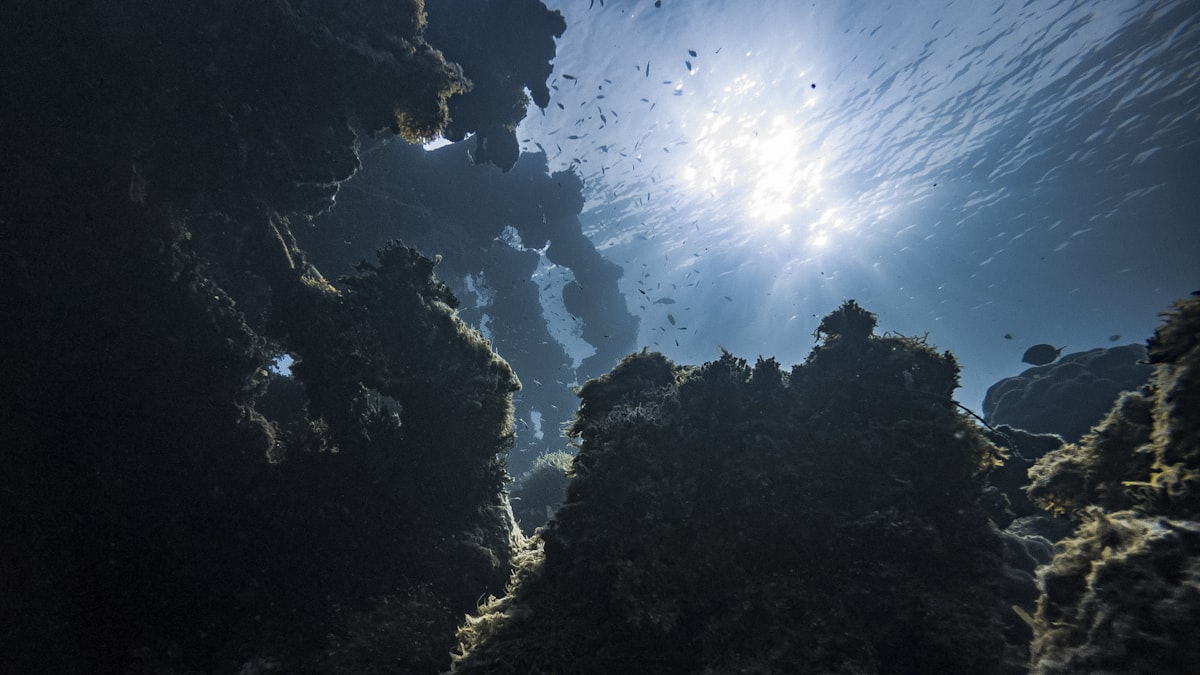

Below the thunders of the upper deep, Far, far beneath in the abysmal sea, His ancient, dreamless, uninvaded sleep The Kraken sleepeth: faintest sunlights flee About his shadowy sides; above him swell Huge sponges of millennial growth and height; And far away into the sickly light, From many a wondrous grot and secret cell Unnumbered and enormous polypi Winnow with giant arms the slumbering green. There hath he lain for ages, and will lie Battening upon huge sea worms in his sleep, Until the latter fire shall heat the deep; Then once by man and angels to be seen, In roaring he shall rise and on the surface die.
That was Alfred Lord Tennyson’s “The Kraken,” published in 1830. In case you hadn’t realised yet, today we’re going to get entangled in the many tentacles belonging to this sea monster, culminating with a question posed by a palaeontology student which asks: “did Late Triassic coleoids actually have biserial suckers?” Yes viewers, we’re going for a deep dive on this one in all senses of the word so make sure those oxygen tanks are full and your mask is clear because it’s time to roll backwards off this boat.
Let’s Get Kraken
Sea monsters have been around for as long as people have been able to travel on the sea. When you’re on your long-haul fishing trip, expedition or whatever, there comes a point when you’re far enough out in the water that you can’t see anything else but the sea. No land, no other boats, nothing but the vast expanse of whatever ocean you’re on, stretching as far as you can see in all directions.
Key Takeaways
- The Kraken is a legendary sea monster often depicted as a giant cephalopod.
- The Kraken’s origins trace back to Norse mythology and various sea monsters from Greek and Roman lore.
- Early scientific texts, including those by Carl Linnaeus and Erik Pontoppidan, contributed to the Kraken’s mythos.
- Modern interpretations of the Kraken are likely influenced by sightings of giant and colossal squids.
- Paleontologist Mark McMenamin’s theory of a Triassic-era Kraken is widely disputed by the scientific community.
Is there anything else that will give you such a horrible feeling of unease as that? You can’t see very far down, anything could be under there! You don’t know how deep it is or whether some awful, toothy creature is speeding up like a bullet from the depths at that very second with its mouth open ready to swallow your boat whole.
What was that over there? An eel? Or just the end of the tentacle of something a lot bigger?
Is there a huge bulbous cephalopod lurking mere feet below, waiting to whip out its tentacles and destroy your vessel or will it just cruise by underneath without you even realising how near death you were? With water covering over 70% of our planet and at least 80% of this never having been explored, it’s little wonder that the seas and oceans hold so much fear and folklore going back as far as humans do.
Before we crack on with the main character of this episode, we need to do a bit of due diligence and go back and look at stories that pre-date what we have collectively come to call “the kraken.” Quick aside: have you been saying “crack-en” or “krah-ken” or maybe even “kray-ken”? I think this is one episode where it doesn’t particularly matter. Personally, I prefer “crack-en” as it’s easier to make jokes with but I’ve already used up the best kraken pun as the title for this section and it wasn’t even very original.
Anyway, back to the story. Way back before this particular sea monster was given a name, we had Scylla (pronounced sillar), and Charybdis (ca-RIB-dis), popping up in Greek mythology and in Homer’s Odyssey around the 8th century BC. These were two sea monsters who lived on opposite sides of a channel meaning you’d have to choose to go nearer one than the other. Apparently the phrase “between Scylla and Charybdis” is synonymous with “between a rock and a hard place” but probably only among the most classical scholarly types.
I’ve seen Scylla described as basically having six dogs instead of legs and a normal head, but also having twelve feet and six heads on necks like snakes. Charybdis is a little more straightforward, either causing or actually being a whirlpool that sucked boats down to their dooms.
Other classical sea monsters of times past include Cetus, which was more whale-like, various hydra and the Biblical sea serpent Leviathan. You may have noticed that none of these monsters really sound much like what we know as the kraken today which is generally represented as some sort of huge octopus or squid thing. This might be because even way back in the time of Aristotle in the 4th century BC, large squid were already recognized as being in existence so the monsters didn’t really resemble them as mythical monsters were usually mash-ups of different creatures or totally bizarre inventions such as dogs instead of legs etc. This all changed over time but we’ve jumped a bit ahead here so let’s get back to the origin story of our sea monster.
We probably get the name “kraken” from old Norse as the thing first burst onto the scene in the Norwegian sea but definition-wise, I’ve seen things ranging from “the arms” to “malformed tree” to “crawling” to “anchor”. Germans use the word “Krake” to refer both to the Kraken specifically and just to an octopus in general, but to avoid confusion, they also use the word “Oktopus” for the non-fictional creature.
The Kraken was also apparently called “soe-trolden” or “sea mischief” which makes it sound like a naughty little troublemaker rather than a monstrous beast that crushed ships and ate people.
It seems like the old Norse people had lots of other monsters going on in the colder parts of the globe. There was also the “hafgufa” which translates to “sea mist” or “steam” which has appeared in written accounts at least as early as the 13th century. This was a sea monster that hung around near Greenland and apparently self-chummed to attract fish. Basically this means it vommed stuff out into the sea as bait and then ate all the fish that turned up which, I guess, later turned into more chum.
There was also the “Lyngbakr” or “heather back” which was a sea monster so large and covered in vegetation that it was mistaken for an island. When sailors pitched up alongside and went for a walkabout on it, it would submerge and drown them all.
These two monsters might also be elements of yet another enormous beast which was called the “aspidochelone” — appearing in the 2nd century text the “Physiologus”, this giant whale or turtle pretends to be an island to lure unwitting sailors and it also attracts fish to it with a sweet smell.
There are actually about a billion other sea monsters we could talk about but these seem to be the main ones in the formation of the kraken legend. The hafgufa and lyngbakr fell out of fashion over the years, people started conflating them and eventually there could be only one monster to rule the sea and it became known as the kraken. By the mid 1700s, the kraken had become an enormous tentacled thing that could destroy ships by wrapping its arms around them, but could also pull them under the water via whirlpool when it submerged, like our old friend Charybdis.
How did it end up as a giant cephalopod when earlier monsters didn’t really have these characteristics? It’s probably because as time went on and people sailed around more, they saw things that actually bore a resemblance to this creature and thus the legends grew. Goodbye whale with an island on its back, hello much larger version of a squid or octopus. It’s also because, starting in the 1700s the kraken started making its name via scientific journals and also from alleged actual encounters.
Swedish biologist Carl Linnaeus is known as the “father of taxonomy” or the slightly less catchy “godfather of binomial nomenclature” for creating biological classifications for all known organisms — you know, the names like “gorilla gorilla” and “rattus rattus”. He started his “Systema naturae” in 1735 and guess what made an appearance in the first edition? The Kraken, classified as “Sepia microcosmos” which comes in the cephalopod class, under the genus of the cuttlefish. Up to this point I hadn’t thought of cuttlefish at all as they’re quite small, although darn it if they don’t actually look like your archetypal kraken i.e. kind of a mixture of a squid and an octopus.
The kraken entry also appeared in 1746’s “Fauna Svecica” with Linnaeus describing it as a “singular monster” albeit one he admitted to never having actually seen. Not long after, it seems that Linnaeus realised the error of his ways and left the sea monster out of future editions of his work but this early rubber-stamping of the creature as real earned it its place in history and also cemented the now common aesthetic of the monstrous cephalopod.
In the 1750s, historian Erik Pontoppidan wrote his “Attempts at Norway’s Natural History” which again featured the kraken as a real creature. He described it as “round, flat, and full of arms” and “the largest and most surprising of all the animal creation.” Pontoppidan gave various examples of what its classification could actually be, ranging from a type of octopus or starfish to a giant crab.
He also said it was so big that it could be mistaken for a mountain when rising up out of the sea and that it had a circumference of 2.5km although I don’t know if that was its body by itself or when it had all its arms outstretched. It might also be worth pointing out here that Pontoppidan seemed to be really into sea lore, also featuring giant sea serpents and mermaids in his natural history, bless him.
The 1800s brought many unsubstantiated tales of encounters with the beast, and paintings, woodcuts and engravings started solidifying the current recognisable form of the kraken. There were stories of how to tell if a kraken was nearby — if your boat is a couple of miles out on a hot day over a particularly deep part of the sea, all the fish in the area would be pushed to the surface as the kraken started rising. Rumour has it that some fishermen actively tried to find the kraken as if they could get away in time, the amount of fish they could catch would be worth the risk.
Tennyson wrote the poem we started with in 1830 and in 1833, William Jardine published “The Naturalist’s Library” featuring a chapter on the kraken which includes this bit: “The belief in this monster is, however, universal among the sailors and fishermen of the Norwegian coast, and it has been alluded to by all the Scandinavian writers from the earliest period down to the present day.” He quotes tales of the kraken from Pontoppidan’s writings before saying: “probably without much difficulty this extraordinary Kraken may be identified with certain species of Sepia or cuttlefish, which have been described in the Annals of Science.” Jardine then quotes someone who had seen a massive cuttlefish but I don’t think they get that large so maybe this person had actually seen a giant squid.
He goes on to list several examples of ships and humans being attacked by massive arms or “tentacula” and also sightings of the kraken by different people all over the world. The chapter ends by saying: “…the great Norwegian animal thus named is to be considered not as a wild and groundless chimera, but as either identical with, or nearly allied to, this colossal cuttlefish. It must be confessed that many of the accounts to which we have referred, if considered singly, are much too vague and indefinite to form the foundation of any opinion; but it is the general import and tendency of the whole combined which should be considered.
In this view, it would be contrary to an enlightened philosophy to reject, as spurious, the history of an animal, the existence of which is rendered so probable, by evidence deduced from the prevailing belief of different tribes of mankind, whose opinions, it is evident, could not have been influenced or affected by the tradition of each other, but must have resulted from the occasional appearances of the monster itself in different quarters of the globe.”
As well as saying the kraken might actually exist albeit as a natural creature, Pontoppidan and Jardine put into print many alleged examples of the creature attacking ships, grabbing and killing sailors and creating whirlpools to drag its hapless victims to their deaths.
In 1851, Herman Melville name checks it in Moby Dick, although it’s a sceptical reference, saying: “There seems some ground to imagine that the great Kraken of Bishop Pontoppdan may ultimately resolve itself into Squid. The manner in which the Bishop describes it, as alternately rising and sinking, with some other particulars he narrates, in all this the two correspond. But much abatement is necessary with respect to the incredible bulk he assigns it.” Hmm, what a logical approach we have there. Call me, Ishmael.
In 1861, a small French warship called “Alecton” had one of the first recorded encounters with a real life giant squid. While there had been anecdotal stories about them before, the general scientific consensus of this period was that they didn’t actually exist. This is slightly confusing as the kraken had been listed as an existing creature a hundred years before but a large squid was not thought of as being a viable creature?
Apparently not. The crew tried to capture the squid but it was too heavy to be pulled aboard and all that they were left with was the end of what they called the “tail” which I assume to be the top fin part, not the end of an arm. This part by itself allegedly weighed about 14 kgs or 30 pounds which is about twice the weight of a bowling ball or one third the weight of a toilet, apparently.
It was sent off for study but it seems to have got lost almost immediately. This thrust the idea of the kraken firmly back into the public consciousness, especially in the world of literature.
We are now awash with krakens popping up in pieces by Victor Hugo, Jules Verne and John Wyndham.
Cthulhu, HP Lovecraft’s seminal monster, was agreed by scholars of his work to have been influenced by the kraken of the Tennyson poem.
Nowadays the monster’s tentacles have spread all over the entertainment sphere, with appearances in Clash of the Titans where it has erroneously been inserted into Greek mythology, a couple of the Pirates of the Caribbean films and a 2023 animated film called Ruby Gillman, Teenage Kraken which sounds like it should rhyme but doesn’t.
Watch Now
Open Video
Video Briefing
The Kraken
House Greyjoy from Game of Thrones has a kraken as their sigil and it made a brief appearance in the TV show Our Flag Means Death. It has been a fixture in video games and tabletop gaming for decades and in 2021, an ice hockey team was founded called the Seattle Kraken.
Octopi Wall Street
Whatever people thought the kraken was or wasn’t, it’s now commonly perceived to be a giant cephalopod of some sort. The common characteristics of cephalopods are that they are marine animals with definite heads and tentacles or arms and the ability to squirt ink. Obviously octopi, squid and cuttlefish are classed as cephalopods, and so is the nautilus but we can count that one out as it has a shell and no mention of the kraken has said it was actually in a huge shell the entire time. We’re going to talk about the differences between octopuses and squid for a moment even though I think this discussion is moot as the kraken is a legend and not actually a real creature so it doesn’t matter whether it is more like an octopus or a squid as it doesn’t exist.
Anyway, early illustrations of the kraken in its familiar cephalopod form definitely skew octopus for me. Many of the pictures show tentacles or arms coming out of the sea and wrapping round a boat, with the monster’s two large eyes and a bit of its head slash body showing. This gives the impression that the head is more rounded like the octopus and not elongated with a triangular end like the squid. Also, the arms all seem more or less the same length and covered in suckers.
As well as having 8 arms, squid also have two longer tentacles with suckers just on the end, not all the way along. Actually, some squid have really creepy looking barbs and hooks on the ends of their tentacles that can swivel about to keep hold of their prey.
Obviously nowadays, anything goes with the kraken being depicted however you want, as long as there are tentacles involved somewhere. By the way, I have been throwing out “arms” and “tentacles” somewhat interchangeably although I know that technically there is a difference with “arms” having the suction cups all over them and tentacles only having them at the end. Thus, an octopus has no tentacles but does have 8 arms. But you know what, when we’re talking specifically about the kraken I think we can use whichever one we feel like and if you don’t agree, please refer to the previous point about it not being real.
The early drawings of the Kraken may look more like octopuses because everyone knew octopuses existed. They don’t live as deep down as larger squid and even now they are viewed as extremely weird creatures so it would be easy to model a many-armed monster on one of these. When the existence of things like giant squid became known later in the 19th century, however, it seemed more likely that the kraken myth was based on these as they can grow much larger than the largest octopus.
I Mollusc You A Question
Here are some squid facts. We know there are little squid and giant squid. The largest giant squid are mysterious animals that live hundreds of metres down in oceans across the globe where humans just can’t go and because they live way down deep, they are products of the amazingly named “abyssal gigantism” where invertebrates can grow massive compared to their relatives living in shallower waters.
While some had washed up or come to the surface in the past, a few strandings occurred in New Zealand and around Newfoundland in the 1870s and 1880s, bringing the possible monster firmly into the realm of reality. The giant squid was also finally officially classified as “Architeuthis dux” in 1857 by Norwegian naturalist Japetus Steenstrup.
It wasn’t until 2004 that we had any photos of a living giant squid in its deep natural habitat so it’s no real wonder that scientists in the past ummed and ahhed over whether it was real or not. And if a giant squid was real, why not something even larger? Well, if you weren’t already aware, there is something even larger than the giant squid in the cold depths of the ocean and that is — drumroll please — the colossal squid. Well, their bodies are much larger, longer and heavier but their tentacles don’t grow quite as long as the giant squid.
It is massive though, with one found in New Zealand weighing almost twice as much as a giant squid at 490 kgs to the puny 275 kgs that a giant squid can grow up to. It also has a massive beak, much larger than the giant squid’s and those things are sharp. Lengthwise though, there’s not much competition or at least, not yet. As with most things that go on in the murky depths of the world’s oceans, we just don’t know that much about the colossal squid.
Here’s what Jon Ablett, the Senior Curator in Charge of Molluscs at the Natural History Museum has to say about this: “Although we don’t know everything that’s in the deep, most scientists now believe that female giant squid reach around 13 metres long, and males around 10 metres. In the case of the colossal squid, the jury is out. The biggest one found to date was around nine metres long, but it wasn’t fully mature. Some scientists believe they don’t get as big as giant squid and never reach 13 metres, while others think they could grow even bigger, to 18 metres”.
OK, an 18 metre or 60 foot long squid is no joke. That’s like 12 Danny DeVitos laid end to end in the water beside you, bobbing about in little lifejackets or maybe reclining on pool inflatables with a nice Mai Tai. Creepy.
In case you’ve been wondering how big octopuses get, you’re going to be disappointed. The largest species of octopus is the Giant Pacific Octopus and while the average length from top to tip is quite impressive at about 5 metres, this is less than half the length a giant squid can get up to.
We can be fairly sure that sightings of a giant squid or possibly even a colossal one are what gave the kraken rumour legs, or rather, arms, but what of its aggressive behaviour? Could a squid really attack a boat? This is fairly unlikely as the giant squid is built to be a deep sea dweller and only comes to the surface if it’s dead or dying.
It’s possible that one that was still alive managed to fling a tentacle or arm over a small boat at some point but this would not have been in an attempt to crush the boat or as a precursor to picking up individual crew members, it would have been just to have something to hold on to. The muscles in the squid’s tentacles aren’t strong enough to wrap around and constrict or crush anything, they mostly just dangle down in the depths waiting for prey to come along. We’ve heard of epic battles between giant squid and sperm whales but the squid aren’t the aggressors here, they’re not engaging in arm to mouth combat with the whales to see who will win, they’re just trying to get away.
I think we’re all pretty much convinced that any tales of the kraken, at least from the past couple of hundred years, have just been tall tales spun from an encounter with a squid that was much larger than anyone would have been expecting. But. What if there actually was something even more enormous in the past. We know that there were huge examples of modern day animals like the giant ground sloth and giant beaver way back in the Ice Age and the megalodon was about three times the size of current great whites so could there have been another deep sea titan ruling the waves?
Release the Triassic Kraken
Since 2011, palaeontologist Mark McMenamin has been putting forth his theory about a huge cephalopod that was killing ichthyosaurs about 250 million years ago. Considering the size of the prey and the remains of a fossilised beak he found in 2013, the ancient sea monster would have reached about 30 metres, 100 feet or twice the length of your largest giant squid these days. What evidence has he found? Well, apparently there are fossilised remains of ichthyosaurs such as the very large Shonisaurus popularis, where the vertebrae have been moved around and placed into neat patterned rows, resembling a double row of suction cups that you’d find on the underside of an octopus’s arm. This also mimics known behaviour of squid and especially of octopuses that are highly intelligent and can easily manipulate objects in this way.
This was only one example but McMenamin also saw a photo of a now-removed museum display that was set out exactly as the skeleton had originally been found. There was another row of removed vertebrae in the same formation laid to one side of the main skeleton. McMenamin said: “We think one plausible explanation of this is an attack on the ichthyosaur by a much larger predator.” He also believes that the formation of these vertebrae to look like a double row of suckers is intentional, a cephalopod’s calling card, if you will, or even something resembling a self portrait.
One source also chimes in with: “These bones look like gigantic octopus kills. Since the Ichthyosaur grows to be 66 feet long, an Octopus would have to be very large indeed to hunt and eat one. Scientists even found one Ichthyosaur skeleton with a ribcage cracked from constriction. It was as if a large tentacle had been wrapped around the Ichthyosaur, crushing it and dragging it down. For this to be possible, a very large octopus must really have existed at one time.”
Add to this the large beak McMenamin found in the same state park as the first skeleton and some tentacles are starting to twitch in the direction of a monstrous octopus. Or maybe the tentacles are twitching but the creature is no longer alive as this theory is not supported by anyone else, apparently in the entire world.
A blog about this by Tyler Greenfield who was a palaeontology student at the time, clearly sets out how, thanks to what we know about marine life in the triassic period and what we know about the evolution of cephalopods, this monster-pus is just impossible. This brings us back to his burning question at the top of the episode — “did Late Triassic coleoids actually have biserial suckers?” What he’s asking is if these types of cephalopods had double rows of suckers at this time in the past and the answer is a resounding no, they only had uniserial suckers!
So this puts paid to the idea that the ginormo-pus was leaving a picture of itself made out of the vertebrae of other animals. Greenfield also points out that the only evidence we have of triassic period coleoids are that they were all less than a metre long.
Are there any other explanations for how these neatly arranged vertebrae formations could have occurred? Er, of course there are. How about just the currents buffeting the bones together as the rest of the skeleton decayed? How about just random chance as there have only been 2 examples of this found so far?
David Fastovsky, a palaeontologist who sat through one of McMenamin’s presentations states: “A kraken isn’t really necessary. Everything can be explained by much less exotic means.” Kind of a killjoy but he’s not wrong.
The fossilised beak wasn’t much in the way of conclusive evidence either as it wasn’t complete and could really have been anything. Even if it was part of a beak, there wasn’t enough of it there to be able to extrapolate the size of a cephalopod out to 30 metres.
Just Squidding: Why This Can’t Be Real
While the sea is vast and unknowable, and even the largest vessels are nothing more than dots on its surface, with the combined knowledge we have of fossils, animal biology and real life specimens or lack thereof, it’s safe to conclude that there is no such thing as the kraken in a 30 metre plus form that consciously attacks boats for fun. Sailors who might have been feeling a little on edge being out in the middle of nowhere probably saw a large cephalopod which might have even attached itself to their boat and their imaginations inflated the encounter when they got back to shore. This would mean more people on the lookout for the kraken and therefore more sightings, whether based on something real or not.
Might there be even larger species of squid or octopus that we don’t yet know about? Maybe, but it’s unlikely they’re going to be more than twice the size of what we’ve currently got.
The main mystery for me here is why the Ancient Greeks and Romans recorded the giant squid as a real animal and then it fell into the realm of legend for centuries before finally being recognized again in the 1850s. Pliny the Elder, a first century AD Roman naturalist and author, wrote about a squid measuring more than 9 metres with “a body like a barrel” in his work “Natural History” and Aristotle had mentioned it even earlier in “Historia Animalium” albeit not quite such a gigantic specimen.
I suppose the giant squid’s elusiveness doesn’t help and it was probably only when more countries started exploring further across the oceans that the chances of seeing one increased. There also haven’t been any modern day kraken sightings and we have to keep going back to the same boring point as we do for all cryptids and monsters: are there just one or two that live for thousands or even millions of years or are there enough of these things to maintain a breeding population? Neither seems very likely so I think we can leave this beast in the story books where it belongs.
I mentioned to my daughter that I was doing an episode on the kraken and she said “The kraken isn’t real, it’s just a giant squid. You don’t have to do a whole episode about it.” Well, joke’s on you girl, ‘cos we just have.
Simon Whistler
Simon Whistler is one of YouTube's most prolific educational creators. Decoding the Unknown is his methodical investigation into the world's strangest phenomena — examined with rigour, curiosity, and a healthy dose of scepticism.
Frequently Asked Questions
What is the origin of the name ‘Kraken’?
The name ‘Kraken’ likely originates from old Norse and first appeared in the Norwegian sea. Various definitions include ‘the arms,’ ‘malformed tree,’ ‘crawling,’ and ‘anchor.’
What are some early sea monsters that predate the Kraken?
Early sea monsters include Scylla and Charybdis from Greek mythology, Cetus, various hydra, and the Biblical sea serpent Leviathan. These monsters did not resemble the modern depiction of the Kraken.
How did the Kraken become associated with giant cephalopods?
As time went on and people sailed more, they encountered creatures that resembled the Kraken, leading to the legend of a giant cephalopod. Scientific journals and alleged encounters in the 1700s solidified this association.
What role did Carl Linnaeus play in the Kraken legend?
Carl Linnaeus, known as the ‘father of taxonomy,’ included the Kraken in the first edition of his ‘Systema naturae’ in 1735, classifying it as ‘Sepia microcosmos’ under the cephalopod class. This early classification helped cement the Kraken’s place in history.
What did Erik Pontoppidan describe the Kraken as in his 1750s work?
Erik Pontoppidan described the Kraken as ‘round, flat, and full of arms’ and ‘the largest and most surprising of all the animal creation.’ He suggested it could be a type of octopus, starfish, or giant crab.
What is the difference between a giant squid and a colossal squid?
The giant squid can grow up to 13 meters long, while the colossal squid has a heavier body but shorter tentacles. The largest colossal squid found weighed almost twice as much as a giant squid but was not fully mature.
What is the theory proposed by Mark McMenamin about a giant cephalopod?
Mark McMenamin proposed that a huge cephalopod, about 30 meters long, was killing ichthyosaurs around 250 million years ago. He based this on fossilized vertebrae arranged in patterns resembling suction cups and a fossilized beak.
Why is the theory of a giant cephalopod killing ichthyosaurs not widely accepted?
The theory is not widely accepted because it is not supported by other scientists. The evidence, such as the arranged vertebrae and the beak, is not conclusive. Additionally, marine life from the Triassic period and the evolution of cephalopods do not support the existence of such a large creature.
What is the likely explanation for sailors’ encounters with the Kraken?
Sailors’ encounters with the Kraken were likely exaggerated accounts of seeing large cephalopods, such as giant squid. Their imaginations inflated these encounters, leading to the legend of a monstrous sea creature.
What is the significance of the giant squid’s elusiveness in the Kraken legend?
The giant squid’s elusiveness contributed to its mythical status. It was only when more countries started exploring the oceans that sightings increased, leading to the recognition of the giant squid in the 1850s.
Sources
- Original Decoding the Unknown video: The Kraken
- Hero image source by Jenn G from Seattle, WA / openverse, by-sa.