When the BBC Micro home computer was first rolled out in late 1981, it was marketed as an innovative step into a new dimension. The BBC Micro Model B was designed to be the ultimate home help, a gateway to a private education for your kids, and your personal electronic accountant, all rolled into one flashy piece of kit with a retail price of just £400. That might seem a bit steep nowadays, considering that we can cram far more power and functionality into a single free app on our phones than the BBC Micro could ever hope to muster.
The marketing also didn’t take into account that all anyone ever really wanted to do on the BBC Micro was play ‘Chuckie Egg’. But perhaps this expensive machine came packaged with a few hidden features that ventured far beyond the concept of trying to create a spreadsheet for your shopping expenses.
In 1984, a story emerged from a cottage situated in the tiny British village of Dodleston in which a borrowed BBC Micro began behaving very strangely indeed, transmitting messages from the past and the future to create a three-way conversation spread across five hundred years. They should have mentioned this kind of thing in the advertisements. That’s got to be a bit more exciting than the accounting package.
Key Takeaways
- The BBC Micro Model B, released in 1981, was marketed as a versatile home computer but was primarily used for gaming.
- In 1984, a BBC Micro in Dodleston, UK, began displaying mysterious messages from the past and future.
- The messages were attributed to a man named Lukas Wainman from 1546 and a group from 2109.
- The story involves poltergeist activity, a witchcraft trial, and a Ufologist named Gary Rowe.
- The authenticity of the messages and the events is highly debated, with many believing it to be a hoax.
But did we learn anything useful about the future of mankind during these ghostly communications which were conducted over the course of a few years? And could this have been the result of a haunted home computer, a pesky poltergeist at work in Dodleston, a baffling technical glitch, a human prankster with too much time on their hands, or a quaint cosy cottage crashing into a calamitous crack in the cosmic corridor of chronology?
The Newcomers to Meadow Cottage
Not that many people could afford to splash out £400 on a computer back in 1984, and 29-year-old teacher Ken Webster was no exception. Born in The Lake District in 1955, Ken graduated from Aberystwyth University on the coast of west Wales in 1976 before taking up his first post as an economics teacher. By 1984, Ken and his 19-year-old girlfriend Debbie Oakes had decided to move to Dodleston after Ken was offered a teaching job at Hawarden High School in Flintshire, Wales.
Dodleston itself is actually an idyllic village and civil parish on the outskirts of Chester, England, but it also sits very close to the North Wales border. And you don’t tend to get too much trouble brewing in Dodleston, as it boasts a tiny population of just 700 people, most of whom are either retired or still waiting to be found dead.
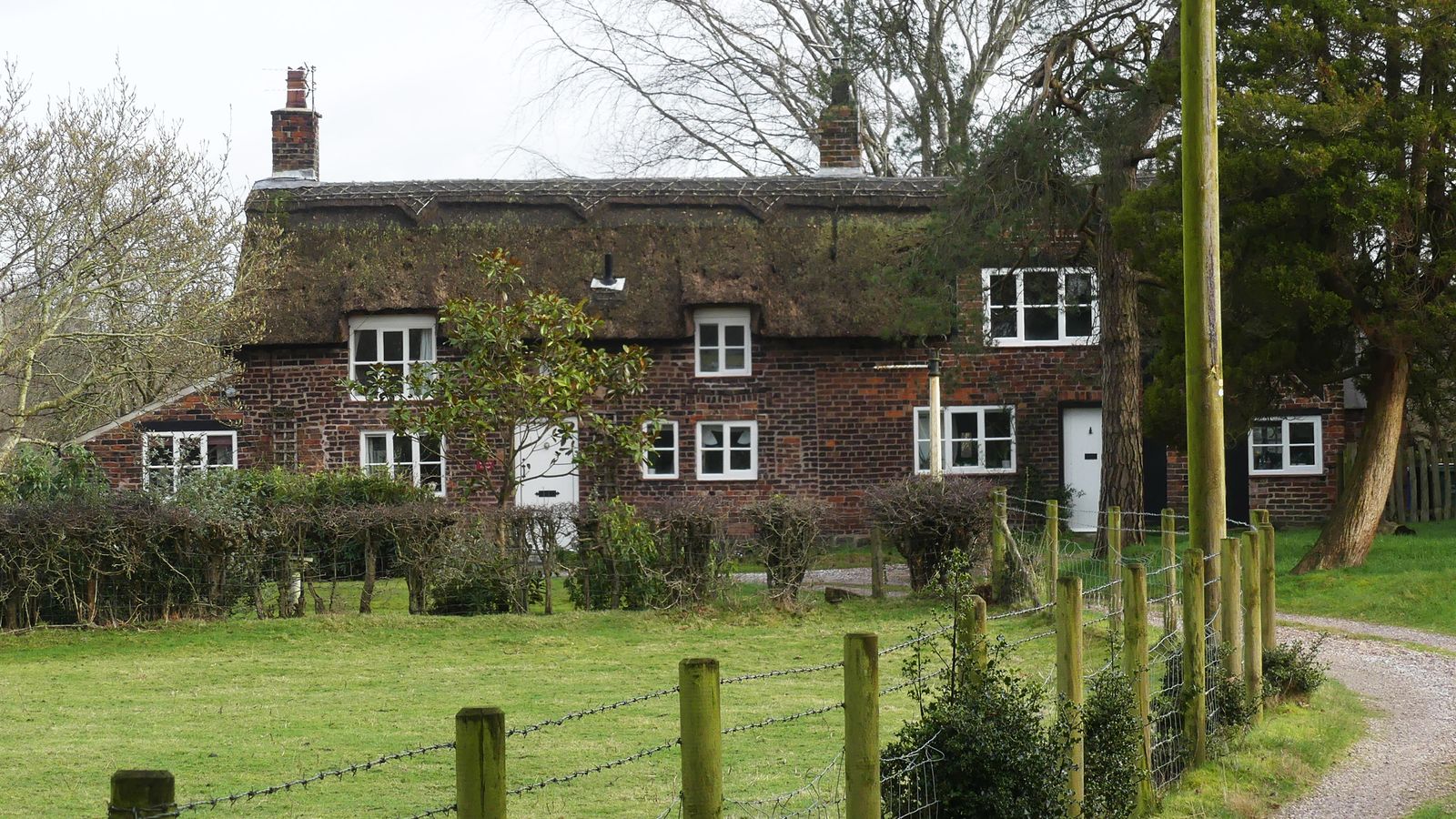
That figure was about to rise to 703, as Ken and Debbie were moving into a new home with their lodger and good friend Nicola Bagguley who was a budding writer of performance sketches. The three newcomers to the village had plenty of work on their hands, though. Ken had bought the keys to Meadow Cottage – a potentially picturesque yet dilapidated 18th century brick stone building in need of tender loving care, extensive restoration, and maybe a few buckets of paint and a novelty doorbell.
But as the trio rolled up their sleeves and got busy, they quickly discovered evidence of another presence lurking in Meadow Cottage, and it wasn’t being entirely helpful. It certainly wasn’t offering to have a go with the paint roller.
Ken began to notice six-toed dusty footprints randomly appearing on the interior cottage walls, as if some strange creature had been trying to walk right up them. Not thinking too much of it at first, he just painted over them, but to his annoyance, they kept reappearing in the exact same spots the very next day. It wasn’t the only weird activity taking place in Meadow Cottage.
Ken, Debbie, and Nicola also reported experiencing sudden gusts of freezing cold wind and the sounds of footsteps upstairs in empty bedrooms. Debbie recalls that she came home from the shops one day to find that all the furniture in the lounge had been stacked into a six-foot-high pile, whilst on another occasion she noted that dozens of tins of cat food had been arranged neatly in a pyramid formation on the kitchen floor.
At first, the trio all began to suspect each other of pissing about. But when the strange activity continued to occur – even after an exasperated Ken pointed out that it was slowing down the renovation of the cottage, and it was costing him a bloody fortune in wasted paint – they began to suspect that it was a prank being staged by other residents of the village. Perhaps it was an effort to drive out these new town folk and their peculiar modern ways.
Or it’s not entirely conceivable that it was just some kind of humorous welcoming ritual. But events in Meadow Cottage were about to take an even stranger turn which surely went way beyond a simple practical joke.
The BBC Micro and the First Message
When the story of The Dodleston Messages gets revisited in more recent years, it’s usually made out that barely anybody in the world had a computer at home in 1984. I’m not convinced that’s entirely accurate. Yes, it wasn’t anything like today where there’s a computer in every home, but plenty of people still had them.
But it’s certainly true that not many people had a BBC Micro Model B at home. This was mainly because rival computers such as the Sinclair ZX Spectrum and the Commodore 64 were significantly cheaper and boasted extensive catalogues of thousands of cool games in comparison to the far more serious and expensive BBC Micro which was largely lacking when it came to gaming support. Produced by Acorn Computers for the BBC Computer Literacy Project in 1981, the BBC Micro Model B was the boring-ass machine you would usually only find in schools getting huddled over by three or four kids all eager to have a go at pressing a button.
In fact, at one point, over 80% of UK schools owned at least one BBC Micro. And that included Hawarden High School where teacher Ken Webster was granted an opportunity to borrow one and take it home for a few days.
Although it’s believed that Ken was something of a computer enthusiast, he wasn’t really thinking about himself. The main reason that he brought it home was because he knew that lodger Nicola was interested in trying out a computer for writing her scripts and sketches. Perhaps when Nicola had finished with it for the night, he could tinker with it himself and knock up a budget spreadsheet to see exactly how much he was forking out for fresh paint every day. The BBC Micro Model B came packaged with a whopping 32k of memory, a floppy disk drive, and a pre-installed word processor which went by the name of EdWord 2.
But on the plus side, this chunky slab of primitive technology did appear to come packaged with a surprise portal into the past.
Before we go any further, we should pause to remember why the sudden appearance of a random message on a 1984 computer screen would have felt so puzzling at the time. Obviously, nobody had commercial internet access at home in 1984, and the BBC Micro didn’t even come equipped with any kind of modem. So the machine was entirely isolated and incapable of communicating with any network.
But it’s also worth bearing in mind that it didn’t even come equipped with a hard drive. You could open up the EdWord2 processor and create a new text document, but the only way of saving your work was to copy it onto an external floppy disk, otherwise it would be all lost forever as soon as you hit the power off button. Power cuts were so much more intense back in 1984.
So this is why the sudden appearance of such a random message on a computer which had been left unattended all evening raised a few quizzical eyebrows in Meadow Cottage. Ken, Debbie, and Nicola had all popped down to the local pub together to celebrate Christmas whilst hopefully avoiding getting spat on by the locals. For some reason, either Ken or Nicola had left the BBC Micro switched on in their absence but it was only displaying the boot screen. Upon their return, the trio stumbled back into the cottage to find that the computer screen was now displaying an EdWord 2 document which had been labelled “KDN” – presumably the first letters of the first names of the intended recipients – and signed under the slightly more mysterious initials of L.W.
The document contained what could either be described as a short poem or a cryptic riddle. But as short as it may be – just seven lines long – it’s still too long to recite here in its entirety because it’s mind-meltingly nonsensical. Just to give you a brief flavour, the message contains references to flowers reaching too high and withering in the sunlight, how faith is a redeemer, and something about Pussy Cat going to London to seek his fame and fortune. You never saw this kind of behaviour from a Commodore 64.
At this point, Ken Webster still suspected that either Debbie or Nicola were just pulling a prank, even if the punchline didn’t seem particularly funny or worthwhile. It’s not too hard to imagine how Nicola could have told the others that she’d left the computer on the boot screen before they departed for the pub, and then acted all surprised when they returned home. Perhaps this was just a snippet of the sort of material she was composing for her performance sketches, in which case it’s no wonder we’ve never heard her name since.
But Ken still wasn’t too troubled by any of this and had largely forgotten about it by the time he was ready to start tucking into the Christmas turkey. The BBC Micro was returned to his school very shortly afterwards and not much more was said about it.
The other weird activity in Meadow Cottage appeared to die down a little bit after Christmas, although there were still very occasional glimpses of odd footprints and echoes of strange noises. But things were taken to the next level when February swung around, and Ken was given another opportunity to borrow a BBC Micro from the school.
The Second Message and Lukas Wainman
Ken, Debbie, and Nicola had again returned home to the cottage following a day out, to find a second message waiting for them on the computer screen. This document was labelled ‘REATE’ which is interesting as it indicates that the author of the message hadn’t entirely got their head around how EdWord 2 worked. I couldn’t dig up an old manual for the ancient word processor, but I believe that it was possible to create a new document by holding down the CTRL button and pressing the letter ‘C’.
But in this case, it seems that the person who created the document felt that it was necessary to keep typing the rest of the word ‘CREATE’. Could this be the result of an inexperienced human user who was still finding their feet with this borrowed technology? Or, more likely, could it be the result of a slight technical error on the part of the powerful star wardens who were engineering this doorway into eternity from a crossroads in time?
If we’re to believe that the author of this new message – who again signed off with the initials L.W. – is genuine, then it’s not too surprising that he may have struggled with the concept of using a BBC Micro. By the sounds of it, he was also struggling to deal with the concepts of electricity and light bulbs. This second communication was more direct and straightforward than the first loony poem, but it was still composed in an archaic form of English which is difficult to comprehend on the first or even the 17th read.
Here’s a condensed version of the second message which appears to be directed towards Ken: “I write on behalf of many. What strange words you speak. You are a worthy man who has a fanciful woman, and you dwell in my home with lights which the devil makes. It was a great crime to have stolen my house.”
So we can glean a few bits of interesting information regarding the author from this rather more insightful and personal communication. For starters, he seems to think that Ken’s girlfriend Debbie is a bit of alright. He’s also somehow capable of observing the residents of Meadow Cottage from wherever he is in time, yet he appears baffled by the electric lighting which he can only put down to the work of the devil. And perhaps of most concern, he seems to be under the impression that Ken Webster has stolen Meadow Cottage from him.
Ken had now decided that it might be useful to get an outside opinion. He saved the message onto a floppy disk and printed it off at school where he showed it to a guy called Peter Trindle – a fellow teacher with a degree in English from Oxford University. Peter was more than a little sceptical at first, and suspected that either Ken was trying to wind him up or that Debbie or Nicola had made a good job of winding up Ken.
But as Peter studied the original olde-worlde-style version of the second message, he became quite fascinated by the content. Well, not so much with what the message was trying to convey about devil lights and stolen property, but rather in the way it was being expressed. Peter concluded that the dialect, sentence structure, and jargon was a genuine example of Middle English used widely in Cheshire in the 16th century.
Such dedicated authenticity would be pretty hard to just quickly whip up when everybody else in the house had nipped to the shops again to buy some more paint. Although Peter still wasn’t entirely convinced that it wasn’t just a hoax, he became quite interested in the theory that this was a genuine message hurtled through time by a local resident from over four hundred years ago.
But if the author did indeed hail from the 16th century as the language suggested, this did pose a few further questions. Well, I mean, yes, it poses quite a lot of questions such as “How was the author able to transmit a message onto a BBC Micro 400 years into the future when he seemed to be so baffled by electric lighting?” and “Was everyone in Dodleston just taking too much acid?” But let’s also not forget that Meadow Cottage wasn’t even built until the 18th century, so why was the author claiming that Ken had stolen his house?
Well, there was one way of getting a few answers out of the man. Ken could just try asking him.
A Conversation Across the Centuries
How exactly would you do that, though? Well, Ken figured that one idea surely worth a shot was just to write his own message on the same document on EdWord 2 and then wander away for a while to see if anything interesting happened in the interim. And bloweth me down with a feather, it worked.
Ken had opened up a whole new channel of direct communication with the man from the 16th century – a conversation which would run for a few years. It’s not entirely clear if Ken ever switched off the computer at any point, but I suspect he kept it on at all times in case the mysterious powers at work in Dodleston didn’t quite stretch to flicking on a BBC Micro that had been turned off. I mean, that would be bordering on the unbelievable.
And whilst we know that Ken continued to regularly borrow the computers from the school, at least for a little while, I assume that at some point he must have splashed out and bought his own. The kids of Hawarden High School must eventually have started feeling pissed off that they were always a computer short because Mr Webster was playing with supernatural forces again.
Over the course of the following weeks, Ken engaged in regular correspondence with the man from the past, usually receiving at least one new message on his screen per day, but only when his back was turned. The stranger from the 16th century gradually revealed in his antediluvian language that his name was Lukas Wainman and he lived in the year 1546 during the reign of King Henry VIII. Lukas claimed that he got a degree from Jesus College in Oxford and then went on to become a farmer, although he wasn’t currently a farmer in the best of spirits after losing both his wife and his son to the plague.
Lukas initially seemed a little annoyed that Ken, Debbie, and Nicola were trespassing on his farm land and making such drastic alterations to his property. Although Meadow Cottage wasn’t destined to be built for another two hundred years, Lukas appeared to live in an earlier dwelling on the exact same spot which was made from red sandstone.
Ken was intrigued by this as during the troubled house renovations, he had come across evidence of another structure buried under the kitchen floor which did indeed appear to be composed of red sandstone. The suspicion gradually thawed over time, as Lukas became a little chattier with Ken and Debbie, and it could even be said that a weird kind of friendship was forming between them. Lodger Nicola appears to have fallen off the radar by 1985, presumably having moved out of Meadow Cottage to find alternative lodgings in which the host didn’t keep hogging the computer all the bloody time.
There were occasional inconsistencies in some of the earlier messages from Lukas, almost as if a hoaxer was slipping up. When asked about the current age of King Henry VIII, his answer was miles off the true age of the king in 1546. And the fact that Lukas gained a degree from Jesus College is particularly impressive, considering that Jesus College wouldn’t actually be built until 1571.
When challenged about this, Lukas sniffily responded that he felt as if was being tested, and so he in turn was testing Ken and Debbie to see if they would pick up on his blatant errors. That could be regarded as a lame defence for getting the age of King Henry VIII wrong, but it’s a baffling defence for the Jesus College error – how would he have known that the college would be built 25 years in the future? Perhaps he had a mate on the Oxford City Planning Council.
Or perhaps he had more insight into the future than he was willing to let on at this stage.
It did seem as if Lukas had access to more functionality at his end in 1546 than Ken and Debbie had at their end in 1985. It was still clear that Lukas could somehow observe Ken and Debbie, but it was very much a one-way mirror. One afternoon, Ken had left a photograph of a Jaguar car lying around the cottage, and Lukas didn’t seem mightily impressed. He noted: “I have found your picture of the cart, but it is a crude thing for without the horse it won’t go far.”
He also shared his own thoughts on how they were all able to communicate with each other. He mused: “I think we are a history book that has its front and back pages joined together. We are each a side of it.”
It would later transpire that Lukas had a bit more to reveal on how exactly he had been given the gift of communicating through the corridors of time. And it involved a third presence lurking silently in this time-hopping party line. A presence from the future.
The 2109 and the Leems Boyste
In the meantime, all this appeared to be taking its toll on Debbie. She was now experiencing frequent vivid dreams in which she held long conversations with Lukas, and she constantly felt as if she was being watched in the house by something that was making eerie tapping sounds and even occasionally pulling her hair. She became even more freaked out when the messages from Lukas began referencing the conversations they’d shared in her dreams in words which meant nothing to Ken but meant everything to Debbie. She was now beginning to wonder if she was at the heart of all this – if she had somehow subconsciously brought Lukas Wainman to life.
Ken was still scratching his head as he tried to get to the bottom of this puzzle. The only real clue he’d managed to dig up so far which may or may not be of significance is that the messages only came through when the BBC Micro had the EdWord 2 ROM chip installed. If the chip was removed – even if it was replaced with the earlier EdWord 1 ROM – the BBC Micro just went all shy and wouldn’t play ball. The only two theories he could come up with from this is that it was either the EdWord 2 word processor that was specifically haunted rather than the BBC Micro itself, or that whoever was behind all this hadn’t been able to track down a manual for the earlier version of EdWord.
Ken eventually grew frustrated with his own fruitless speculation and decided that it was time to call in the experts. When your home is haunted by a mysterious invisible entity who has a habit of rearranging your furniture and cat food tins behind your back, who ya gonna call? That’s right. The Society of Physical Research.
This London-based non-profit organisation which explores psychic or paranormal activity may not enjoy quite the same funky reputation as the Ghostbusters team, and they certainly didn’t arrive armed with Proton packs, but they were the best option available to Ken at the time. Unfortunately, the three investigators assigned to the case seemed very sceptical of the whole thing from the very beginning.
They begrudgingly set up listening posts to capture unusual sounds, investigated the components of the BBC Micro, and sealed up the room in which the computer was kept for long periods to prevent any scope for human tomfoolery. Ken later claimed that even with such measures in place, new messages were still coming through, but the investigators just didn’t seem that interested. They apparently just came to the conclusion that it was still some kind of hoax being staged by either Ken, Debbie, or local troublemakers in the village.
We only have Ken’s word on this, though. It could be the case that The Society of Physical Research found no unusual activity at all when nobody could get to the computer, and they just buggered off home after a few days. We don’t know for certain because the Society never even bothered filing a report on the matter which seems a little odd.
You would never have received such sloppy service from Dan Ackroyd and his gang. It looked as if Ken and Debbie would have to go it alone for now.
Bearing in mind that Lukas had struck up an unlikely friendship of sorts with Ken and Debbie, it could only be a matter of time before Ken got around to asking Lukas what all the spooky poltergeist activity was about, and maybe even ask him to calm down a bit with all that nonsense as it was upsetting Debbie and the cat. But it turns out that Lukas didn’t have anything to do with it – in fact, he complained of similarly annoying activity at his end in 1546 which was upsetting the chickens on his farm. Somebody or something else was the invisible force behind the dusty footprints and the moving furniture. And it wouldn’t be too long before Ken was given a few more clues as to the identity of this third presence in Meadow Cottage.
During their early conversations, Lukas appeared to be labouring under the misapprehension that Ken and Debbie hailed from an even farther future than 1985. In one of Ken’s later responses to Lukas, Ken just happened to mention the current year for the first time, and this seemed to confuse Lukas, prompting him to send one of his most curious messages of all. He said: “You said your time is 1985, but I thought you were from 2109 like your friend who brought the Leems Boyste?”
I can’t be the only one who was wondering how exactly Lukas was writing and sending his own messages over four hundred years forward in time. Did he have his own BBC Micro at his end, installed with the EdWord 2 processor, but most definitely not the EdWord 1 version? Or considering the superior functionality at his end, maybe he had a far more futuristic system to work with? A Commodore Amiga, perhaps?
Well, it turns out that he was using a Leems Boyste, so that’s one little mystery solved, eh? But I’m afraid you’re out of luck if you were hoping for a definitive explanation of what this was or how it was used.
Lukas revealed that long before he started chatting with Ken and Debbie, he was visited by another person from the future who gifted him a device which Lukas referred to as the Leems Boyste – roughly translated as ‘lightbox’ or ‘box of lights’. Although Lukas is vague as to what exactly this is and how he uses it, the lightbox certainly seems a bit more powerful than your average BBC Micro Model B. For starters, he claimed that the lightbox was invisible to most of the visitors to his house.
And he doesn’t appear to be using a keyboard of any kind – instead he gives the impression that it’s more like gazing into a magic mirror which shows him people from the future such as Ken and Debbie. Lukas talks directly into the lightbox which transforms his speech into a EdWord 2 document in 1985, although I’m still a little lost as to how he receives and interprets Ken’s text responses. And whilst the box of lights sounds pretty impressive, it does have a couple of design flaws.
Lukas discovered that it completely stops working if it’s ever taken outside his home. And his connection to 1985 could be a bit temperamental – the signal came and went depending on who was inside the future Meadow Cottage at the time. Whenever Ken and Debbie were alone, Lukas got a good five bars of reception, but when other people were in the cottage – such as, say, three grumpy investigators from The Society of Physical Research – the signal went a bit dodgy.
Funny, that.
But let’s not get too bogged down with the technical details, such as they are – I’m sure we’re far more interested in the identity of this earlier mysterious visitor who gifted the lightbox to Lukas. Well, would you believe it, that’s a bit vague too. The entity apparently hails from the year 2109.
Lukas often refers to him as ‘One’ which may sound pretty singular, but just to confuse matters, Lukas also gives the impression that it may be a group of people which he collectively refers to as “The 2109.” When Lukas first started chatting with Ken and Debbie, he assumed for a while that they were both part of The 2109, and seemed surprised when Ken declared that he knew nothing about them. Could these shadowy characters from well over a hundred years into Ken and Debbie’s future be the real diggers of the Meadow Cottage Time Tunnel?
And if so, what were they trying to achieve? Well, there was one way of getting some answers out of The 2109. Ken could just try asking him.
Them. Whatever.
Contacting the Future
Watch Now
Open Video
Video Briefing
The Dodleston Messages: Cryptic Computer Warnings from The Past…and Future
How exactly would you do that, though? Well, Ken figured that one idea surely worth a shot was just to create a new document on EdWord 2 labelled ‘CALLING 2109’ and then wander away for a while to see if anything interesting happened in the interim. And bloweth me down with another feather, it worked.
By this point, Ken’s fellow teacher Peter Trindle was back on the scene, having become intrigued by the idea that Meadow Cottage was now not only a portal into 1546 but also a potential portal into 2109. It’s one thing deciphering archaic language from the 16th century to gain insight into the past, but what thrilling secrets of the future could be unlocked by deciphering tomorrow’s language from The 2109?
The first reply from The 2109 gave a taste of what was to come. The language felt surprisingly contemporary and easy to read, although it was frequently littered with weird spelling mistakes – unless of course the spelling of very basic words evolves dramatically over the next century. So, in a sense, the words were easier to translate than the messages from Lukas Wainman. But the bigger problem was in deciphering what the hell The 2109 was supposed to be waffling on about.
Or to put it another way, the biggest problem with The 2109 is that they insisted on spouting absolute bollocks.
Here’s the first message in full, with my apologies: “Ken, Deb, Peter, We are sorry that we can give you only two choices. 1) That you either have your predicament explained in such a non-rhyme way that you may have instant understanding but cause what should not be to happen, or 2) Try to understand that you three have a purpose that shall in your lifetime change the face of history. We, 2109, must not affect your thoughts directly but give you some sort of guidance that will allow room for your own destiny. All we can say is that we are all part of the same god, whatever he… it?
…is.”
Now, a grammar nazi would start having convulsions about some of this. Not just because the original version of this message contained almost child-like spelling mistakes and errors, but also because of the way The 2109 talks about presenting the trio with ‘two choices’. They are actually presenting two ‘options’ which in turn presents only one choice to make.
Common mistake today, and it seems, still a common mistake in 2109. Just to be clear, I’m not a grammar nazi at all. I firmly believe that you can write or speak in whatever way you like as long as your intended meaning is clearly understood and not open to misinterpretation.
This is why I would probably have made a rubbish English teacher. But this is where the messages from The 2109 fall down. They generally read like impenetrable riddles composed by a new age hippy who is trying to make out that he holds the key to enlightenment but is not nearly as clever as he thinks he is.
It now sounded as if that very first message that popped up on the BBC Micro – the weird poem about withering flowers and Pussy Cat going to London – was from the hand of The 2109 rather than from Lukas Wainman as previously assumed. Here are some more of the fried golden nuggets of wisdom that were spat out by The 2109 over the course of the next few years:
“How can we have a name? We are many but no more than one in the time to come. We have no retirement. Ah, what an age to be if the digits were reversed!”
“It is better to have no knowledge at all than to have a distorted view of the truth because of your lack of understanding.”
“We move at a speed so that we cover every point in your time and universe. We have no form. We feed off a neat energy that you will not have heard of”.
“The eyes are open yet nothing do you see. The grey retarding mass is your convict. Quietly, alone he sits in the dark waiting for sentence to be passed, and demanding through the eyes of the blind of unspoken questions to answers of ethereal kind. The soul he is the traveller, chain nor bar can hold him to frail flesh. Here is the ruler of time and space. Here is your God.”
This is not just any old new-age hippy, it sounds like a new-age hippy who’s indulged in far too many disco biscuits and is never coming back down again. It also has to be said that in contrast to the friendly tone of the conversations with Lukas Wainman, the communications from The 2109 were decidedly cold and often bordering on the condescending and even downright threatening.
One nice touch from The 2109 is that they admitted responsibility for the poltergeist activity in Meadow Cottage and agreed to nip it in the bud on Ken’s polite request, although they never made it clear why they were doing it in the first place. Ken also claims that The 2109 made a couple of accurate predictions which came true over the next few years, including the validation of Fermat’s Last Theorem which was first proposed in 1637 but not officially solved until 1995. They also provided the coordinates of an undiscovered star which matched the coordinates of a quasar discovered just a few years later.
But aside from this poltergeist termination and crystal ball gazing, The 2109 were rarely in the mood for a cosy chat, and it often seemed as if they found the interruptions from Ken and Debbie to be somewhat annoying. One of their later messages read: “We, 2109, are not without compassion but if you continue to disrupt our experiments then it is likely you will find your destiny.”
Although it’s hard to decipher much of real value from the dozens of messages composed by The 2109, we can just about ascertain that they are from a Tachyon universe, although they point out that our own current understanding of what a Tachyon universe might be is wholly incorrect. The 2109 are now embroiled in some kind of experiment with a wider cosmic purpose which is either beyond the understanding of the current residents of Meadow Cottage, or too dangerous for them to hear. Yet they also concede that they are not entirely in command of the experiment, but are merely attempting to guide Ken, Debbie, and Lukas Wainman through it safely and ensure that they don’t mess it up with their pesky human inquisitiveness.
However, The 2109 may not have been expecting the curveball that was thrown into the mix following events that unfolded in the 1576 segment of the Meadow Cottage Time Tunnel. If you thought that this story was already bat-shit crazy, then be warned it’s about to get as nutty as a mooncalf.
Thomas Hawarden and the Witchcraft Trial
Lukas Wainman only went and got himself arrested for witchcraft. Well, that’s if Lukas Wainman was his real name which it turns out it wasn’t. Although Lukas had previously claimed that his Box of Lights was invisible to most other people, it seems that this didn’t apply to everyone. When Ken and Debbie were checking the BBC Micro one day for any new messages from Lukas or any new wishy-washy drivel from The 2109, they were surprised to see a message from an entirely new person in 1546.
His name was John, and he was a good mate of Lukas. But he had bad news to impart. The local sheriff Sir Thomas Fowleshurst had heard rumours of Lukas and his devilish Box of Lights, and he had decided to arrest Lukas on charges of witchcraft and communicating with spirits.
John explained the dilemma in detail to Ken and Debbie: “The sheriff does ask that you speak to him in person rather than through the computer, which he can’t see. Otherwise the computer must be taken to Lukas in Boughton Prison to show that he spoke the truth. But it is not easy to move the device as it seems to disappear when any have tried. Only when Lukas is here does it appear solid. I beg a quick reply so I may go to him.”
During these exchanges, it was revealed that Lukas had been lying about his name all along. His real name was apparently Thomas Hawarden but he had been living under a pseudonym to protect his true identity from witch hunters, and he clearly hadn’t trusted Ken or Debbie quite enough to ever disclose his birth name. That didn’t dissuade Ken and Debbie from leaping into action to help rescue their friend from the fate of being burned alive.
They actually got pretty tough and hardcore with the Sheriff who reluctantly agreed to communicate with them via the Box of Lights, presumably in the presence of Lukas – sorry, Thomas – to ensure that the Leems Boyste didn’t suddenly disappear into thin air. Ken and Debbie threatened to use their mystical powers from the future against Sheriff Fowleshurst if Thomas wasn’t released immediately, and this eventually spooked the Sheriff enough to have Thomas released within a matter of days. Bravo for Ken and Debbie.
Not sure what they would have done if the Sheriff had called their bluff, though. Maybe they could have just started sending him cuss words from the 1980s.
But now they had another problem to contend with. For some reason, The 2109 was furious that Thomas Hawarden’s real name had been revealed. This had not been part of the plan. In their subsequent lengthy angry rant to Ken, they explained – in the very loosest sense of the word: “We, in your better interests, have made slight adjustments to your conversations.
Thomas is a person living in the 16th century, but, unknown to him, he is not quite what he seems to be. You must state how much information you have on this man -everything! Word for word. Avoid any other communication with him.
Desperation, be quick!”
Ken and Debbie were actually getting a bit fed up with The 2109 now, particularly after The 2109 had admitted to editing the conversations taking place between the 1540s and the 1980s in what may have been a failed attempt to stop the revelation of Thomas Hawarden’s true identity. Fresh out of jail, Thomas was feeling similarly distrustful of The 2109 and proposed a new more private method of communication with Ken which might eliminate any risk of outside interference. He suggested that Ken should leave a pen and a piece of paper by the side of the computer before he went to bed that night. Sure enough, Ken awoke the next morning to find an elegantly handwritten message had been inscribed on the paper which was signed by Thomas Hawarden.
I don’t know about you but this is all starting to get a bit far-fetched for me now. But from Ken’s perspective, this new method of conversation seemed to go unseen by The 2109, and proved useful for receiving more confidential messages from Thomas, even if Ken couldn’t respond in the same way. It would appear that the Box of Lights – which was interestingly described as a ‘computer’ by Thomas’s friend John – had even more swishy functions than we first thought, and that crack in the fabric of time wasn’t entirely focused on the BBC Micro after all.
The 2109, perhaps sensing that they were losing their grip on the experiment, had a final request to make of Ken which involved getting outside help from, of all people, a Ufologist. The 2109 made the request in a surprisingly direct and straightforward message: “We ask you to do the following. There is a brilliant researcher. A Ufologist.
We know you don’t like the word. His name is Gary Rowe. His ideas differ somewhat to yours, but nevertheless, he can help you with a couple of your problems. You may phone him at the number below and invite him to talk with you.
When he comes, show him this and ask him what he makes of it. Peter Trindle must do the telephoning. Tell him that you got this number from a UFO enthusiast.”
So it was that the nutty flying saucer spotter – sorry, highly respected Ufologist – Gary Rowe was dutifully called into Meadow Cottage to carry out his own deep specialist investigation into The Dodleston Messages. However, he didn’t really hit it off with Ken and the others. The problems started when The 2109 instructed Ken to print off its new messages, seal them in an envelope, and pass them to Gary without looking at the contents himself.
These messages were for the eyes of Gary Rowe only. This naturally irritated Ken quite a bit, and he started hassling Gary about what exactly these secret communications were all about, but Gary was adamant that he wouldn’t disclose the contents of the sealed envelopes. The 2109 later attempted to diffuse the tense situation when they sent this message to Ken: “The communication between Gary and 2109 is not of interest to you.
Gary has a better understanding of us than you do, his experiences are most definitely an advantage to this. You must not be ‘pushy’ with Gary, you underestimate his abilities and that indirectly is an insult to us. If you had opened your eyes a bit wider and read the communications more intensely you would have had half the advantage that Gary has.
Gary Rowe has and will serve his purpose.”
Did it work? Nah. Following one last game of secret squirrel, Ken lost his temper with Gary. It’s perhaps understandable why Ken had become frustrated, having been deeply involved with The Dodleston Messages since Day One but now getting shut out of the latest development in the mystery that had been haunting him for years. In response, Gary Rowe stormed out of the cottage and would never return, taking the secrets of the sealed 2109 messages with him.
The Final Communications
I guess this three-way conversation taking place across the 1540s, the 1980s, and 2109 couldn’t last forever, and it was Thomas Hawarden who was the first to leave the party. Although he may have been released from jail by the Sheriff, it sounded as if the other residents of Dodleston were still very wary of Thomas and his witchcraft box of tricks. He felt that he was being hounded out of the village and that his farm was under threat of being burned down in the middle of the night.
So Thomas had taken the decision to leave behind the farm, Dodleston, and his Leems Boyste. He now intended to catch a boat to Bristol with the ultimate aim of getting to Oxford and settling down in the same city at which he would have obtained his degree in Jesus College had it been built by then. But he also promised to write a book on his strange experiences and leave it in a place where it may eventually be found by Ken, Debbie, and Peter at some point in the future.
Within his very last communication, he wrote: “My true fellows and sweet maid, One day you will all sit down at my table for wine and meat by the river in Oxford where we shall read each other’s books and laugh and we shall speak of truth and good men. In your time my book is old but I shall not go to my god until it is written. Then we will all be truly embraced. My love to you all. I shall await you in Oxford. Thomas Hawarden.”
The idea of Thomas writing a book seemed to be confirmed by The 2109 in what proved to be their final communication with Ken and Debbie. The style of this final message harked back to the original nonsense poem found on the BBC Micro with references to pussy cats and withered flowers, along with stark warnings such as: “Knowledge will be your progress but your kind are coming close to getting their fingers burnt…indirectly, you may prevent this! Get out your bricks. Get ready to build. Write the book!”
In one of the more coherent parts of their conclusion to the final message, they wrote: “Thomas did eventually write his book and soon died shortly after. He placed it in a secure place. It shouldn’t take too many years to find it, though he wrote it in Latin with the help of a friend that he met in Oxford. We will finish now, you have a lot of work to do! There is no need for you to write back as we will have gone. Thank you for your cooperation. 2109.”
This final communication appears to be an urgent call for Ken to write his own book, along with a prediction that he will eventually hunt down the book written by Thomas Hawarden and left in a safe place over four hundred years earlier. Any such book written by Thomas Hawarden has still yet to be found. Still, Ken did get round to writing his own book which went under the name of ‘The Vertical Plane’ and was published in 1989.
The book recounts the full story of The Dodleston Messages from Ken’s perspective, and proved to be a popular read for thousands of readers, although others dismiss it as tedious waste of trees which is almost impossible to comprehend or finish. It actually went out print for decades to follow and rare copies often fetched around £500 on eBay, but a second edition with a little bit of additional material was finally published in 2022.
After communications had fallen silent over Meadow Cottage, the only other occasion in which Ken and Debbie stepped back into the limelight was an appearance on an episode of a 1996 BBC TV show called ‘Out of This World’ which delved into the kooky world of the strange and the mysterious, and staged comically cheap and tacky reconstructions of supposedly real-life events. I say that they stepped back into the limelight – they decided not to participate in the dramatic reconstructions, and instead chose only to appear in interviews which didn’t show their faces. The reason given was they just wanted to get on with their lives and didn’t want their faces forever associated with The Dodleston Messages.
And moving on with their lives is exactly what they did. Ken got a new job and moved to Manchester, presumably with Debbie, and we never really heard of them ever again. They fell as quiet as ghosts. It would have been interesting to find out if Ken Webster has ever again dared to switch on a BBC Micro since his Dodleston days, but for now he’s not saying.
He’s maybe still too busy trying to hunt down a copy of Thomas Hawarden’s book which admittedly, if ever found, could open up a whole new can of haunted worms. Sadly, it seems that Thomas hid the book a little too well.
Theories and Explanations
So, whilst we’re waiting for the discovery of the Thomas Hawarden book, what else do we have to work with that might explain what was really going on with The Dodleston Messages? It’s a case which certainly continues to inspire lengthy conjecture in lively social media groups and online forums, even nearly forty years later. Some of the wackier theories include the idea that Ken had indeed tapped into a time portal via the medium of BBC Micro, but that the Earth had been destroyed by the year 2109.
The group of experimenters from the future were operating from a Tachyon reality in a bid to change the course of history and prevent the Earth’s destruction. It’s also speculated that Thomas Hawarden – whom the 2109 described as being “not what he seems” – was not directly communicating from the year 1546, but was instead either a ghostly spirit wandering restlessly around Meadow Cottage in 1985, or even a member of The 2109 with a different agenda. It might even have been the case that Lukas Wainman and Thomas Hawarden were two entirely different entities, and whilst The 2109 were happy for Ken to chat with Lukas, they had serious objections to any communication with Thomas.
Another slightly different theory is that Debbie had become an unwitting medium who was tapping into her dormant telekinesis skills to awaken spirits from the past and future who were mooching about in the astral plane.
It’s quite interesting to note that one of the most frequent contributors to these long-winded online discussions is none other than Ufologist Gary Rowe – or at least somebody going under that name. Whilst Ken and Debbie seem to have largely retreated back into the shadows, Gary Rowe – if it is indeed the same man, which appears to be widely accepted – is happy to rabbit on until the cows come home. Unfortunately, he never seems to say anything remotely insightful.
He keeps banging on about how he alone has seen those mind-blowing secret sealed messages from The 2109, but he’s not allowed to share them with anyone under any circumstances. He kind of comes across as the annoying kid in the playground who wanders around chanting “I know something you don’t!”
Leaving aside the more outlandish theories for now, a more rational mind in search of a more plausible answer might naturally assume that this entire saga was just a hoax perpetrated by Ken Webster or others. It’s a thought which we’ll return to in a moment, but could there be any other possible explanation to explore first? I couldn’t dig up any information about what Debbie did for a living, but it does seem odd that Ken Webster and Peter Trindle were two teachers who would surely have more important and worthwhile things to do with their time than orchestrate such a long-running hoax.
According to his author’s biography, Ken Webster has a rich background in business and economics, and has held such titles as the Head of Innovation for The Ellen MacArthur Foundation and Visiting Fellow at Cranfield University. He doesn’t seem the type to piss about for years on end.
And some of the names that popped up in The Dodleston Messages aren’t necessarily just fictional characters created by a bored economics teacher; they check out with a little digging into the history books. For example, there was a real Thomas Hawarden who became a vicar in Gloucestershire between 1551 and 1554, although of course that doesn’t mean it was the same person who was gifted a box of lights a few years earlier. On a slightly more compelling note, there was a Sheriff on duty in Cheshire from 1529 onwards by the name of Thomas Fouleshurst – the name is spelt a little differently from the Sheriff Fowleshurst who had Thomas Hawarden arrested for witchcraft, but it’s pronounced exactly the same.
As for Peter Trindle, he was another highly respected teacher and language expert who put a great deal of effort into analysing the early messages from 1546, and reckoned that it perfectly matched the dialect and spellings of the region and the time. He insists that it would have been impossible to replicate this language so authentically in every single message, particularly as many of the responses came through so quickly. So that leaves us with the only obvious conclusion left on the table: The BBC Micro Model B was haunted. It’s not quite as uncommon as you may think.
Perhaps it’s more likely that the BBC Micro just happened to be installed with a very early and even shittier version of ChatGPT. Or, putting our serious hat on for a minute, perhaps it’s likelier still that the Dodleston Messages were somehow being sent remotely from another machine. One quite intriguing element here is that the EdWord 2 chip was manufactured in Clwyd which was a mere eleven miles away from Dodleston and only about five miles away from the school at which Ken and Peter worked.
Could there possibly have been any way in which a wayward employee of the manufacturers was toying with the residents of Meadow Cottage? And could this be why the messaging only worked on EdWord 2 rather than the earlier EdWord 1 chip? Whilst there was no way for the primitive BBC Micro to hook up with the fledgling World Wide Web, some retro techie types have speculated that the Dodleston Messages could have somehow been transmitted by early radio frequency signalling across a short distance from the Clwyd manufacturing plant.
It’s debatable whether this would have been remotely possible in 1985, and it certainly would never have worked both ways. The BBC Micro itself would also have had to be equipped with some pretty cutting-edge technology, and we should remember that Ken was borrowing different random machines from the school in the early days. Besides, none of this would explain how Thomas Hawarden managed to communicate with Ken by projecting his thoughts onto a piece of paper during their later conversations.
If it wasn’t the manufacturers of the EdWord 2 chip who were playing a prank, is there any chance it could have been somebody else outside of the Meadow Cottage inner circle, such as mischievous locals breaking in to plant the messages and move around the furniture? This is a pretty popular theory, as it might also explain why the peculiar poltergeist activity didn’t exactly involve plates and cups levitating across the room in front of Ken and Debbie. The dusty footprints and cat food tin formations all took place with no witnesses, and there was nothing truly amazing or otherworldly happening here such as blood spurting out of the kitchen walls. It was all stuff that could easily be done by humans with a few minutes to spare.
Some have pondered why Ken and Debbie didn’t just set up a hidden camera to monitor the computer and potentially catch a prankster – or maybe each other – in the act. If the messages still continued to spill through even when it was proven that nobody touched the computer, that could be an indicator that something truly strange really was going on in Meadow Cottage. But it’s understandable why Ken and Debbie didn’t go down this route, bearing in mind that the earliest camcorders first came onto the market in 1983 and they cost an absolute fortune – about $6,000 in today’s money. If they couldn’t afford to buy their own computer in the early days, they wouldn’t have been able to afford a camcorder, either.
I’m of the opinion that the biggest issue with the ‘village pranksters’ theory is that it’s almost as ridiculous as the theory that all the messages from 1546 and 2109 were completely genuine. There were well all over 300 messages received from either Thomas Hawarden or The 2109, not to mention all the ghostly activity that was going on, so this means that the pranksters would have had to break in undetected hundreds of times in a relatively short period for the plan to work. I know that home security wasn’t exactly hi-tech back in 1985, but this is stretching credulity just a little bit, unless Ken and Debbie spent their whole lives walking around in a daze.
The Case for a Hoax
If anyone is still clinging to the idea that The Dodleston Messages must therefore have been genuine, there are just a few too many suspicious elements for my liking, quite aside from the fundamental problem that the whole concept is as mad as a lightbox of frogs. There’s the aforementioned issue of Lukas Wainman – as he was known then – supposedly ‘testing’ Ken and Debbie by pretending that he attended Jesus College in Oxford when it wouldn’t have been built for another 25 years. Whilst some have questioned how on Earth Lukas could have known that Jesus College would be built in 1571, I suppose he could have learned this from The 2109.
It’s more puzzling why the name of Lukas suddenly changed to Thomas Hawarden later on in the story. Yes, maybe he was hiding under a pseudonym to evade witch hunters, but I can’t help feeling there was a different reason. There was no trace of a real Lukas Wainman dating back to the 16th century, but there most certainly was a Thomas Hawarden.
Could a potential perpetrator of the hoax have come across the evidence of a real Thomas Hawarden and decided to change the name of his main character to add a bit more credibility to his story? It’s also quite curious that the new surname matches the name of the nearby village in which both Ken and Peter taught at Hawarden High School. It was even the name of Peter’s house.
Sheriff Fowleshurt may be another person who really existed, but this part of the saga is particularly unconvincing, and the Sheriff acts in a most peculiar manner. Shortly after having Thomas Hawarden arrested for looking into a witchcraft lightbox, he himself decides to commit the exact same crime before releasing his prisoner and allowing him to take his sinister box of tricks with him. But even Sheriff Fowleshurt is not quite as unconvincing as The 2109 themselves.
You’re always going to have a bit of difficulty faking language from the far future as you have to try and predict how the language and orthography will have evolved over time. The potential perpetrator of this hoax seemed to try and get around this problem by just having The 2109 converse in a fairly modern manner, but shoving in loads of silly spelling mistakes to make the text look a bit distinctive. As for The 2109 themselves, they can’t seem to make up their minds about who they are, what they want, and whether or not they’re in charge of the experiments.
Most of their messages are just inane meaningless drivel which is trying far too hard to sound mysterious and clever but rarely says anything at all. If The 2109 really did come from the future, then sadly the future is full of idiots. Maybe that’s not so implausible.
The idea of Thomas Hawarden writing a book and leaving it somewhere for Ken Webster to find in the future is quite a clever idea, but it’s not an original idea. Fifteen years before The Dodleston Messages started coming through, Jack Finney wrote a novel called ‘Time and Again’ in 1970 which has been described by Stephen King as the greatest time-travel novel ever written. The novel includes a segment in which the narrator explains that he wrote this manuscript after travelling back in time to 1882, and then left it hidden in the New York Public Library for his friend to find in the future. Could this have been the stolen idea which inspired one of the final plot twists in The Dodleston Messages?
If, as seems incredibly likely, The Dodleston Messages was all just one big hoax, which of the main characters was behind it? When I first started digging into the story, I had my money on the lodger Nicola Bagguley. Well, no, first I had my money on the pet cat, but then I changed my mind and went with Nicola.
After all, she seemed to be a creative soul who enjoyed writing performance sketches, and maybe this was the ultimate performance sketch. However, as she disappears from the story quite early on, I think we have to rule out Nicola. Whilst we’re at it, I think we can rule out Peter Trindle too, as he seemed to be quite suspicious of the whole thing himself, and noted that during his own observations, the new messages usually came through when Debbie was in Meadow Cottage.
Debbie was also the only one who claimed to see visions of Lukas Wainman in her dreams, and appeared to be far more affected by the poltergeist than boyfriend Ken. However, the most accepted theory is that the hoax was perpetrated by Ken Webster, either with or without assistance from Debbie.
I actually have another final suspect in the frame which I find far more intriguing, but let’s stick with Ken for the moment. Ken admits in his own book ‘The Vertical Plane’ that he was growing tired of The Dodleston Messages and was keen to move on with his life by the late 1980s. That’s possibly an odd thing to say when you believe that you’re receiving messages from the past and the future – “I’m bored of all this potentially earth-shattering stuff that is happening to me, I think I’ll take up bowling instead.”
Whilst he was still at Dodleston, he also left behind his job at Hawarden High School and took up a new position which apparently was far more demanding and left him with very little spare time. It seems more than just a little coincidental that during the exact same period when Ken was allegedly growing bored of it all and found himself with less free time, both Thomas Hawarden and The 2109 suddenly decided to cease all communications and fall silent forever.
It’s possible that all this was a shrewd marketing plan gone wrong. Ken may have been setting us all up for the discovery of Thomas Hawarden’s manuscript which he intended to write himself but then had a change of heart. Perhaps he realised it would be quite difficult to write an entire book in the challenging 16th century language of Thomas Hawarden and it would fail to pass the intense scrutiny of experts who were bound to deem the manuscript to be a fraud.
It would be so much easier and less risky to just write his own ‘true story’ book on the matter and forget about the antique manuscript which was destined never to be found, despite the confident predictions of The 2109. Or maybe Ken just lost a bit of faith following the fairly cool reaction from the press which bordered on complete disinterest. Although certain quarters of the UK press usually lap up a good ghost story, this one didn’t seem to generate much interest at all at the time, aside from a small article in The Daily Mail.
Ken’s idea of writing his own ‘true story’ book under his own name may have proven to be his downfall. Dr Laura Wright of Cambridge University is a language expert who disagreed with Peter Trindle’s assessment that the Tudor text of The Dodleston Messages was authentic. She reckoned that the verb structure was hopelessly wrong and concluded “If it’s supposed to look like early modern English writing, it doesn’t even look close.”
But Dr Laura Wright also took the time to compare the text of all The Dodleston Messages to Ken Webster’s own language used in his book ‘The Vertical Plane’. And following close analysis of the use of adjectives in front of nouns, she concluded that the styles of writing were remarkably similar. It sounds as if Ken Webster may have written himself into a corner, and that The Dodleston Messages and ‘The Vertical Plane’ were both written by the same hand.
But here’s one final plot twist I want to throw into the mix before we reach the final page: What if Ken Webster never existed and the true perpetrator was nutty Ufologist Gary Rowe all along? If we rewind the VHS cassette back to that 1996 UK TV show ‘Out of this World’, there’s a fascinating moment which largely gets overlooked by followers of The Dodleston Messages. As I mentioned earlier, we never get to see the faces of either Ken or Debbie during their interview as they’re keen to protect their privacy.
The narrator also went to great lengths to stress that neither Ken or Debbie wanted to be identified. If that’s the case, then could it be that the shadowy Ken and Debbie were actually using pseudonyms? If they were that keen to protect their privacy, it seems a bit silly to have their real names plastered across the TV screens of Great Britain.
There’s not really much evidence at all to suggest that Ken Webster was a real person, or at least there’s not much evidence to suggest that the author of ‘The Vertical Plane’ was a teacher living in Dodleston named Ken Webster. At some point, somebody gave an interview to The Daily Mail, somebody wrote a book under the name of Ken Webster, and somebody gave a faceless interview on television. It’s true that a man who at least sometimes goes by the name of Ken Webster has an author’s biography and appears to have held some prestigious positions, but it’s not out of the question that he and Gary Rowe may be one and the same. It’s been tricky to dig up any concrete information about any of the main players in this story, so it can’t be ruled out that Gary Rowe just created his own cast of characters in a long-running work of fiction which never happened, in this dimension at least.
The idea that The Society of Physical Research allegedly got involved adds a little bit of authenticity to the story, but the fact that they never filed a report suggests that they only got involved in the author’s overworked mind. And it’s funny how when The 2109 were looking for a Ufologist to help make further progress on an experiment that was never actually explained, they selected a guy who just happened to live around the corner in Rhyl West – an electoral ward which was reportedly made up of precisely 2109 households at the time. Was that a cheeky clue?
Whilst Ken, Debbie and the rest of the cast of characters have slipped into obscurity, Gary Rowe is the only one still keeping the flame burning in his regular forum posts which often sound as nonsensical and meaningless as the supposed communications from The 2109. Perhaps Gary was on another marketing drive to help generate fresh interest in the 2022 reprint of ‘The Vertical Plane’. Or maybe he even plans to spill the beans one day on those secret communications in a book written under his own name.
This could be the latest development in a quite remarkable promotional strategy which has so far spanned nearly forty years.
Conclusion
Whilst I would conclude that The Dodleston Messages was almost certainly a hoax engineered by either the entity known as Ken Webster or the entity known as Gary Rowe, I’d be happy to eat an entire pyramid formation of cat food tins if I’m proved wrong by the discovery of a 16th century book penned by Thomas Hawarden which is deemed to be authentic. But which of these two potential books is likely to be the first to land in a bookstore near you? ‘My Quite Remarkable Adventures with The Leems Boyste’ by Thomas Hawarden?
Or ‘Okay Then, I’ll Tell You What Was Inside Those Sealed Envelopes’ by Gary Rowe? Placeth your bets now…
Simon Whistler
Simon Whistler is one of YouTube's most prolific educational creators. Decoding the Unknown is his methodical investigation into the world's strangest phenomena — examined with rigour, curiosity, and a healthy dose of scepticism.
Frequently Asked Questions
What was the BBC Micro Model B?
The BBC Micro Model B was a home computer released in late 1981. It was marketed as an innovative device that could serve as a personal electronic accountant, a gateway to private education, and a home help. It had a retail price of £400 and was designed to be the ultimate home computer.
What strange events occurred in Meadow Cottage?
In Meadow Cottage, strange events included six-toed dusty footprints appearing on walls, sudden gusts of freezing cold wind, sounds of footsteps in empty bedrooms, furniture being stacked into piles, and cat food tins arranged in pyramid formations. These events were initially suspected to be pranks but later became part of a mysterious series of communications.
What was the significance of the EdWord 2 ROM chip?
The messages from the past and future only appeared on the BBC Micro when the EdWord 2 ROM chip was installed. If the chip was removed, the computer would not display the messages, suggesting that the EdWord 2 word processor was specifically involved in the mysterious communications.
Who was Lukas Wainman and what was his connection to the messages?
Lukas Wainman was a man from the year 1546 who claimed to live on the same spot where Meadow Cottage was later built. He communicated with Ken Webster through the BBC Micro, using a device called the Leems Boyste. Lukas initially seemed annoyed that Ken and his girlfriend were renovating his former home but later formed a friendship with them.
What was the Leems Boyste?
The Leems Boyste was a device given to Lukas Wainman by a visitor from the year 2109. It allowed Lukas to communicate with Ken Webster through the BBC Micro. The device was described as a ‘lightbox’ or ‘box of lights’ and had the ability to display messages and observe the future.
Who were The 2109 and what was their role in the Dodleston Messages?
The 2109 were entities from the year 2109 who communicated with Ken Webster through the BBC Micro. They claimed to be conducting experiments with a wider cosmic purpose and provided cryptic messages and warnings. They also admitted to being responsible for the poltergeist activity in Meadow Cottage.
What was the outcome of the Society of Physical Research’s investigation?
The Society of Physical Research investigated the Dodleston Messages but concluded that it was likely a hoax. They set up listening posts and sealed the room with the computer but found no unusual activity when no one could access the computer. They never filed a report on the matter.
What happened to Thomas Hawarden?
Thomas Hawarden, whose real name was revealed to be Lukas Wainman, was arrested for witchcraft but later released with the help of Ken and Debbie. He decided to leave Dodleston and catch a boat to Bristol, intending to settle in Oxford. He promised to write a book about his experiences and leave it in a place where it could be found by Ken, Debbie, and Peter.
What was the final communication from The 2109?
The final communication from The 2109 urged Ken to write his own book and predicted that he would eventually find the book written by Thomas Hawarden. They mentioned that Thomas had written his book in Latin and placed it in a secure location. They also warned about the dangers of knowledge and the importance of building and writing.
What are some of the theories about the Dodleston Messages?
Some theories suggest that the Dodleston Messages were a hoax perpetrated by Ken Webster or Gary Rowe. Others propose that the messages were genuine communications from the past and future, involving time travel or supernatural phenomena. There are also theories about the involvement of local pranksters or advanced technology.
Sources
- Original Decoding the Unknown video: The Dodleston Messages: Cryptic Computer Warnings from The Past…and Future
- Hero image source by Dave.Dunford / openverse, by-sa.