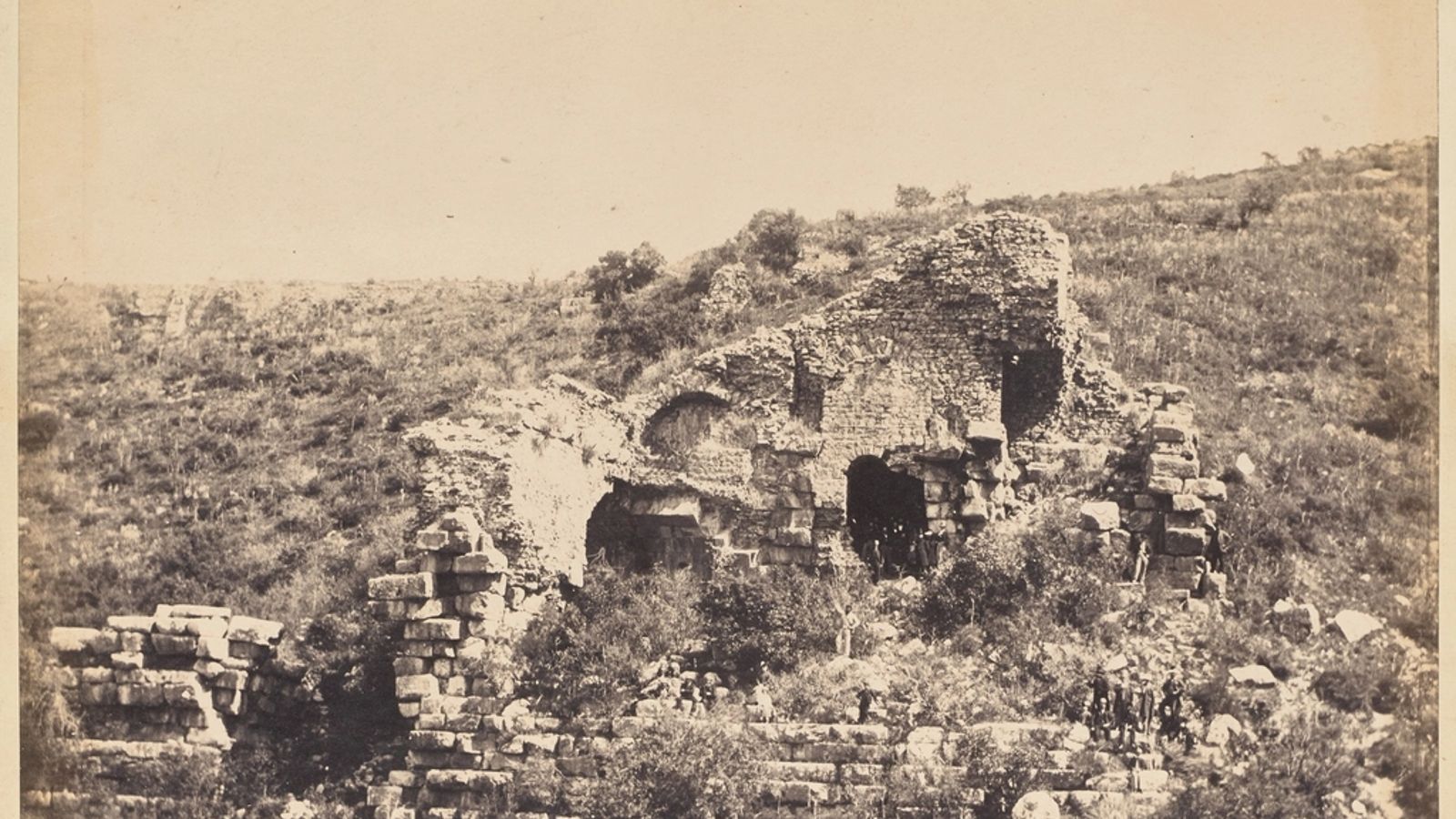
Today we’re travelling as far south as we can, to the icy continent of Antarctica, a land of extremes. Around 98% of the continent—that’s around 5 million square miles or 8 million square kilometres in total—is covered by ice sheets, some up to 3 miles (4.8 km) deep. On an average day, you can expect a balmy temperature of around -45 degrees Celsius (-46.3 degrees Fahrenheit) with a brisk breeze gusting up to 100 miles per hour.
It’s not exactly an ideal holiday destination, unless you’re a penguin, but if you’re looking for a quiet neighbourhood, you can’t do much better. With about 66 research stations, of which only 37 are in use all year, dotting the continent, you’re looking at sharing your icy abode with only about 4,000 people, spread out over a continent about 1.5 times bigger than the United States, during the peak summer months. So, if you don’t like queues and traffic, you don’t mind ancient or extra-terrestrial neighbours with some strange ideas when it comes to architecture, and you’re a Disney princess unbothered by the cold, you’ll fit right in.
Antarctica isn’t just a continent of extreme temperatures—it’s also a conspiracy theorist’s dream. The stories coming from the shores of the icy continent will either terrify or delight depending on your taste in fiction. Eyewitness accounts of alien craft zipping around the icy desert, world governments secretly working with extra-terrestrial invaders or colonizers, who knows, on secret projects, world billionaires spending a small fortune to recover alien tech and working with the aliens themselves to direct the course of world affairs, placing immense power in the hands of an elite few, and, of course the reason we’re all here today, pyramids—Antarctica’s got it all!
Key Takeaways
- Antarctica is a remote, icy continent with extreme temperatures and strong winds.
- The continent is covered by ice sheets up to 3 miles deep, with only 2% ice-free.
- Antarctica has been the subject of various conspiracy theories, including pyramids and alien activity.
- Geologists confirm that the ‘pyramids’ in Antarctica are actually natural mountain formations.
- Theories about ancient civilizations and aliens in Antarctica are largely unfounded and speculative.
A Pyramid in the Icy Desert
When we hear the word pyramid, the first image that comes to mind, for most people, is the Great Pyramids at Giza, rising majestically from the golden desert sand; however, pyramids are found all over the world. Mesoamerica, Mesopotamia, Sudan, Indonesia, even Rome—wherever ancient cultures flourished, pyramids were as inevitable as death and taxes. There’s still a lot of mystery surrounding pyramids—how they were built, why were they built, is there any significance to where exactly they were built and why a pyramid, why not a square or a circle? In fact, pretty much the only thing we do know is that, no matter where they are found, be it Egypt or Antarctica, pyramid building is definitely a marvel of ancient engineering.
In 2016, stories of pyramids in Antarctica took the world by storm. Satellite imagery showed a cluster of what appeared to be pyramids in the Heritage range of the Southern Ellsworth Mountains, first discovered by American aviator Lincoln Ellsworth, back in 1935, who either didn’t see the pyramid or didn’t bother to report it. One pyramid in particular looks like it was snatched straight off the Giza plateau and dropped in the icy wastes of Antarctica; but don’t worry, I checked and the pyramids of Giza are all accounted for.
The resemblance is especially striking when seen from above which is the angle most Google Earth users have seen it from since few of us can afford, or survive, an extended stay in the Antarctic. The base of the pyramid appears to be a perfect square, 2km on each side, with each side lining up perfectly with north, south, east, and west, and the sides of the pyramid seem fairly smooth. The whole construction appears to be far too precise for natural processes and hints at intelligent design.
The pyramid stands around 4,150 feet (1,265m) tall. The Great Pyramid at Giza, for comparison, is only about 481 feet, that’s around 147m tall. That would make our Antarctic pyramid the tallest and, quite possibly, the oldest pyramid ever discovered.
Of course, tales and conspiracies featuring pyramids on the frozen continent aren’t exactly new. The first pyramid was discovered in Antarctica by the British Antarctic Expedition of 1910–1913. Instead of telling the world, ‘they’ decided to keep the discovery of this pyramid a secret and claim that it was nothing but a mountain.
In order to keep this pyramid under wraps, the expedition named this ‘mountain’ The Pyramid and used the label ‘The Pyramid’ on every single geological survey and map of the area. Clearly, the world governments of 1910–1913 were a little vague on the concept of keeping secrets. However, around 100 years later, people would finally see through this diabolic double bluff and reveal to the world that The Pyramid wasn’t actually a mountain at all.
In around 2012, the tales were revived when several pyramids and pyramid-like structures were spotted by eagle-eyed Google Earth users. However, it’s the 2016 discovery that really got the ball rolling again with the discovery of three pyramids, including our Giza-look-alike—two pyramids can be found around 10 miles inland while the third lies closer to the coast. Apparently the government, I’m assuming the US government since they seem to be the culprit of choice in most conspiracy theories, even built a research base near these pyramids, in case there’s any doubt that these are, in fact, pyramids and not mountains.
Strangely though, considering the enormity of this find, and the implications for history and archaeology, details are a bit vague.
You see, a pyramid in Antarctica would quite possibly be the most important find in decades and throws a monkey wrench, one of those really big ones, into the works—everything we think we know about the history of human development will need to be re-evaluated. As for the conspiracy theorists, well, they’re having a field day! Since Antarctica isn’t really the first place that comes to mind when we think of the origins of mankind, where do these pyramids come from?
Mysterious Pyramid Builders
Traditional geologists, you know the ones who have degrees in this sort of thing and tend to keep themselves busy with scientific research, have long believed that no humans had ever settled on the Antarctic continent—it’s much too hostile to support human life. However, if these pyramids are, indeed pyramids, someone built them suggesting that, at some point in the continent’s past, someone managed to live there. There are basically two theories to identify the potential builders of the pyramids in Antarctica and, before I continue, I strongly recommend activating your ‘suspend disbelief’ setting. This is going to be a wild ride.
An Ancient Civilization
The first, and most obvious, suggestion is that the pyramids were built by a lost ancient civilization. The biggest problem with the idea of an ancient civilization settling in the icy desert that is Antarctica is, well, all that ice. Despite all the miles of frozen water, Antarctica is considered the world’s largest desert. The odds that ancient sea-farers arrived on its icy shores and managed to survive long enough to build shelter as well as find food with the necessary amount of calories for survival and drinkable water is very slim.
However, what if Antarctica wasn’t always a frozen wasteland?
In 2017, researchers drilling for ice core samples in a glacier in west Antarctica discovered over 65 different species of pollens, spores and other plant life in the layers of ice. I’ve seen this movie and we’re really lucky that’s all they found. However, horror tropes aside, this tells us that Antarctica wasn’t always a frozen wasteland.
At one time, the continent had a much warmer climate. This isn’t entirely news though—the discovery of dinosaur fossils in Antarctica is further testament to the notion that Antarctica was once a lush forest, similar to what New Zealand is today. Of course, contrary to what some folks believe, humans and dinosaurs didn’t co-exist, so the presence of dinosaur bones isn’t proof of human life.
However, some believers argue that Antarctica’s climate either remained warm and habitable long enough for a human civilization to establish itself after the dinosaurs went the way of, well, the dinosaurs or, perhaps, it had a warmer cycle far more recently. Some folks even theorize that Antarctica, or at least parts of the continent, was ice free until around 4000 BCE which is round about the time we see early civilizations start developing in regions like Mesopotamia. However, die-hards believe that the ancient civilization that built the pyramids in Antarctica was already flourishing long before the Mesopotamians built their ziggurats, a construction similar to a pyramid.
Dates for this supposed civilization range from 6,000 years ago to 12,000 years ago to millions of years ago, depending on who you ask.
One of the main proponents of the ancient civilization in Antarctica theory is Graham Hancock, a British author who started his career as an investigative journalist and who has spent the last 30 or so years writing books on ancient civilizations and pretty much going against mainstream archaeology as much as possible. Needless to say, he’s not very popular in academic circles, but his books have sold millions of copies so clearly he’s popular where it’s most financially advantageous. Hancock’s theories of an advanced civilization in Antarctica are based on a few sound scientific ideas, such as the fact that Antarctica once had a temperate climate. However, he also based some of his ideas on the work of Dr Charles Hapgood, Harvard educated historian and explorer, whose theories are a bit on the unconventional side.
According to Hapgood’s theory, Antarctica had a temperate climate and was home to an advanced civilization not too long ago. The reason why they were able to survive in Antarctica is because the continent, or at least part of it, wasn’t situated at the South Pole yet. In fact, the continent was closer to the equator.
However, around 12,000 years ago, a sudden, and I’m guessing probably somewhat violent, displacement of the earth’s crust relocated Antarctica from its nice, warm location down to the South Pole where it is today. Hapgood believed this shift could’ve occurred in less than a week, perhaps even a day, in which case the destruction would’ve been catastrophic. A natural disaster of that magnitude would’ve wiped out any civilization, in fact, most forms of life, if not all life, that managed to find themselves trapped on a landmass attempting to break a F1 record.
The layers of ice would’ve started building immediately, burying whatever remained deep under the ice and snow.
The idea of tectonic shift is sound; the earth’s crust floats on the mantle, so tectonic plates are always moving and colliding, but they do it very slowly over thousands and millions of years, so this theory seems a bit implausible. You would need an impressive catalyst to speed up this process to a matter of weeks, never mind a single day. Hancock claims that, according to Flavio Barbiero in his book A Civilization Under the Ice, a book I can’t find anywhere, this sudden shift from the equator to the South Pole was caused by a major impact event. Scientists have theorized that around 12,000 to 13,000 years ago, a giant asteroid hit the planet leading to a sudden warm period. The ice sheets melted, dumping a lot of fresh water into the oceans causing sea levels to rise around 400 feet. This, in turn, led to a sudden colder period known as the Younger Dryas period. Was it this impact that caused Antarctica to move over a thousand miles?
In 1966, Hapgood published a book, Maps of the Ancient Sea Kings which included, among others, the Piri Reis map, a world map compiled by Ottoman admiral and cartographer, Piri Reis, back in 1513, to further cement his theories. The map was rediscovered by scholars working in the Topkapi Palace Library in 1929. I say rediscovered but I’m not entirely sure it was ever really lost. Regardless, the map is supposedly very accurate, depicting details that other maps of the time missed like river inlets along the Brazilian coastline and the Caribbean Islands. Apparently, the map also includes notes on first encounters between the European explorers and the indigenous explored populations, but most significant is its depiction of a southern continent which appears to be Antarctica. The map includes geographical features, like mountain ranges and valleys, found underneath the ice-cap of Queen Maud Land in Antarctica using seismological instruments many centuries later. The coastline is also devoid of ice, but in the 1500s, Antarctica looked very much like it does today—a frozen desert. Officially, Antarctica was first sighted by Europeans in 1820, so how could it appear on a map drawn in 1513?
Admiral Muhiddin Piri, better known as Piri Reis, was a busy man. It’s unlikely that he had the time to sail all the way to Antarctica, map the coastline himself, and make it back home only for history to forget about what would’ve been one of the most impressive sea journeys of the age. A far more likely scenario, according to Hancock, is that Reis used earlier maps, around 20 of them, to compile his own map.
Whatever source maps Reis used have sadly been lost by now, but it seems that these original maps were remarkably accurate and must’ve been made by people with the navigational expertise to travel great distances and create very precise maps of their voyages. Since ancient scientists didn’t have the equipment we have today, whoever drew the map must’ve seen Antarctica’s coastline before it froze over. That’s the only way to explain the level of accuracy.
Of course, the only logical conclusion is that at least one of these mapmakers lived in the ancient equivalent of a comfortable apartment, with a great ocean view, within walking distance of all the amenities offered by the ancient civilization of Antarctica. The Piri Reis map also isn’t the only map to show an accurate Antarctic coastline free of ice. The Orontius Finaeus map, compiled in 1531 by French mathematician and cartographer Oronce Fine also shows what appears to be Antarctica; however, on this map, Antarctica is in the wrong place.
Of course, that only means that the source map for this particular map was drawn before Antarctica moved to its current position at the South Pole and has nothing to do with human error. Some theorists take this even further claiming that some of the interior features of this southern continent found on the Orontius Finaeus map, like mountain ranges, we only know of today thanks to satellite images, something they most definitely didn’t have access to in the 1500s, suggesting that, much like the Nazca lines, whoever drew the map had the ability to see the planet from above. The plot thickens.
However, if you really start digging into older maps, you’ll make a rather astonishing discovery—these two maps aren’t the only ones showing a southern continent. It was hypothesized at the time that there had to be a large landmass to the south to balance out the landmass in the north, so a lot of old maps indicate this hypothetical southern continent. Since it was just a theory though, no-one knew where exactly this continent was supposed to be.
As far as explanations go, that’s really boring, so we’re going with the far more unlikely, but far more exciting, theory that an ancient civilization was alive and well on a jungle continent drawing maps for future explorers to use in their maps. But, what happened to this marvelous non-frozen civilization?
Hancock believes that many of the older flood stories are not, in fact, just stories but rather based on a remembered history. We already mentioned the Younger Dryas period and the rising sea levels. Rising sea levels would lead to floods.
See where I’m going with this? Most cultures around the world have tales of a flood—in the Bible, Noah built an ark to ride out the flood. The epic of Gilgamesh, some ancient Egyptian texts, even Mesoamerican cultures, like the Aztecs, have tales of a global flood destroying most of the planet and everyone who lives there.
Which brings us to, you guessed it, Atlantis. According to some theories, the ancient city of Atlantis was in the southern hemisphere. Atlantis, for those who didn’t watch our fantastic video on Atlantis, was a city described in the works of the Greek philosopher Plato.
An ancient civilization whose hubris led to its destruction at the hands of some wrathful gods who leveled the city with an earthquake and then drowned it with a flood. Returning to the Younger Dryas period, when the sea levels rose, the ancient city, once thriving in the jungles of Antarctica, flooded. Finally, the continent moved into the position it is now, thanks to the impact event that led to the Younger Dryas in the first place, and everything just froze over.
This means that the ruins of this ancient civilization are still there, buried under miles of ice. If a mammoth could freeze with food still in its mouth, perhaps a frozen Pompeii is still waiting to be found buried deep in the layers of Antarctic ice. Hancock isn’t saying that Antarctica is Atlantis, there are some who believe that but Hancock isn’t one of them.
He simply believes that the stories of Atlantis might be based on an actual civilization that was destroyed by a flood.
So, did everyone die after this period of flooding and flash freezing? Well, no, and we know this because of the pyramids. Took a while but we’re back to the pyramids. After this natural disaster of biblical proportions, the ancient Antarcticans dispersed around the globe, presumably using their advanced navigational skills and superior ship building technology, making their way to other civilizations that were just getting started like the ancient Mesopotamians, Sumerians and Egyptians. Everywhere they settled, they shared their knowledge of how to build pyramids with their new friends and countrymen making the pyramid in Antarctica the blueprint on which all other pyramids are based. Obviously, the timeline is a bit wonky here since not all these civilizations left the starting line on the same day, but let’s not get bogged down by history. Anyway, this exodus of survivors explains the many similarities in ancient cultures across the world when it comes to astronomy and architecture—all this knowledge has the same point of origin. According to some Polynesian folk tales, compiled into a book, Out of Antarctica by French academic Robert Argod, published in 2001, there are stories of Polynesian folk heroes who travelled to an unknown land. The stories describe a strange land with white rocks that come out of the water, probably icebergs, and all manner of peculiar creatures that sounds very much like seals and penguins. It seems that these tales are describing what we know today as Antarctica and, to the Polynesian people, this was the place where their ancestors came from originally. And, before you ask, Rapa Iti, an island forming part of French Polynesia, is home to the Morongo Uta pyramids—a bit of a puzzle to archaeologists and historians alike. The ancient Polynesians were excellent sailors able to navigate vast distances. Did the Polynesian ancestors from the frozen desert teach their descendants the art of pyramid building and sailing?
Now, if you don’t think about it too hard, in fact, I recommend not thinking about it at all, this theory does make sense. The minute you start thinking about it, the theory has more plot holes than Swiss cheese. However, if this theory is correct, it would mean that there was an advanced civilization knocking around Antarctica back when it was lush and green, thousands of years before the human species even learned how to light a fire, never mind build a boat and figure out the first principles of cartography.
Apparently, in 2002, a TV crew for a production company called Atlantis TV set out to find proof of this theory and visited Antarctica to investigate a massive archaeological dig that was excavating something around 2 miles beneath the ice, according to rumour. As is usually the case in stories like this, the crew vanished without a trace. Navy rescuers later found their camp and their equipment.
Among the equipment, a videotape was recovered and shown to scientists at McMurdo station. Apparently, the tape showed images of amazing ruins buried miles beneath the ice—it seemed that a secret military expedition, and by military I mean the US military of course, discovered an entire pyramid complex and decided to keep it to themselves. Atlantis TV tried to get their property back, even suing the military, like that’s going to end well, but it seems that they lost and whatever the TV crew found will never see the light of day.
As for the company, they went out of business a few years later. I’ve not been able to verify any of this. I couldn’t find any record of an archaeological expedition to Antarctica in 2002 and the only Atlantis TV I could find is a French production company that’s still going strong, so I’m going to chalk this up as pure fiction, but who knows.
Perhaps the TV crew found the truth and it was buried so deep that no trace of the crew, the production company, or whatever they found, still remains.
Of course, not everyone believes that the ancient civilization who built the pyramids in Antarctica has gone the way of the mammoth. Apparently, they are still there, alive and kicking, either hiding in advanced complexes under the ice or working with world governments on secret projects. If you think the theories up to now have been a bit wild, hold onto your tinfoil hats. It’s about to get stranger.
Watch Now
Open Video
Video Briefing
Pyramids In Antarctica?
Operation Highjump
On August 26th, 1946, Operation Highjump, also known as the United States Navy Arctic Developments Program, departed for the South Pole led by Admiral Richard Byrd. It was the largest expedition to Antarctica to date and included 13 ships, 33 aircraft and 4,700 troops. Clearly they expected trouble, and according to those in the know, they found it, but more about that later.
The goal of the operation was more military than exploratory—they wanted to find ways to train and test personnel and equipment in icy conditions as well as evaluate the feasibility of establishing and maintaining bases in Antarctica, among other objectives. Admiral Byrd was a well-known figure, at the time the youngest man to ever make the rank of Admiral, and a celebrated polar explorer and aviation pioneer. However, in certain circles, he’s better known for his secret diary.
This secret diary only surfaced a few years after the Admiral’s death and has never been confirmed to be the real deal, but in this secret diary he tells a fascinating tale. This diary is often used to prove the truth of the hollow earth theory—another one of the greats when it comes to conspiracies and mysteries. The Hollow Earth theory, if you haven’t watched our fantastic video on Agartha, posits that the earth is, in fact, hollow.
It’s all there in the name really. However, not only is the earth hollow, there is another advanced civilization inside the core of our planet and the entrances to the hollow earth can be found at the north and south poles. According to one whistle blower, only known as Brian, in the early 1980s, during a rescue mission transporting an injured scientist from Davis station to McMurdo station, the crew flew over a remote camp labelled ‘air sampling station’.
The area was marked as a no-fly zone so off limits to planes, but there was a life on the line, so the navigator decided that a short-cut was necessary. As they flew over the ‘air sampling station’, the flight crew started having trouble with their instruments due to magnetic anomalies and they were losing power. Looking out the window, Brian saw a big hole in the ice.
He described it as a huge entrance to a cave, but slanted, going down. There were a lot of tracks criss-crossing the area, some even leading down inside the hole, so apparently there were a lot of people sampling the air. Luckily, the crew made it back to McMurdo station and the patient survived, but the crew found themselves in the commander’s office where they were informed that they were not to tell anyone about what they saw.
In fact, they didn’t see anything at all. Did Brian and his crew spot the entrance to the hollow earth?
According to Byrd’s diary, he had encounters with strange beings communicating telepathically inside the earth and while they weren’t fans of nuclear weapons, their stance on pyramid building is a bit unclear. However, what’s of more importance to us is the jungle. While flying across the continent, Byrd claimed to have spotted a lush green jungle, complete with wildlife, waterfalls and whatever else you’d expect to find in a lush green jungle, somewhere in the heart of the Antarctic continent.
A vibrant green jungle, teeming with wildlife, definitely sounds like something that could sustain human life. The idea of a green patch anywhere on the Antarctic continent might sound ridiculous to you and me, but one theory suggests that geothermal phenomena, in other words things like hot springs and volcanic flows, could create a microclimate in valleys protected from the icy conditions that plague the rest of the continent. These microclimates could’ve supported an ancient civilization at some point.
Of course, some argue that not only do these pockets exist, there are still advanced humans, or at the very least, advanced beings living in these pockets. If like me you’re wondering why the ever vigilant seekers of truth who spend hours on Google Earth looking for anomalies haven’t spotted a bright green jungle in the white waste of Antarctica, that’s easily explained. Certain areas of Antarctica are blurred out in Google Earth images, and Antarctica has a whole lot of no-fly zones, so other than Admiral Byrd, no other pilot or flight crew have ever reported spotting a jungle anywhere on the continent.
Is our pocket of pyramid builders hidden behind a blurred image in a no-fly zone?
If not in a blurry no-fly zone, perhaps our pyramid builders can be found in a lake. In 2013, scientists from the University of California, Berkeley, discovered an enormous underground lake, about the size of Lake Erie, 2,500m beneath the layers of Antarctic ice, which could possibly support life. While this is an indisputable scientific discovery, there are some interesting theories that came with it.
Some believe the lake itself could be the home of a race of ancient peoples that have been living down there for centuries, protected from the harsh Antarctic climate. Honestly, “pyramid building mermaids in Antarctica” was not on my bingo card when I started writing this script, but here we are. However, if that sounds ridiculous, the lake could be the gateway to an underground world, home to a variety of strange creatures, perhaps even intelligent life; however, whether that intelligent life originated on this planet is a whole different question.
I warned things were about to get stranger but, as we say in South Africa, hold my beer cause we’re not done yet.
Aliens in Antarctica
While some are leaning towards an ancient civilization being behind the pyramids, others believe that ancient humans couldn’t have built the pyramids, any pyramid, pick one, themselves. They had outside help, so the ancient civilization that flourished in Antarctica when it had a more temperate climate did so with the help of little green men, or tall grey men, or reptilian men, or whatever you think aliens look like. Personally, I favor whatever Harry Vanderspeigle is supposed to be in Resident Alien. These otherworldly visitors helped the ancient peoples develop advanced technologies which they used to build impressive structures and cities, and, of course, pyramids. Apparently, in his dialogues, Plato basically tells us that Atlantis was an extra-terrestrial colony. Clearly I have to go read the dialogues again because I completely missed that detail the first time round.
This brings us back to Operation Highjump with its complement of 13 ships, 33 aircraft and 4,700 troops supposedly heading to Antarctica for exploration. It may come as no surprise to you that that was just a cover. The real objective of the operation was to investigate alien encounters and find advanced alien technologies hidden beneath the icy wastes.
Admiral Byrd himself once said that Antarctica was ‘the center of the new development of the world’. Personally, I think he was referring to scientific endeavors, but apparently I’m completely wrong. He was actually referring to the discovery of advanced technology, either alien or ancient depending on which theory you favour.
However, things went sideways and the expedition returned nine months later after fighting a battle in Antarctica, probably between remnants of the Third Reich, we’re in Antarctica, of course there are going to be Nazis, and some extra-terrestrials though it’s unclear if it was a three way battle or whether the aliens were allied with the Nazis or the Americans. I’m fairly sure that even an alien threat couldn’t convince the Americans and the Nazis to fight together. Regardless of who was fighting who, military personnel on the ground, though no names are ever mentioned, told stories of craft coming out of the water and attacking them, and these flying saucers apparently gave the American forces a run for their money.
Where exactly these stories come from is a little vague; however, any story making Americans look bad, especially against flying saucers, could probably be traced back to the Soviets—we’re so deep in conspiracy theories at this point, I feel like we’d be failing if we didn’t insert one of our own. Apparently, in March 1947, Byrd even reported that there was a new enemy that had been discovered that could fly from one pole to the other in an instant. I’ve researched Admiral Byrd pretty thoroughly, but I completely missed that quote as well.
It seems that I’m not a very good researcher. According to some reports, Admiral Byrd was hospitalized soon after he said this, and he was also told never to do an interview again. He finally passed away in 1957, peacefully at home, from a heart ailment—or so they say.
All the proof of these ancient, extra-terrestrial cities, including eyewitness accounts from military personnel who claimed to have seen unusual structures and relics uncovered during Operation Highjump, has been classified and tucked away in secret warehouses by the US government to keep the truth of the wonders of Antarctica and the ancient world from the rest of us. Apparently, the government decided that these discoveries were too disruptive or could lead to large scale panic should it ever become known to the general public. Of course, being able to study these artifacts and reverse-engineer them would give the US a great military advantage, so keeping it out of the hands of the Russians, for example, was another important reason for keeping it all secret.
Besides, the government already built secret warehouses for all the artifacts Indiana Jones kept bringing home so they had the space. Might just as well use it I suppose.
Apparently, tales of aliens in Antarctica died down a little bit after the 50s, but in the last 10 or so years, multiple whistleblowers have stepped forward with their own stories about weird things happening on our southern continent. In 2018, a man claiming to be a retired Navy SEAL came forward with an incredible tale of entering an ancient structure in August 2003 while on a mission to recover a certain scientist and his work. Of course, we don’t know the man’s true identity, but his story was imaginative and very detailed—I’m sure his high school English teacher is very proud.
The team came across an octagonal structure protruding from the ice. The doors were thick and sturdy, but you could push them open with one finger. The temperature inside the building was warmer than outside and a lime green light illuminated the ceiling, walls and floor though they couldn’t tell where the light was coming from.
The walls were covered in what appeared to be hieroglyphics of a sort, but nothing like the hieroglyphics he’d ever seen. I’m not sure how much training Navy SEALs get in hieroglyphics, but perhaps he’s a history nut. Now, this is obviously not a pyramid, but apparently Antarctica was prime real estate for aliens and, if stories are to be believed, there are abandoned ancient structures, or alien structures, or both, all over the continent, so it’s really no surprise that the aliens or ancients, or ancient aliens, built pyramids.
Many years later, our man Brian again, was out on another rescue mission to pick up scientists from a research station on Mary Byrd Land. The researchers had vanished and a rescue team sent to investigate the disappearance reported that there were no signs of a struggle—the scientists were simply gone. A few days later, they suddenly reappeared, calling McMurdo and asking for an immediate pick-up.
They wanted to get out of there and they wanted to get out now. The flight back to McMurdo was two hours long and in those two hours, none of the scientists said a word. Upon arrival at McMurdo, the scientists’ equipment was stored and later transferred to Wright-Patterson Air Force Base in Ohio.
Now, apparently, if you’re up to date with your UFO lore, this is where recovered craft is packed off to. I thought that was Area 51 but clearly my UFO knowledge is a bit out of date. Apparently, this was also the HQ for Project Blue Book, the Air Force UFO investigation unit.
After this most peculiar and silent trip, the rescue crew was called into the commander’s office and, once again, informed by two men wearing plain clothes, freshly arrived from Washington D.C., that they would never speak of this incident again. In fact, none of this ever happened.
So clearly there is a hidden UFO base in Antarctica and these extra-terrestrials may or may not be the original builders of the pyramids. But why would you want to build a pyramid in Antarctica? As we’ve seen, you get pyramids everywhere, even Polynesia, and, according to one theory, the Antarctic pyramid is just one node in a global network of pyramids. The triangular structure of a pyramid is some kind of power generator and this network of pyramids were designed to transmit huge amounts of energy wirelessly across the globe. All this generated power doesn’t seem to be of much use to us lowly commoners, especially in South Africa where we have so many power outages that it has an official name and a schedule that you can check, but ancient ships, presumably from these ancient advanced civilizations, or extra-terrestrial craft powered by superior technology, could use this sea of wireless energy to navigate around the planet. Of course, to cover the whole planet with this blanket of wireless energy, there would have to be some pyramids in Antarctica. Makes perfect sense I suppose. Others have claimed that the pyramids were built as launching pads for alien spaceships. I never realized Stargate SG-1 was a documentary; here I thought it was just fiction.
What’s Going on in Antarctica?
Pyramids aren’t the only hint that something was going on back in the early days of the Antarctic continent. Seismic surveys, meant to map the bedrock of the continent beneath all the layers of ice, have revealed features that could possibly have been man-made, or, at the very least, altered by humans, or some kind of beings, like a uniform plateau, possibly to support buildings or other structures. Aliens, ancient civilizations, Nazis—who built the pyramids, when did they build them and why? It seems that we have many unanswered questions, but I fear we are missing the most important question of them all—are there actually any pyramids in Antarctica to begin with?
According to geologists, the answer to this is a resounding no. These pyramids aren’t actually pyramids but mountains—the result of an extraordinary, but still very natural, process of weathering and erosion. If you pay attention, you’ll notice that the pyramid shape is not very complicated, so it does show up in nature, especially when it comes to mountains. A four-faced pyramid peak, such as the one found in Antarctica, is called a glacial horn or a matterhorn, named after the Matterhorn in the Alps, quite possibly the best known example of this kind of mountain.
Most mountains are made up of various different types of rock which is why the erosion might be more pronounced on one or two sides, depending on the direction of the prevailing wind, rain, and the type of rock. The peak in Antarctica, the mountain that would win the prize for the best Giza pyramid impersonation of the century, eroded away on all sides at a similar rate suggesting that the mountain mostly consists of one type of rock and is experiencing similar wind conditions from all sides which is not unexpected in Antarctica. Of course, these types of mountains usually only have two sides, so a four-sided horn is a little unusual, but it’s not impossible.
The unnamed mountain may have gained fame with its ‘discovery’ on Google Earth, but it wasn’t exactly a secret or a new feature suddenly exposed out of the ice. In fact, there are so many pyramidal shaped mountain peaks in Antarctica that it seems researchers are no longer bothering to name them. We have the Pyramid, a peak named by the British Antarctic Expedition of 1910–1913.
Another Pyramid can be found near the head of Hope Bay on the Antarctic Peninsula, so named by the Swedish Antarctic Expedition of 1901–1904. Pyramid Mountain can be found in the Quartermain Mountains while another Pyramid Mountain lies along the Ferrar Glacier and Mount Pyramid can be found in the Churchill Mountains. Many photos of Antarctica often show scientists hard at work or hikers, probably scientists on their day off, hiking through the icy landscape with pyramid shaped mountains in the background, but no-one in the photo seem at all interested in them.
Clearly, there are far more interesting things going on in Antarctica than pyramid-shaped mountains.
Conclusion
Most mysteries we decode on this channel require some suspension of disbelief in order to seem somewhat plausible. In this instance, not only did we have to suspend disbelief, all measure of rational thinking got tossed out the window of a fast-moving freight train somewhere in Siberia and is now buried so deep underneath the ice, it’ll never be found again.
Antarctica was never near the equator, and it certainly didn’t break the tectonic plate record moving all the way to the South Pole. The Antarctic continent has always been pretty much where it is now—it was the earth around it that warmed and cooled. In order for an ancient civilization to thrive in Antarctica, they would’ve had to exist 100 million years ago which is highly unlikely.
The first hominids only arrived on the scene around 2 million years ago and were nowhere near sophisticated enough to build pyramids or engage in vast ocean voyages, mapping unknown continents. As for the incredible discovery of pyramids in 2012 and again in 2016, it might’ve been news to the rest of the world, but scientists have been aware of the existence of these pyramid-shaped mountains for over 100 years. If there was any chance that they were anything other than mountains shaped by millions of years of erosion, someone would’ve taken a closer look by now.
Tales of governments hiding the existence of ancient civilizations, alien technologies, and pyramid complexes buried beneath the ice seems highly improbable. Research in Antarctica is tightly regulated by the Antarctic Treaty, so it’s unlikely that anyone would be able to hide anything for any length of time. The logistics involved, and the cooperation needed between governments, in order to make sure that every researcher working in Antarctica either keeps their mouth shut about what’s going on down there, or never stumbles across anything they’re not supposed to see, seems much too complex to have been maintained for over 100 years. I’m sure anyone who’s ever had to put up with any kind of government bureaucracy can attest to this.
Sadly, it seems that tales of pyramids in Antarctica is a simple case of much ado about nothing. In fact, the pyramids in Antarctica story feels like a greatest hits compilation. It seems that someone made a list of all the most popular and enduring conspiracy theories over the last couple of decades and built one conspiracy combining elements of all their favorites.
If anybody feels like a game of Decoding the Unknown Bingo, the mysteries covered by this one conspiracy include Atlantis, a global flood, the Hollow Earth theory, the Piri Reis map, advanced ancient civilizations, alien visitations, Nazis in Antarctica, Reptilians manipulating and shaping the direction of world events, the New World Order and, if you dig deep enough, even the Knights Templar and the Ark of the Covenant gets a special mention. Of course, if I wrote this story, I would’ve tossed in the Holy Grail and at least one lost treasure for good measure, but I suppose you can’t have it all.
Simon Whistler
Simon Whistler is one of YouTube's most prolific educational creators. Decoding the Unknown is his methodical investigation into the world's strangest phenomena — examined with rigour, curiosity, and a healthy dose of scepticism.
Frequently Asked Questions
What is the temperature like in Antarctica?
On an average day, you can expect a balmy temperature of around -45 degrees Celsius (-46.3 degrees Fahrenheit) with a brisk breeze gusting up to 100 miles per hour.
How many research stations are there in Antarctica?
There are about 66 research stations in Antarctica, of which only 37 are in use all year.
What percentage of Antarctica is covered by ice sheets?
Around 98% of the continent, that’s around 5 million square miles or 8 million square kilometres in total, is covered by ice sheets.
When were pyramids first discovered in Antarctica?
The first pyramid was discovered in Antarctica by the British Antarctic Expedition of 1910-1913.
What is the height of the tallest pyramid in Antarctica?
The pyramid stands around 4150 feet (1265m) tall.
What is the theory about the Piri Reis map?
The Piri Reis map, compiled by Ottoman admiral and cartographer Piri Reis in 1513, includes a depiction of a southern continent which appears to be Antarctica, complete with geographical features found underneath the ice-cap of Queen Maud Land in Antarctica.
What is Operation Highjump?
Operation Highjump, also known as the United States Navy Arctic Developments Program, was the largest expedition to Antarctica to date and included 13 ships, 33 aircraft and 4700 troops. It departed on August 26th, 1946, led by Admiral Richard Byrd.
What is the Hollow Earth theory?
The Hollow Earth theory posits that the earth is hollow and there is another advanced civilization inside the core of our planet. The entrances to the hollow earth can be found at the north and south poles.
What are the theories about the pyramids in Antarctica?
Theories about the pyramids in Antarctica include the idea that they were built by a lost ancient civilization, that they were built with the help of extraterrestrials, or that they are part of a global network of pyramids designed to transmit energy wirelessly across the globe.
What do geologists say about the pyramids in Antarctica?
Geologists say that the pyramids in Antarctica are not actually pyramids but mountains, the result of an extraordinary, but still very natural, process of weathering and erosion.
Sources
- Original Decoding the Unknown video: Pyramids In Antarctica?
- Hero image source by thegetty / openverse, cc0.