As Sherlock Holmes will tell you, footprints are fascinating. Where there once was a foot, there’s now a print and if you can find the foot, you can solve the mystery. However, on the odd occasion, instead of answering the question, footprints can actually just deepen the mystery leading to lots of tourists and the money they bring as was discovered by the peaceful inhabitants of Glen Rose, Texas.
Glen Rose is a small town despite everything being bigger in Texas with a rather colorful history. It started as a trading post, eventually drawing all kinds of self-styled healers thanks to the natural mineral springs before becoming a moonshining hotspot during prohibition. Today, the town is once again flooded with tourists, but not those in search of healing or moonshine, but rather those in search of dinosaurs and Jesus.
In one weekend, you can visit Dinosaur Valley State Park to see some dinosaur tracks and visit the Creation Evidence Museum of Texas to learn about how the earth is only around 6000 years old – and this time, they have proof. For mixed in among the dinosaur tracks along the Paluxy River, is a different footprint, belonging to no beast, which will completely overthrow evolution and prove, once and for all, that the Young Earth Creationists were right all along and geologists should give up their jobs and become truck drivers. Just what life-shattering, world-changing evidence is tucked away in Glen Rose, Texas?
Key Takeaways
- Glen Rose, Texas, is known for dinosaur tracks and controversial human-like footprints.
- The Paluxy River’s dinosaur tracks were first discovered in 1908 by George Adams.
- Young Earth Creationists and evolutionists debate the authenticity of human-like prints.
- The Taylor trail is a famous site with overlapping dinosaur and supposed human footprints.
- Critics argue that many of the human-like prints are eroded dinosaur tracks or carvings.
The Great Discovery
In 1908, the town of Glen Rose saw destruction on a massive scale. The Paluxy River, well known for its occasional flash flooding, threw a tantrum to be remembered, ripping up sandstone slabs from the riverbed and washing boulders the size of a Volkswagen downstream. However, what initially looked like disaster would become a blessing in disguise for it wasn’t long after this flood that a discovery was made that would put Glen Rose on the map for good.
In the spring of 1908, shortly after the devastating flood, a local teenager, young George Adams, was off exploring a tributary of the Paluxy River known as the Wheeler branch. Why exactly a teenager was in the river that day has been lost to history but having grown up next to one, I’m fairly sure it had nothing to do with the scenery. While doing whatever he was down there for, young George came across a series of very large, three-toed footprints in the limestone floor of the river. George wasn’t the first person to come across tracks like these – Native American tribes in the area had discovered tracks like these much earlier, describing them as “giant turkey tracks”, and considering that birds today are the descendants of theropod dinosaurs, they weren’t too far off the mark.
However, George wasn’t all that familiar with dinosaurs. The word dinosaur had only been coined in 1842 by Sir Richard Owen, and the first American dinosaur had only been discovered in 1858 so the concept of dinosaurs was still relatively new. It would be a few more years before Jurassic Park became the smash hit that just keeps on giving. Luckily, the local schoolmaster, Robert E.
McDonald was a little more familiar with dinosaurs and at first glance was able to crush dreams of giant turkeys and a Thanksgiving you’ll never forget by identify the tracks as dinosaur tracks. This is the kind of thing I expect from schoolmasters, so hopefully the man got a raise.
Over the years more tracks were discovered by the local residents of Glen Rose, and we’ll be getting back to some of those a bit later, but, as interesting as the prints were, the people of Glen Rose had bigger problems. There was that big war in Europe that kicked off in 1914, prohibition in the 20s, and the Great Depression in the 30s, to name a few, so a couple of dinosaur prints were a fun diversion but nothing more. That all changed in 1938 with the arrival of Roland T. Bird.
A field explorer for the American Museum of Natural History in New York, Roland T. Bird, a man very aptly named considering his profession, was passing through New Mexico hunting for dinosaur tracks. It was at a trading post in the town of Gallup where Bird came across something that stopped him in his tracks - a set of human footprints in rock, around 15 inches long, was sitting in a window display.
He immediately entered the shop, asking about the prints and was told that the two human prints had been taken from the rock bed of the Paluxy River. Bird described the prints as the strangest thing of its kind that he’d ever come across, but claimed that they looked very real. He never referred to them as human tracks but rather as mystery tracks.
However, he was far more excited to learn that there were two dinosaur tracks, from the very same place in the Paluxy River, for sale at another shop in Lupten, New Mexico. Giddy as a schoolboy, Bird made his way to Lupten, eager to find the dinosaur prints and, lo and behold, there they were. Once again, the proprietor told him the tracks had been carved from the riverbed of the Paluxy River in Glen Rose, Texas.
Bird knew the prints, both human and dinosaur, were carvings, but the dinosaur carvings were accurate enough, not completely right but close enough, that he was convinced whoever had carved them had access to a real saurian footprint. To Bird, the next step was only logical – find the source of these marvelous tracks.
Arriving in Glen Rose, Bird was directed to a man named Jim Ryals who was apparently the local expert on these mystery tracks. Excited, Bird set off to the home of Jim, who lived on the banks of the Paluxy River, hoping to learn more about these mysterious prints. Ryals was a bit confused at first but soon realized that Bird was talking about the giant man tracks.
We’ll get back to these giant man tracks in a bit. Apparently, he was a bit reluctant at first but eventually took the excited researcher to see the tracks in the riverbed. Being a scientist, and a bit of a dinosaur geek, Bird wasn’t too interested in the human-shaped tracks, he was there for the dinosaur tracks, and he was not disappointed.
After about a week in Glen Rose, Bird had found what he believed was a long trail of sauropod dinosaur tracks and he was really excited about the size, number and clarity of these tracks. After doing a thorough study of the area for the museum, the dinosaur tracks were excavated and around seven train car loads of dinosaur tracks were removed and shipped off to the American Museum of Natural History in New York for a large dinosaur display which you can still visit today. According to one local reverend, there was a trail of human footprints near the trail of sauropod tracks which Bird sadly chose to ignore and left behind in the river bed when the dinosaur tracks were shipped off.
Bird’s research has been taken out of context quite often so I’m just going to make it very clear – Roland T. Bird never believed that there were human footprints in the Paluxy River. He was of the opinion that any human prints were faked.
However, there are many who disagree with this statement, so did our excited little scientist miss something?
Giant Men in Texas
The Glen Rose mystery is interesting because it’s a twofer – the evolutionists and young earth creationists are slugging it out over the dinosaur and human prints and the implications of that which we’ll get to next, but another interesting part of the mystery has all but been forgotten. I’m referring to the giant man tracks and since there were no giant woman tracks, I think I’ve solved the mystery of what happened to the giants. Of course, given the state’s reputation, I’m not really surprised that, in all of America, Texas is the home of these giant footprints.
Remember young master George who set the ball rolling with his discovery of ancient dinosaur tracks? Well, George had a brother, Ernest Adams. In 1909, while swimming in the Paluxy River, Ernest showed his good friend, one Charlie Moss, another set of tracks which he referred to as ‘giant man tracks’, and these weren’t the only ones.
According to Ernest, there was a clear set of at least nine of these giant human footprints to be found at a location known as the 4th river crossing near a waterfall several miles upstream from Glen Rose. Ernest also wasn’t the only one telling the story. Apparently, at least fifteen people all testified that they had seen these tracks which became known locally as the 4th crossing tracks.
According to Charlie Moss, and I quote, “They were so plain you could see where he was walkin’ and then he got up on the balls of his feet and commenced to run.’ Charlie would go on to discover tracks of his own, along with his brother Grady, while fishing in the river in 1910. The siblings discovered a trail of three-toed dinosaur tracks on a limestone shelf but far more interesting to them was the series of large, oblong human tracks.
Charlie was convinced they were giant man tracks and, human or not, the tracks were soon accepted to be genuine human footprints, if somewhat on the large side, by the local townsfolk. It’s not clear if anyone thought to contact the geologists to come take a look or whether they looked and just couldn’t explain it. Charlie was quite lucky when it came to footprints though because he made another impressive find - what he initially believed to be giant elephant tracks.
While there are no elephants roaming the wild lands of America these days, there was a time when now extinct species of elephant did call the open plains of America home. However, it was eventually determined that these tracks were, in fact, sauropod tracks. Not elephant but a remarkable discovery all the same.
Around 1918, another flood hit Glen Rose, unfortunately washing away the 4th crossing giant man tracks. However, on the bright side, even more rock layers were exposed. Mr. Moss, freshly returned from WWI, made yet another discovery of giant man tracks at another location called ‘Blue Hole’ which today can be found in the Dinosaur Valley State Park.
These tracks were known as ‘Charlie’s Tracks’ by the locals but, alas, another flood in the 1930s got rid of these giant man tracks as well. Like I said in the beginning, the Paluxy River is well-known for throwing the occasional tantrum.
Charlie wasn’t the only known resident discovering human prints. Emmett McFall, who owned some sweet property against the Paluxy River, claimed that he had first seen giant man tracks in 1923 when he was around 28 years old. Being of entrepreneurial spirit, he placed a sign outside his property, advertising his find of giant man tracks and dinosaur tracks, which at that stage were more prevalent there than anywhere else along the river, to the general public.
For a small fee, he would act as tour guide, showing curious tourists along the banks of the river behind his house. It’s not entirely clear what happened to these giant tracks – whether they were destroyed, removed, or perhaps still there, I simply don’t know.
In 1971, a chiropractor, Cecil N. Dougherty, published a book, Valley of the Giants which gave some descriptions, locations and pictures of these giant man tracks, after 17 years of diligent research. However, other than this book, it doesn’t seem like anyone really paid much attention to these giant human footprints. According to one article, the skeleton of a woman who was around seven feet tall was also excavated from the Paluxy River Basin and exhibited in the Somervell County Museum in Glen Rose. Unfortunately, there doesn’t seem to be any more information on this find. Apparently, the museum at one point had a seven foot replica skeleton, gender unknown, nicknamed Mortimer, but where it came from and where it went is a mystery not even I could decode. However, if real, it means that perhaps when Texans brag that everything is bigger in Texas, they’re actually more accurate than they realize.
What little we know about the giant man tracks suggests that we’re looking at a man with a seven foot long stride and a foot around 21 inches in length which is pretty darn big. According to some creationists, the explanation for the giant prints and huge strides is actually very simple – humans before the Flood were much larger on average than people are today. This reasoning isn’t too far off the mark – according to the fossil record, there are a lot of instances where animals today are quite a bit smaller than their predecessors.
I would venture to suggest evolution to explain this but let’s not kick the hornet’s nest just yet. If there’s any doubt about giants living in Texas though, Genesis mentions giants and since there’s no arguing with Genesis, we can all just pack up and go home. Mystery solved.
Man and Dinosaur
You know that hornet’s nest I mentioned? Well, this is it. Young Earth Creationists and evolutionists have been at each other’s throats over this for decades. In a nutshell, Young Earth Creationists take the creation account literally.
They believe the earth is about 6000 to 10 000 years old, the Great Flood where Noah built a really big boat was real, and humans, dinosaurs and all animals that have gone extinct to date were created at the same time and frolicked around the meadows together. The earth must’ve been as crowded as a train to Piccadilly square in peak tourist season. By contrast, evolutionists believe the earth is billions of years old, and there’s at least a 64 million year gap between the death of the last dinosaur and the birth of the first human ancestors.
Needless to say, the discovery of human footprints in the same rock strata as dinosaur prints would be a huge blow for evolutionary theory and would suggest that the biblical account of creation is correct. Young Earth Creationists insist that they’ve found this proof; the scientific community, and them unholy evolutionists, don’t agree. The level of drama between these two factions would put a telenovela to shame and the mud flinging and name calling makes for great comedic relief; however, that’s not what we’re here for. You want to know about the prints, so I’ll do my best to focus on that and ignore some of the most unscientific comments I have ever heard from people calling themselves scientists.
When the first discovery of dinosaur tracks and giant man tracks were made in Glen Rose way back in 1908, the theory of evolution wasn’t that widespread. The idea of evolution in some form actually dates back all the way to the ancient Greeks and before them but Darwin only published his theories in 1859. It would take another 100 years or so before the theory of evolution was finally accepted.
For the people of Glen Rose, seeing human footprints alongside dinosaur footprints wasn’t that big of a deal. Once again, it was a curiosity but they had bigger fish to fry. It was only after Roland T.
Bird introduced the world to the paleontological treasures of Glen Rose that the rest of the world really took notice. During the 1940s, 50s, and 60s, thousands of people, both local residents and visitors apparently saw these human and dinosaur tracks side by side and thought nothing of it. However, by the 1970s and 1980s, evolution was accepted, even being taught in schools, so it wasn’t long for the big creationist versus evolutionist dust-up to get under way and they’re still at it.
According to proponents of the human footprints, there are hundreds of prints scattered all along the Paluxy River and the State park; however, according to the critics, very few of these hundreds of tracks actually have much detail and those that do are irregularly distributed and generally quite rare – you’re not going to be falling over human footprints if you visit the park. However, proponents counter, tracks quickly erode once they’re discovered so the toe details on most of these tracks have eroded away only leaving heel prints. Alternatively, there’s also the possibility that the ancient humans who made them were wearing some kind of shoe.
They call these prints quasi-human prints and strongly feel that there are simply too many of these quasi-human prints to ignore the possible implication. Creationist researchers excavate and remove the good prints as soon as they find them, not the prints in the Dinosaur Valley State Park, as removing those are illegal so please don’t try it, but this of course gives evolutionists an “out”. They claim the tracks were carved and the documentation staged.
Since I value my sanity, and Simon’s sanity, or what’s left of it at this point, I’m not even going to try and look at all the tracks proponents wave around to make their point. Well, the casts they wave around as the original stone slabs would be much too heavy to wave around without someone throwing out their back or causing serious injury to whomever happens to be standing next to them. We’ll just look at some of the highlights because if you’ve seen one track, you’ve really seen them all.
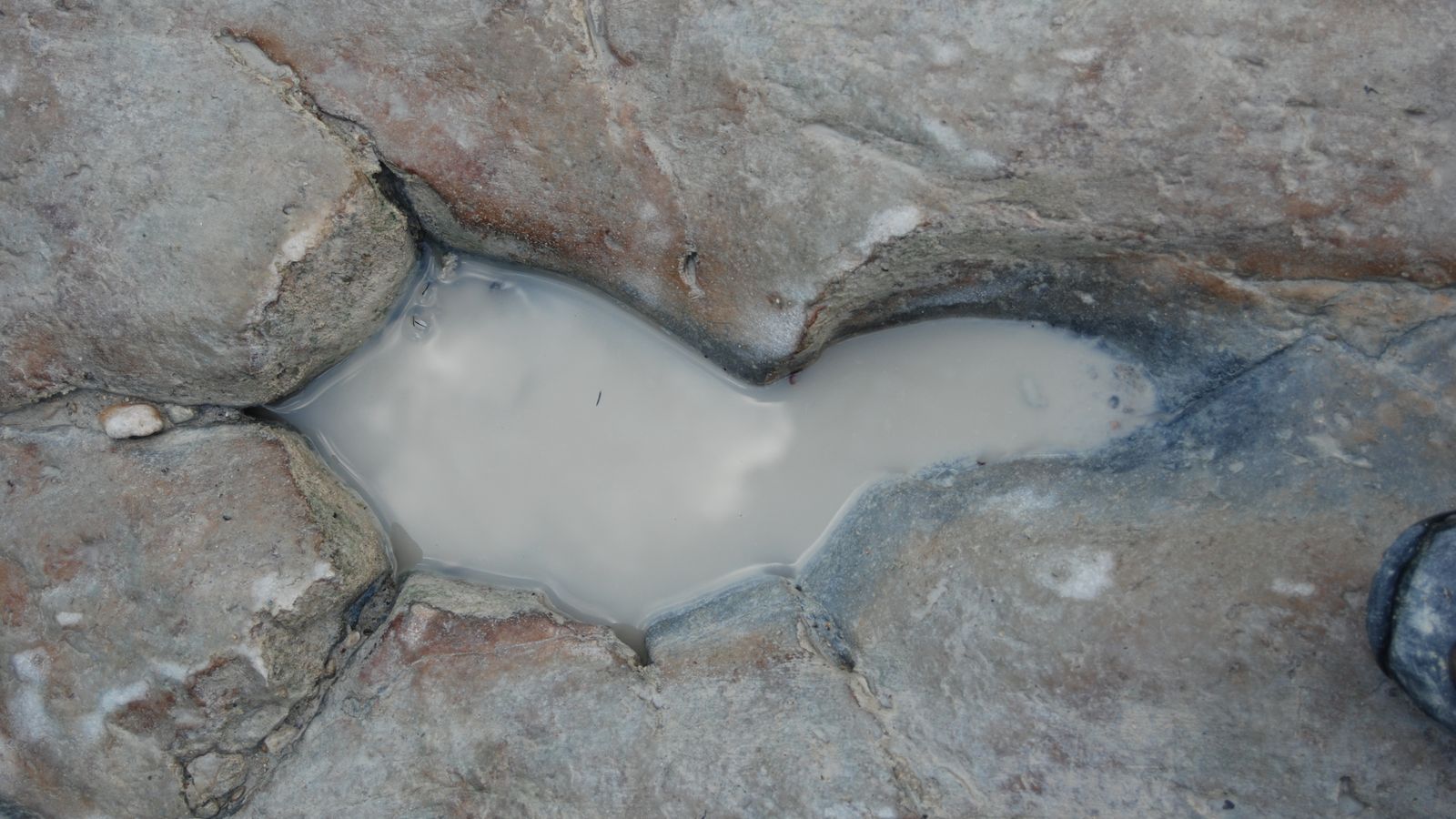
Probably the most famous of all the trails in the Paluxy River is the Taylor trail. The trail is a series of fourteen dinosaur tracks in a left-right pattern where a dinosaur walked in the mud and, not long after the dinosaur strolled by, a human stepped in the dinosaur’s tracks and human prints overlaying the dinosaur prints now show up in thirteen of these prints. One dinosaur track shows the human print next to the dinosaur track, not inside it. Now, I’ve studied the grainy photos as much as I could and honestly, I don’t see it but maybe the rest of you will.
The Taylor trail was named after a Baptist minister, Stanley Taylor, who arrived in Glen Rose in 1968, after hearing tales of these mysterious man tracks found in the stone of the Paluxy River. Taylor owned a small apologetics film company known as Films for Christ and decided to locate and film the man tracks in and along the Paluxy River as part of a documentary on the whole Creation vs. Evolution debate that was raging at that stage. During a series of expeditions to Glen Rose, between 1968 and 1972, led by Taylor himself, the good reverend interviewed residents of Glen Rose and, with the help of some locals, located a number of oblong markings which he and his team, consisting of locals and representatives from other creationist groups, all considered to be genuine human tracks. His findings were first reported in articles published by the Bible Science Association and eventually, by 1972, a film was released called Footprints in Stone. This film was widely circulated and shown in schools, churches and wherever creationists gather, further fanning the flames of the man-track theory, but in the late 1980s, enough new research came to light to convince Stanley’s son that, just perhaps, the tracks weren’t actually human after all and mistakes had been made, so the film was pulled from circulation. However, in the late 1990s and from the noughties onwards, a new generation of Young Earth Creationists flocked to the prints, deciding that the new evidence, although by that time it wasn’t really all that new anymore, rather than disprove the man tracks of the Taylor trail, actually strengthens the argument in favor of human footprints. For a while, there was a lot of back and forth among the Young Earth Creationists with some defending the prints while others claimed that they were to ambiguous to be used as proof of a young earth, and they were just too busy fighting each other to really pay attention to the evolutionists. However, it seems they finally agreed to disagree and they’re back to fighting the evolutionists - Telenovela level drama as promised.
Studying the actual trail to find these human footprints is a bit tricky as it’s usually under water, so it’s only when the trail is exposed either due to droughts or the creative application of sandbags, in the case of Stanley Taylor, that we can actually see and properly photograph the trail. Some of the tracks only had a vaguely human shape while others clearly showed toe impressions which meant these had to be human prints; there just wasn’t any other possible explanation. One print, for example was pristine with a ball, arch, heel and toe impressions all well preserved by the mud.
At the time Taylor was excavating the tracks and making his movie, the dinosaur tracks weren’t that obvious. However, years later, something strange happened. A distinct, rust colored, three-toed dinosaur print developed covering the human shaped depression.
This discoloring was imaginatively named ghost tracks. These rust colored dinosaur prints also started appearing in areas where there hadn’t been any prints before. Taylor believed he was only excavating human footprints, not human footprints overlapping dinosaur prints.
Evolutionists argued that these ghost prints proved that these were dinosaur prints and what is supposedly the human foot shape is actually the heel of the dinosaur, but I’ll explain how they got to that in a bit. However, the creationists argued that the heel shape keeps moving around the foot in relation to the dinosaur’s toes which doesn’t make sense. First it’s at the back, then the heel is next to the left toe, then it’s up against the middle toe, etc.
If this was the heel of the dinosaur, you’d expect the heel to be in the same place, towards the back of the track, right? This shape, which is supposedly the heel of the dinosaur also show some human-like toes and point in the same direction suggesting our human had places to be. A second dinosaur trail crossing and then leading away from the Taylor trail also show dinosaur prints but these prints don’t have the human-like heel shape so if it was a dinosaur walking on its heel, why didn’t the second dinosaur also leave heel impressions?
This is not a bad argument, but I’m not sold on the idea yet.
Watch Now
Open Video
Video Briefing
Paluxy River Prints: The Footprints That Defy Evolution
The Upper Taylor trail is further upstream and is probably a continuation of the human trail from the Taylor trail and was excavated in 1999 by Dr Carl Baugh and his team. This Upper Taylor trail consists of fifteen human footprints in a left-right pattern and also gives further proof of separate human and dinosaur tracks. The number 12 track on the Upper Taylor trail is a human footprint, with well-preserved toes, all five of them, overlapping a dinosaur track.
However, the other dinosaur tracks in the trail don’t have the human-like heel depression. The number 12 track is also showing some differential erosion. Over the years, the erosion seemed to have raised the dinosaur track while eroding the human print.
Differential erosion occurs when you have two different rock types exposed to the elements. Since hard rock will erode slowly but soft rock will erode quickly, they erode at different rates. Where the dinosaur stepped, the rock is harder, so the softer rock around the track eroded away faster than the dinosaur track.
However, the human print eroded faster than the riverbed because apparently the rock is softer. Since the human track and dinosaur track didn’t erode at the same pace, it couldn’t have been the same track. Again, I’m not a geologist so this sounds reasonable to me but I’m one of them unholy evolutionists, so I’m still not entirely convinced.
The Taylor trail is by far the most famous and the one most believers present as proof of their claims; however, it’s not the only one. There are a whole bunch of trails – the McFall trail, the Ryals trail, Turnage Trail, Giant Run, and the Willet trail to name a few, and all of these trails supposedly have pristine examples of human footprints. However, some of the best examples of human footprints are found in loose slabs, but this presents a problem.
As any archaeologists or paleontologist will tell you, documentation is vital. Without proper documentation to show where exactly the print was found, how, when and by whom it was removed and the exact processes used to clean it, the artifact, be it dinosaur print or medieval goblet, lacks what we call provenance and without provenance, your artifact is pretty much worthless. However, creationists weren’t deterred and now we finally get to one of the biggest players in the human footprint saga, the owner of the Creation Evidence Museum, Dr.
Carl Baugh.
Carl Baugh arrived in Glen Rose in 1982 to do some first-hand excavations of the dinosaur tracks in the Paluxy River for his Master’s degree in archaeology. Apparently, when he arrived, young, bright-eyed and bushy-tailed, he was of the evolutionary persuasion, a long-age creationist as opposed to a young earth creationist. He started his work on an area along the McFall ledge where his team removed limestone around seven to eight inches thick to uncover new dinosaur tracks, and they were very successful, finding around nineteen new dinosaur prints.
However, it wasn’t the dinosaur prints that would change the course of Baugh’s life. Apparently, his team was having so much fun lugging around heavy rocks in the Texas sun that they wanted to keep going even after they found enough prints to satisfy Baugh’s degree requirements. Having done my fair share of group projects at varsity, I find this hard to believe.
It was thanks to all these eager beavers whom I assume were hoping for some extra credit that a 16 inch human footprint, showing a dominant big toe and four other toes, an arch, and even the ball of the foot was discovered a mere 17 inches away from a dinosaur print that they’d uncovered a few hours prior. This was apparently a shocker for our, at that time, long-age creationist since it proved that man and dinosaur weren’t separated by millions of years. In fact, this unexpected find actually agreed with what Baugh had felt in his gut all along - the earth was young and man and dinosaur once frolicked together.
This was the turning point. He remained in Glen Rose, continuing his excavations for decades and opening his museum in 1984 just down the road from the Dinosaur Valley State Park.
From the many articles and YouTube videos about the illustrious Carl Baugh it seems that he single-handedly discovered more human footprints than all the previous expeditions put together, however, it’s not without controversy. While some of the volunteers who worked on his excavations insist that the digs are all conducted in a professional, scholarly fashion, with video recordings and proper documentation, others claim there are some irregularities going on. No-one is saying that Baugh sneaks out in the middle of the night to carve prints in the riverbed in order to discover them later in the presence of witnesses, but there has been some suggestion that some of the prints, genuine prints, not carved prints, may have been altered just a little – not enough for it to be an obvious case of tampering, but just enough to highlight the human features of the print.
Apparently, you can even see this happening in one of Baugh’s own videos though I haven’t seen it. When critical observers would visit his sites to see these amazingly detailed prints for themselves, Baugh would claim that the prints were perfect when he found them but the toes had eroded away quickly once they were exposed. Now, tracks once uncovered do erode away, but not that fast.
They usually remain recognizable for years. He also discovered, and collected, all kinds of out-of-place fossils and artifacts for his museum, to further bolster his claims that man and dinosaur walked together. These artifacts include a giant cat print, a human tooth, a hammer, a fossil finger and a Cretaceous trilobite; however, all these claims were later refuted.
The human tooth turned out to be a fish tooth.
Loose tracks show up in one of two ways. People either removed tracks from the river bed without properly documenting it because they either didn’t know how to or didn’t care to. Alternatively, the flash floods that swing by, ripping up the riverbed, deposit loose slabs containing prints all over the place for industrious prospectors to find.
Two of these loose prints, the Willet track and Delk print are both pristine examples of human prints. The Willet print was discovered in the 1950s by local resident O.W. Willet while he was fishing at the Blue Hole.
The fish just weren’t biting and Willard got bored so he wandered downstream and came across a fossil footprint which he proceeded to cut out of the rock and take home with him without any proper documentation of course. I’m wondering what kind of fish he was trying to catch if he happened to have the tools on hand to cut a footprint out of a piece of limestone, but perhaps he came back another day, the articles aren’t really clear on this. The print shows a human stepping on a dinosaur footprint, much like most of the Taylor trail, but the Delk print is a bit more interesting.
If these prints were genuine, it would be a remarkable find, but, like most loose prints, they lacked provenance.
The Delk print is pristine – the ball, the arch, the heel, all five toes, it’s all accounted for. The big toe is bent down in a bit of an unusual way but this could be due to a common foot disorder known as Hallux Varus where the big toe points away from the second toe. Unlike the Taylor trail and Willet print, in the case of the Delk print, the human stepped first and then after the human had gone, the dinosaur came along and most inconsiderately clipped the human print with its clumsy middle toe.
Apparently, the print was discovered by amateur archaeologists Alvis Delk and James Bishop from Stephenville, Texas. Delk and Bishop claimed to have found the loose slab on a pile of rocks along the creek that flows into the Paluxy River around 2000. In 2008, Delk took a fall from a ladder and needed to pay some medical bills.
He decided to sell some of his possessions, among them, the loose slab with the dinosaur print to rustle up some funds. However, when he cleaned up the slab, he discovered the human print underneath the dinosaur print and promptly sold the 140 pound slab to Carl Baugh. To me is it seems a bit odd that an experienced amateur archaeologist wouldn’t properly document his find.
He didn’t take photos of where exactly they found the slab or what it looked like when they found it so we don’t know if there originally were two tracks or if something was added a little later. To date, it’s not even been established whether the rock actually came from the riverbed near Glen Rose since Baugh won’t allow any independent testing. I also find it strange that Delk and Bishop sold the print to Baugh.
Apparently, James Bishop was convinced that this discovery would change history and disprove all of Darwin’s hard work. If I was that convinced of the authenticity of my find, I probably wouldn’t have sold it to someone known for promoting fake artifacts but rather sold it to a university. The timing of this discovery was also very fortuitous.
It happened to coincide with a time when strict creationists were pushing to get their views into Texas public schools. Baugh was convinced of the authenticity, but there was still the problem of provenance, so Baugh had an idea – he would use spiral CAT scans to examine the tracks.
A spiral CAT scan is basically a three dimensional X-ray. On an X-ray image, the denser an object is, the whiter it is. That’s why bone is white but muscle barely shows up at all.
Baugh theorized that by using CAT scans, he could examine the density variations inside the rock hosting the two prints. If the track is genuine, the human foot would’ve compressed the mud where our ancient ancestor stepped on his way to, well wherever he was going. Considering that a dinosaur stepped on his footprint, my guess is he was hastily going far, far away.
This compression would be denser than the surrounding rock. Scanning the Delk track showed that the area immediately under the toes is whiter meaning the rock is denser under the toes suggesting that the track is genuine. They also took a scan of a track they knew to be a carving and lo and behold, there’s a distinct lack of higher density rock under the toes of this particular track.
This is surprisingly solid science – paleontologists actually use this exact technique to determine whether a dinosaur print is genuine or not. It’s unfortunate that Baugh won’t allow any independent testing of the Delk track. If independent researchers have the same result, then we might need to reconsider human evolution.
But the creationists don’t trust the evolutionists, they’re convinced the evolutionists will destroy the evidence or just lie about the results, so that’s unlikely to happen. However, the CAT scans also picked up another interesting detail. Over time, a thin veneer of high density rock crystalizes on the surface of the limestone.
If this thin veneer had been broken, that’s a clear indication of a carving while, in a genuine print, this veneer would conform to the shape of the track. There are some YouTube videos showing the scans of the Willet track, and, honestly, that veneer looked pretty thin and dare I say a bit broken to me, but I’m a biased unholy evolutionist so don’t take my word for it.
As with the trails, there are a whole lot of loose human footprints that many claimed were cut from the Paluxy River at some point. Unfortunately, none of them have any proper documentation which is still necessary, even if the CAT scans might suggest they’re real. Without provenance, these prints are, in an archaeological sense, interesting but not worth a whole lot.
The Verdict: Evolution or Creation?
I’m about to say something I never thought I’d say, but, for the first time ever, the Young Earth Creationists have actually made an effort to present some real science, CT scans of human and dinosaur prints, to back up their claims instead of just yelling ‘because the Bible said so’, so credit where credit is due. However, have they presented enough evidence to convince skeptics like me that man and dinosaur wandered side by side along the ancient shoreline?
The man who probably did the most work to derail the human footprints in Glen Rose was Glen Kuban who arrived around 1980. At the time, Kuban was actually hoping to find evidence of human tracks and was planning to do a better job of scientifically documenting the prints than Taylor had done in the early 1970s, so he didn’t set out with the plan to destroy the Young Earth Creationist view – to the contrary.
Kuban started his work on the State Park Shelf but soon realized that these were just erosion features that only vaguely resembled human footprints. When very selectively highlighted, as was often done in Young Earth Creationist literature, the features definitely looked like human prints but without the convenient use of water and oil to highlight the tracks, they were just random depressions and erosion marks that didn’t actually look like anything. Interestingly, another team from Loma Linda University, a Seventh-day Adventist university, had already come to this same conclusion in 1975.
However, the tracks at the Taylor site looked far more promising. This was an actual trail with a left-right stride as you’d expect to find in bipedal creatures, like humans. The prints themselves even had humanlike shapes.
However, as Kuban and his team cleaned and excavated, they noticed some problems. Firstly, the stride was simply too large, even for humans of unusual size. Some of the supposed human prints splayed widely at the front and some also showed traces of tridactyl digit patterns, so three-toed patterns, which you’d expect to find on dinosaurs, not humans.
On some prints, the human big toe appeared to be on the outside of the foot instead of the inside of the foot where most of us have our big toe or the big toe impression would be much longer than what a human toe should be unless the human in question had some interesting birth defects. Kuban eventually came to the conclusion that the elongated shape which appeared to be a human footprint was, in fact, the heel of the dinosaur pressing into the mud. Now, this was quite a revolutionary idea because it was believed at this point that dinosaurs were traipsing around the Jurassic only on their tippy toes like ballerinas.
Today, we know that most theropod dinosaurs did in fact walk on their toes, so digitigrade, like cats and dogs. However, walking in slippery mud can be tricky, so in an attempt to avoid becoming the first comedy act of the Triassic, the dinosaur might’ve hunkered down plantigrade, so flat on their heel, thus leaving deeper and larger impressions than they normally would.
These strange plantigrade, or metatarsal as they’re also called, tracks, showing not only the toe impressions but also the heels as the dinosaur is apparently walking flat-footed, have been found in other places around the world, so the tracks aren’t unique to the Paluxy River. Now, remember earlier when I mentioned how the Young Earth Creationists insist that this doesn’t make sense because the heel of the dinosaur apparently kept moving around in the foot? Well, I went looking for photos to see these wandering heels for myself, but I couldn’t find any.
It appears that these deductions for a wandering heel were made off of sketches, probably done by the original Taylor team who was under the impression that they were excavating human footprints. This theory also doesn’t seem to take into account other possible causes for this wandering heel like natural erosion, very slippery walking conditions with dinosaurs sliding around in the mud, or the possibility of multiple dinosaurs trampling each other’s prints.
This also brings us back to those rust colored discolorations in the shape of three-toed dinosaur prints that Taylor and many Young Earth Creationists insist only developed much later. Apparently, when the dinosaur first strolled by, the mud was very soft, so the fresh print was almost immediately filled in with watery mud which evidently contained some traces of iron contamination. The toe prints would’ve been shallower than the deep heel print so obviously, the toe prints might have filled in completely whereas the heel didn’t.
The mixture then hardened and turned into stone. Many years later, the track was exposed, be it by man or nature, but the iron contamination is still there. Thanks to oxidation, this iron contamination changes colour under different conditions so sometimes these infilled prints will be the same greyish color as the limestone but other times they will be a rusty red or even green.
According to Kuban, these infilled prints, what some creationists called ghost prints, were clearly visible back when Taylor was making his documentary, but it was ignored by Taylor and ilk because they were trying to prove a specific point.
As for the McFall site, or Upper Taylor trail, Kuban concluded that the prints didn’t even closely resemble human prints. Once again, the oblong prints were mud-collapsed or just poorly preserved metatarsal dinosaur tracks. The striding sequence didn’t fit a human, but definitely fit a dinosaur, and some of the supposed tracks were long, sometimes curved, incompletely cleaned grooves which often occur along dinosaur trails and is probably imprints of the animal’s tail, snout or some other protruding body part that made contact with the ground for whatever reason. One set of human toe marks were actually an invertebrate burrow system made by some ancient crustaceans which is actually a pretty cool find, but it had nothing to do with human footprints.
Kuban also theorized that these metatarsal tracks probably explained the giant man tracks found earlier – metatarsal dinosaur tracks with indistinct claw marks look remarkably like large human tracks and it’s not like the good people of Glen Rose was all that familiar with dinosaurs and how they walked. As is human nature, if you don’t know what you’re seeing, your brain will give you its best guess even if it doesn’t quite make sense, like giant human footprints. Many of the supposed man tracks were also straight-forward three-toed dinosaur tracks.
The dinosaur placed most of its weight on the middle toe meaning the middle toe imprint was deeper. Since the two side toes were shallower, these eroded away over time leaving only the deeper middle toe which, once again, happens to look a bit like a human foot in shape and size. The fact that the supposed human and dinosaur prints are often of equal depth, even if the human didn’t step in the dinosaur track, further supports the idea that the tracks aren’t human.
Dinosaurs weighed a bit more than your average human so the dinosaur tracks should be much deeper. As for the human tracks that overlap the dinosaur tracks, this would suggest that humans and bipedal dinosaurs had the same stride which simply isn’t the case. More researchers followed, some pro-creationists and some not, but most non-creationists found that the supposed man tracks were erosional features, invertebrate burrows or poorly preserved and badly eroded dinosaur tracks.
Critics are also quick to suggest that those pristine prints on the loose slabs, and maybe even some of the better prints in the riverbed, are all either carved from scratch or, at the very least, touched up a little to better resemble human prints. Creationists insist that the vast majority of tracks had been uncovered from underneath solid limestone in the presence of multiple witnesses making carving unlikely; however, carved dinosaur tracks are nothing new in Glen Rose. While the town might be doing really well today, thanks to all those tourists, this wasn’t always the case.
The Great Depression of the 1930s hit the town hard, and plans had to be made to bring in a bit of money, so the enterprising folks of Glen Rose made a plan. Local residents, like Jim Ryals who eventually had a trail named after him, chiseled some of the dinosaur and apparently human tracks out of the riverbed to sell to tourists. If they couldn’t find dinosaur tracks, they simply carved some themselves.
Dinosaur tracks were more impressive than human tracks, and they sold much better than the human tracks, but we know some human footprints were carved and sold as well – the artists said as much.
According to one story, the very first human track discovered, the one that set the ball rolling, was, itself, a fake. According to a Mr. Weldon Eakin, the flood of 1908 exposed a number of dinosaur tracks that were so fresh that you could actually see the veins on the creature’s feet.
Since I’ve never come across any animal where you could see the veins on their feet, never mind in their tracks, I’m already a little doubtful about this story, but let’s press on. However, there were only dinosaur tracks, no human tracks. Mr Eakin explained that he was one of the many who made replicas of human, dinosaur and saber tooth cat tracks during the depression years, selling them to tourists and whoever else was interested to earn some money.
Then, one fine day, his father-in-law, George Adams, suggested that they carve a human footprint in the Paluxy Riverbed next to a genuine dinosaur track using Adams’ foot as the template. With Mr Adams on the riverbank acting as a lookout, while making genuine Indian arrow heads to sell to tourists, Mr Eakin chiseled out a human footprint beside the real dinosaur footprint. Eventually, someone came across his installation art and cut the whole block of limestone containing both tracks from the riverbed.
What happened to this block and where it is now is a mystery. Mr Eakin insisted that the only human footprint ever found in the riverbed was his creation. Whether this story has any more truth to it than many of the other tales of wonder we’ve encountered thus far is unknown but I have my doubts.
As for Mr Eakin, he insisted that he initially tried to explain to people that there were no human tracks – he had created the tracks but no-one believed him, and eventually he decided to just keep it to himself because he didn’t want to get into trouble. Wise man.
Whether there’s any truth to Eakin’s tale we’ll never know, but in 1970, Wayland Adams also described the techniques his uncle, George Adams, used to carve the tracks that he sold during the Depression years to a group of creationist researchers. Apparently George was a very busy bloke. He explained that his uncle would often start with a block that already had a natural depression and then carve the human features chilling in the shade of a tree.
Apparently, his method meant less chance of breakage than chiseling and transporting actual tracks from the riverbed, and it meant George could add or highlight some little details that were missing - either because they were never there or because they eroded away, I suppose it depends on your point of view. However, apparently it’s not that hard to identify an Adams original as it shows some serious anatomic errors, like misplaced ball and arch and long, misshapen toes, so a podiatrist our carver was not. George would carve the footprints using a hammer and chisel and he also used a center punch to simulate raindrops and would finally apply some hydrochloric acid to dull the chisel and punch marks for a more weathered appearance.
The slab would then be covered with manure for a few days to get that aged, vintage look. Finally, George would chip the edges of the slab to make it look as if the track had been chiseled from the riverbed and not carved in the shade of a tree.
Of course, many young earth creationists argue that it’s a well-known fact that there are some carved prints, but the carvers had to get the idea somewhere, so there must’ve been human footprints in the riverbed; however, if Mr Eakin’s story has even a grain of truth to it, the original human footprint that would’ve inspired the carvers was, itself, a fake. Believers also insist that the carved tracks are very easy to spot since real tracks show mud push-up around the prints as well as weathering but both these features are easy enough to fake. Of course, just prospecting the river and chiseling out existing prints was also considerably less work than finding a decent rock and then carving a print and while I agree with this, desperate times call for desperate measures. If no prints could be found, the carvers had no choice but to make their own.
There are some really good examples of outright carvings, including the Burdick Print and the Caldwell track. Even the Delk print, one of the prints that Baugh ran through the CT scanner, have a number of unrealistic features like unusually long middle toes, the instep of the print is a bit too straight and the heel is overly square, among other details. This doesn’t prove that it was carved, but if a carver started off with a slab which already had a depression in it and had to work around that, it might explain the weird features. The dinosaur track that makes up part of this twin footprint also has its fair share of abnormalities suggesting that it too might have been carved or, at the very least, touched up a bit.
Unfortunately, these known carvings definitely throw a bit of a spanner in the works when it comes to those CT scans. Since some of the carvers, like George Adams, admitted to using slabs that already had an indent, usually a vague or partial dinosaur print, the rock density differences caused by the compression of the foot picked up by the CT scans prove that it’s definitely a genuine print, but it doesn’t prove that it’s specifically a human footprint. The Delk print specifically showed more density under what is supposed to be the human toes, but what about the rest of the foot?
I couldn’t find a thorough CT scan of the entire print online, but I might’ve missed it. Unfortunately, this does mean that the CT scans, while a brilliant idea, doesn’t prove without a doubt the existence of humans at the same time as dinosaurs.
Conclusion
From a paleontological perspective, the Paluxy River dinosaur tracks was a remarkable find and for those of you who love dinosaurs, it’s probably one of the best places in America to see dinosaur footprints. Thus far, no dinosaur fossils have been discovered along the Paluxy River, so identifying the exact dinosaurs that roamed the area is a bit tricky – and before you come at us, the excavation of the fossil discovered by Carl Baugh was botched so badly that no scientist wants to come near it so unfortunately, it doesn’t count. However, scientists believed that the bipedal, carnivorous Acrocanthosaurus, which lived between 115 and 105 million years ago, probably is responsible for quite a lot of the tracks while the sauropod tracks were probably left by Sauroposeidon.
However, are there any human prints? While creation science, yes that is actually a thing, has made some serious attempts to prove that some of the tracks are, in fact, human, evolutionary science, which I’m personally a great fan of, remains skeptical. The dinosaurs leaving their prints along the Paluxy River did so around 113 million years ago, so if human footprints were actually found, that would raise some serious questions about science, evolution and the possibility of time travel. I’m always willing to keep an open mind but, as things stand, I’m not convinced.
Simon Whistler
Simon Whistler is one of YouTube's most prolific educational creators. Decoding the Unknown is his methodical investigation into the world's strangest phenomena — examined with rigour, curiosity, and a healthy dose of scepticism.
Frequently Asked Questions
What significant discovery was made in Glen Rose, Texas in 1908?
In 1908, a local teenager named George Adams discovered a series of very large, three-toed footprints in the limestone floor of the Paluxy River, which were later identified as dinosaur tracks by the local schoolmaster, Robert E. McDonald.
Who was Roland T. Bird and what was his role in the discovery of the Paluxy River prints?
Roland T. Bird was a field explorer for the American Museum of Natural History in New York. He discovered human-like footprints in a shop window in New Mexico, which led him to Glen Rose, Texas, where he found dinosaur tracks and conducted extensive research on the area.
What are the ‘giant man tracks’ mentioned in the article?
The ‘giant man tracks’ are large, oblong human-like footprints discovered by residents of Glen Rose, Texas, along the Paluxy River. These tracks were initially believed to be evidence of giant humans, but their authenticity and origin remain debated.
What is the Taylor trail and why is it significant?
The Taylor trail is a series of fourteen dinosaur tracks in the Paluxy River where human-like footprints overlay the dinosaur prints. It is significant because it is often cited by Young Earth Creationists as evidence that humans and dinosaurs coexisted.
What are ‘ghost tracks’ and how do they relate to the debate over the Paluxy River prints?
Ghost tracks are rust-colored, three-toed dinosaur prints that developed over time in areas where human-like footprints were initially observed. Evolutionists argue that these ghost tracks prove the original prints were dinosaur tracks, while creationists dispute this interpretation.
Who is Carl Baugh and what is his role in the Paluxy River prints controversy?
Carl Baugh is the owner of the Creation Evidence Museum in Glen Rose, Texas. He conducted extensive excavations and research on the Paluxy River prints, presenting them as evidence of human and dinosaur coexistence. His work is controversial due to allegations of tampering and lack of proper documentation.
What are the Delk print and Willet print, and why are they controversial?
The Delk print and Willet print are loose slabs containing human-like footprints that overlap dinosaur prints. They are controversial because they lack proper documentation and provenance, leading to debates about their authenticity and origin.
What is the significance of the CAT scans conducted by Carl Baugh?
Carl Baugh used spiral CAT scans to examine the density variations inside the rock hosting the Delk and Willet prints. He argued that the scans showed genuine compression under the toes, suggesting the prints were authentic. However, the scans do not definitively prove the prints are human.
What are some of the arguments presented by critics of the human-like footprints in the Paluxy River?
Critics argue that many of the human-like footprints are actually erosional features, invertebrate burrows, or poorly preserved dinosaur tracks. They also suggest that some prints may have been carved or altered to resemble human footprints.
What is the conclusion of the article regarding the Paluxy River prints?
The article concludes that while the Paluxy River dinosaur tracks are a remarkable paleontological find, the evidence for human footprints remains inconclusive. Evolutionary science remains skeptical of the claims that humans and dinosaurs coexisted based on the available evidence.
Sources
- Original Decoding the Unknown video: Paluxy River Prints: The Footprints That Defy Evolution
- Hero image source by Dill Tom / openverse, by.