It was 7:50 pm on Saturday, June 3rd, 1995. A security guard knocked on the door of room 2805, but instead of the occupant answering the door, the guard instead heard the unmistakable sound of a gun being fired. He took cover in an alcove, eventually taking the elevator downstairs to get the head of security for assistance.
This case bears some surface similarities to the murder in room 1046, in which a mysterious John Doe was found inside his hotel room having been shot. However, the death in room 2805 departs from that previous tale in a number of significant ways.
To start, this time around the victim is a Jane Doe rather than a John Doe. This case also took place in 1995 rather than 1935, so there’s a lot more evidence and forensics, though as will become clear, not nearly as much as there should be. But the biggest difference between these two cases is that while police knew Artemis Ogletree was clearly murdered in room 1046, police in this case stated with a 99.9% degree of certainty that this Jane Doe took her own life. And not a single person believes that story.
Key Takeaways
- Jennifer Fergate checked into a luxury Oslo hotel under a fake identity, with no valid ID or credit card.
- Jennifer’s behavior was highly unusual, including disappearing for 24 hours and leaving no trace.
- The official ruling of suicide is widely disputed due to numerous inconsistencies in the crime scene.
- Jennifer’s room contained strange items and lacked personal belongings, suggesting foul play.
- The most plausible theory is that Jennifer was a spy, given her fake identity and professional staging of the crime scene.
This is an adventure involving fake identities, unexplainable details, potential communist spies, half-eaten bratwurst, and an allegedly self-inflicted injury that’s even less convincing than Jeffrey Epstein’s.
Checking In to the Hotel
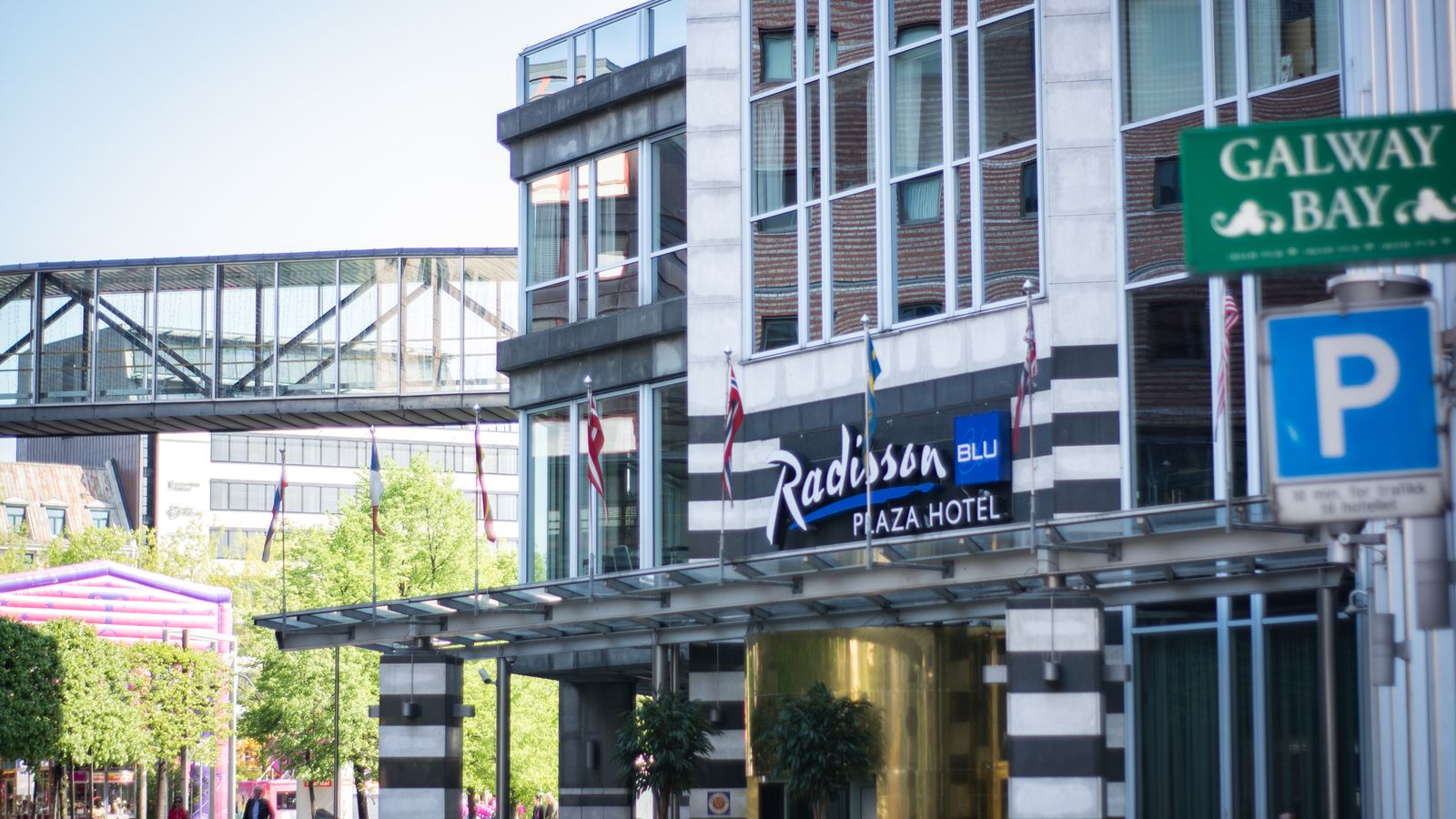
It all began on May 22nd at the Radisson Blu Plaza Hotel, known locally just as the Oslo Plaza. This was the number one luxury hotel in Oslo, perhaps in all of Norway. At 37 stories tall it is the second tallest building in all of Norway, and a footbridge connects the hotel to Oslo Spektrum arena. The Spektrum is famous for hosting the Nobel Peace Prize Concert every year, as well as for hosting the Eurovision Song Contest multiple times.
The Oslo Plaza was a really big deal. It was frequent host to celebrities and foreign heads of state, and the five-star hotel was officially opened by none other than King Olav V himself. It was the pinnacle of luxury accommodations in Oslo, and was conveniently within walking distance of so much of the city. And on May 22nd, hotel reception received a call from a woman looking to book a room.
The woman spoke in perfect English with no discernible accent, though it’s unclear what day the reservation was originally for. It’s an everyday part of reception’s job to take these calls, so it wouldn’t be expected that whoever answered the phone that day would remember weeks later. It’s honestly surprising they remember she spoke in English, unless receiving calls from English speakers was particularly noteworthy. Or maybe it was just standard practice to note what language a phone call was in since this seems to have been a major destination for international travelers.
But the reason the original date isn’t known is that the woman called back on Wednesday, May 31st to change her reservation. At least it is assumed it was the same woman, but anything is possible with this case. This time she was speaking fluent German, and the person answering the phone call believed she had an Eastern European accent. She was calling to let them know that she wanted to check into the hotel that night, and that there would be another guest joining her in the room.
The names were recorded as Jennifer and Lois Fairgate. In this context Lois was being used as a man’s name, and as far as can be determined it’s supposed to be pronounced like “Lewis.”
At around 10:40 pm, Jennifer arrived to check in to the hotel. She was described as being short, about 5’2, with blue eyes, having short, dark hair in sort of a pixie cut, and wearing a long, black leather jacket. She would also write down a date of birth that would have made her 21 years old, but she was 21 in the same way that most guys on Tinder are 6 feet tall. Jennifer was greeted by receptionist Sascha Anonsen, who gave her a registration card to fill out.
Because the reservation was made over the phone, some of the information was typed onto the card. This has led to a lot of confusion over Jennifer’s name, with different articles using Fairgate or Fergate interchangeably. The spelling was just a clerical error due to whoever took the call mishearing the name, but Jennifer signed her name as Fergate multiple times, so it is assumed that is the correct spelling. It’s also largely irrelevant since, as will become obvious, it wasn’t even her real name.
But clerical errors aside, this is where things already start to get a bit strange. Sascha claimed that Jennifer was checking in alone, but the head receptionist, Evy Gjertsen, told a different story. Evy has remained confident for over two decades that there was a man with Jennifer at check-in, the mysterious Lois. She described him as tall, maybe 6’1, with dark hair and roughly 35-40 years old. That’s not the only thing that Sascha and Evy disagreed about either.
There are a couple very notable things on that registration card as it concerns Jennifer’s original check-in. Sascha marked X’s in pen on the fields that Jennifer was supposed to fill out, but she left her passport number and issuing passport authority both blank. The card is also marked as Jennifer having paid for the room in cash.
However, even when a room is paid in cash, it’s standard procedure for the hotel to request a card be put on file for “incidentals.” This allows the hotel to charge guests for any expenses incurred that weren’t part of the original room charge, such as room service, eating snacks out of the minibar, or damaging the room. And yet, this didn’t happen. Despite this being a premier luxury hotel, Jennifer was able to check in without providing a credit card or any form of identification.
Even budget hotels require these things and have for decades, and it was official hotel policy to do so. So how was this possible?
According to Evy, it shouldn’t have been. She stated, “It’s incomprehensible to me. We had strict routines at the hotel. It just shouldn’t be possible.”
But Sascha claimed that this sort of thing happened all the time. Jennifer had arrived to the hotel late in the evening, just after the final flights for three major airlines each touched down at the nearby international airport almost simultaneously. This unfortunate circumstance of airline scheduling meant that the hotel lobby was far busier than a typical Wednesday.
As Sascha stated with regards to how Jennifer could get through reception without an ID or credit card, “It was all about assigning rooms as quickly as possible. We mustn’t keep the guests waiting.” That’s very different from what Evy said, so how can these two statements be reconciled? A lot of people seem to get really hung up on this, suggesting that either Evy or Sascha was part of a larger conspiracy, but the different responses can be explained quite easily.
Anyone who has ever worked for a giant, customer-facing corporation can likely understand.
Consider a hypothetical: at a large grocery chain, employees might grind beef daily that was labeled as being 85% lean. If you were to ask the manager if they tested the ground beef to ensure it contained no more than 15% fat, he would tell you that of course they tested every single grind, as was corporate policy. But if you were to ask one of the regular employees, the answer would be of course not; there isn’t time for that.
They just eyeballed it. In summary, these differing statements are likely a red herring. In all likelihood, Sascha was telling the truth to investigators because there was a dead body involved, while Evy continued to toe the company line to protect her lower management position.
It’s completely reasonable that, given the alleged unspoken policy of moving the line as fast as possible, Sascha decided to just accept the cash payment and not worry about ID. After all, if the hotel room was already paid for in full with cash, then who cares what her real name was? It’s not like they had to worry that she was using a stolen credit card or something.
There is one other thing worth addressing quickly, because every single other source appears to represent this inaccurately. The price on the card for Jennifer’s stay was 1,845 kroner per night. Adjusted for inflation to 2024 currency, that comes out to over 3,600 kroner, or about $340 today. That is how every available source describes the price, and it is technically accurate, but something feels off.
Luxury hotels in Europe are less expensive than in the US, but this was Norway’s premier luxury hotel at the time. The price felt far too cheap, so the exchange rates were investigated.
It turns out that the kroner was a lot stronger in 1995 than it is today. On June 1st, 1995, the exchange rate was 6.35 kroner to the dollar. Today, it’s 10.75 kroner to the dollar. This means that a room at Oslo Plaza in 1995 was $290, or almost $590 today. That price makes a lot more sense for a hotel that was housing heads of state.
Jennifer received two keycards for the room: one for her and one for Lois, who may or may not have been standing next to her this whole time. But because this was a fancy hotel, they had a log system that tracked every time a guest’s keycard was used to access their room. This means we know exactly when and how many times Jennifer used her keycard. However, the system only logged instances in which the keycard was used.
If two people were staying in the same room, one could open the door for the other and there would be no log of it. More importantly, there was no way to know when somebody left their room, only when they returned.
That said, the keycard log can be used to attempt to build a timeline for Jennifer during her stay. This is obviously a very limited amount of information to work with, but sometimes less is more. And it’s actually the lack of information in the log that raises one of the most interesting questions.
Establishing a Timeline
Jennifer began checking in at 10:40 pm on Wednesday night, and her keycard was first used to enter room 2805 at 10:44 pm. It was used one more time that night at 12:21 am, though both Sascha and Evy claim to have seen Jennifer during this time period. Evy insisted that she saw Jennifer standing with a man by the hotel’s currency exchange.
She believed they were exchanging US dollars for kroner, but she wasn’t absolutely certain on what currency they were handing in. Evy also wasn’t sure whether or not it was the same man who had been standing beside Jennifer during check-in, but she was 100% confident there was a man with her.
Sascha, on the other hand, saw Jennifer standing alone by the elevators while he was checking in other guests. These two statements don’t necessarily contradict one another, as it’s possible she was standing at currency exchange with someone who then didn’t go up to her room with her. In fact, that seems incredibly possible, as most people one conducts business with do not then come up to one’s room.
Or maybe she was waiting at the elevator for the man who then went to currency exchange with her and they retired to the same room together. Regardless, assuming Evy’s memory was correct, then this brief trip out of Jennifer’s hotel room that night was easily explained as getting the necessary currency for whatever she had planned during her trip. However, this was the last time anyone would see a man with Jennifer, and both times it was only Evy that saw him. As far as anyone knows, the mysterious Lois never actually existed.
It certainly didn’t appear as if he was sharing a room with her.
The next time Jennifer’s keycard was used was at 8:34 am the next morning, Thursday. Given the time of day it’s assumed that she just left to have some breakfast, but nobody saw Jennifer enter or leave her room, nor did anybody remember seeing her at breakfast at the hotel. There was also no reason for anyone to be keeping an eye out for her specifically, so unless she had been disappointed with the breakfast options and complained to the staff, it’s not a surprise nobody would remember if she was there. Of course, she may also have left the hotel entirely and had breakfast somewhere else.
Now here is when things start to get strange. Sometime that morning, Jennifer went to the hotel receptionist to extend her stay. She had originally booked two nights, but she wanted to extend her stay until Sunday. This wasn’t an unusual request, so the receptionist changed her booking to add two more days and gave Jennifer two new keycards, as the originals were programmed to stop working the next day.
Once again Jennifer was not asked for a credit card or ID, but that may not be as strange as most sources seem to think. Although there are reasons why she may have been able to originally check in without providing these things, it was still highly unusual and against corporate policy for this to have happened. As such, whoever extended Jennifer’s reservation would have just assumed those things were already on file. Updating the checkout date likely didn’t require the receptionist to update or even look at the payment information on file.
But even if her ability to once again deal with reception without showing an ID or credit card can be explained, it was the use of this new keycard that really raises questions. Room 2805 was next opened three times between 12:44 and 12:50 pm, but it wasn’t by Jennifer; it was housekeeping using their keycards to open the door. When they entered the room, it was empty. There was no Jennifer and no Lois, though the latter should go without saying as nobody saw him again.
There were two housekeepers tidying up the room that day. Vigdis Valø was in charge and had been with the hotel for some time, but she also had a 19-year-old trainee with her. Vigdis had been the one to prepare the room the day before, and because there were supposed to be two people staying in the room it was standard procedure to provide two duvets for the bed. However, one of the duvets had been folded and placed off to the side rather than being used.
While this is seen as further proof that there was only one person staying in the room, the significance of the unused duvet is somewhat debatable. A duvet is what Americans generally refer to as a comforter, and it’s not obvious why anyone would expect each person to use their own. Perhaps providing a second one may have become standard practice after too many late-night calls to housekeeping from people left in the cold by blanket hogs, but it doesn’t seem like using separate blankets would be the default for two people sharing a bed.
Maybe it’s some European cultural thing. The more crucial piece of evidence with regards to the bed was that Vigdis observed that only one pillow had been used. That certainly seems more compelling for anyone still entertaining the idea that there was a second person staying in the room with Jennifer.
Anyway, the unused duvet was folded and placed in the closet, and housekeeping did regular cleaning like replacing towels and whatnot. While waiting for her trainee to finish cleaning the bathroom, a pair of shoes caught Vigdis’ attention. The clothes Jennifer wore were predominantly black or grey, nothing that would make a person stand out.
But these shoes were brightly coloured and extremely pretty, so much so that Vigdis had to take a closer look. She looked inside the shoes to see who they were made by in the hopes of perhaps buying her own pair, but by the time anyone learned this detail and asked her, she had since forgotten who made the shoes; and that’s assuming she ever got the answer in the first place, for reasons that will become clear later.
The exact time the housekeepers left the room isn’t known, but the room was empty when they arrived. Jennifer wasn’t there, but there was no evidence of anybody else staying in the room either. And nobody was going to return to that room for quite a while. The next time Jennifer’s keycard was used was 8:50 am on Friday.
If you’re able to follow along with the timeline, this is very strange. Jennifer used her keycard at 8:30 Thursday morning and not again until 8:50 Friday morning. This means that she left her room, went to reception to extend her reservation by two days, and didn’t return to her hotel room until 20-24 hours later. There’s no log of exactly when she visited reception, but she was already gone by the time housekeeping arrived which meant that Jennifer was gone for at minimum 20 hours.
So where was she? Unfortunately, there is no answer to that. Nobody knows if she had business in Oslo that kept her out all night or if she spent the night in a different room in the hotel. Jennifer was basically invisible for her entire stay. She was the sort of person that could walk around a crowded building without ever being seen or drawing attention to herself.
Throughout her entire stay, there are virtually no accounts of staff ever seeing her and none of the hotel guests remembered seeing her at all. It’s like she was a ghost.
That said, a member of staff did see Jennifer open her hotel room that morning. Karin Løvbrøtte was filling in for Vigdis on the 28th floor that day, and she saw Jennifer walking towards her room. She greeted Jennifer in English saying “good morning,” and Jennifer smiled and returned the pleasantry before opening the door to her room.
When she got back to her room, there was a message waiting for her on the TV. Sometime Thursday afternoon, somebody in reception had finally realized that there was no credit card on file for room 2805. At 2:19 pm, a message was sent that would appear on the TV screen until somebody in the room clicked “ok” on the remote to acknowledge the message. The message urgently requested that the occupant go see the cashier about their room, and shortly after returning to her room Jennifer acknowledged the message.
Of course, Jennifer never was going to see the cashier about the matter. The cash she had paid for the room no longer covered her extended stay, but Jennifer had a secret weapon up her sleeve. The same hotel employee that saw her first enter her room watched again as she opened the door and placed a “Do not disturb” sign on the handle. They could send all the messages to her TV that they wanted, but the hotel was now powerless to come to her room and try to address the situation with her personally.
For the time being, so long as Jennifer kept the “do not disturb” sign on her door, hotel staff weren’t going to come bother her about the money. Generally, if people kept those signs on their door that long it meant something was going on in the room that they didn’t want people to see, and this usually meant illegal activity.
Jennifer’s keycard was used again at 11:03 am, but once again it is unknown where she had been or why. All we know is that she didn’t go to the cashier to settle her bill. That was the last time her card was used to gain access to the room, so as far as anybody knows she never left room 2805 again.
At 8:06 pm Jennifer called room service to order a plate of bratwurst and potato salad. The food arrived at 8:23, delivered by Kristin Andersen. Because this was a five-star hotel not some cheap dive, the food wasn’t just dropped off at the door. It was customary for the hotel staff to bring room service into the room and lay the meal out on the table for the guests.
Kristin noted how easy this was to do, because Jennifer hadn’t put anything on the table. She also described the room as being “almost sterile.” Of course, these statements were all translated from Norwegian, so whatever word Kristin used that meant “sterile” may have had some added nuance that was lost in translation.
However, Kristin also noted that the bed clearly had not been slept in. The hotel had form-fitting sheets and the beds were made in a very particular way that guests were unable to replicate. The bed not being slept in is not necessarily unusual, as Jennifer had only returned to her room that morning. However, since she had been gone from the hotel for 24 hours previously, it means that either she was able to sleep wherever she went, or that she was particularly skilled at going extended periods of time without sleep.
But while Kristin may have described the room as sterile, she hadn’t thought it was particularly unusual at the time. The empty table made serving dinner easier, but she just assumed that Jennifer was a flight attendant. It was common for flight attendants to stay at the hotel, and unlike regular guests they never unpacked and spread out their belongings. They were also easily identifiable because they wore dark suits and had wheeled suitcases, which apparently weren’t common yet in 1995, at least not in Oslo.
Since Jennifer was wearing a dark suit with a skirt and had a wheeled suitcase, her being a flight attendant was a logical assumption to make. Of course, could Kristin’s memory about these details really be trusted? She probably delivered food to lots of rooms, and she wouldn’t be asked anything about this until over 24 hours later. Considering she also said that Jennifer had no interest in small talk, what then could have made this interaction notable enough for Kristin to remember?
That would be the large tip that Jennifer gave her. Jennifer tipped a 50 kroner note, which was exceptional. Kristin said, “If we got 10 kroner, we thought it was a lot.” While 50 kroner was only about $8 US at the time, which probably doesn’t seem memorably generous to American audiences, it’s important to remember that this wasn’t America. Tipping isn’t and wasn’t customary in Norway, where employees are instead paid a reasonable wage.
Despite the fact that Jennifer clearly had some amount of cash on her, she charged the meal to her room. The fact that room service was unaware she had no form of payment on file only furthers the belief that whoever was working reception the previous morning when she extended her stay had no idea this was the case.
After Kristin had left, Jennifer presumably ate her dinner. At 8:57 pm Friday evening, another message was sent to Jennifer’s TV telling her to come see the cashier. It was acknowledged 8 minutes later, but she never went to the cashier.
It wasn’t until Saturday night that Evy finally became concerned about the situation. The guest in room 2805 had acknowledged two requests but never came down to reception to provide payment for the room. She sent another message to the TV at 7:36 pm on Saturday, and it was quickly acknowledged.
When Jennifer didn’t come downstairs or call, Evy sent someone from reception up to the room. But alas, there, hanging on the door, was the big, red “do not disturb” sign. The sign acted as a force field, preventing hotel staff from approaching the door, so all the employee could do was return to reception and inform Evy.
Regardless, Evy finally decided that it was time to do something. Jennifer had acknowledged yet ignored three requests to come to the front desk, and the do not disturb sign had been on her door for two days straight now. Evy called for security to go knock on the door, which is where our story began.
Espen Næss was a 25-year-old student who worked part time as a security guard at the hotel every third weekend. When he knocked on the door at 7:50 pm Saturday evening, he immediately heard the unmistakable sound of a gunshot inside the room. He ducked into an alcove and contemplated what to do. He knew that there were two people registered to the room. Had one of them shot the other? Were they firing at him?
Although Espen had a two-way radio, he opted to take the elevator back to security instead of radioing for help. If he used the radio the entire staff would have heard instead of just the security team, and he didn’t want to cause a panic. Espen told the head of security what happened while also calling the Oslo Police. He wanted to find out if they knew anything about Jennifer or Lois Fergate, if they were known dangerous criminals or something similar. Naturally, the police had never heard the names before.
The head of security went up to the room and used his keycard to enter at 8:04 pm. He noted that the door had been locked from the inside, something that only the security keycards were able to override. The room was dark, but the TV was on. The head of security called out, but there was no response. As he took another step forward, he saw a woman lying on the bed in an unnatural position.
He also noticed an acrid smell in the room. Acrid is a very specific word, and one that is commonly associated with things having been burned, including spent gunpowder. Once again he called out, but there was no response. The woman’s chest remained still, as if she wasn’t breathing. The head of security decided that he wasn’t going to tempt fate and backed out of the room. He grabbed a phone in the corridor and called the police, who finally arrived about 30 minutes later.
The police spent the next 8 or 9 hours investigating the room before finally releasing it back to the hotel at 5 am Sunday morning. According to an internal hotel document written by the head of security that evening, the police had stated that they were 99.9% sure that Jennifer took her own life. Whether that percentage changed or not based on later evidence, the death was officially ruled a suicide and that was pretty much the end of it. After thirteen months of waiting for somebody to come forward to claim or identify the body, she was eventually buried in an unmarked grave.
But did the police get it right? While technically their conclusion is one of the top theories, it’s far at the bottom of the list. So let’s go over the evidence and inconsistencies and see exactly what can be found out about Jennifer Fergate, if that even is her real name. Which it’s not.
The Evidence
First, let’s start with the door itself. A big part of the theory that Jennifer took her own life is that the door was double locked. But was it really? That’s not the sort of information recorded in the keycard log, so the only evidence this was the case is the head of security’s statement. He might have been mistaken. Or maybe the police wanted him to make that statement so the case could be tied up in a neat little bow.
Even if the head of security was correct that the door had been locked from the inside, it probably doesn’t mean what most people think. The first instinct upon hearing those words is likely that the door had a deadbolt. However, that’s not how these doors worked. To lock the door from the inside, guests would turn the handle up then down to initiate the double lock.
What wasn’t as well known was that this same thing worked from outside the room as well. This meant it was possible for the door to be double locked without actually having been locked from the inside. Of course, there is a caveat to that. The technique only worked from the outside while a keycard was inserted into the door, and both keycards Jennifer had been given were inside the room.
Forensic technicians concluded that it would have been physically impossible for someone else to have entered the room, shot Jennifer, and double locked the door on the way out. Unless they had access to a different keycard that would work on the door, like a staff keycard or some method to bypass the electronics.
Next let’s talk about Jennifer’s body. Jennifer was lying on her back on the bed, her legs hanging off the end with her feet on the floor. There was a bullet hole in her forehead with significant blood loss. It was on the mattress, the pillows, the telephone, the walls, even some on the ceiling.
Blood had spattered everywhere, or at least almost everywhere. The gun was in Jennifer’s right hand, which was resting on her chest. But despite police ruling that the gunshot was self-inflicted, let’s take a look at how she was holding the gun.
Watch Now
Open Video
Video Briefing
Jennifer Fergate: The Oslo Plaza Woman
Many people who have used a firearm before can hopefully agree that they’ve never seen somebody use their thumb to pull the trigger before. But that’s not the only strange thing. There was blood almost everywhere, including on the ceiling, but there isn’t any blood on her hand, on the gun, or on her torso. The barrel of the gun might look as if it was dipped in blood, but that’s actually tarnish; it’s speculated that the gun was routinely stored in and removed from a leather holster by somebody who didn’t take particularly good care of it.
Jennifer’s thumb was also still holding down the trigger, which shouldn’t be possible. When police removed her thumb from the trigger there was a distinctive click sound, indicating that the trigger had not been released since firing. However, the gun used was a Browning 9mm, also known as a Browning Hi-Power, and it is a powerful handgun. The Belgian-manufactured semi-automatic pistol was a favorite among militaries and police forces.
These pistols were used by both Axis and Allied forces during World War II, and at one point 50 armies including nearly all NATO nations used it as their standard issue sidearm.
All of that is to say that this is an extremely powerful and effective weapon, coincidentally with a whole lot of recoil. Considering the very awkward way that Jennifer was holding the gun, it is believed that the recoil should have knocked it out of her grip. Even if it didn’t, her thumb realistically shouldn’t have been able to keep the trigger depressed. The muscles relax when a person dies until rigor mortis, but that takes hours to set in.
The only way to explain this is an extremely rare and theoretical condition known as “cadaver spasm” in which some of a person’s muscles immediately tense after death instead of relaxing. When this happens the muscles are even tighter than during rigor mortis, and it is usually restricted to hands.
But again, this is a theoretical condition. There is no scientific consensus on whether or not that’s a real thing, and no scientific explanation for why it would be the case. In short, it is extraordinarily unlikely that Jennifer could have fired the gun without dropping it when she died, and even less likely that there would be no blood on her hand or the gun. Such an outcome is effectively unheard of. And while we’re on the topic of her hands, there was no gunpowder residue either.
That’s not necessarily a major red flag by itself as gunpowder residue can sometimes be unpredictable, but it’s extremely suspicious that there isn’t any since the gun was fired twice. In addition to the fatal shot, another shot had been fired through a pillow and the mattress, winding up in the concrete floor below. Oddly, the pillow was then turned over to conceal the scorch marks in the fabric from the gun having been fired while directly against it.
It was the police’s opinion that this had been a test shot, using the pillow as a silencer. There’s not really an explanation given for why such a test shot would be necessary. If Jennifer was taking her own life, it’s not like she had to be concerned that something would go wrong and the gun would hurt her. One would assume someone in that situation would just pull the trigger under the assumption it would work, and if it somehow didn’t they would deal with it after; maybe they’d even take it as a sign from God that they shouldn’t be doing this.
But the police disagreed.
They maintained that she fired the gun into the mattress to test it, then reversed her grip on the gun to aim it at herself and pull the trigger with her thumb. Even if we accept their theory of a test shot and believe this is an accurate account of events, the police must have also believed Jennifer was some sort of sorceress. After all, she accomplished all of that without leaving a single fingerprint on the gun.
The gun, which was found in Jennifer’s hand, did not have any fingerprints on it. Neither did the spent shell casings found on the floor, nor any of the other seven bullets in her gun’s magazine. Everyone remembers to wipe down a gun, but they always forget about the bullets and shell casings. Just as it’s rare to see somebody use their thumb to pull a trigger, it’s rare to see somebody load a gun without using their hands.
And it’s not like Jennifer had burned her fingerprints off or something, but we’ll come back to that in a moment.
There’s one other particularly interesting bit about the gun, which is that there was no serial number on it. This wasn’t some amateur who filed down the serial number, either. Once upon a time that actually worked, but with modern forensic techniques those numbers can usually be recovered even after being filed off. In this case, however, the number was removed using acid. It’s a more difficult and intricate technique, requiring knowledge of exactly how deep into the metal needed to be dissolved with acid.
Forensic analysis was only able to recover a couple numbers from the barrel of the gun. It was enough to determine it was manufactured in Belgium in 1990 or 1991, but nothing else. However, even this isn’t definitive of the gun’s origins. While there’s no dispute that the barrel itself is a genuine Browning from the early 1990s, some experts contend that the whole thing is sort of a Franken-gun, pieced together from parts of different weapons.
They contend that the majority of the gun looks much older, likely built with parts from the Hungarian factory FEG.
This factory was making imitation Brownings during the 1960s and 1970s, and it is parts from those guns that these experts believe comprise the majority of the gun. These FEG knockoffs were heavily used as military weapons, but the market became flooded with them following the fall of the Berlin Wall and the Eastern Bloc in 1989. It was common for parts on military service weapons to be replaced due to wear, hence the appearance of being pieced together from different guns. It’s speculated that Jennifer’s gun was one of these former service weapons that had the barrel replaced in the early 1990s with an authentic Browning barrel.
Now let’s go back to the lack of fingerprints found on the gun. There were other items found in the room that her fingerprints were on, such as three empty bottles taken from the minibar. The alcohol was untouched, but somebody had consumed a bottle of Coke, of Diet Coke (or Coca-Cola Light as it’s branded in Norway), and Asina orange soda. There was also a partially eaten bag of potato chips taken from the minibar as well.
But the drinks are a bit strange. It is unclear whether or not there was more than one of each beverage in the minibar. Looking at the contents of various present-day Radisson minibars, it seems that there should be more than one of each soda. If this was the case back in 1995, which certainly seems likely, why would Jennifer have consumed all three of those drinks?
As a general rule, people drink diet soda or regular and that’s the end of it; they don’t drink both. Does that mean then that somebody else was in the room with Jennifer? Perhaps this mysterious Lois who nobody except Evy ever saw?
Maybe, but there’s no evidence of a man staying in the room with Jennifer. The only item found in the room that even suggests a man might have been there was a bottle of men’s cologne, which Jennifer’s fingerprints were also found on. By itself that doesn’t mean anything though. It’s not uncommon for women to use men’s cologne or men’s deodorant simply because they like the scent more than products designed for women.
The cologne was situated on the table directly beside the plate of leftover bratwurst and potato salad, and we need to talk about that food for a moment.
This plate of food is a major point of contention in this case, thanks to the autopsy report. According to the autopsy, there was undigested bratwurst in Jennifer’s stomach when she died. Food passes through the stomach in 2-4 hours, which meant one of two things. The first possibility is that Jennifer was murdered nearly 20 hours before she was found and the gunshot Espen heard was the supposed “test shot” being used to scare him off so the killer could escape.
The idea that she was actually killed much earlier is extremely popular, but let’s examine that theory.
If this was a murder, it was clearly professional. There’s a lot of really weird stuff going on, but no actual evidence of a murderer. And since that’s the case, what sort of professional killer takes out their target then just chills in the same room as the dead body for another 20 hours? That’s like amateur hour. Even if the killer had to clean the crime scene themselves, that couldn’t take more than an hour or two. This theory can be dismissed outright.
But if that’s not what happened, then what about the food? The only other reasonable conclusion is that Jennifer ordered the food and then just ignored it for about 24 hours before actually eating it. This seems to be the accepted sequence of events, and it really doesn’t make sense either. Fortunately, there is a much more sensible answer.
According to the autopsy, there were 50 milliliters of undigested bratwurst in Jennifer’s stomach. That is an obnoxious unit of measurement to use since bratwurst isn’t a liquid, so it really should have been in grams. However, after discussing this thoroughly with a group of scientists, a suitable conversion from mL to bratwurst has been found. Basically, 50 mL of bratwurst is one pretty big bite or two smaller bites; it’s essentially a shot glass full of brat.
Looking at the photo of Jennifer’s leftovers from the crime scene, assuming the bratwurst wasn’t abnormally long, there is about 50 mL missing from that brat. And if someone ordered bratwurst for dinner and was brought a plate that had that much green, leafy garnish on it and only a single sausage, they would genuinely be upset. And based on the amount of condiments that appear to have been put on the plate and used up, it seems all but certain that there was more than one bratwurst originally.
It can be argued that Jennifer ate a brat or two when the food was delivered but didn’t finish her meal. A couple hours before her death she got hungry and decided to try a bite or two of the sausage, but decided that it was cold and gross so she didn’t finish the rest. This isn’t the first time this has been proposed, but the rationale is worth examining since Jennifer ignoring the food entirely for 24 hours is the most commonly accepted version of events.
So what other evidence was found in the room? Next to the bed was a black attaché case. The case was eventually identified as being produced by the German company Braun Büffel sometime between 1986 and 1991. Unfortunately, there is no information about where in the world these cases were sold, which won’t help identify where Jennifer might have come from or who she was.
Nor would the contents of the case help, because it was basically empty. There was nothing inside the attaché case except for twenty-five 9mm bullets, identical to the ones found inside the gun.
If Jennifer was planning to kill herself as the police determined, she certainly was more than adequately prepared. Bringing a single bullet should realistically be enough, though the gun having a full clip wouldn’t be unusual either. But to bring 25 extra rounds is wholly unnecessary. It’s not like she had loaded the gun from a box of ammo and there happened to be 25 bullets left in the box, either.
These were just loose in the briefcase. Whatever Jennifer intended to use her gun for, it seems reasonable to conclude she believed reloading may have needed to be a possibility. That wouldn’t make any sense if her only target was herself.
There was another bag in the room as well, a turquoise travel bag by the German company Travelite. Inside the bag was a pair of black stockings, three lace bras, and a black silk top. Between the closet and a shelf in the room were found a sweater, the black leather jacket she was previously seen wearing, a grey blazer, a trenchcoat, and a sleeveless blouse.
Most interesting about these clothes is that nearly all of the labels were removed. Some were just cut out when able, but others had been meticulously removed stitch by stitch. Even the brand name inside the shoes was rubbed out completely. The only label that remained was in the blazer, as that one would have been impossible to remove without completely destroying the lining.
It’s the same reason the Travelite bag still had its logo, as cutting it off would have destroyed the bag. Inside the blazer the label read René Lezard, a German fashion company, though all police were able to find out was that it had been sold in Germany.
The only other pieces of evidence in the room itself were an iron, an ironing board, and a newspaper, though none of these are particularly suspicious. Every guest received a free copy of USA Today at their door each day, which was the newspaper in question. However, the room number on the bag for the paper in Jennifer’s room was 2816 rather than 2805.
It’s possible that whoever delivered the papers either switched those two by mistake or just didn’t pay attention to room numbers in general. After all, everyone got a paper and they were all the same, so who really cares. And since Jennifer’s room didn’t also contain the paper for 2805, it probably didn’t mean anything. The only reason it’s of note is that the only fingerprint found in the room not belonging to Jennifer was on this newspaper bag.
Whether or not the police tried to match the print to whoever delivered the papers that day is unclear, but they didn’t get around to shipping it off to Interpol until 2017. Coincidentally, that’s the same year that Jennifer’s prints were finally sent to Interpol as well. And neither print has returned any results yet.
As for the ironing board and iron, the items themselves aren’t suspicious. The reason it’s noteworthy is that there’s no record of Jennifer requesting these items or anyone bringing them to the room. There were specific rooms in the hotel designated as “ladies rooms,” which always had an iron and ironing board inside them.
The other rooms had a trouser press mounted to the wall, and guests would need to specifically request an iron be brought to them by housekeeping. A trouser press is visible in some of the crime scene photos, meaning that Jennifer was not in a ladies room and would have had to specifically ask for an iron. Since every other time staff went to room 2805 is known down to the minute, it’s unusual that there would be no record of this request at all.
That covers all the evidence that was in the room, but what about the evidence that wasn’t? Obviously, there was no wallet or ID anywhere in the room. If there was, Jennifer’s real identity probably wouldn’t be a mystery. There were no keys or cash or anything else people typically carry in their pockets either. But lots of other things that were expected to be in the room were not as well.
For example, when Jennifer was found dead on the bed, she was wearing black shoes, black stockings, a black, thigh-length cotton jacket, and black silk undershorts. Silk undershorts are basically shorts worn under a dress or skirt for an extra layer of comfort and possibly modesty. In total, that means Jennifer’s room contained four jackets, four bras, two pairs of stockings, a sweater, a blouse, a pair of undershorts, and a single pair of shoes. Hopefully it’s clear that there are some noticeable omissions from that list.
Despite being checked into the hotel for over 72 hours and expecting to stay for one more night, there wasn’t a single pair of panties in Jennifer’s room. There also weren’t any skirts, pants, or anything else to cover the lower half of her body. Since there are laws against public nudity, it’s difficult to imagine traveling to a hotel for a four-night stay without bringing a single pair of pants.
And we know there should have been at least one garment for her bottom half, because when Kristin brought Jennifer her room service, Jennifer was wearing a dark suit with a skirt that made her look like a flight attendant. Those clothes weren’t present in the room, nor were the brightly coloured shoes that had previously caught Vigdis’ attention. The wheeled suitcase that Kristin had seen was also not in the room. It’s unlikely she was mistaken about having seen it in Jennifer’s room, as there was no way that all of the clothing in the room could fit in the single Travelite bag.
There surprisingly weren’t any toiletries in the room either. Hotels obviously provide soap and shampoo, and the ones in the bathroom had been used. A used towel was also tossed on the floor in front of the bathtub, indicating that someone had taken a shower at some point. However, there was no toothbrush, toothpaste, or hairbrush.
Maybe one could argue that Jennifer took poor care of her teeth and had short enough hair that she could just brush it with her hand, though the word “elegant” was used to describe her so this seems unlikely.
Regardless, there also wasn’t any makeup in the room. This, despite the fact that Jennifer was wearing eyeliner when her body was found. Considering it had been 33 hours since her keycard was last used to enter the room, this would have meant that Jennifer put eyeliner on somewhere else 33 hours earlier. The idea that her eyeliner wouldn’t have faded over that long stretch of time is a bit hard to believe, especially since she appears to have showered and washed her hair during that time period.
However, there were other things missing from the room than just physical objects. It’s clear that the opinion here is that Jennifer did not kill herself, but there wasn’t evidence of another person either. Not only that, but there wasn’t evidence of a struggle.
There were no defensive wounds on her body, and the bullet that pierced her skull went straight through the mattress beneath her head, indicating that her body had not been moved. That also indicates that police believed she shot herself in the forehead while lying down and holding the gun with that bizarre grip, and that her hand wound up resting neatly on her chest, still holding the gun.
It’s all very weird, and while many of the suspicious details indicate that this was likely a murder, there’s no evidence in the room of any of that. We’re going to have to dig deeper if there’s any hope of uncovering the truth about Jennifer Fergate.
The Investigation
Since the police ruled that Jennifer’s death wasn’t a homicide, most of the investigation was conducted independently. Much of this was done by journalist Lars Christian Wegner from Verdens Gang newspaper, or VG. VG is the largest newspaper in Norway, and while it’s often described as a tabloid, it appears to be a genuine, respected source of news.
Some of the first things looked at were information provided by Jennifer and her activities in the hotel. She ordered two pay-TV programs during her stay, one Friday and one Saturday. Unfortunately, there was no record of what channel she watched or in what language, so this isn’t particularly helpful.
Although police weren’t taking this seriously as a murder, they did look into two phone numbers that Jennifer had called from her room. Both numbers were in Belgium and they differed by only a single digit. Coincidentally neither number actually existed, so no phone call took place.
The fact that the numbers differed by only one digit suggests that Jennifer was trying to contact someone, but failed. Maybe she had memorized a phone number but could no longer remember it, or maybe she had a phone number written down but it was difficult to read. If the latter was the case one would think that she would have made more than two attempts, but that’s just speculation. Perhaps she was dialing random Belgian numbers so that the calls would show up on her bill to help establish her as a Belgian woman doing ordinary, Belgian things in Oslo.
That brings us back to her registration card. The address listed is 148 Rue de la Stehde, 7968, Verlaine, Belgium. This may come as a shock, but no such address exists. Rue de la Stehde is not a real street in Verlaine. The only name close was Rue de la Station, but the numbers on that street only go to 100. The postal code is also incorrect for Verlaine; 7968 is the postal code for Felsőszentmárton, Hungary. The proper code would have been 4537.
Lars traveled to Verlaine to speak with the mayor and others about Jennifer. There was no record of a Jennifer or Lois Fergate ever existing in the town, and not a single person recognized her picture. Verlaine is a small town of only about 4,000 people, so if Jennifer had spent any time there then it’s almost certain somebody would have recognized her picture.
The phone number Jennifer gave also didn’t exist, nor was it the correct area code for Verlaine. That number did exist in two nearby area codes and 068 was an area code for the French part of Belgium, but everything was just a little bit off.
There’s also the company she works for, listed as Cerbis, but no such company exists. The only company that existed back then with Cerbis in its name is Cerbis Ceramics, out of Australia. However, it is possible that this part was a mistake.
After all, whoever took Jennifer’s name down over the phone spelled her fake last name wrong, so perhaps this was a miscommunication as well. CERBIS does exist as an initialism for Civil Engineering Research-Based Initiatives & Services, so perhaps this was meant to be listed as an occupation rather than an employer. It would certainly make a great cover story for a fake identity, as civil engineering research is sufficiently boring enough and technical enough that it wouldn’t result in a lot of follow-up questions.
Then there’s the date of birth, which was disputed following the autopsy. While her listed birthday would have made her 21, the coroner believed Jennifer to be about 30, give or take 5 years. They also did a toxicology screening during the autopsy, but unfortunately it was very minimal. All that was tested for was the presence of alcohol in Jennifer’s blood, of which there was none.
Her blood was not tested for drugs, the kind that might have sedated her so that a killer could shoot her in the head without her fighting back.
They also didn’t scrape under Jennifer’s fingernails to see if maybe she had scratched an attacker, nor did they conduct any tests to see if she had been sexually assaulted. Or even had consensual sex for that matter. Normally consensual sex wouldn’t be anyone’s business, but since one of the theories is that she was a high-end sex worker, it could have been theoretically relevant.
DNA testing was still new at the time and not common, but a sample of Jennifer’s blood was stored in case it could be used later to build a DNA profile. Unfortunately, that sample was later discarded, something that happened with most of the evidence. The hotel tossed the bloody bedspread and mattress in the trash just hours after police left. Two months after Jennifer was buried, an assistance chief of police decided it was time to throw out all the other evidence.
The only things that weren’t thrown out were a diving watch, a gold earring, and the gold ring on her hand in the photo with the gun. Those were instead sold at police auction.
The autopsy did also reveal that Jennifer had expensive dental work done in both gold and porcelain. Unfortunately, that was a dead end as both materials were common across multiple European countries as well as the United States.
So if forensics isn’t going to help, what about witnesses? Could anybody have seen anything? Well sure, all the security cameras probably could have been used to answer if there was a man staying with Jennifer, if she visited other rooms in the hotel, or a whole host of other questions. They could have, but they can’t now.
Because police were 99.9% confident that Jennifer had killed herself, the 0.1% uncertainty wasn’t deemed reason enough to ask the hotel about their security tapes. And by the time Lars got involved investigating the case, the tapes had long since been deleted.
As for other people, they weren’t a lot of help either. Not that police even asked. The hotel’s records from 1995 were long gone before Lars started poking around, but he was able to identify some of the other hotel guests from copies of documents that had been saved. For the most part, the story was the same from everyone: they hadn’t heard a thing.
They never saw Jennifer or anybody else enter or leave the room, and they had no idea anything was wrong until they saw police tape blocking off the door to room 2805.
Only one guest reported hearing anything, but she was several rooms down the hall and the noises she heard were hours apart from when the bullet was fired. Seeing as she didn’t claim to hear the gunshot, whatever she heard was likely unrelated. And unfortunately, police never spoke to whoever was staying in room 2816 and those records are all long gone. The incorrect newspaper in Jennifer’s room was likely nothing other than the result of an employee giving her the wrong paper, but for completion’s sake it’s worth mentioning that person’s identity remains a mystery.
However, there was one very interesting person staying in the hotel at the same time as Jennifer. Directly across the hall, with a perfect view of Jennifer’s door, was a man Lars identified only as Mr. F, because he was from the French part of Belgium. Though potentially a coincidence, that is still interesting since it’s the same general area as Jennifer’s fake address.
After an incessant amount of badgering that probably would have gotten him shot if this was in the United States, as there were multiple visits to Mr. F’s home, Lars was finally able to get him on the phone to talk about what happened in Oslo. Mr. F was in Oslo on business, and he stayed in the room from Friday to Saturday.
When asked if he stayed at the hotel in 1995, Mr. F said yes and then went on, “There was a woman who died, wasn’t there?…I remember it well because they asked me about it at the front desk when I checked out. Someone asked if I had heard or seen anything, since it was in the same corridor. But I slept well that night and knew nothing about it.”
Lars found this response to be extremely interesting. Not only because Mr. F volunteered this information without him needing to bring up Jennifer’s death, but because Mr. F checked out of the hotel before she had even died. He left Saturday morning and she didn’t die until Saturday night, so how could the hotel have asked during Mr. F’s checkout about the death of a woman who was still alive at the time? Unsurprisingly, Mr. F didn’t have an answer to that question and the conversation was over.
It’s an interesting development, but there’s some important context to this. When the phone call took place, Mr. F was inside his home where he had been receiving a stream of letters, messages, and business cards slipped under his door. During the call, Lars was standing outside of the house for the second day.
It’s not unreasonable to consider that any statement made by Mr. F was done so with the explicit purpose of getting Lars off his property. The statement is still noteworthy, but it’s not clear how reliable a witness Mr. F actually is.
The final details came from later testing done in 2017. Jennifer’s body was exhumed in late 2016 in the hopes of unlocking the truth about her past. DNA samples were taken, as well as a tooth to be used to determine her exact age. A nearly complete DNA profile was able to be created, which has shown her to be of European ancestry, which isn’t a huge surprise. More specifically, she was definitely not Scandinavian and probably Eastern European, with a high likelihood of her being born in East Germany.
Her age was able to be determined using the most accurate method known, and both her stated age and the coroner’s guess were incorrect. Radiocarbon dating, also referred to as carbon dating or carbon-14 dating, uses the amount of carbon-14 found in a sample to determine its age. This is great for archaeology since the half-life of carbon-14 is 5,730 years, but it doesn’t seem like it would be terribly useful for people born recently.
However, nuclear bombs changed all that. Nuclear tests caused a major spike in carbon-14 in the atmosphere, which has been slowly going back down. Tooth enamel forms when we’re still fetuses, and once it’s formed the content of carbon-14 in the enamel doesn’t ever change, other than the eventual radioactive decay that takes thousands of years.
This means that by measuring the content of carbon-14 in the tooth enamel of a person born after nuclear testing began and comparing it to atmospheric levels, a person’s year of birth can be identified with incredible precision. Using this technique, it was determined that Jennifer was actually 24 years old when she died.
The Theories
Let’s examine the major theories, ignoring the more fringe possibilities. First up: Jennifer was killed by “Lois Fergate.” It’s hard to give this theory any weight, since nobody but Evy ever saw a man with Jennifer. Hotel staff were in the room multiple times and they saw Jennifer and her belongings, but nobody else was ever seen in the room, nor did staff see evidence of a male companion.
While evidence does suggest that somebody else was involved in Jennifer’s death, there’s nothing to suggest that it was a person that actually came to the hotel with her.
The next theory is that it was Mr. F. Did Lars catch him in a lie, accidentally outing himself as a murderer? Or even if he wasn’t the person to pull the trigger, was he somehow in on it?
Maybe, but it’s not super convincing. To start, the conversation happened over 20 years after Jennifer’s death. It’s easy to misremember stuff after that period of time. Since he had stayed at the hotel the day before she died, maybe he had told the story to people in the past and added some personal embellishments to make the story more interesting.
Were that the case, and if he had done so for years, it would be easy for him to have forgotten that he was never actually asked about the death at checkout. Or, as alluded to earlier, maybe he wanted Lars to infer that he was capable of murder. The man had been coming to his door for two days and wouldn’t leave. Maybe deliberately slipping up like this would finally scare Lars off his lawn.
It’s not impossible that Mr. F was involved. Maybe it really was a mistake and he revealed too much information. And if somebody killed Jennifer, then why not Mr. F? It’s not like a more compelling suspect has appeared in this story yet. However, seeing as the only evidence tying Mr. F specifically to the crime was a vague statement made 20 years after the fact and arguably under duress, this theory remains unconvincing.
So what about the police’s theory? Could Jennifer have actually killed herself? Did she meticulously wipe down her gun and ammunition to remove her fingerprints from them before picking up the gun again without gloves to fire a test shot then shoot herself without getting new fingerprints on the gun? The evidence has been examined in enough detail that this seems extremely implausible.
Of course, that wouldn’t answer the question of where all of her stuff went. The wheeled suitcase and her other clothes were in the room when Kristin brought room service, and that was already 9 hours after the last time Jennifer’s keycard was used. Did she load the bag full of clothes and makeup and toss it out the window? The window in her room was found ajar so maybe that’s possible, but it’s also the sort of thing that somebody probably would have made a note of.
It’s not every day that luggage gets thrown from the 28th floor of the city’s finest hotel.
Based on the available evidence, this theory appears genuinely impossible.
One theory mentioned earlier was that Jennifer was a high-end sex worker, so is that at all possible? Sure, at least on the surface. It does explain some of the stranger things, like why she would extend her stay by two nights then not return to her room until 24 hours later. Maybe somebody in a different room in the hotel had wanted to pay her for a full day girlfriend experience with overnight.
It could also account for some of the unexplained trips out of her room that lasted no more than a few hours each, though both of those were in the morning and 8-11 am doesn’t seem like peak business hours for sex workers. But maybe it was international travelers who hadn’t adjusted to the time difference yet.
But if this all was the case, wouldn’t she probably have had more trips out of her room? Or if she was having guests come to her room, wouldn’t the bed have appeared more used? It also seems likely that somebody would have seen or heard something under these circumstances.
Even if she was a sex worker, which only barely seems more likely than that she killed herself, it doesn’t explain how she died. Are we to believe that, by mere coincidence, she was murdered by a client who had the skills to do so without leaving a trace and also felt inclined to steal a bunch of her personal belongings? Oh, and he also knew how to make the door appear double locked after he left?
The part about the door could be explained if her last John was a member of the hotel staff, but it still doesn’t explain all the other stuff. And if the killer was hotel staff, in all likelihood there’d have been a lot more bodies showing up dead in the hotel.
That just brings us to the final theory. It’s a theory that, in most cases, would be listed among the ridiculous theories only included for the sake of a few jokes. And yet with Jennifer, it genuinely seems like the most probable. The final theory is that Jennifer Fergate was a spy. Or at least that she worked for some secret intelligence agency.
Admittedly, there aren’t readily available PDFs of classified secret intelligence operating procedures. As such, all that can be done is rely on the word of experts. In this case, much of that expert analysis comes from Ola Kaldager, former head of E14, a covert section of the Norwegian Intelligence Service. And based on the analysis, a lot of Jennifer’s story lines up with covert operations.
To start, there’s the fake name and address and all of that, as well as the failure to produce any identification. While Sascha may have been telling the truth that this sort of thing happened all the time, Jennifer also could have slipped him a few hundred kroner to stop asking so many questions.
Removing labels from clothing and things is also common behavior among spies. In the event something goes wrong, there should be as little as possible to trace the person back to a country of origin. Many brands aren’t available across the entire world, or at least weren’t back in 1995 when internet shopping was in its infancy, so removing the labels was a simple precaution.
The manner in which the serial number was removed from the gun screams of professional involvement as well. It could have been removed by a highly skilled criminal just as easily as by secret intelligence, but the careful use of acid to destroy the serial number showed that it was somebody who really knew what they were doing.
It also gives possible explanations to Jennifer’s sudden disappearance from the hotel for an entire day. It’s common for spies to have alternate locations to stay at when they’re abroad, kind of like a safe house. She may have spent the day at such a location in meetings, or possibly returned to an alternate location after a mission to clean up and whatnot before returning to the hotel.
If secret intelligence was involved, it also explains why the scene was staged so professionally. The locked door wouldn’t have been an impediment for intelligence organizations, and undoubtedly they would have known how to make the door appear double locked after leaving. Of course, none of this explains why there weren’t signs of a struggle. Most likely there was some sort of sedative involved, but it’s a matter of how it was administered.
Were the killer known to Jennifer and someone she trusted, perhaps they could have drugged one of her drinks; it would also explain why there were two sugary drinks and one diet drink consumed. It wouldn’t explain why they killed her, but maybe one of them was a double agent or something. If the killer was assigned to take Jennifer out and wasn’t someone she knew, perhaps they were able to sneak up on her and inject her with a sedative before too much of a fight broke out. It’s not like something as small as a needle puncture would have shown up in the rather half-assed autopsy, and if she had scratched an attacker in defense, well, there’s no way to know since that wasn’t checked for.
Getting out of the room seems like it could have been a problem, and maybe here’s where the killer got a little lucky. The gunshot scared Espen away, and the door was left unattended for 15 minutes. While this was framed by security as “only 15 minutes” that the door was unguarded, it would take less than 15 seconds for someone to walk out of the door. And since hotel doors have peepholes, the killer would have known whether or not someone was going to see him.
This also potentially explains what the police ruled a “test shot.” It’s possible that the murder had already taken place, and the killer was finishing cleaning up and staging the scene. When the knock on the door interrupted them, they fired through the pillow hoping it would scare the person off so they could escape. They then quickly put the gun in Jennifer’s hand, grabbed the wheeled suitcase, and got out of there once the coast was clear.
The haste with which the killer had to leave could explain the bizarre grip Jennifer had on the gun; a professional wouldn’t have done something so strange even when in a hurry, but it’s not a situation most people have ever been in. As for why the second bullet was shot through the pillow, it was supposed to look like she killed herself. It’s pretty rare for somebody to shoot themselves in the head twice, and there’s a good chance that forensics would have known that the second was a postmortem injury anyway.
But perhaps the most important piece of evidence to suggest that Jennifer was a spy is that nobody has come forward to identify the body. She was only 24 when she died, and sketches of her have been widely distributed for decades. These aren’t mediocre sketches based on a vague description, either. There are pictures of Jennifer from the crime scene and the autopsy that were used as the basis for the sketches, so they definitely look like her.
Whether it was family, friends, or coworkers, realistically somebody, anybody, should have recognized her. And yet nobody has ever come forward.
Ola had a simple explanation for this seemingly bizarre detail of the case. While nations often request bodies of deceased agents to be returned for burial, if it was someone working in covert ops this isn’t usually the case. The family would be informed in vague terms what happened, be paid enough to never have to worry about money again, and be instructed to never report the person missing or to say what happened. Something like, “Your daughter died a hero to our nation.
Here’s $10 million. Now never speak of her again.”
And were something like this the case, everything suggests that people who knew Jennifer’s real identity would know to keep their mouths shut anyway. All signs point to her being German, particularly East German. Being 24 years old in 1995 meant she would have grown up in the communist controlled Eastern Bloc. While organizations like the Stasi and KGB officially ceased to exist after the fall of communism, that doesn’t mean there weren’t still supporters.
The existence of underground, radicalized groups is all but certain, and had Jennifer been a true believer in communism then perhaps she fell in with this crowd. In this case it would be to the benefit of everyone that knew Jennifer, not just family members that may have been paid off, to keep their mouths shut about what they knew. The communist ties are more speculative than the idea of her being in intelligence in general, but it’s not worth ignoring entirely.
One final detail of all of this is that the Oslo Plaza hotel was no stranger to secret intelligence. The Oslo Accords were signed in September of 1993, but the hotel had played host to many secret negotiations both before and after the accords were signed. While these were taking place, it was common for professional bodyguards and secret intelligence to be all over the hotel. None of that ever resulted in bloodshed, but it doesn’t mean this couldn’t have been something similar.
According to Ola, Norway, Sweden, and Austria were big destinations for these types of secret intelligence meetings. He didn’t specifically know of anything taking place in May or June of 1995, but that doesn’t mean such meetings couldn’t have been taking place.
Conclusion
So who really was Jennifer Fergate? Was she just a sad woman who wanted to enjoy a few free nights at Oslo’s fanciest hotel before ending her life, like the police thought, or was she a communist spy taken out by adversarial forces? Or maybe just a regular spy instead of a communist one.
Unfortunately that answer remains unknown, but that doesn’t mean the answer will never be known. If Jennifer were still alive, she would only be in her early fifties right now. Most of the people who knew her are probably still alive and well, so there’s no reason for anyone to say anything. But as those people age, especially her parents (assuming they’re still alive), there’s always the chance for a deathbed confession.
Barring that, there is still the full DNA profile of Jennifer. There isn’t anyone specific to match it against to confirm her identity, but eventually there will be a match found. It’s only a matter of time before somebody with a shared ancestor to Jennifer uploads their DNA to a database and opts in to allowing law enforcement to use their profile to help solve crimes. Once that happens, the investigation can truly begin.
Most of the theories just seem so absurdly unlikely that they can barely be humored in an impartial fashion. But once Jennifer’s true identity is finally revealed, one can only hope it turns out she was associated with Cold War-era intelligence. Spy stories are always more interesting when the Soviets are involved.
Simon Whistler
Simon Whistler is one of YouTube's most prolific educational creators. Decoding the Unknown is his methodical investigation into the world's strangest phenomena — examined with rigour, curiosity, and a healthy dose of scepticism.
Frequently Asked Questions
What was the name of the hotel where Jennifer Fergate was found?
The hotel where Jennifer Fergate was found is the Radisson Blu Plaza Hotel, also known as the Oslo Plaza.
What was the date and time when Jennifer Fergate was found dead?
Jennifer Fergate was found dead on Saturday, June 3rd, 1995, at around 7:50 pm.
What was the name Jennifer used to check into the hotel?
Jennifer used the name Jennifer Fergate to check into the hotel.
What was the name of the person who was supposed to be staying with Jennifer?
The name of the person who was supposed to be staying with Jennifer was Lois Fergate.
What was the description of Jennifer given by the receptionist?
Jennifer was described as being short, about 5’2, with blue eyes, having short, dark hair in a pixie cut, and wearing a long, black leather jacket.
What was the price of Jennifer’s hotel room per night?
The price of Jennifer’s hotel room was 1,845 kroner per night, which is equivalent to approximately $290 USD at the time.
What was the last meal Jennifer ordered before she was found dead?
The last meal Jennifer ordered before she was found dead was a plate of bratwurst and potato salad.
What was the gun used in Jennifer’s death?
The gun used in Jennifer’s death was a Browning 9mm, also known as a Browning Hi-Power.
What was the theory proposed by the police regarding Jennifer’s death?
The police stated with a 99.9% degree of certainty that Jennifer took her own life.
What was the most probable theory regarding Jennifer’s identity?
The most probable theory regarding Jennifer’s identity is that she was associated with secret intelligence, possibly as a spy.
Sources
- Original Decoding the Unknown video: Jennifer Fergate: The Oslo Plaza Woman
- Hero image source by Aksel Lian / openverse, by-sa.