“So tomorrow we disappear into the unknown. This account I am transmitting down the river by canoe, and it may be our last word to those who are interested in our fate.” – Sir Arthur Conan Doyle.
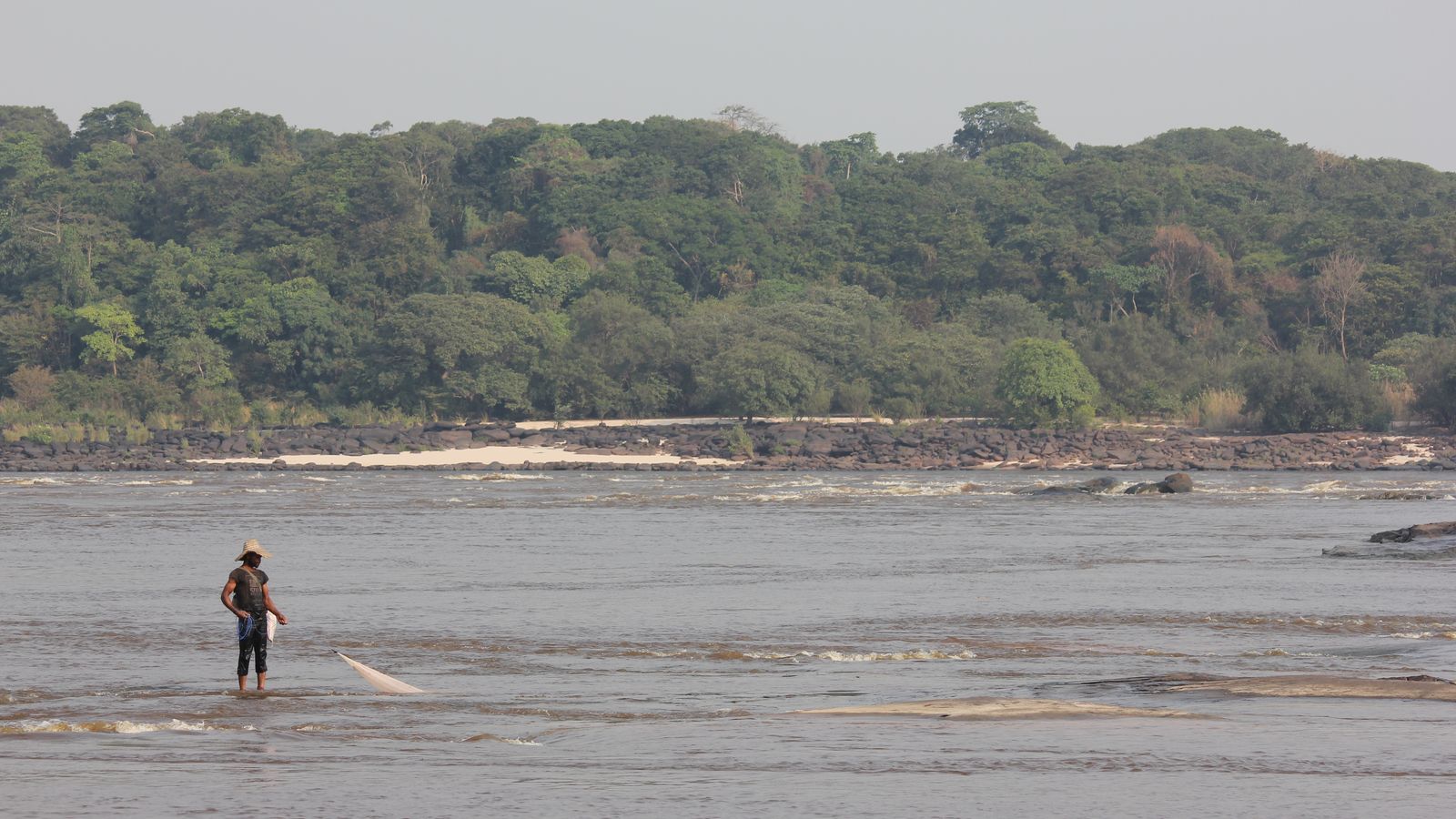
Untouched by man and his destructive ways, deep in the heart of Africa, lies the Congo River Basin, the second largest rainforest on the planet. This mysterious land, locked in time, is a lost world where the naïve, yet noble, savage hunts, and is hunted by, monstrous creatures from the dawn of time stalking the dark jungles and deadly swamps.
Or at least, this was the belief held in the early 1900s, further popularized by writers like Arthur Conan Doyle and his book The Lost World, but let’s set the record straight, the locals of the Congo Basin is neither savage nor naïve; however, this idea of the African jungle as a lost world, filled with unknown creatures and living dinosaurs seems to persist well into 2024. According to paleontologists, the last of the non-avian dinosaurs went extinct around 65 million years ago. However, what if Owuo, the god of death and destruction, missed one?
Key Takeaways
- Mokele-mbembe is a cryptid described as a neo-dinosaur, with sightings reported in the Congo Basin and surrounding regions.
- Despite numerous expeditions, no concrete evidence of mokele-mbembe’s existence has been found, and many sightings can be attributed to misidentification of known animals.
- The name ‘mokele-mbembe’ has been translated in various ways, and its meaning has evolved over time due to western influence.
- Many expeditions searching for mokele-mbembe have used questionable research methods, potentially biasing local testimonies.
- The most likely explanations for mokele-mbembe sightings include mistaken identity of known animals, an undiscovered species, or simply human imagination.
For over a century, stories of a fearsome beast, living in the rivers and swamps, have been told around campfires and whispered to missionaries. Is it a spirit creature, a guardian and protector, or a malevolent entity intent on destroying everything in its path? Or is it a real animal, unknown to science? Today we’re battling our way through the dense jungles and muddy swamps of the Congo Basin, like the explorers of old, on the trail of the ever elusive mokele-mbembe.
Meet Mokele-Mbembe
Mokele-mbembe, the ‘one who stops the flow of rivers’, which is a suitably dramatic name for a cryptid, is a neo-dinosaur apparently found mainly in the Likouala swamp region in the Congo Basin. Initially, sightings were reported in the Republic of the Congo (Brazzaville) and the Democratic Republic of the Congo (Kinshasa) which are two different places because in Africa we like to confuse people; however, it’s also been reported in Cameroon, Gabon and a few other places. A neo-dinosaur, for those of you not well-versed in the wonderful world of cryptids, is a cryptid that looks a lot like a dinosaur.
However, mokele-mbembe is no dainty little dinosaur; it’s a big, bulky fellow. Some claim it’s about the size of an elephant, at least the size of a hippo, while others insist it’s much larger than a mere elephant. It has a very long, flexible neck, thick as a man’s thigh, ending in a small head, usually compared to the head of a snake, lizard or turtle with nostrils on the front of the snout. It sports a long, powerful tail, similar to that of a crocodile.
The skin is smooth and the colour depends on who you talk to and can range from grey, brown, or reddish. In some regions, like Cameroon, mokele-mbembe is also covered in thick, armour-like scales, once again, similar to a crocodile.
The animal is quadrupedal; a fancy way of saying it’s got four feet, usually described to be the size of frying pans which leave deep three-clawed footprints in the soft soil of muddy riverbanks. However, considering the variety in sizes when it comes to frying pans these days, I’m not sure that’s a very accurate form of measurement. The creature is often described as having three relatively long, slender, pointed toes; however, according to some tales, it has flipper-like limbs which would make sense since it’s supposedly aquatic or, at least, semi-aquatic.
You’re most likely to come across mokele-mbembe in the deep pools and the underwater caves of the swampy jungles of western Africa. However, it seems to prefer rivers and will often find washed out caves in river bends. You’re unlikely to see the whole animal though; usually, only the head and neck are visible and, like hippos, it can submerge completely, hiding under the water. It’ll occasionally venture onto land at dusk and dawn to feed on the apple-like fruit of the molombo plant growing on the riverbank, so be alert if you’re going for an evening stroll or a morning jog in the jungles.
Mokele-mbembe might be an herbivore, but it’s very territorial, with a particularly deep-seated hatred of hippos and general ill-will towards canoes. It has a fiery temper, doesn’t like to be disturbed and will tip canoes floating into its territory, usually drowning, but not eating, the occupants. A story here and there paints it as a protector; however, a few stories also mention it killing and eating domestic goats. Since the molombo fruit is very low on protein and fibre, I suppose even a neo-dinosaur needs to stoop to the occasional goat to supplement its diet.
Africa is a big continent and it’s not uncommon to have slightly different variations of the same model of animal which might explain some discrepancies in description. In some regions, it’s described to have a horn while others describe it as having a coxcomb similar to a rooster. Some eyewitnesses also mentioned dermal spines on the neck, down the spine and tail. According to some story-tellers, it roars aggressively when approached by a human which is understandable.
I wish I too could roar aggressively when approached by humans. Others claim the beast is silent, making no sound at all, which doesn’t make a lot of sense as all animals make a sound; some are just quieter than others.
The best time to see mokele-mbembe is during the rainy season as it appears when the rivers rise and then leave, presumably going downstream, when the rivers fall where it spends the dry season hiding in natural caves along the riverbank. Air passages dug deep into the riverside allows our sleepy mokele-mbembe to breathe. Of course, only the male mokele-mbembe gets to sleep the dry season away – the female is busy raising little mokele-mbembes in nests in the swamps.
The Baka hunters believe they only do this once every 20 years which might explain why they are so rare. There’s also some debate over whether they give live birth or lay eggs, but if their eggs are the preferred lunch of the Nile crocodile, monitor lizards and pythons, it could certainly explain their scarcity as well.
If you think this description fits a sauropod, the massive, long-necked herbivore that sneezed on poor Lex in Jurassic Park, you’d be applauded by cryptozoologists everywhere. Of course, if a full-sized Apatosaurus or Brachiosaurus was running around the Congo, we would’ve seen them by now, so, in order to make the story more plausible, mokele-mbembe resembles a small Apatosaurus. This might sound like an unlikely creature to you and me, but millions of dollars have been spent looking for it.
The Search is on!
Searching the Congo Basin, even for an animal the size of a small dinosaur, is no easy task; the region is vast with many obstacles along the way, including dangerous animals and dense jungles. However, despite the hardships in finding it, mokele-mbembe has been reported for decades. There are simply too many sightings and expeditions to cover all of them, so I chose some of the more influential names in the mokele-mbembe game.
The first mention of a monster in the Congo comes from the writings of French clergyman – Abbe Lievin Bonaventure Proyart who published a book, History of the Loango, Kakonga and other Kingdoms in Africa, in 1776 after working as a missionary in Africa. Cryptozoologists love quoting Proyart; almost every article about mokele-mbembe lauds him as the first man to tell the truth about monsters in Africa. However, if you read the full two sentences he dedicates to the footprint of the supposed monster, you quickly realize the print most likely belonged to a large rhino.
The stories about dinosaurs running around Africa only show up much later and the man we have to thank for that is Carl Hagenbeck – showman, zoologist, animal dealer, big game hunter and zoo supplier, so not the most reliable of witnesses and probably not too concerned with animal conservation. In his book, Beasts and Men, published in 1909, he recounts stories he’d heard from locals, missionaries and hunters of a huge animal, described as half-elephant and half-dragon, roaming the wild expanse of what we now call Zimbabwe and Zambia. Cave drawings in Central Africa, which is a long way from Zimbabwe, apparently depict a brontosaurus, but unfortunately he never bothered to tell anyone where to find these caves, and Central Africa is a sizeable piece of real estate to search. One of Hagenbeck’s sources also mentioned a distinct lack of hippos at Lake Bangwelu in Zambia, and what creature do we know with an innate hatred of hippos? Hagenbeck was convinced the monster was real, and set out on a most expensive expedition to find the creature, probably to sell to a zoo, but he was unsuccessful.
Hagenbeck’s claims of dinosaurs in Africa couldn’t have come at a better time; dinosaurs were all the rage in the early 20th century. In 1905, the American Museum of Natural History unveiled a mounted skeleton of an Apatosaurus and London’s Natural History Museum unveiled a Diplodocus. It didn’t take long for museums all over the world to start showcasing gigantic skeletons of sauropods, mostly thanks to Andrew Carnegie, an industrialist and patron of the sciences who happily funded many an excavation. Hagenbeck’s book was snapped up by an eager audience caught up in the dinosaur craze helped along by Arthur Conan Doyle and Rider Haggard, among others.
However, the man we have to thank for naming the creature is German explorer Ludwig Freiherr von Stein zu Lausnitz who we’ll only refer to as Von Stein to preserve what little is left of Simon’s sanity. In 1913, while leading an expedition to map out parts of the Germany colonies in what is today Cameroon, he encountered a whole lot of interesting wildlife and collected some wild stories about a greatly feared river monster living in the Congo Basin. The descriptions matched that of a small sauropod, around the size of an elephant or hippo, with a single horn on its head. Von Stein considered the story-tellers to be trustworthy and credible, and noted that the stories remained consistent. Deeply intrigued, he carefully documented the various tales. While he believed it to be a creature from folklore, he also thought the stories might be based on something real. Sadly, his trip was cut short by the outbreak of WWI, and his manuscript was never published; however, snippets of his account show up in later works by Wilhelm Bosche and German-American science writer Willy Ley. In Exotic Zoology (1959), Ley compares eyewitness accounts of mokele-mbembe with known dinosaurs, and, because he was a science writer, dinosaurs in the Congo had to be real, right?
The first westerner to spot mokele-mbembe was zoologist Ivan T. Sanderson, who ran into mokele-mbembe in 1932 during the Percy Sladen Expedition to West Africa. While canoeing along the Mainyu River with fellow expeditioner Gerald Russell and two local guides, the men were startled by loud, terrifying roars as they passed some submerged caves on the cliff-like riverbank at dusk.
At the first bellow from the caves, the native guides, the only ones who could confirm the sighting, conveniently fainted. Sanderson found his canoe being swept closer to the entrance of the cave when another wild roar was followed by an animal rising out of the water, giving a final roar, and plunging into the river, disappearing from sight. The animal was shiny and black and its head alone was about the size of a hippo.
The locals later informed Sanderson that he had crossed paths with Mbulu-eMbemb, or M’kuoo-m’bemboo, Sanderson couldn’t quite get his story straight on that detail. Personally, I’m inclined to believe our man encountered a most annoyed hippo who didn’t like being disturbed, but Sanderson insisted that it was mokele-mbembe herself.
By the 1940s, western interest in mokele-mbembe dwindled; there were more interesting things happening in the world. There were local sightings aplenty, but mokele-mbembe pretty much vanished from public imagination until the late 1970s when there was an unexpected revival in interest in the Congo dinosaur, spear-headed by James Powell and Dr. Roy Mackal.
It all started in 1976 when James Powell, an American herpetologist, decided to launch an expedition to study crocodiles in the rainforests of Gabon. He was also interested in learning more about a mysterious water creature after reading Trader Horn, the 1927 memoir of Alfred Smith, an employee of the British Trading Company out of Gabon in the late 1800s. The book recounts some of the more memorable local tales of a dragon-like water beast known as ‘amali’ or ‘jago-nini’, meaning ‘giant diver’. However, unlike mokele-mbembe, this creature would leave the water to devour people. Apparently goats weren’t good enough. Following up on these stories, Powell visited the villages of the local Fang people in Gabon who shared stories of their own river monster, the N’yamala. A local witchdoctor, Michael Obang, claimed to have seen the creature while swimming in a jungle pool, sometime around 1946. In an attempt to figure out what the creature looked like, Powell showed Obang pictures of a variety of animals, both living and extinct, and was surprised when Obang picked out the diplodocus, a long-necked sauropod, as the closest match to the N’yamala. Showing the locals pictures of dinosaurs became a popular gimmick used by every expedition that followed, but it seems like the idea originated with Powell. Upon his return home to the United States, he eagerly shared this remarkable discovery with Dr. Roy Mackal, a biochemist from the University of Chicago and vice president of the International Society of Cryptozoology.
In 1979, Mackal, along with Powell, arrived in the Republic of the Congo launching their first expedition in search of mokele-mbembe. Their plan was to travel from one small village to the next collecting eyewitness accounts from local people. Everywhere the expedition went they heard tales of a water-dwelling creature, grazing at dusk, and leaving large tracks on the muddy riverbanks.
One of their first witnesses, Firman Mosomele, claimed to have come across mokele-mbembe when he was around 14 years old while paddling around a bend in the Likouala-aux-Herbes River. It had the signature long neck and our man Mosomele, wisely deciding not to tangle with the creature, promptly started rowing in the opposite direction; however, the animal quickly vanished. Apparently, Mackal had a book on prehistoric animals casually lying on a table during the interview, and without being asked, Mosomele picked out a picture of a sauropod claiming it closely resembled the creature he saw.
Some of Mackal’s techniques were a bit questionable, so I have to wonder – did Mosomele pick up the book and page through it until he found a sauropod, or was the book conveniently open on a picture of a sauropod. Soon, more witnesses came forward, and they all agreed that mokele-mbembe was a sauropod-like creature.
Some locals also shared an exciting tale of a sighting at Lake Tele, around 1959, when a mokele-mbembe was actually killed by a local tribe. Lake Tele was a favorite fishing spot for both the tribe and mokele-mbembe, so the fishermen blocked off the waterway where the animals lived and built a barricade with large spikes to keep them out. When one of the animals tried to break through the barricade, it was trapped and killed with spears.
Parts of the animal were cooked and eaten during a traditional victory celebration. However, everyone who ate of the meat soon died leading to rumors that the meat of the mokele-mbembe is poisonous. Mackal, being a man of science when it suited him, speculated that the deaths were more likely the result of food poisoning due to spoiled meat and natural causes; after all, the life expectancy in the region is quite low.
By the 1980s, some of the stakes used to construct this trap could still be seen at Lake Tele so obviously the story is 100% true. Of course, by the time Mackal and Powell heard the story, everyone who had been involved were already dead and no-one knew what had become of the skeletal remains, so, once again, were are left with nothing but a story.
Based on all their research, Mackal determined that the most likely habitat for mokele-mbembe was the remote Lake Tele, so, in 1981, Mackal was back in the Congo, this time with Jack Bryan, heading south on the Likouala-aux-Herbes River in an attempt to reach the small, shallow lake in the heart of the swamps. Fallen trees and dense vegetation made passage along the narrow waterways near impossible, so the team didn’t make it to Lake Tele, but at least they had their own mokele-mbembe encounter. Coming around a bend in the Likouala River north of Epena, the expedition first heard a loud splash and then a large wake, around 5 inches (25cm) high, originating from the east bank, washed over the canoe.
The wake could only have been caused by something big suddenly dipping below the water. It was too big to be the result of a crocodile, and there were no hippos in the area; however, the local guides apparently starting screaming ‘Mokele-mbembe!’ so apparently they knew what it was.
Mackal and his fellow expeditioners, though by the sound of it not the locals who were terrified and wanted to turn around and get the hell out of there, searched the area for around 30 minutes, but whatever had caused the wake, and terrified the locals, was long gone. So close and yet so far.
After unsuccessfully attempting to raise funds for a third expedition, Mackal finally published a book, A Living Dinosaur? In Search of Mokele-Mbembe, based on his expeditions. The book also included pictures of cave paintings in Tanzania and Zambia supposedly depicting long-necked quadrupeds unknown to science. However, after a quick glance at the pictures, I’m fairly certain the long-necked creatures are giraffe and the thick-tailed creatures are most likely lizards. Mackal and his team never found anything conclusive, but he believed the number of eyewitness reports meant there was something out there that science has yet to explain.
Around the same time as Mackal’s second expedition, another expedition, led by Pasadena native Herman Regusters and his wife Kia, set out for Lake Tele overland and, unlike the Mackal expedition, they actually managed to get there. If you believe the tales they brought back, the Regusters expedition was, by far, the most successful as they reported multiple encounters with what could’ve been mokele-mbembe.
While exploring the southernmost lobe of the lake, Herman and Kia first heard a loud cry, from an unknown animal, coming from the jungle. They described the cry as starting with a low, windy roar, increasing into a deep-throated trumpeting growl, followed by the sounds of a large beast of some kind moving through the jungle. After 5 minutes, they heard it again but after that, it went quiet.
Interesting side note: elephants also growl, a startling sound if you’re not expecting it, and forest elephants live in the jungles; make of that what you will. The sound was heard again a few times during their stay, and the expedition attempted to record it, but the resulting recordings were of very poor quality.
The expedition also reported a number of sightings but, conveniently, the team photographer managed to miss most of them. The most impressive sighting was made by Kia while exploring the southernmost tip of the lake. Two members of the team heard the strange cry, followed by a loud splashing sound as something big entered the water. Not long after, Kia claimed to have seen a long serpent-like neck emerging from the water, around 30m (or 98 feet) away, facing the direction of the inflatable raft; not sure that’s what I would’ve used to go and find a creature that loves to tip canoes and drown people.
The expedition finally returned home with footprint casts, low quality photos and low-quality sound recordings of an unknown animal. They also claimed to have filmed one of their encounters with mokele-mbembe but the heat and humidity ruined the film. Their guides were later interviewed by other expeditions, but, despite Regusters claiming that at least ten local guides were present at one of the sightings, they didn’t remember seeing anything.
Mackal criticized the expedition arguing that the sound they heard was made by the emela-ntouka, another unproven cryptid, and not by mokele-mbembe, our unproven cryptid. Somewhere out there a whole herd of forest elephants are having a grand chuckle at the whole affair.
In 1985 William ‘Bill’ Gibbons arrived on the scene to join the eternal quest to find mokele-mbembe. The first expedition, creatively named ‘Operation Congo’ lasted from November 1985 to May 1986. They made it to Lake Tele, but found no signs of mokele-mbembe.
They discovered a new subspecies of monkey though, so I guess it wasn’t a complete waste of time. Gibbons wasn’t going to give up that easily, so a second expedition, ‘Operation Congo 2’ was launched in November 1992. This time, the team made their way along the largely unexplored Bai River, through dense swamps, and searched two unmapped small lakes, Lake Fouloko and Lake Tibeke, which, according to local folklore, was supposedly home to mokele-mbembe.
Their search was hampered by fear and superstition; the locals believed that talking to white outsiders about mokele-mbembe meant certain death, so the expedition finally had to give up and return home with nothing to show for their efforts.
In 1994, a bloody civil war broke out in the Congo, effectively putting a stop to any further expeditions as the region became far too dangerous for foreigners. However, Gibbons had heard tales of unidentified creatures spotted in the unexplored forests, swamps and rivers of southeastern Cameroon which borders the Congo. So, in November 2000, Gibbons teamed up with Dave Woetzel and Pierre Sima, a Cameroon hunter familiar with the jungles and the Baka people who live there. The team spent most of their time wading through waist-high swamps and floating down rivers, travelling from one rural village to the next, collecting first-hand eyewitness accounts of mokele-mbembe, though the locals referred to it as li’kela-mbembe.
Watch Now
Open Video
Video Briefing
Is Congo's 'Living Dinosaur' Real?
It turned out that the Baka people in Cameroon didn’t have the same fear and superstitions attached to mokele-mbembe as their Congolese neighbours and were perfectly happy to answer any questions, quickly confirming that the creature still inhabited the rivers and swamps of southern Cameroon which borders Gabon, the Congo and the Central African Republic, suggesting a wider range for mokele-mbembe than was considered before. It was the first time they were asked about these animals, and once again, they were shown pictures – firstly animals they knew, like the crocodile, followed by pictures of animals they wouldn’t recognize, like the American brown bear, and finally, they were presented with extinct animals. They didn’t recognize bipedal dinosaurs, like T-Rex or the flying creatures, like pterodactyls, but did get very excited about the sauropod dinosaurs and the triceratops.
When shown pictures of different sauropods, they identified diplodocus with its long neck and brachiosaurus with its dermal spikes as most like mokele-mbembe. It was the first time the picture parade was done in Cameroon, so it’s interesting that the locals still picked out the sauropod.
In 2001, Gibbons was back with a new team, a joint venture between CryptoSafari and the British Columbia Scientific Cryptozoology Club (BSCC). After an arduous cross-country journey, since there doesn’t seem to be any other kind of journey in this part of Africa, the team set up base camp near a major river in the south of Cameroon. One member of the expedition, Robert Mullin, casually mentioned the search to a young boy who became very excited because his father, grandfather and uncle had all seen the creature they called mokele-mbembe.
The father and uncle agreed to an interview and described a huge creature with a long neck and fiery temperament that didn’t take kindly to being disturbed. Once again, the picture books were whipped out and, once again, our witnesses dutifully picked out sauropods, specifically diplodocus and brachiosaurus. Other villagers were also asked to identify the animal and they too identified diplodocus and brachiosaurus as mokele-mbembe.
During their time spent in Cameroon, the CryptoSafari crew didn’t come across a single hippo or crocodile; according to the locals, mokele-mbembe had chased them all away.
In 2012, Gibbons finally had his own mokele-mbembe encounter which just goes to show – if at first you don’t succeed, keep trying. An expedition including Bill and Andrew Gibbons, John Kirk, and Michel Ballot returned to Cameroon to explore the Dja River, as far north as the Falls of Nki. However, one of the expeditioners came down with a serious medical issue so the expedition had to be cut short.
At 6:30 am on the morning they were set to leave, three members of the expedition journeyed upriver to take a closer look at the falls before starting their journey back down the river to Ndongo. Not long after the party left, Bill Gibbons and John Kirk heard a strange bellowing coming from the middle of the river. With trees in their way, the men scrambled to reach a spot where they could see the river; however, just as they were finally in position to see what was making the noise, the others returned in their motorized pirogue and their mysterious quarry went quiet and vanished.
The 2000s saw a slew of TV documentaries, from National Geographic to the History Channel, featuring American and British adventurers hunting for mokele-mbembe. Most of these documentaries were focused on entertainment rather than accuracy so not much was found. A Monster Quest episode airing in 2009 followed a Bill Gibbons expedition taking place near the Dja River in Cameroon, close to the Republic of the Congo; the expedition discovered some large underwater caves and what appeared to be air vents; however, for some reason they decided not to investigate it any further by, you know, lowering a camera into the caves. They had a whole film crew with them – I’m sure someone had something on hand that could do the job. In 2016, a South African crew made their own documentary about mokele-mbembe which they later sold to Discovery Africa. Some of the folks they interviewed claimed the creature was very real, but they also told the crew that the last mokele-mbembe died around 2006, so, whatever the creature was, it’s now extinct.
A civil war kicked off in Cameroon in 2017 making field work in the region a challenge. Cryptozoologists have now turned their attention towards Gabon where there is some interest in, and a healthy amount of sightings, of mokele-mbembe. Personally, I think it’s very considerate of mokele-mbembe to keep moving out of warzones to make it easier for westerners looking for her not to find her.
Where’s the evidence?
Considering all the eyewitness accounts collected by Mackal, Gibbons and every other mokele-mbembe expedition to make its way into Africa, there must be hundreds of sightings going all the way back to 1907 and the tales of Carl Hagenbeck. While this number of sightings is impressive, other than vague photos that don’t actually show us anything, is there any proof for mokele-mbembe?
Digging around looking for more evidence, I came across a few artifacts eagerly presented as proof of mokele-mbembe’s existence. The first is a wooden carving discovered in a souvenir shop in the Congo in the 1980s of what appears to be a long-necked animal with short powerful legs, a long powerful tail, no visible ears, and a head somewhat resembling that of a snake with large eyes and what seems to be a frill down its back. It doesn’t have teeth, thus meaning it must be an herbivore.
According to the Young Earth Creationist website presenting this piece as actual proof, this carving is an attempt to depict a sauropod dinosaur thus proving that mokele-mbembe is real. So, if you buy a Nessie figurine in Scotland it’s a tourist souvenir. If you buy a figurine in the Congo that may or may not be a representation of mokele-mbembe, it must be proof that the creature exists because obviously the locals can’t possibly be that artistic, creative or show some entrepreneurial spirit by giving tourists what they want.
Not cool guys, not cool.
Another interesting artefact is a reptile-shaped Ashanti gold weight obtained from Ghana called the ‘little gold dinosaur’ often associated with mokele-mbembe and other similar cryptids. These weights were made from brass and used to ensure fair trade. The creature’s head is unusually large for the body, which clashes with the popular description of a small head, but if this is mokele-mbembe, it suggests that the animal’s range could extend into Ghana. Skeptics, who have to ruin everything, have argued that the weight is just a stylized monitor lizard.
A third possible mokele-mbembe artifact was found in the most unusual of places – Ireland. Residing at the Glencomeragh House of the Rosminian Missionary Fathers, the piece possibly dates to the 1950s. The Rosminian Fathers is a missionary order that worked in Africa for many years, and many of the missionaries brought back souvenirs.
The piece is around six inches, that’s 15 cm, tall, carved from a single piece of wood, and consists of two creatures. The larger of the two looks somewhat like a sauropod, with the long neck and everything; however, some details, like the large, pangolin-like overlapping scales on the body is a bit of a problem as sauropods didn’t have scales. A second smaller creature, with the same scales, is standing upright, on its hind legs, resting directly on the larger creature’s body.
It doesn’t have a long neck, so perhaps it’s a baby or the carver ran out of wood. Both creatures have a peculiar fin-like structure visible at the base of the tail. The large creature also seems to have long pointed teeth that would be a bit at odds with an herbivore unless it’s feeding on super-size Venus flytraps.
If the carving dates to the 1950s, it would’ve been made before the Mackal expedition in the 80s that really set the mokele-mbembe ball rolling. What makes this carving interesting is a story told by Dr. Pierre Nuyen, who found himself stationed in French Equatorial Africa in 1958 – 1959.
Arriving at a small village while travelling from Impfondo to Epena, the villagers told Nuyen about an animal living in the swamps of Lake Tele that looked something like an enormous pangolin. Was our carver depicting a real animal?
Pictures of footprints and footprint casts are also often presented as indisputable proof. During a 2004 expedition to Cameroon, led by Milt Marcy, one of the expedition members, Peter Beach, found a three-toed footprint on a very small island known as Swamp Island in the Dja River. Some of the overhanging vines had been stripped away, suggesting an animal around 18 feet, or 5.4 meters, tall and the print was the size of an elephant print.
Beach made a cast of one of the toes since he didn’t have enough plaster to cast the entire print. You know you’re hunting something big; why wouldn’t bring enough plaster? The locals informed the expedition of the nearby caves where mokele-mbembe likes to spend the dry season and the team found scratch marks on the wall of one of these caves thus leading to the inevitable conclusion that the print belonged to mokele-mbembe.
If you’re still not convinced, we even have video footage of mokele-mbembe. In 1992, a Japanese film crew making a documentary was filming aerial footage over Lake Tele when they spotted something in the lake. What follows is around 15 seconds of footage, found all over YouTube, of a black object moving across the lake. Some articles claim that it dives out of sight, but the footage I watched cut out before this supposed dive takes place.
The film has been analyzed extensively, and most people agree that we’re looking at a crocodile, a boat with two people, or an elephant. Elephants are surprisingly good swimmers and they enjoy being in the water. They even dive, using their trunks as a snorkel. So, yes, seeing mokele-mbembe would be cool, but guys - diving elephants.
One more reason not to go snorkeling in African lakes, but isn’t nature amazing?
Is It Real?
It seems that, for the last century, stories of living dinosaurs in the heart of Africa have been exciting the imagination and emptying the pockets of eager explorers desperate to be the one who makes possibly the greatest discovery since table salt and string cheese. However, is there anything lurking in the dark jungles patiently waiting to be discovered, or are we chasing phantoms?
Nowadays, the Young Earth Creationists leading the charge seem very keen on proving that mokele-mbembe is a living dinosaur as it will somehow disprove evolution and prove the bible. However, there are a lot of details about mokele-mbembe that doesn’t fit the description of a sauropod dinosaur starting with the three-toed footprints. Sauropods didn’t have toes; they had compact feet, like that of an elephant.
For a long time, paleontologists also imagined that sauropods were living in swamps, but we know today that Apatosaurus and friends preferred seasonally dry woodlands where they could chow down on conifer trees and cycads. The idea that the animal will nest in caves in river bends, in some cases even burrowing out these caverns, also doesn’t make sense. Small dinosaurs certainly were capable of burrowing, but sauropods, even the smaller ones, didn’t burrow.
Many accounts also mention a horn, which a sauropod most definitely didn’t have. The horn is often ignored or it’s explained away as a misidentification – Von Stein saw an emela-ntouka and thought it was a mokele-mbembe, but how do you confuse something you’re naming and describing for the first time with something that’s not been invented yet?
Speaking of the name, that’s another problem altogether. How accurate is the translation: one that stops the flow of rivers? We know the name, mokele-mbembe, originated with Von Stein; however, we only have Willy Ley’s translation of Von Stein’s work and, since the original manuscript is lost, we have no idea what Von Stein actually wrote. The name only shows up in Exotic Biology in 1959 and while Ley claims it was a name used by locals, he also admits that Von Stein wasn’t sure if the name had any special meaning at all. The name was only translated as ‘one who stops the flow of rivers’ by Herman Regusters in 1982, and he was neither linguist nor native Lingala speaker. Another possible translation, ‘he who divides the waters’ sounds rather biblical and would certainly fit the young earth creationist literature. When French anthropologist and linguist, Pierre Alexandre attempted to determine the origin and meaning of the name, he was told by around 30 young Congolese natives that the mokele-mbembe was a species of giant crocodile.
Another possible translation comes from the second Mackal expedition. There’s some debate about how this all went down, so I’ll just tell the story and let you decide for yourself. Apparently, during an interview with an important government official serving in the Epena District of the Likouala region, Mackal mentioned the name mokele-mbembe to which the man smiled, claiming that, in Lingala, it means rainbow. Mackal, seemingly under the impression that he was more familiar with Lingala than the people who actually spoke the language, insisted that the man was wrong and quoted a passage from Exotic Zoology, written by a German who had never set foot in Africa. He told the official that if a rainbow could be killed with spears and eat fruit, he would be very interested in seeing it. The very next day, the official changed his story claiming that, after some reflection, he decided to tell them the truth about mokele-mbembe, even offering up a whole bunch of witnesses who had seen the creature. Personally, I think he saw an arrogant little white man who didn’t care about the truth, so he told the expedition what they wanted to hear to get them out of his district.
Now, language is a fascinating thing – it grows and changes. While we have no idea what mokele-mbembe meant when Von Stein heard it back in 1913, after Mackal’s meddling, and with each new expedition going on a monster hunt bringing books full of dinosaur pictures, it seems that the word mokele-mbembe has now taken on a new meaning, though nothing as dramatic as ‘one who stops the flow of rivers’. These days it’s used to refer to sauropod dinosaurs, and in the Aka language, it’s apparently also used to refer to any large, unknown animal which obviously leads to a bit of confusion for all our intrepid cryptid hunters.
Sadly, the alleged incident with the government official wasn’t the only example of bad research that I came across. For someone with a science degree, some of Mackal’s alleged research methods were questionable at best. He was eager to tell his audience how every local picked out sauropods when asked to identify mokele-mbembe.
However, it appears that this wasn’t always the case. In one village near Lake Tele, the villagers told Mackal they’d never seen it. Instead of noting it down like a scientist would, he decided that they were all in on a conspiracy to keep it secret.
In another village, a Congolese government official allegedly just flat-out threatened people who then suddenly remembered encounters with mokele-mbembe. Mackal was also accompanied everywhere by a security team with AK47s, which is pretty intimidating if you’re a rural farmer or villager just trying to go about your day. In some instances, his interview approach would be to tell the locals everything he knew about the creature, then give them a beer and ask them to tell him the truth as they knew it.
If the guy with the beer and security team carrying AK47s in a country rife with government and police corruption is asking you to tell a specific story, bro, you’re going to sing like a canary, any tune that white man wants to hear as long as he leaves and takes his AK47 wielding friends with him. Is it just me, or do all those eyewitness accounts of mokele-mbembe, which Mackal used to build his case, suddenly seem a bit hollow?
Mackal and those following him had no anthropological training and, in anthropological terms, they were a disaster. The picture parade of animals, with the locals invariably picking out the sauropods as a spitting image for mokele-mbembe, makes for great TV. However, pictures of sauropods have been circulated so much by westerners looking for mokele-mbembe that the testimony from locals is now tainted with whatever the previous expedition with their dinosaur book showed them or wanted to hear.
With their constant interference over the last 100 years, it’s possible that the folk memories and stories about mokele-mbembe have been twisted to follow a narrative more acceptable to westerners meaning that the local stories can no longer be trusted. Now, please don’t send a lynch-mob, I’m not saying anyone is lying intentionally, but the stories have been told to the tourists and explorers for so many years by so many generations that many of the local people now also believe the stories they’ve heard from their parents, grandparents and village elders.
While these questionable research practices are problematic enough, there are just as many expeditions, actually even more, who went to the Congo and found absolutely nothing. In the early 1970s, when James Powell was doing his first expeditions, he travelled through the same area Von Stein was in when he wrote his lost manuscript. Powell showed the locals pictures of sauropods and plesiosaurs, but they didn’t recognize it and when asked about mokele-mbembe, they claimed they’d never heard of it. A Dutch expedition visiting the Congo in 1986 interviewed the guides of the Regusters expedition, which claimed to have had so many encounters, but none of them remembered seeing anything. A 2001 BBC series, Congo, also tried to replicate the tired old ‘pick the animal’ trick but instead of pointing out a sauropod dinosaur, their locals picked out a rhino; well, there goes the ratings.
Many of these expeditions, especially the more recent ones, rely very heavily on the idea of the ‘noble savage’ who has no reason to lie. In MonsterQuest, the narrator claims that these people have virtually no contact with the outside world and according to Bill Gibbons, the people native to the region, especially in rural areas and small villages, have no television, radios, books, or magazines and are mostly illiterate. However, while filming one of the many television documentaries in a small village, the narrators asked what mokele-mbembe looked like and one villager said it looked like a brontosaurus. When asked where he heard the word, he said he heard it on TV. This idea that rural Africans have little contact with the outside world and is completely out of touch is old-fashioned at best and horribly racist at worst. Even the most remote of these communities have contact with missionaries and well-meaning aid organizations providing relief efforts in often war torn countries where the majority of the population lives in extreme poverty.
In 1989, British travel writer, Redmond O’Hanlon, went on his own expedition to find mokele-mbembe. A lot of the people he encountered claimed the creature was a creature of spirit, specifically a water spirit, not an actual living being. In one village, he was informed by the son of a village elder that stories of the Congolese dinosaur were meant to ‘bring idiots like you here.
And make a lot of money.’ Far from being too naive and innocent to see the economic potential in a creature like mokele-mbembe, the local people in the area are well aware of the western fascination with their living dinosaur. They have a vested interest in keeping the creature alive and just out of reach – the rich westerners keep coming back, spending a lot of money hiring guides, trackers, porters, and in the case of Mackal, handing out beer to anyone who can tell them what they want to hear.
It’s easy money in a region rife with poverty, and if the gullible white man keeps throwing it at them, why shouldn’t they take it?
However, the biggest argument against the existence of mokele-mbembe is the fact that not a single specimen, alive or dead, has ever been found. A single dinosaur couldn’t live for 65 million years, so if mokele-mbembe is real, there has to be a breeding colony somewhere. Considering its supposed size, even a small breeding colony would’ve been found by now.
Animals leave behind scat, footprints, and when they die, carcasses. We’ve found the skeletal remains of rhino and elephant graveyards, but so far we haven’t found a single bone from a mokele-mbembe, or any other neo-dinosaur for that matter. Advanced technology, especially aerial and satellite surveillance, makes it possible to identify elephants, so we should’ve seen a sauropod, even a little one, by now.
I will be the first to admit that large animals can hide surprisingly well in the bush – just ask anyone who has ever accidentally come across an elephant, rhino or buffalo. However, while the jungles of the Congo are very dense, the area isn’t completely unpopulated – even if we can’t catch a glimpse of a living sauropod with a drone, there are enough photographers, hunters, journalists, park rangers, writers, smugglers, war lords, evangelical Christians working to disprove evolution, camera crews, poachers, documentary makers, cryptozoologists with unrelated qualifications and no field training, and locals carrying phones with cameras built in that, if a sauropod-like creature was roaming the jungles of Africa, the law of sheer dumb luck dictates that someone should’ve gotten a clear shot by now.
What is really lurking in the jungles?
I’m sure we can all agree that whatever mokele-mbembe is, it’s definitely not a dinosaur. However, considering all the reported sightings, it’s clear that people are seeing something in the jungles of Africa, so what is the most likely explanation?
Of course, the first argument presented is the one that creatures once believed to be extinct was rediscovered millions of years later; yes, it’s that fish again – you know the one I’m talking about. A study done by University of Queensland zoologists showed that it’s possible for some modern mammals, thought to be extinct, to still survive in small, hard-to-find pockets of their former haunts; however, they found that if a proper search was launched, the once-extinct animal would usually be rediscovered within three to six searches. After more than eleven unsuccessful searches, the odds start dwindling which doesn’t bode well for the Tasmanian tiger and the Yangtze River dolphin, but is even worse news for mokele-mbembe who’s been the subject of more than 50 expeditions over the last 40 years or so.
Of course, this study assumes that those doing the searching are trained and qualified zoologists or researchers in related fields approaching the search in a strictly scientific framework; as we know, this is not the case for mokele-mbembe. The majority of those looking for it are self-described explorers with little or no relevant training in scientific methods or experience in doing fieldwork or tracking and studying wildlife. Ironically, if the animal in the Congo Basin is a living sauropod once thought extinct, it means that it adapted to live in a swampy environment which actually proves evolution instead of disproving it.
Another possibility is an undiscovered species. We sometimes think that we’ve learned everything there is to know about this amazing planet of ours, but the Megamouth shark was only discovered in 1976, and a new species of monkey, the Highland Managebey, was discovered in Tanzania in 2005. In 2008, 125 000 Lowland Gorillas were discovered living in the Congolese jungles at a time when they were considered to be on the brink of extinction.
Environments that make it easy to hide, and which quickly erase any trace of a creature being there, like dense jungles, is a very likely contender for housing some undiscovered species. If the animal is particularly shy or the species is critically endangered, and therefore small in number, the possibility of it still being undiscovered by science further increases. There are also a lot of species endemic to the Congo Basin which certainly supports the idea that there could be animals living there that’s found nowhere else on earth.
The Congo Basin and surrounding regions also aren’t the most hospitable place in the world to do research; you have to deal with political instability and war, a lack of infrastructure like roads and reliable internet, corrupt governments and a level of bureaucracy that would make Arthur Dent weep in hopelessness.
A more likely explanation is a simple case of mistaken identity. Our elusive dinosaur has a lot of traits in common with regular African animals, like elephant, rhino and hippo; all these animals are gray in color, hippos sweat is red which might explain why some people describe a reddish-colour animal, and the rhino has a horn. Hippos aren’t indigenous in all the regions where mokele-mbembe sightings have been reported so another possibility is the West African manatee, but neither the hippo nor the manatee looks much like a sauropod.
We’ve already seen that elephants can swim and dive, holding their trunks above the water to breathe, which might explain the thin neck and small head seen from a distance. Karl Shuker, a well-known cryptozoologist, argues that this is unlikely as such encounters would be rare, but it’s not like people bump into mokele-mbembe on a daily basis Karl.
Some reptiles could also fit the bill. Considering that many eyewitnesses describe the neck and head as snake-like, we should consider the possibility of rock pythons, a snake that can grow up to 16.5 feet, around 5 meters, and likes to swim, as if I need another reason not to swim in any river in Africa. The African soft-shell turtle also has a wide range and isn’t too picky about its environment, living in rivers, streams, lagoons, swamps, and lakes.
It spends its days lying in the muddy bottoms of waterways, coming out at night to feed leaving three-toed footprints in the mud. The head and neck can seem quite long and while it’s obviously nowhere near the size of a sauropod, most sightings only describe the head and neck, and sometimes the rounded back as the animal dives beneath the water. Perhaps instead of seeing a big animal very far away, people were actually seeing a smaller animal a tad bit closer.
Finally, mokele-mbembe might be nothing more than our imagination. When you find yourself in a new and unfamiliar environment, like say a jungle, it’s common to see things that aren’t necessarily there. People go into the jungles looking for mokele-mbembe; they believe it’s there, and confirmation bias does the rest.
Conclusion
With its dense jungles and uncharted swamps, it seems that, if a mysterious prehistoric creature was still alive, the heart of Africa is where it would be, and in a world where real giants, like elephant, rhino, and giraffe exist, stories of mysterious giants hiding in the forest makes perfect sense. We often create fictional monsters to slay the monsters that we can’t, so I find it very telling that mokele-mbembe is a hippo-killer. Hippos are the most dangerous animals found in Africa.
The big cats are fearsome beasts and I’ve personally had an experience with an elephant that will make me think twice about going into the bush again, but nothing compares to a hippo. Perhaps mokele-mbembe was real; perhaps it even killed hippos, or maybe it was a gentle giant which only became Buffy the Hippo-slayer when the last mokele-mbembe disappeared from the swamps and jungles of the Congo and entered the realm of folklore.
To me, it seems that there are two mokele-mbembes. The mokele-mbembe created by westerners, rooted in a colonialist and racist perspective of Africa as a backwards continent, a dark continent, which had made little progress since the time of the dinosaur. Instead of learning about the beauty of the continent, western explorers came in droves, looking for dinosaurs and monsters. This mokele-mbembe probably never existed.
However, the second mokele-mbembe is the creature known to the native people. Each tribe and region had their own name – Li’kela-mbembe, Chipekwe, Ngoubou, Jago-nini, and the list goes on. To some, it was a creature of spirit wrapped up in mysticism and magic. Some describe it as a ghost.
However, others insist that it’s a real creature, and if you go back to stories told before the arrival of Mackal and Co, there are one or two stories that stand out. In Von Stein’s tales, the creature is about the size of a simple elephant, not the size of a diplodocus, and an elephant-sized animal isn’t outside the realm of possibility. It’s also interesting that the first people shown pictures by Powell back in the early 70s identified a sauropod.
Perhaps it was creature from memory; many regions with tales of mokele-mbembe don’t have rhinos, but decades ago, these animals were far more abundant and would often stray into neighbouring regions. A fisherman or hunter who’s never encountered a rhino is going to have an interesting story to tell after their first meeting. It could even have been the memory of an extinct animal, something that looked like the pangolin depicted in the strange carving in Ireland. The local stories describe the animal in great detail and while these stories may have become twisted, perhaps they still contain a grain of truth that’s been exaggerated over the years.
Personally, I would’ve loved to hear the original stories of mokele-mbembe told around campfires at night before westerners arrived to muddy the waters, imposing their ideas on a continent and a people they made no effort to understand. It seems that, instead of searching for mokele-mbembe, they destroyed it.
Simon Whistler
Simon Whistler is one of YouTube's most prolific educational creators. Decoding the Unknown is his methodical investigation into the world's strangest phenomena — examined with rigour, curiosity, and a healthy dose of scepticism.
Frequently Asked Questions
What is Mokele-Mbembe?
Mokele-Mbembe is a cryptid described as a neo-dinosaur found mainly in the Likouala swamp region in the Congo Basin. It is said to be a large, quadrupedal creature with a long, flexible neck, a small head, and a powerful tail, often compared to a sauropod dinosaur.
Where has Mokele-Mbembe been reported?
Mokele-Mbembe has been reported in the Republic of the Congo (Brazzaville), the Democratic Republic of the Congo (Kinshasa), Cameroon, Gabon, and a few other places in western Africa.
What does the name Mokele-Mbembe mean?
The name Mokele-Mbembe means ‘one who stops the flow of rivers.’ However, there is debate over the accuracy of this translation, and it may have different meanings in various local languages.
What are some of the physical characteristics of Mokele-Mbembe?
Mokele-Mbembe is described as having a long, flexible neck as thick as a man’s thigh, a small head resembling that of a snake, lizard, or turtle, and a powerful tail similar to that of a crocodile. Its skin is smooth, and its color varies by region, ranging from grey, brown, or reddish.
What is the behavior of Mokele-Mbembe?
Mokele-Mbembe is said to be territorial and has a deep-seated hatred of hippos. It is often described as tipping canoes and drowning occupants. It is also believed to feed on the fruit of the molombo plant and occasionally domestic goats.
What are some of the expeditions that have searched for Mokele-Mbembe?
Several expeditions have searched for Mokele-Mbembe, including those led by Carl Hagenbeck, Ludwig Freiherr von Stein zu Lausnitz, Ivan T. Sanderson, James Powell, Dr. Roy Mackal, Herman Regusters, and Bill Gibbons. These expeditions have taken place over the past century, with varying degrees of success.
What evidence has been presented to support the existence of Mokele-Mbembe?
Evidence presented includes eyewitness accounts, footprint casts, low-quality photos, and sound recordings. However, much of this evidence is considered inconclusive or debunked, with many sightings attributed to misidentifications of known animals or hoaxes.
What are some alternative explanations for Mokele-Mbembe sightings?
Alternative explanations include misidentifications of known animals such as elephants, hippos, or large reptiles, as well as the possibility of an undiscovered species or a case of mistaken identity due to confirmation bias.
What is the significance of Mokele-Mbembe in local folklore?
In local folklore, Mokele-Mbembe is often described as a creature of spirit or a guardian and protector. Different tribes and regions have their own names and stories about the creature, which may have been influenced by western explorers and their search for living dinosaurs.
What are some of the challenges in searching for Mokele-Mbembe?
Challenges include the dense jungles and muddy swamps of the Congo Basin, political instability, lack of infrastructure, and the influence of western explorers on local stories and beliefs about the creature.
Sources
- Original Decoding the Unknown video: Is Congo’s ‘Living Dinosaur’ Real?
- Hero image source by Cethuyghe / openverse, by-sa.