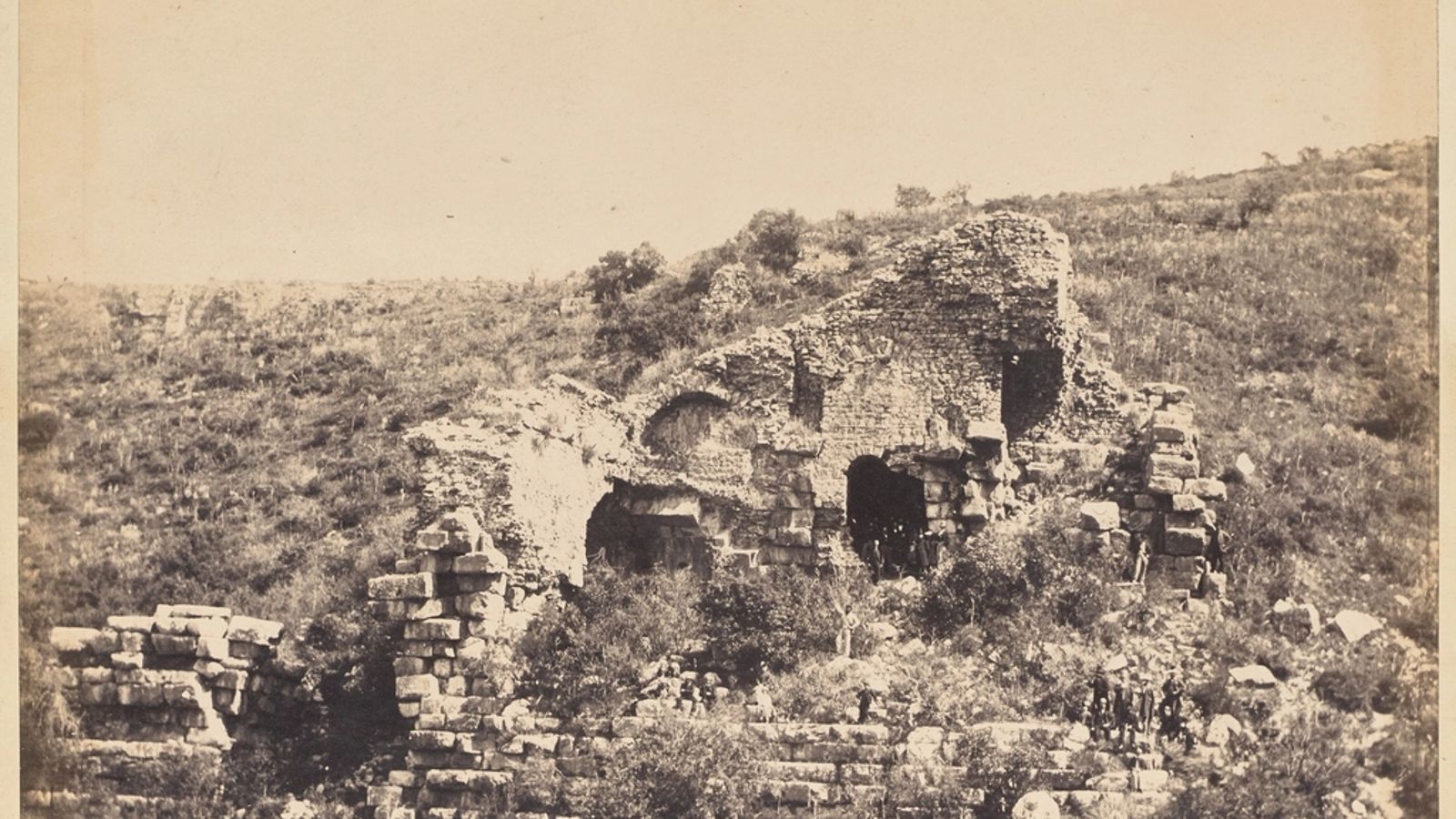
As the sun gently rose over fifth century Dinas Emrys, one of many among the rolling green hills of north-west Wales, a weary group of stonemasons set out to continue work on what should’ve been, by now anyway, the majestic towers of a magnificent castle to none other than King Vortigen himself. However, what started out as a dream job – the type of project that creates a lasting legacy, and one that many a stonemason dreams about, had become a soul-crushing defeat. As with every other morning, they were met with the same disheartening sight.
All their tools were missing and all the work done the previous day had somehow become undone. What should’ve been walls was nothing but a pile of rubble – crushed stone and broken dreams. There was only one thing left to do now – the time had come to call on the wizards.
Now, when the king calls, you do what you’re told and, after doing whatever magical men did those days, the assembled wizards finally came up with a solution: in order to remove whatever curse beset the construction work, the ground had to be sprinkled with the blood of a child born from a human mother and a father from ‘the other world’. After much searching, only one candidate was found: a young lad called Myrddin, better known today as Merlin.
Key Takeaways
- Dragons are a universal myth found in cultures worldwide, often used to explain natural phenomena.
- European dragons were often depicted as malevolent, fire-breathing creatures, while Eastern dragons were seen as benevolent and wise.
- Theories about the origin of dragon myths include a combination of real predators, dinosaur fossils, and human imagination.
- Historical accounts and art suggest that early humans may have encountered large reptiles, contributing to dragon legends.
- Modern dragons, like the Komodo dragon, are real but endangered, highlighting the need for conservation efforts.
Merlin, probably being a typical teenager, decided that dying in the name of construction was not how he wanted to go out and convinced King Vortigen that his castle was falling down every night because it was being built upon an underground lake in which slept two dragons – a white dragon and a red dragon. While modern engineering would suggest that it might’ve been the lake causing all the trouble, back in the fifth century, the blame was placed squarely on the slumbering dragons.
The labourers got to work and, after digging into the side of the hill, discovered the lake young Merlin insisted would be there. The lake was drained and the two dragons awoke and started fighting. The red dragon was victorious, the white dragon fled, and Vortigen could finally build his castle now that the problem was resolved. Merlin lived another day to become Arthur’s right-hand wizard, and all was well, except perhaps for the white dragon who was now homeless.
This is just one of thousands of tales of dragons spread across all continents and cultures. These days, we’ve replaced dragons with science but, back in the age before mankind had a better understanding of how the world worked, dragons, like many other mythological creatures and tales of magic, were often used to explain natural cycles and catastrophic events, from the dawn of creation itself to something as mundane as castle walls falling down, because the people of the time simply couldn’t explain it by any other means.
But, is there a grain of truth in the tales? Were dragons ever real? After all, every culture has stories of dragons, there is art depicting dragons and written accounts of dragons, both in literature and history, and even early naturalists considered dragons to be real animals, not creatures of fiction.
And all these dragons are so similar; surely, these tales must have been based on an existing creature, right? The truth of it is that to this day, historians, and other people much smarter than me, haven’t been able to pinpoint exactly where tales of dragons originated. We could probably devote an entire YouTube channel to dragons and have enough content to keep going for years, so for this dive into the world of dragons, I’ve decided to try and limit my focus mainly on that one question: Are the tales of dragons based on real animals that existed at one time?
A Dragon in Every Culture
The first thing I’d like to address before we even continue onwards is the notion that dragons across different cultures are the same. Now, even Simon, who has made his feelings towards fantasy very clear, but we enjoy your content anyway, should be able to tell you that this is simply not the case. However, it’s an opinion I became aware of, mostly among people who doesn’t know as much about mythology as they think they do, so let’s start by clearing that up. Almost every culture has tales of dragons that much is true, but the nature of the dragons, their appearance, and the purpose of the legends can differ greatly between various cultures.
The origin of dragons is lost to history but it’s generally accepted that the stories started, like so many things, in ancient Greece. However, the dragon of ancient Greece was a different beast to the dragon of today. The word dragon is considered to be from the Greek drakon which means serpent. The ancient Greeks had another word for snake, ophis, and while both words are used in Greek texts, the word drakon is used in more religious or mythological contexts. The very first dragons were mostly considered to be large serpents. In Homer’s Iliad, an eagle flying overhead drops a red dragon. To the Trojans, this was both a good and a bad omen. They would win their upcoming battle against the Archaens, but they wouldn’t return home without losses. While there is much to unpack in the Iliad, the important take-away here is that the red dragon was carried by an eagle – this would imply that, initially, dragons were a lot smaller. Either that or ancient Greece had remarkably large eagles. Of course, the story of dragons evolved and later Greek mythology had much larger, and much more dangerous, dragons, but we all start out small. The evolution of dragons from mere serpents to the monsters we know today is truly fascinating, but I feel that is a story for another time – perhaps when Simon branches out again and creates a new channel all about mythology. Unlikely, I know, but can a girl can dream.
When people picture dragons, the first image that comes to mind is a gigantic, fire-breathing reptile with wings – like Drogon, one of Daenrys’s dragons from Game of Thrones. This image is based on the Western dragon. However, European dragon would probably be a better name though as it refers to dragons from Ireland to the Scandinavian countries. However, the legends of dragons differ wildly between different countries, or even between different regions within the same country, so it becomes difficult to create a single picture of the Western dragon.
European dragons came in different shapes and sizes, though they were mostly based on reptiles or snakes. There was the four legged, sometimes two legged, winged kind of dragon that breathed fire and could fly. On the other hand, there were also more serpentine dragons without wings that basically looked like a really large snake.
For the dragon experts in the audience, a two legged dragon is called a wyvern and is usually smaller than a dragon, but for the purpose of this script, let’s stick to just using the word dragon as an umbrella term instead of frustrating Simon with a long list of various types of dragons. One site I visited listed 51 different types of dragon and while you and I may find that fascinating, dear dragon lover, our fantasy-deprived host may not so after a moment of silent mourning for all that he’s missing out on in life, may your kids love dungeons and dragons, let’s continue.
Initially, dragons could be benevolent and helpful, even taking on the role of protector, but more often they would be malevolent entities, creatures with evil supernatural powers. Dragons were often cast in the role of guardian – either of their own treasure hordes or, especially in Greek mythology, set to guard something by the gods, like Python, a dragon sent by Gaea, the earth goddess, to guard the Oracle of Delphi. Of course, then Apollo came along and killed it when he seized the shrine because the Greek gods clearly had too much time on their hands, but I digress.
In many early tales, dragons are cast as a villain and their role is simply to be slain by a knight and the treasure they guard, because what would a dragon need gold for anyway, becomes the knight’s reward for a brave deed since knights apparently had little else do to other than seek out dragons minding their own business, killing them, and running off with their treasure. Of course, not all dragon slayers were knights and not all treasure was gold – in the story of Smok Wawelski, or the Wawel dragon, in Krakow, Poland, the hero was a simple shoe-maker’s apprentice who outwitted the dragon terrorizing the town. The hero stuffed a lamb with sulphur.
Of course the greedy dragon ate the lamb, and when its stomach started burning, due to all that sulfur, it drank water until it exploded. Instead of gold, the king gave the shoe-maker’s apprentice his daughter’s hand in marriage though it’s unclear from the story whether the princess was as thrilled with this outcome as her future husband.
However, in some legends, dragons were more than mere beasts and they were given human characteristics, like intelligence and the ability to speak, sometimes on the same level of humans, often sharing human emotions and imparting wisdom and warnings. In the story of Sigurd and Fáfnir, Sigurd is warned by the dragon that Regin, who sent Sigurd after the dragon in the first place, was planning on killing him and keeping the dragon’s treasure for himself instead of sharing it as promised. For the most part though, European dragons were merely feral beasts with the sole purpose of offering bored knights some way of winning over a fair maiden and proving their bravery.
Once the Christians came along, the nature and role of dragons changed completely. To the people of the time, dragons weren’t only real, they were evil – the representation of Satan himself. Dragons guarding their treasure were depicted as lazy and greedy – for those who know their deadly sins that’s two: sloth and greed.
Some scholars believe that the all-time favourite fire-breathing ability also has its roots in the medieval descriptions of the entrance to hell: literally the mouth of a monster, complete with smoke and flame. Our ancestors really had a flair for the dramatic. Dragon slaying knights, like St George, the patron saint of England, became representatives of the church.
During his travels, our dragon slaying saint came across the town of Silene which found itself in the clutches of a dragon. In order to gain access to their only water source, the townsfolk had to sacrifice livestock to the dragon. However, once the livestock ran out, they started sacrificing their children – no parenting awards for you.
St George arrived just as the princess of the royal family was about to be sacrificed. He leapt to the defence of the innocent maiden, made the sign of the cross, and defeated the dragon. Out of gratitude for saving their town, the people immediately converted to Christianity.
Knights defeating dragons became a symbol of good, or more specifically the church, being victorious over evil, or more specifically, Satan.
Despite dragons being depicted as evil beasts and minions of Satan through most of the middle ages, they were also seen as symbols of nobility and bravery and were often used in heraldry and on flags – like the red dragon on the flag of Wales and the dragons in the coat of arms for Iceland and the cities of London and Moscow, to name a few. It appears that the true nature of the dragon has been eluding us for centuries.
Eastern Dragons
On the opposite side of the globe, on the shores of China and living in the green mountains of Asia, a completely different creature was making an impression on mankind. We call them dragons, but a few articles I read suggested that this might be a mistranslation since the Eastern dragon, or Long, is very different from what we in the West imagine as a dragon.
Eastern dragons, also called Oriental dragons, can be traced as far back as 2100 BCE – that’s well before dragons started terrorizing the west. The Chinese dragon is more than just a reptile – it’s a composite creature with elements drawn from multiple existing animals. Unfortunately, I don’t read Mandarin, so I had to use English articles and there are some discrepancies among them, but, for the most part, Chinese dragons appear to consist of: the head of a camel, the claws of an eagle, the soles of a tiger, the neck and body of a serpent, the belly of a clam, the scales of a carp, the ears of an ox, the horns of a deer, and the eyes of a devil.
Unlike Western dragons, the Eastern dragons are mostly serpents without wings; however, despite not having wings, they are still majestic fliers. They often sport manes or dorsal fins and come in a variety of shapes, colours, and sizes though red and gold is most common.
One article I read described the Oriental dragons as the angles of the east. They are considered beautiful and friendly, benevolent, spiritual entities, sources of great wisdom and guides. These dragons also have magical or supernatural powers and are often associated with wells, rain, and rivers.
They not only guide the living, they also transport humans to the celestial realm after they die. Where dragons in the west were feared and hunted, dragons in the east were beloved and worshipped with shrines built in their honor. Dragons are also sometimes capable of speech, and some are even able to speak all the languages spoken by man.
The Eastern dragon has a lifespan of hundreds or even thousands of years – and since they weren’t being hunted by bored knights or the church looking to defeat Satan, I’m guessing they had a far better chance of actually living that long.
In Chinese mythology, the dragon is considered a sign of nobility and only the Emperor was allowed to wear robes decorated with images of a dragon. While the Chinese people consider themselves to be descendants of dragons, some Emperors, starting with the first emperor of the Han dynasty, Lui Bang, claimed to be a direct descendant of dragons – in his case, he was the result of his mother’s divine meeting with a dragon.
While Eastern dragons are mostly associated with China, we even call them Chinese dragons, dragons are found all across Asia. According to Vietnamese mythology, for example, the Vietnamese people are the descendants of a water dragon and a mountain fairy, and any of you who had seen Raya and the Last Dragon should know that Sisu, the dragon, was based on the Naga – a benevolent water dragon of Southeast Asian mythology that protects and guides and are often considered keepers of magic. Truth be told, I think I’d rather meet an eastern dragon than a European one.
While these two types of dragons are the dragons most of us are familiar with, dragons appear in other cultures as well. Quetzalcoatl (Ket-sahl-koh-ah-tul), a Mesoamerican god of wind, air, and learning, is described as a feathered serpent. In Egypt, the dragon Apep fought the sun god Ra, and among the Australian aboriginal peoples, the rainbow serpents are considered to be descendants of creatures living in the milky way galaxy and associated with rain, rivers, waterholes, and, of course, rainbows.
And these are just a few. I even discovered some dragons in South Africa – one of the most notable being the nanabolele, a water-dwelling dragon, slayed by our own legendary dragon slayer – princess Thakane (Ta-ka-ne). So dragons really are everywhere!
Where Did the Stories Originate?
So, to get back to why we’re all here – were dragons real? I often hear people say that all legends have a kernel of truth to them, and, who knows, maybe they’re right. After all, after years of presumably diligent study, scholars still can’t tell us where and when the stories of dragons started. However, there are a number of theories doing the rounds, but I’ve decided to focus on the four most popular theories:
Humans and Dinosaurs Co-existed
I’ll be honest, the idea of humans and dinosaurs sharing a planet deeply appeals to the writer in me. I’m imagining a world where my ancestors had tiny dinosaurs for pets and went shopping at the local caves and watering holes riding the latest model of dinosaur, perhaps with a pair of woolly dice or a rosary tied to a convenient horn or scale for those who wanted to be really chic. Sadly, despite what the Flintstones might have you believe, this was unlikely.
The argument about whether humans and dinosaurs co-existed is essentially an argument between the creationists and the evolutionists. Now, when I was a wee lass, a kindly church elder informed me that dinosaurs were, in fact, mythological and never really existed so, in a way, I suppose at least one branch of the church have come a long way.
If you believe them unholy evolutionists, non-avian dinosaurs died out around 65 million years ago – give or take a million years. Dinosaurs graced our planet for roughly 186 million years during the Mesozoic age – generally divided into the Triassic, Jurassic, and Cretaceous. The very first human ancestors only made their appearance around 5.8 to 4.4 million years ago, so there is a 60 million year gap between non-avian dinosaurs and humans.
In fact, you are closer to the T-Rex today than the Stegosaurus was back in the time of the dinosaurs. Archaeologists and palaeontologists have been digging up bones for many years and dinosaur bones and the skeletons of our human ancestors have never been found in the same layers of rock, so it’s safe to say that the two of them never met face to face.
Of course, this is only true of non-avian dinosaurs. Birds, interesting balls of rage and feathers that they are, are direct descendants from a group of theropod dinosaurs – that’s the bipedal, carnivorous kind, like T-Rex, but we’re talking about the smaller, in some cases feathered, therapods. Of course, this means Sylvester has been chasing a dinosaur, not merely a canary, which does put that timeless battle into a little more perspective.
The genus Pterosauria (te-ruh-so-ree-a), of which the pterodactyl (te-ruh-dak-tl) is probably the best known example, were flying reptiles and they died out at the end of the Cretaceous period along with the other dinosaurs. To simplify that - even though your budgie is a dinosaur, our human ancestors never encountered large flying reptiles.
Now, I’m not a scientist, but I do know that evolution is a long process and not something that happens overnight. So, if you want to get really technical about it, mammals did co-exist with dinosaurs, but they were very small and there just weren’t that many of them. When the dinosaurs went extinct, the mammals didn’t all follow suit and were able to flourish once the big lizards, yes, I know they weren’t all lizards, it’s called poetic license, had gone the way of, well, the dinosaur.
Among these mammals were a primate species known as the Purgatorius. Not much is known about this mouse-sized creature other than it had teeth, ankles, climbed trees, and lived around 65 million years ago. Now, to be clear, these primates may in a sense be considered the earliest ancestors of primates that eventually evolved into the charming, fantasy loving, homo sapiens of today, but at the time, they were animals climbing trees, possibly eating fruit, and doing whatever purgatorius did in those days – they definitely weren’t telling stories about dragons to their purgatorius babies around campfires while Dave was off painting some cave walls.
According to creationists, however, the earth is not billions of years old. In fact, it’s only around 6000 to 10 000 years old. For those who might be a bit unclear on this – creationism is the belief that the earth was created by a single deity that is beyond human understanding.
This deity is still involved in its creation and, without the deity’s attention, the creation would cease to exist. As with all things involving humans, there are some disagreements. For example, some creationists believe that a day, back when the earth was created in seven days, was exactly 24 hours while others conceded that a day might have been a bit longer.
They also argue that radiometric dating is inaccurate because it’s based on assumptions and interpretations, which I suppose math and science technically is but it’s well-researched assumptions and interpretations. Instead, they look to the bible and, based on the chronology of the bible, the earth can’t be billions of years old. Now, according to scripture, on day five, God created great sea creatures and flying creatures which some creationists consider to include dinosaurs such as plesiosaurus (sea creature) and pterodactyl (flying creatures).
On day six, he created land animals that would’ve included land dinosaurs, and, finally, on day seven, he created man. Now, considering the number of animal species that have existed all through time, I’m guessing the planet must’ve been a bit crowded back then.
Watch Now
Open Video
Video Briefing
Dragons: Is There Anything to This? Or Just Total Fiction?
Creationists mainly use the Bible to prove their theory, but before we get to scripture, we do need to pause and consider another source that could possibly indicate that humans and dinosaurs co-existed in the past: ancient art. There are many examples of animals that bear a close resemblance to dinosaurs showing up in ancient cave drawings, carvings, on pottery and even small figurines. Probably one of the most popular is the stegosaurus on the walls of the Ta Prohm temple near Angkor Wat in Cambodia, built in the 12th century.
Now, even I have to admit that this carving does look a lot like a stegosaurus – it even has the arranged plates on its back. Scholars feel that the carving is more likely a rhino with some artistic embellishment or even a hoax. The site has been popular with movie crews for many years, so some scholars are of the opinion that the carving is a later addition.
That feels like a bit of a stretch to me, but I’ll come back to this stegosaurus a little later. There are more examples of supposed dinosaurs in ancient art – some of it has been explained by scientists as images of other animals that’s been misinterpreted, like the supposed dinosaur carvings on the Kachina Bridge in Utah by the Anasazi people, or simple vandalism by well-meaning amateurs who used chalk to outline what they perceived to be dinosaurs which is what happened to the cave paintings in the Black Dragon Canyon, also in Utah. Others haven’t really been fully explained at all, like the Sirrush of the Ishtar Gate created in around 600 BCE – but we’ll get back to this one too.
For now, let’s get back to the creationists’ favourite source to prove their theory: the bible. Now the bible is not entirely a piece of fiction. We’ll give Simon five minutes. Ok, now that Simon is done disagreeing with me, hear me out.
The Bible was written by people and, like all legends and mythology, was used to explain things that people at the time couldn’t always make sense of. That is why there are instances in the Bible that refer to actual historical events that occurred and real people that lived and ruled at the time. As a student of literature, I can confidently say there is much we can learn from ancient texts about what people believed and how they lived. However, this doesn’t mean that I consider the Bible to be a 100% scientifically accurate account.
And now that we’re all going to hell, let’s continue.
The Bible makes several references to dragons notably the Leviathan and the dragon in the book of Revelations. In the book of Job, a behemoth is described as a creature that eats grass like an ox, moves its tail like a cedar, and with bones like beams of bronze. Apparently, to those in the know, this describes a Sauropod, like a Brachiosaurus, which proves that humans and dinosaurs roamed the earth together and what we call dragons were actually dinosaurs.
Now, I went and read the detailed description of the behemoth, but to be honest, to me it sounds more like a mammoth, a creature ancient man certainly co-existed with, or perhaps even a bison. However, I’m one of them unholy evolutionists so don’t take my word for it and feel free to read it yourself. Of course, I don’t like to generalize, and I do have some family and friends who are Christian, so please know that not all Christians believe this – to many, the dragon is merely a symbol of Satan and they believe that Christ will defeat it in the end-times.
Some of the other Abrahamic religions also mention dragons but, once again, not all believers are of the opinion that dragons were ever real – religion and faith of any kind relies heavily on symbolism and, well, faith, so let’s conclude this section by saying that some creationists believe that dragons were dinosaurs but not all believers, of any faith, are creationists - some of them are scientists and find the whole thing ridiculous. Now, let’s get back to them dragons.
Of course, there are some who believe that not only did humans and dinosaurs once co-exit – we still do, and I’m not talking about birds. This is known as the neo-dinosaur theory. Some cryptozoologists are of the belief that actual dinosaurs still exist today.
The Loch Ness monster, which we all know is real, of course, was long considered to be a plesiosaurus that somehow managed to survive in the loch for millions of years. Nessie is not the only plesiosaurus though – residents of the Congo believe that the Mokele-Mbembe, another neo-dinosaurian cryptid, is alive and well in the Congo basin. And if these animals are around today, then they surely were around in the time of our ancestors, probably in larger numbers.
Now, much as I wish this was true, the fact is that for a species to survive, it needs a sustainable breeding colony. A breeding colony of dinosaurs would’ve been documented. And, before you say it, tales of fire-breathing lizards hoarding treasure and dispensing advice doesn’t count – if our ancestors could document elephants and giraffe without adding the ability to spit fire and hold long conversations, I’m sure they would’ve managed the same with a breeding colony of dinosaurs.
A Combination of Predators
Every child hears stories about certain dangers to avoid – those stories and dangers change with the times. When I was a child, I was told horror stories by teachers and friends about what happens to kids who accept candy or get into cars with strangers. However, my nieces today will probably be told horror stories about the dangers hiding in online chat rooms and the importance of always making sure your friends know where you are if you’re going to meet a stranger you met online. And while the monsters today are lurking online or were part of the stranger danger craze, back when our ancestors were starting their path to evolution, those monsters were dangerous predators, of the animal kingdom kind, and, of course, mythical monsters, like dragons.
While this doesn’t hold true for all dragons, most dragons show characteristics related to big cats, birds of prey, and snakes. According to anthropologist, David E Jones, dragons essentially encapsulate all the predators our ancestors feared into one neat package and this fear was passed from one generation to the next. A good example would be a fear of snakes which is one of the most common phobias in the world – even among people who don’t interact with snakes that much.
An interesting study was done on macaques to see if there is a genetic fear of snakes. The macaques raised in captivity initially didn’t show any reaction to a rubber snake. However, after seeing a video of other macaques screaming at a snake, their attitude completely changed and they developed an almost immediate fear of snakes – even the rubber ones.
This suggests that there is an inherent fear of snakes that was activated when the macaques saw other macaques reacting to a snake. Today, more people have a phobia of snakes than, say motor vehicles or guns, though your chances of facing an armed criminal or being in a car accident is much higher than being bitten by a snake, especially if you live in a city. However, it appears that millions of years of evolutionary bias towards serpents is hard to overcome.
Of course, fewer people have a phobia of big cats or birds of prey, but large predators, like big cats and wolves, and large raptors, would most certainly have been a threat to our ancestors who were smaller in stature than we are today. Some of the largest birds of prey around these days, like the Harpy eagle or the Philippine eagle, will hunt small animals like monkeys and possums and even small deer, so early homo-sapien children would’ve been fair game.
Every child has heard the words don’t play in [insert name of dangerous place] because the [insert name of local monster] will get you. I’m fairly certain this is trend that began when the first child decided to go play in the local tar pit and their parents grunted a warning about the local sabre tooth snacking on their bones. Dragons very rarely live in comfortable homes with extra security.
Instead, they prefer living in dark underground caves, marshes, and even underwater in the case of water dragons. These are all places that would’ve been dangerous for our ancestors – bears and other predators often live or sleep in caves, large snakes like pythons prefer marshlands, and if you’re not a strong swimmer, falling into a deep or fast-flowing river means you will drown, or perhaps become a snack to creatures like crocodiles and, once again, pythons that live in or around waterholes.
Stories of monsters have been used as warnings for centuries, and I don’t think it’s too much of a stretch to believe that some fears, like a fear of snakes or large predators, is to some degree programmed into our DNA from when our ancestors still faced these dangers every day. And, as humans are prone to do, fears became tales in which heroes defeat the dangerous dragons that the story-tellers themselves couldn’t slay just yet.
Dinosaurs, Again
You thought we were done with dinosaurs, right? Well, I say dinosaurs, but that’s not entirely accurate – rather, I should say dinosaur bones. While palaeontology only became an accepted branch of science in the 1800s, humans have been digging up bones for thousands of years, and to our medieval ancestors, dragons were not the creatures of myth and legend - they were living, breathing animals. And they had the bones to prove it!
For a moment, imagine that you are an ancient Greek lad wandering across the country side or a simple medieval farmer who can’t properly read or write, just hoeing your land, planting potatoes and cabbage, and not bothering anyone. One day, while exploring some local hills on your travels or while digging up a new field because you wish to expand into carrots, you come across some very large bones – nothing like any animal you’ve ever seen. What’s a man with no education to make of this?
Well, obviously, you’ve just uncovered a dragon. To us, this may seem like a silly conclusion to jump to, but the truth is that, back then, people simply had no idea what exactly they were looking at.
A lot of the research to connect dinosaur fossils with dragons was done by Adrienne Mayor, a folklorist and historian of ancient science, who became a self-taught expert in the relatively new field of geomythology. I’ve never heard of this either, but it turns out that geomythology is when geology and mythology come together – mythology was often used to explain geological processes, like volcanic eruptions, that people at the time couldn’t explain in any other way. By studying both the geology and mythology of an area, you can learn much of what happened in that particular place and time with regards to natural processes. Mayor spent two decades collecting and comparing ancient paleontological reports with ancient literature to prove her hypothesis – that tales of ancient creatures, like dragons and griffins, had some foundation in fossils found in the areas the stories originated.
A good example would be the myth of the griffins as told by Herodotus – either the first historian or a story-teller of note – in around 400 BCE. According to Herodotus, griffins were a tribe of creatures that guarded rich gold deposits in the mountains of Scythia against their neighbours, the Arimaspians, a mythical race of one-eyed men, who constantly tried to steal their gold. Sounds like pure fiction, am I right? Well, as it turns out, the Gobi desert where the Scythian people dug for gold had protoceratops fossils aplenty.
The protoceratops is considered a predecessor to the triceratops though it was much smaller. If you look at the skull, it looks like the animal had a beak, much like a bird. It also had a tail and four legs, so obviously, it couldn’t be just a bird – so it became a half-bird.
What this story illustrates is that, not only did our ancestors come across fossils, like people all through history, they made sense of the fossils in the only way they could – in this instance, the fossils became a griffin. This also brings us back to the stegosaurus on the temple in Cambodia I mentioned earlier and perhaps even the Sirrush of the Ishtar gate commissioned by King Nebuchadnezzer. Because the other animals depicted in the carvings on the temple and in the artwork on the gate were real animals, some folks use this as proof that the sirrush and the stegosaurus were also based on living animals the artists encountered; however, ancient peoples discovering dinosaur bones, or even whale bones, could’ve assumed that the bones belonged to real, living animals they simply haven’t seen yet.
There are plenty of creatures living in the depths of the ocean that we haven’t seen yet – doesn’t mean they don’t exist. I don’t think we can fault our ancestors for believing the same thing and using their imagination to fill in the blanks.
A very popular tale of dinosaur fossils being classified as dragons comes from ancient China. Fossils are plentiful in China and, in around 350 CE, Chinese scholar, Qu Chang, described dragons bones being found in what is today the Sichuan (Sech-waan) Province in China. There is also tales of dragon bones being discovered during the construction of a canal in 120 BCE.
Dragon bones is a staple in traditional Chinese medicine and, from my research, it looks like you can cure almost anything with the application of powdered dragon bone, so this is quite a valuable commodity, even today. However, as some palaeontologists have pointed out, while the Sichuan Province is renowned for its fossil beds, without proper descriptions, which is sadly lacking in most accounts, we can’t say for sure whether the dragon bones found were, in fact, dinosaur bones.
Of course, folks living in the medieval ages, and well into the 1600 and even 1700s, didn’t have to use their imagination all that much. The bible told them dragons were real and the bones simply reinforced what they already knew to be the truth. In fact, in 1672, a group of German scholars reported that a cave had been found in the Carpathians, in Transylvania, containing dragon bones.
But what if you were an ancient human living in a region bereft of dinosaurs? That’s not a problem since dinosaur fossils were not the only bones considered to be those of a dragon. Any prehistoric animal that had gone extinct could be considered a dragon as is the case with the dragon of Klagenfurt.
According to the tale, long ago, as there never seems to be an exact date in these things, in the marches near the town of Klagenfurt, Austria, the townsfolk were terrorized by a serpent-like dragon. The dragon wasn’t picky and would eat anything that came its way – be it people or livestock. Finally, a knight was found to slay the dragon since “slaying unwanted dragons” is right at the top of any self-respecting knight’s resume.
As the hero is wont to do, the knight prevailed, the dragon was slain, and its skull was placed in the town hall to commemorate the event. In 1582, the skull was used by an artist to model a sculpture of this notorious dragon which still stands in the city today. In the 1800s, zoologists realized that the skull was actually that of an ice age wooly rhinoceros – not a dragon – but, like dinosaurs, it was an unfamiliar animal and for folks who didn’t know better, obviously, it was the skull of a dragon.
Dragons Were, in Fact, Real
Imagine, for a second dear listener, you are a future human, living on a space ship orbiting the third moon of a planet you can’t quite pronounce. You are surrounded by aliens of all shapes and sizes and the earth is a distant memory. The only earth animals that survived the destruction of the planet were dogs because humans loaded them onto their space ships when they left, fleas because they were on the dogs, and cats because they were originally from Mars anyway.
Your new bunkmate, an odd fellow perhaps but harmless, has discovered a picture book, hidden in a derelict spaceship you are salvaging and excitedly starts telling you all about giraffes. Animals with impossibly long necks, spotted from top to bottom, and two small horns on their heads. And that’s without creative embellishment.
If you add a little creativity, the animal might have read eyes, sharp teeth, and spit acid. I don’t know about you, but I’d be a little sceptical. However, giraffes are very real; and they’re not the only odd animals out there.
Imagine trying to describe a platypus to someone who’s never even heard of one.
Historical accounts of dragons are plentiful. Pliny the elder, in his natural histories, describes dragons in detail. According to good old Pliny, dragons came from Africa and India and were the natural enemies of elephants, another creature he seemed quite enamoured with, and he devotes a whole chapter on the medicinal properties of the different parts of a dragon – there is a great remedy for nightmares.
All you need is the dry, powdered eye of a dragon mixed with honey. While Pliny was considered a very learned man in his time, he also wrote extensively about mermaids so I tend to take whatever he said with a pinch of salt. Scholars today is of the opinion that he was writing about very large snakes that are mostly extinct or, at the least, very rare.
Pliny was not the only naturalist in antiquity to mention dragons. Cicero describes flying serpents from the Libyan Desert and Ammianus Marcellius, a Roman soldier and historian because even back then people needed multiple jobs, described winged armies of snakes from Arabia in around 380 BCE. Since the origin of the word dragon is in ancient Greek, perhaps dragons in ancient Greece were very real – only, instead of the fire-breathing monsters we imagine, they were merely large, sometimes flying, snakes.
Moving on to the medieval ages, dragons appear in literature and art quite often. However, if you look at medieval paintings of dragons you’ll find something interesting – medieval dragons were not that big. Some were the size of a horse, but some were even smaller – closer to the size of a dog.
They are distinctly lizard-like, usually with wings. Europe may not have had quite the variety of really large lizards that you’d find in the rest of the world, but as early as ancient Greece, people have travelled to other parts of the world, including North Africa and Egypt, home to the Nile Monitor, a lizard that can reach anything from 120 cm to 220 cm (that’s around 4 to 7 feet), and the Nile crocodile, but we’ll get back to crocodiles in a bit. We also know that the first Europeans arrived in Indonesia, home to the Komodo dragon, in 1512.
The average Komodo dragon can weigh between 70 and 80 kg (that’s 150 to 170 pounds) and reach up to 3 m (that’s around 10 feet) – that’s not a lizard I would tangle with. The first Europeans arrived in Australia, the country of all things that want to kill you, in 1606, and Australia has quite a collection of lizards. It’s entirely possible that there was a large lizard, perhaps even the size of dog, in Europe that we just haven’t discovered yet – we’re discovering amazing new things about our planet and its history daily.
However, it’s also, and perhaps more, possible that the dragon of medieval Europe was a combination of strange lizards discovered in far off lands all combined to create a single creature.
Many scholars believe that tales of dragons might have been based on reptiles like the Nile crocodile that swam across the Mediterranean and ended up in Italy or Greece. To me, crocodiles seem to be the most likely culprit. As scary as the thought might be, a study has found that ancient crocodiles from Africa could cross the Mediterranean – even today, saltwater crocodiles can travel in the ocean using water currents as they’re not excellent swimmers.
One crocodile travelled 590 km (that’s around 940 miles) in the open sea. In fact, even freshwater crocodiles can survive in the ocean. Nile crocodiles can be found in Madagascar and some have been found as far north as Syria.
While crocodiles mostly stay flat on their bellies, even when they move around, they can lift themselves off the ground. Fossils of giant crocodiles, measuring up to 8 metres (that’s about 26 feet), have been found to have co-existed with early man, quite possible snacking on our ancestors. Considering that the average length of a saltwater crocodile, the largest species of crocodile alive today, is around 4.5 metres (or around 14 feet), we’re talking about a pretty big lizard.
Venetian explorer, Marco Polo, gave an account of dragons after his extensive travels through the Far East. He described serpents around 50 feet long, that’s around 15 meters, with a girth of 100 inches, that’s around 250 cm. The creatures had two short legs towards the front with three claws on each. They had large eyes, jaws big enough to swallow a man, and sharp teeth.
Of course, there were smaller specimens that the locals hunted and killed. The creatures were nocturnal, hid in caverns during the day, and preferred water sources such as lakes and rivers, especially after killing some prey. Their bodies left deep impressions behind, like a heavy beam had been drawn along the sand. Either Marco Polo is describing an animal not yet discovered or, more likely, he’s describing an Asian crocodile or some ancestor to the Asian crocodile.
I’ve mentioned the possibility of animals not yet known to science in both medieval Europe and in Marco Polo’s descriptions of serpents in Asia. While the idea of it might seem a bit far-fetched, new discoveries are made all the time. As recently as 2022, two giant dwarf crocodiles, not two words I usually expect to see together, were identified to have lived in what is today considered Kenya and a new species of Abelisaurid, the Guemesia Ochoai, was found in Argentina in 2022.
No, I don’t know how to pronounce that either, but I do know that it was a therapod dinosaur that lived in the cretaceous period, and it’s a very recent discovery in the world of palaeontology. So, it’s plausible that there once was a large crocodile or crocodile-like creature with longer legs that could lift itself higher off the ground. It’s even possible that dragon bones are still waiting to be discovered or, perhaps, that dragon fossils have been uncovered but have been classified as something else entirely.
Are Flying Dragons Impossible?
So we know that flying, fire-breathing dragons don’t exist. But I couldn’t help wondering – is something like that possible in nature? Turns out that I’m not the only one wondering, and some scientists have a little too much time on their hands because, according to science, it’s entirely possible.
The first consideration would simply be size – the larger a creature is, the less likely it is to get airborne. The largest bird in the world, the ostrich, can’t fly at all. However, the largest known flying animal in fossil record was the late cretaceous pterosaur Quetzlcoatlus (Ket-sahl-koh-ah-tu-lus) Northropi, which, coincidentally, is not a bird. It had a wing span of up to 11 metres, that’s around 36 feet, and weighed around 200 to 250 kg, that’s around 440 to 550 pounds.
That would make it bigger than a lion or tiger, so it would totally have been able to make off with livestock or even early man.
Now, if you’re of the belief that only birds, bats, and bugs can fly, you’re in for a surprise. There are a number of lizards, like the draco lizard from South East Asia, that prove you don’t need wings to fly. The draco lizard can flatten its body and use wing-like flaps to glide up to 60 metres (around 190 feet). Luckily, these lizards are fairly small and only eat insects, so you, your granny, and your pet goat are all safe.
Of course, lizards are not the only ones who can glide. Some snakes, known as flying snakes, can also glide as far as the length of a soccer field because, you know, we didn’t have enough to worry about already, so we can now add flying snakes to the list. These snakes are mostly found in South Asia and the Indonesian Archipelago. If you happen to live in any of those regions, I’m so sorry.
The fire-breathing is a bit of problem though. No animal has ever been able to breathe fire. However, some species have developed self-defence mechanisms that are somewhat similar. The bombardier beetle ejects a mixture of hydroquinone (hai-drow-kwi-nown) and hydrogen peroxide.
When exposed to air, the chemicals mix, causing an exothermic reaction, basically creating a boiling hot fluid. It may not be fire but it’s pretty close and a fairly good start. Fire needs three things: something to ignite the flame, fuel, and oxygen. One possibility would be methane, a by-product of digestion that can be turned into methanol by some bacteria.
An animal would have to adapt a way to store and ignite the fuel and you’d have a dragon! This is all very unlikely, I know, but not entirely impossible so who knows, maybe, just maybe, we’ll have dragons one day.
Real Dragons
Normally, I would end a script about cryptids and mythological creatures with a triumphant grin, proudly exclaiming – well, we’ve decoded that mystery. And I suppose we have. Flying, fire-breathing dragons condemning sinners to hell probably didn’t exist but dragons are very real. In fact, not only are they still around, they could really use some assistance.
The Komodo dragon is the largest lizard in the world and are limited to a few small Indonesian Islands, among them the island of Komodo which is the longest but still only 35km long, that’s around 56 miles, so their natural habitat is not exactly extensive. Komodo dragons can be dangerous, as is most animals when provoked, and its bite contains potent venom that can kill an adult human. However, as with most animals, if you leave it alone, you should be fine. Unlike medieval dragons, Komodo dragons don’t hunt people – sinners or otherwise. Sadly, they’re considered an endangered species and there are only about 3000 dragons left in the wild. They aren’t the only dragons – in Asia you’ll find the Chinese Water Dragon that’s a popular pet and the draco lizards, or the flying lizards; Australia has the Eastern Water Dragon and the Bearded Dragon; and here in South Africa we have Smaug (that’s the dragon from The Hobbit, Simon). Ok, so it’s not exactly Smaug – it’s a Giant Girdled lizard, better known in these parts as a sun gazer, reaching only around 12 to 20 cm in length (that’s about five to seven inches), but it’s the best we could do. Smaug was named after the villain from The Hobbit in honour of the author, JRR Tolkien, who was born in South Africa. Unfortunately, Smaug is facing its own troubles that have nothing to do with dwarves or hobbits. So far, it’s been nearly impossible to breed these lizards in captivity and, due to poaching and the illegal animal trade, their numbers are declining rapidly – according to one source, they could face complete extinction in the wild in as little as 10 years.
So, if you have a love of reptiles and you want any kind of lizard as a pet – make sure you buy your pet from a reputable breeder, someone who both respects and loves reptiles as much as you do, and not someone illegally catching them in the wild, causing great damage to the species and everything else that depends on them, in the name of profit.
Conclusion
It seems that these days, you can’t swing a cat without hitting a couple of dragons – they’re simply everywhere! From friendly nightfuries, that’s the How to Train your Dragon franchise which I’m sure even Simon knows because everyone with kids knows those dragons, to the ferocious beasts of the Game of Thrones franchise commanded by a rather tiny girl, and everything in-between. Clearly, the image of dragons have shifted from the villain whose sole purpose was to get slayed by brave Knights who apparently had little else to do, to fierce protectors and companions to awkward teens. Dragons are a bit like movies – everyone has a favourite. Personally, I’m quite fond of Errol from the Discworld novels and, of course, Toothless.
Today, most people accept that dragons are creatures of myth and fiction but there are the occasional die-hards like the creationists who believe dragons were dinosaurs, no matter what science says, and that one guy in Florida who was arrested after trying to break into the Patrick Space Force base in Brevard county, Florida, with a stolen car in order to warn the US government about an imminent war between aliens and Chinese dragons. I hope someone thanked him for the information and if we’re placing bets, my money’s on the dragons.
A lot of people have pointed to literature – scripture, stories of legendary creatures passed from one generation to the next, fantastic tales to both entertain and educate – to prove that dragons were real. However, as a student of literature, I can say one thing with confidence. The human imagination is an incredibly powerful thing.
The tale of Beowulf is not an historical account of a Viking chief fighting off a dragon; it’s a story about protecting the beer hall – the centre point of the community. If we can accept tales from writers like Neil Gaiman as pure fiction, stories meant to entertain, aren’t we doing ancient story-tellers a great disservice by assuming that all their stories had to be based in truth and fact? As we’ve already established on several of Simon’s channels, the past was the worst so, if ever there was a people that needed some form of escape, who needed a hero to slay the imaginary dragons they themselves couldn’t, it was the folks being chased and eaten by wild predators, it was the peasants and the poor, people living in horrible conditions.
So, let’s give story-tellers the recognition they deserve and appreciate their stories as just that – tales meant to entertain.
Simon Whistler
Simon Whistler is one of YouTube's most prolific educational creators. Decoding the Unknown is his methodical investigation into the world's strangest phenomena — examined with rigour, curiosity, and a healthy dose of scepticism.
Frequently Asked Questions
What is the origin of the word ‘dragon’?
The word ‘dragon’ is considered to be from the Greek ‘drakon’ which means serpent.
What did the ancient Greeks believe dragons were?
The ancient Greeks initially considered dragons to be large serpents.
What is the significance of the red dragon in the story of King Vortigen?
In the story of King Vortigen, the red dragon was victorious over the white dragon, allowing the construction of the castle to proceed.
How did the nature of dragons change with the arrival of Christianity?
With the arrival of Christianity, dragons were depicted as evil, representing Satan himself, and dragon-slaying knights became symbols of the church defeating evil.
What are some characteristics of Eastern dragons?
Eastern dragons are often depicted as benevolent, spiritual entities with magical powers, associated with wells, rain, and rivers. They are often seen as guides and protectors.
What is the theory about humans and dinosaurs co-existing?
The theory suggests that humans and non-avian dinosaurs did not co-exist, as dinosaurs went extinct around 65 million years ago, while the first human ancestors appeared much later.
What is the neo-dinosaur theory?
The neo-dinosaur theory proposes that actual dinosaurs still exist today, with examples like the Loch Ness monster and the Mokele-Mbembe in the Congo basin.
What is the theory about dragons being a combination of predators?
This theory suggests that dragons encapsulate all the predators our ancestors feared into one creature, reflecting fears of snakes, big cats, and birds of prey.
What is the theory about dinosaur fossils being mistaken for dragon bones?
This theory proposes that ancient humans, finding large, unfamiliar bones, assumed they belonged to dragons, leading to tales and legends about these mythical creatures.
What is the status of the Komodo dragon today?
The Komodo dragon is considered an endangered species, with only about 3000 left in the wild, facing threats from poaching and the illegal animal trade.
Sources
- Original Decoding the Unknown video: Dragons: Is There Anything to This? Or Just Total Fiction?
- Hero image source by thegetty / openverse, cc0.