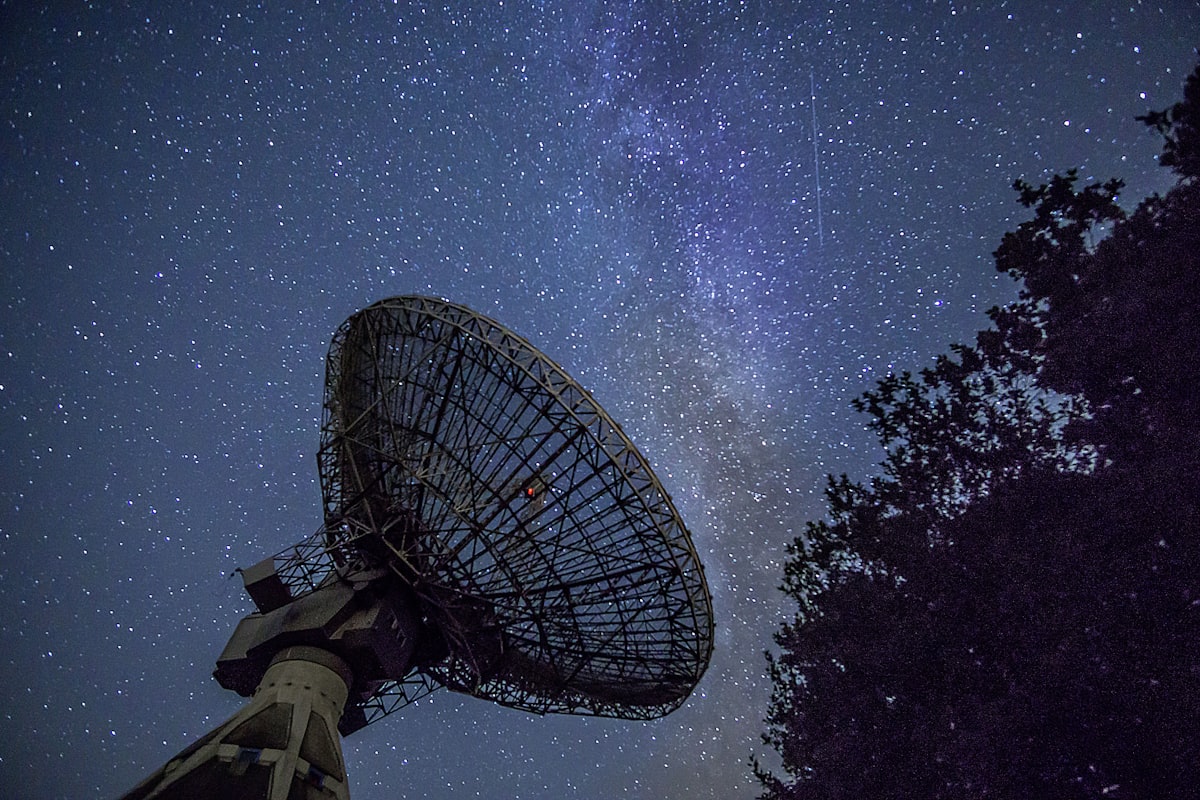

Imagine for a moment that many light years away on the far side of the galaxy, there lies the world of Discobiscuit—a small planet of little consequence.
Most of the inhabitants of Discobiscuit are of the rather arrogant opinion that they are entirely alone in the universe.
But a few of the scientists are convinced that there must be other intelligent life lurking out there somewhere in the unfathomable vastness of space—and some of them even claim to have picked up some peculiar activity from a region far away at the other side of the Teapot of Sagittarius.
Key Takeaways
- The Wow! signal, detected in 1977, is considered one of the strongest candidates for extraterrestrial communication.
- The signal was a narrowband transmission at 1420 megahertz, the frequency at which hydrogen emits energy.
- The Wow! signal was only detected once, and despite numerous attempts, it has not been found again.
- Theories about the signal’s origin range from natural phenomena to alien communication.
- The signal’s unique characteristics and the lack of a definitive explanation keep the mystery alive.
So one day they took it upon themselves to blast a signal into that region and announce their presence. Although there was always likely to be something of a language barrier, the idea was that the short signal would be broadcast in such a way that any advanced life out there would immediately recognise it as an intelligent transmission rather than some kind of natural universe burp.
However, after nearly fifty years had passed, the scientists of Discobiscuit had still yet to receive any kind of response.
Shrugging in defeat, they eventually concluded that they might have to leave it a few more million years before their celestial neighbours got around to evolving opposable thumbs and inventing radio telescopes.
But what the inhabitants of Discobiscuit could never have known is that their signal had indeed been picked up by a small team of astronomers from Earth—a small, mostly harmless blue-green planet of little consequence.
The signal was identified during a period that the primitive Earthlings referred to as the year of 1977, the very night before one of the most famous members of their species met an untimely end in his own bathroom.
But the problem is that the Earthlings didn’t really know what to do with it, and wasted the next fifty years attempting to find a follow-up message which was never sent.
The planet of Discobiscuit may be fictional, but the strong narrowband signal picked up in 1977 by the Big Ear Telescope in Delaware, Ohio, was very real.
And the fascinating thing about ‘The Wow! Signal’—so-called because of the excited one-word reaction from the astronomer who first detected it—is that it really does tick most of the boxes for potential extraterrestrial origin, and is often considered to be the strongest candidate yet for a genuine communication from the stars.
Whilst the exact origins may be destined to remain a frustrating mystery, this does make for a pretty unusual video for ‘Decoding the Unknown’ on which we regularly dismiss the wackier theories about UFOs and alien abductions and anal probes before moving onto the much more reasonable—and admittedly far less exciting—explanations involving weather balloons and experimental aircraft and misinformation spread by nutty conspiracy theorists who are trying to flog a few more books.
There’s absolutely no hint of a conspiracy theory here—we’re dealing purely with the cold, hard scientific facts.
But many of the more crushingly down-to-earth explanations can be ruled out in this case, leaving many to conclude that the idea of an unanswered alien message might just be one of the more credible options that we have left on the table.
What’s The Frequency, Kenneth?
It’s all very well looking up to the skies and keeping an ear out for anything that sounds a bit out of the ordinary—but it helps a great deal if you can pinpoint exactly what you’re looking for.
It stands to reason that an intelligent alien life form would most likely use a radio wave transmission to send a cheerful greeting to another planet, as radio waves are relatively cheap and easy to produce, and can travel enormous distances across space without losing any signal integrity. They’re also an example of very basic and super-simple science, so even a planet of plebs would hopefully know how to both generate them and identify them. Well, that’s the theory.
Focused efforts to monitor space for potential alien radio wave broadcasts and any other signs of life have been going on since the 1960s under the umbrella name of SETI—The Search for Extraterrestrial Intelligence. This is not so much a centralised organisation but more a collective term for a whole bunch of scientific projects funded by a variety of different sources.
There’s a problem here, though. Space is full of bloody radio waves making a right royal racket every day. And these are nearly always generated by perfectly natural sources such as planets, stars, comets, quasars, magnetars, and even the throbbing background radiation still hanging around after The Big Bang.
They’re all over the place. And that’s not even mentioning all the unintentional leakage that we beam into space ourselves from terrestrial broadcasts and radar and dodgy microwaves.
So how are we supposed to block out all this interstellar noise and identify a signal that could potentially be a message from an alien civilization?
A couple of physicists from Cornell University in New York already had this one figured out in 1959.
Giuseppe Cocconi and Phillip Morrison published a paper in the Nature journal which proposed that any genuine extraterrestrial message would most likely be sent at the exact frequency of 1420 megahertz—a particularly quiet band of the electromagnetic spectrum at which hydrogen emits a distinctive electromagnetic frequency.
The reasoning here is that hydrogen is the most common element in the universe. No matter what you call it or how you measure it, hydrogen is a universal physical constant.
So it would make sense for an alien species to transmit a message over the same frequency at which the most abundant element in the universe emits energy, as the properties of hydrogen should be recognised by any species that ever managed to make it out of the swamps.
We might be struggling to enjoy a half-decent game of Scrabble during any early communications with extraterrestrials, but we should all at least be familiar with the common language of hydrogen.
Not only that, but as most of the other noises from natural astrophysical emissions are largely cancelled out at this frequency, it’s by far the most likely frequency at which your broadcasts will be clearly heard and identified.
That’s why the frequency band between 1420 and 1662 megahertz goes by the nickname of ‘The Water Hole’ as it’s considered to be the most suitable place to hang out and hook up with aliens.
It’s also why the specific frequency of 1420 megahertz is considered to be a protected frequency on Earth at which nobody is legally allowed to broadcast aside for approved astronomical use. We don’t want any Earth-based jibber jabber drowning out the channel that we’re keeping free purely for potential extraterrestrial messages.
Giuseppe Cocconi and Phillip Morrison had another point to make in their paper which would help narrow down the search even further:
Any potential message from the stars would most likely be extremely narrowband—in other words, it would be concentrated on a tiny range of frequencies instead of randomly drifting about all over the place as is the case with most cosmic radio sources.
This would help indicate that the signal was a ‘technosignature’ intentionally created by intelligent life and purposefully targeted at a specific frequency rather than just a natural scattershot occurrence.
The conclusions of Cocconi and Morrison would help future astronomers save a lot of time and effort. Instead of engaging in the practically impossible task of attempting to monitor the entire electromagnetic spectrum at all times, we should tune out from all the background crap and focus our efforts on monitoring the water hole frequency, or more specifically, the exact protected frequency of 1420 megahertz—which I’ll refer to from now as ‘The Soup Machine Frequency’ as it rolls off the tongue much more smoothly than repeated references to 1420 megahertz.
So, bearing all this in mind, the kind of discovery that would really make astronomers start feeling all fizzy with excitement would be the detection of a strong narrowband signal of any significant length emanating from the depths of space at the soup machine frequency, as this would bear all the hallmarks of a genuine message from intelligent life getting purposefully beamed into our general direction.
And that’s exactly what was found by the Big Ear Telescope in 1977.
Some people seem to be under the mistaken impression that the Wow! signal was some kind of captured audio recording of a message from space which lasted for exactly 72 seconds.
In fact, that’s wrong on all counts. But before we dive into the detail, let’s first take a look at the radio telescope that detected it.
The Big Ear telescope was parked for 37 years on the campus of the Perkins Observatory at Ohio Wesleyan University in Delaware, Ohio.
Designed in 1956 by award-winning American physicist and electrical engineer Dr John D. Kraus, construction of the telescope took seven years to complete, and as there wasn’t much money in the pot to fund the project, the university professor managed to rope in his own students to help out with all the heavy lifting in their spare time.
In that sense it’s a good job that Dr Kraus didn’t leave it until a few years later when all the students would have been spending their spare time dropping acid tabs and finding hidden meanings in the lyrics of The Velvet Underground and Strawberry Alarm Clock.
After construction was completed in 1961, it then appeared to take Dr Kraus another two years to find the power switch, as Big Ear wasn’t officially turned on until 1963.
The initial purpose of the radio telescope—officially known as The Ohio State University Radio Observatory, but the nickname of Big Ear is more fun—had nothing at all to with listening out for little green men.
Big Ear’s original task was to undertake an astronomical survey of cosmic radio signals, the results of which formed the world’s most accurate and comprehensive ‘sky map’ for many years to follow.
After this project was finally wrapped up in 1971, Big Ear was left twiddling its thumbs for a couple of years before it was given another job to crack on with.
And it was at this point that Big Ear jumped on board with the program of searching for extraterrestrial existence, tuning in exclusively to the soup machine frequency to listen out for any signals which were unlikely to have been generated by natural causes.
In fact, this went on to become the official longest-running full-scale SETI project in history, stretching from between 1973 to 1998 when Big Ear was sadly dismantled.
This wasn’t because the project was deemed to be complete in any way—it’s because some clown at Ohio State University had sold the patch of land on which Big Ear stood to developers in 1983. And it was a decision that the university deeply regretted fifteen years later when the developers finally demanded the demolition of Big Ear to make way for a nice extension to the neighbouring Delaware Golf Club.
The historic radio telescope that possibly detected the first evidence of alien life may have been reduced to a worthless pile of rubble, but now the local golfers get to enjoy a full 18-hole course instead of having to make do with just nine.
I’d like to think that before his death in 2004, the legendary Dr Kraus was at least offered a lifetime membership card.
Big Ear never looked like your typical radio telescope, though.
Whenever I imagine a big radio telescope, I tend to instinctively think of a massive dish which is frequently tilting and turning, but there’s no sign of any over-sized disco kitchenware on display here.
To be honest, there wasn’t much sign of anything at all going on here. The whole area just resembled a huge abandoned car park with a few funny pointy bits scattered around here and there. Fair play to Delaware Golf Club, the new extension is probably a lot easier on the eye.
And the whole process of capturing data from the stars seemed unusually lethargic for a radio telescope, as it remained largely stationary and relied on the natural rotation of the Earth to scan the sky.
The process began with a flat tiltable reflector standing 100 feet high at one end of the car park, and concluded with reams of computer print-outs containing strings of usually very similar digits which were later analysed by volunteers, but there was a fair bit going on in-between.
The flat reflector swept the sky in a single line to pick up radio waves from outer space. Whilst it could be tilted to move up and down a bit, it couldn’t move left or right at all so its field of vision was limited to a relatively narrow strip of the sky at which it just happened to be pointing at as the Earth slowly turned. Every few days, someone would come along and tilt the flat reflector slightly so that it was monitoring different patches of the sky.
After the radio waves had struck the flat reflector, they were bounced over to a static curved reflector—or paraboloidal reflector if we’re trying to be fancy, which we’re not—situated at the other end of the car park.
The paraboloidal reflector—or static curved reflector if we’re trying to use simple English, which we’re not—then focused the signals into a beam which was shot over to one of a couple of tall, thin funnel-shaped ‘feed horns’ in the middle of the car park.
The beam was then fed from the horns into a clunky old IBM 1130 computer housed at Big Ear HQ—in reality, a shed in the car park which looked like the kind of place you’d expect to find the attendant puffing away on a Lucky Strike.
The data was analysed by the computer which then spat out its findings onto sheets of perforated paper which were later closely scrutinised by the volunteer astronomers every few days or so, before the hard drive—which held a mighty capacity of one whole megabyte—got wiped clean to make space for the next set of results.
At this point though, we should make it very clear what exactly Big Ear was picking up and analysing.
It’s often wrongly assumed that the radio telescope was attempting to pick up actual audio recordings of messages or signals. Some websites have even posted audio clips of the noise supposedly made by the Wow! signal, but they’re all completely bogus. One particular audio clip which was doing the rounds on YouTube for a while and racking up some serious views, was later revealed to be a dramatically sped-up recording of a police officer saying “10-61”—the police radio code usually deployed when about to stop a suspicious vehicle.
I guess there just had to be at least a few nutcases spreading misinformation somewhere in this story.
The truth is that Big Ear simply didn’t have the capacity to record audio at the time.
The equipment was essentially just taking notes of any fluctuations in the intensity of the noise within the particularly quiet soup machine frequency, and then expressing the result as a single digit.
In that sense, it was a bit like watching a record player without ever knowing or hearing what was being played on it. All the attention is instead focused on the volume dial, on the off chance that it suddenly starts rapidly turning up the noise that you can’t hear to a level that is considered highly irregular.
Every digit printed out by the IBM 1130 would represent the intensity of the sound picked up over a period of twelve seconds.
The scale began with a blank space to represent zero—which indicated that nothing was going on here aside from the constant gentle background hum of the universe.
The scale then rose from the numbers 1 to 9, the latter of which would indicate a 10-fold excess in the intensity of noise you’d usually expect to hear in the soup machine frequency.
Things really got really serious when the numbers changed into letters, as the scale then moved up from A to Z.
But the chances of ever seeing a letter come up on the computer printout seemed pretty remote.
The printouts displayed the digits in chunks of six—covering the six twelve-second periods that made up the entire 72-second window when a fixed spot of sky could be monitored before it naturally rotated out of the telescope’s range.
A typical printout would simply be an endless array of blank spaces and ‘1’s, with maybe just a very occasional ‘2’ popping up every few pages or so to spice up an otherwise boring day.
But even a ‘2’ didn’t indicate anything of great significance, other than maybe a passing hydrogen cloud. And for the first five years, the prospect of ever reaching the dizzy heights of ‘3’ may have seemed as unlikely as scoring a hole-in-one across all eighteen holes of the extended golf course that would eventually boot Big Ear off the land.
But all that was to change on the night of August 15th, 1977.
Well, to be more accurate, it would all change a few days later when a volunteer astronomer first had the opportunity to take a good nosy at the most recent results that Big Ear had collected.
Fall on Me
The handy thing about the Big Ear telescope is that it practically ran itself in a way.
Every now and then, somebody might have to come along and make a slight adjustment to the flat tiltable reflector. I suspect that they also occasionally had to turn away unwelcome drivers who were trying to find the ticket machine.
But then you could pretty much just leave it running on its own, as Big Ear got busy bouncing around the signals from the flat reflector to the static reflector to the feed horns and finally into the IBM 1130.
It’s a good job really, as aside from the odd few crumbs thrown at the project by NASA, there was never enough funding to employ many workers down at Big Ear, and the 25-year SETI project was largely kept alive by the generosity and dedication of unpaid volunteers.
Every few days, someone would pop into the shed to wipe the hard drive and pick up the latest computer printouts which would be given to a bike messenger who would deliver them to the home of the guy who had kindly agreed to study all the data.
That guy’s name was Jerry R. Ehman.
This radio astronomer and later university professor used to enjoy a salaried position on the Big Ear project in the early days, but he’d been laid off after The National Science Foundation cut their annual funding in 1972.
But Jerry had continued to support the project on a voluntary basis for several years afterwards, and he was still sifting through all the data at home in 1977.
To be honest, it doesn’t sound like the most exciting way to spend your spare time.
Jerry would just sit at his kitchen table and scrutinise hundreds of sheets of perforated paper which would contain endless rows of blank spaces and ‘1’s.
He probably treated himself to a cigarette break and a shot of whisky every time he came across something as exciting as a ‘2’.
But then he suddenly came across a single string of six digits which would have totally blown his mind and prompted him to sit down on a chair for a while if he hadn’t been doing so already.
The six digits read:
6 E Q U J 5.
This represents a 72-second period of time in which Big Ear had picked up a radio signal which was initially around 7 times louder than the baseline background noise, and then rapidly increased as it rotated closer into Big Ear’s view, reaching a peak of ‘U’—just over 30 times more intense than usual—before it died down again as the source gradually spun away from Big Ear’s field of vision.
And this meant something huge. Big Ear had picked up a continuous radio signal which was way louder than anything it had ever heard before or since.
Jerry R. Ehman was so enthused by this that he immediately picked up a red pen and circled the six astonishing digits, scribbling the word ‘WOW!’ in big letters right next to them, unwittingly giving the signal the name by which it would be forever known.
We should thank good old Jerry for this, as ‘The Wow! Signal’ is a lot catchier than ‘The 6EQUJ5 Signal’.
And it’s a relief that Jerry was such a mild-mannered astronomer, otherwise we could well have been making a video about the legendary ‘Shit on a Sandwich! Signal’.
We know that the signal had been picked up a few days earlier at 11:16 pm on August 15th, but there’s an awful lot that we don’t know about it, and there’s still widespread misunderstanding over some of the specifics.
It’s often reported that the duration of the signal was exactly 72 seconds, but this is simply the maximum amount of time that Big Ear was able to observe it before the Earth naturally rotated the source out of Big Ear’s sight. The signal could potentially have lasted anywhere between 72 seconds and 24 hours.
Another frustrating little niggle with the limitations of Big Ear is that we only have a fairly rough idea of the direction that it came from, rather than a precise location.
The signal only made it into one of the two feed horns which was itself pretty surprising. The feed horns would have been collecting data from just a few minutes apart, so after the signal had been beamed into the first feed horn, you would have expected the second horn to collect the same signal very shortly afterwards.
The fact that it was only picked up by one of them indicates that the signal either started or stopped at some point during this tiny gap.
But it was impossible to tell which of the feed horns had picked it up which made it trickier to ascertain the location of the source.
We do know that it came from the general direction of the M55 globular cluster in the south of the constellation of Sagittarius, near the core of the Milky Way, but that’s a pretty wide area to go looking for a needle in a cosmic haystack of around 100,000 stars.
And we’re none the wiser as to how far the signal travelled or how long ago it was sent.
The closest to the Earth from which it could possibly have originated is the distance from here to the moon, but it could potentially have been carried from thousands of light years away. It may even have been a pretty weak and lame signal which just happened to experience the effects of ‘gravitational microlensing’—a phenomenon not discovered until later in 1989 in which an object or radio wave can be massively magnified by a passing star or galaxy or black hole which would serve as a kind of temporary magnifying glass and heat up the intensity of the signal.
Scientists reckon that this is probably a bit unlikely though, as the visible and audible effects of gravitational microlensing would have been more likely to last for weeks and months, rather than just popping up once in a 24-hour period.
As we don’t know the distance travelled, we also can’t even begin to figure out the age of the signal.
It could potentially have been a fairly recent message from an extraterrestrial neighbour asking us to keep the noise down a bit, or it could have been a message sent 66 million years ago which was meant to warn the dinosaurs that a nasty-looking asteroid was heading their way.
It’s actually a bit of a shame that the Wow! signal wasn’t detected just three years later by which time the telescope had been kitted out with some more advanced tech which would have allowed Big Ear to stay focused on a spot at which it found anything interesting.
I’m not sure if they may also have upgraded the computer to a new Commodore VIC-20 by that time.
But all that Dr Kraus, Jerry R. Ehman, and the Big Ear team could do back in 1977 was to try and have another look for it.
After confirming that no comets or planets or satellites matched up to the area in which the signal had been detected, the team decided to fix Big Ear’s focus on the same patch of stars that had spawned those six incredible digits in the hope of finding it again.
But a whole month went by without generating anything higher than a boring old ‘2’.
Big Ear eventually returned to its normal duties of sweeping the whole sky for the subsequent twenty years, but it never detected the Wow! signal ever again.
A few other people rolled up their sleeves and had a good go at finding it over the years.
One man in particular, data analyst Robert Gray, known to his friends as Bob—developed a long-running fascination with the Wow! signal, and probably spent more hours trying to find it again than anyone else on Earth.
A keen amateur astronomer himself, Bob originally scanned the skies from his backyard in Chicago with his own titchy telescope for many years, until he eventually persuaded the right people to let him have a go on something a little bigger.
In 1987 and 1989, he made a couple of attempts at locating the signal with The META Array at the Oak Ridge Observatory in Harvard, Massachusetts.
This 84-foot (or 26m) radio telescope—which looks far more like your traditional wobbling dish design—was a part of what was considered to be one of the largest working observational systems in the world at the time. The construction had been helped along by a very generous donation from Steven Spielberg, the director famous for inspiring the 1988 classic ‘Mac and Me’.
Much later in 1995 and 1996, Bob was allowed to have a play with The Very Large Array in the Plains of San Agustin in New Mexico. The Very Large Array Observatory comprises no less than 27 huge radio antennas packed with enough muscle to make Big Ear look like a few rubbish pointy things scattered around a disused car park.
Bob was granted permission to point The Very Large Array at the M55 globular cluster in Sagittarius for a while, and in doing so became the first astronomer—well, amateur astronomer—to use the most powerful radio telescope in the world at the time to search for extraterrestrial activity.
But sadly, neither Bob Gray nor any of the other tiny pockets of people to take an interest in the Wow! signal have ever come across anything like it since that single transmission in 1977.
It’s perhaps a little surprising that a bit more effort wasn’t put into catching a repeat performance, and there’s certainly never been a generously funded large-scale attempt to get back in touch with the Wow. It’s largely been left to keen amateurs like Bob Gray to carry on the search.
Big Ear itself may have made way for a golf course extension in 1998, but the observatory could have been in trouble even if the developers hadn’t moved onto the land, as NASA had recently cut what little annual funding it was giving to Big Ear.
And in fact, SETI projects in general had been hit pretty hard since 1993 when Congress abruptly terminated any financial support to the ongoing search for extraterrestrial life on the grounds that spending tax dollars on trying to find mushroom men from outer space was an embarrassing waste of money.
But it’s also a little surprising how the Wow! signal doesn’t get talked about quite as often as you’d imagine.
It got a brief namecheck in a 1994 episode of ‘The X Files’, and it’s just cropped up as a pretty big plot point in the 2024 Netflix sci-fi series ‘3 Body Problem’.
Watch Now
Open Video
Video Briefing
A Message from the Stars: Who Sent ‘The Wow! Signal’?
I recently finished watching this new show co-developed by the makers of ‘Game of Thrones’, in which it’s suggested that the Wow! signal was also picked up by a base in Inner Mongolia in China where it was secretly verified as a genuine communication from aliens who were later invited to Earth with disastrous consequences.
I’d recommend giving it a watch if you haven’t already, although the dizzying narrative was a lot more complicated than I imagined, and it was probably a mistake to try and make sense of what was going on whilst consuming several bottles of toilet wine.
As ‘Games of Thrones’ is often described as ‘tits and dragons’, I was expecting ‘3 Body Problem’ to be ‘tits and spaceships’ but it required a bit more concentration than I expected.
If nothing else, it did remind me to finally get around to pitching this very script to Simon.
But back in the real world, interest in the Wow! signal appeared to largely die down in the mainstream after a while, which is quite odd considering the unique nature of the signal.
Admittedly, it’s not the only detection of a curious radio wave to have caused initial ripples of excitement.
In 2015, a signal detected by the RATAN-600 radio in Russia was briefly thought to be a potential technosignature from an alien civilisation, but this was swiftly ruled out by the Special Astrophysical Observatory who put it down to distinctly terrestrial disturbance.
On a similar note, a mysterious signal picked up during the course of an Australian SETI project in 2020 was initially considered to be a potential message coming from the direction of Proxima Centauri—the closest star to Earth, aside from our sun.
This was again quickly ruled out after scientists declared that it was most likely just interference from Earth-based technology.
But whereas these two relatively recent detections were promptly given a widely-accepted and rather mundane explanation, the Wow! signal is still capable of transmitting a tantalising tingle down the spine nearly fifty years after it was detected, as the theory of the signal being of extraterrestrial origin is still one of the most compelling by far.
I mean, what else could it have been?
Nightswimming
Let’s just take a quick look at some of the more oddball theories relating to the Wow! signal before we return to the more credible theories involving aliens—and that’s not a sentence I get to say very often on ‘Decoding the Unknown’.
One idea suggests that the strange signal in the sky was a sign of the second coming of our lord and saviour Jesus Christ who died for all our sins.
The comeback tour of Jesus Christ is often associated with strange activity in the sky, and we have to remember that his birth was marked with the miraculous appearance of The Star of Bethlehem which led the three wise men to the birthday barn dance, long before the days of SatNav.
However, having been mercifully spared the brutality of Sunday School, I have to confess that I’m not massively familiar with the segment in ‘The Book of Revelation’ which reads:
“And behold, I shall return, bringing my recompense with me, to repay each one for what he has done. Hallelujah! My return shall be foreshadowed by a narrowband transmission which only ever gets picked up by one feed horn in The Ohio State University Radio Observatory in Delaware. Not the golf course, that’s on the other side of the fence.
They could probably do with extending that one day. Why even bother with a 9-hole golf course? It’s not the dark ages, is it? Sorry, lost my train of thought there.
Um…Blessed are those who wash their robes. Anyway, back in a bit! Don’t forget to check out my merch store!”
Besides, I don’t remember hearing much from Jesus since 1977, although he could just be keeping a low profile. But I would have at least expected him to participate in ‘Dancing with the Stars’ or something.
On a more religious note, it’s also been suggested that the signal foreshadowed the death of Elvis Presley who died the following morning in his bathroom.
I’ve been trying my best to keep conspiracy theorists out of this one, but some Elvis fans take the slightly different view that the real date and time of the signal detection was faked, and that it was actually picked up the following morning at the exact time of the King’s death, as some kind of acknowledgement or tribute from beyond the stars. If an audio version of the signal did exist, it could possibly have been just a 72-second blast of ‘Return to Sender’.
But I think we can conclusively disprove such a silly notion on the grounds that Elvis Presley clearly faked his own death, and is still living today under the identity of Singing Pastor Bob Joyce from Arkansas.
Another idea that kind of misses the point is that the signal could have emanated from a passing aircraft.
For starters, airplanes tend to move pretty rapidly in relation to their cosmic backdrop rather than just hovering awkwardly in the sky for long periods. There’s no way that Big Ear would have picked up a continuous signal for a whole 72 seconds from a rapidly moving object, particularly as the intensity of the signal gradually increased and then decreased as Big Ear slowly moved across it. The aircraft would have had to be pretty much hanging still in the air for that to happen.
Also, considering that we already have a rough idea of where the signal came from, I have to say that I’d feel more than a little concerned if any passenger on a plane heard a message coming through the speakers which announced that the flight had drifted off-course slightly into the M55 globular cluster in the constellation of Sagittarius.
So, that brings us back to the far more sensible topic of aliens.
The team at Big Ear certainly had reason to speculate over the thrilling possibility of what they had just found.
Shortly after the signal was first detected, Dr John D. Kraus wrote a letter to legendary astronomer, planetary scientist, and champion of rational scepticism Carl Sagan.
A widely-quoted snippet from the letter reads: “The signal is highly suggestive of extraterrestrial origin.”
The slightly lesser-quoted snippet which immediately follows this reads: “But little more can be said until it returns for further study.”
Meanwhile Jerry R. Ehman has chosen his words very carefully over the years.
As recently as 2019, he gave an interview in which he stated: “I’m convinced that The Wow! signal certainly has the potential of being the first signal from extraterrestrial intelligence.”
But he has also warned against the dangers of getting a bit too carried away and “drawing vast conclusions from half-vast data.”
Bearing in mind that Jerry could potentially go down in history as the first human being to detect evidence of extraterrestrial life, his display of cautious restraint here is admirable. He generally seems very happy to concede that there may well be a far less exciting explanation, but also notes that nobody has found it yet.
However, you couldn’t have blamed the Big Ear team if they had gotten a bit too giddy.
I mean, they’d just identified a continuous narrowband transmission from the densest cluster of stars which had been picked up on the specific frequency identified as the one most likely to be used by chatty extraterrestrials.
The concentrated narrowband range indicated that an intelligence had purposefully broadcast the signal through a transmitter. Whereas any natural radio sources would spread static over a wide range of frequencies, this one was clearly and deliberately targeted at the soup machine frequency.
As Jerry himself explains: “In order to create a narrowband signal, you have to have some electronics to handle that. It’s not a natural phenomenon.”
In short, it perfectly fitted the profile of what they had been searching for.
That obviously doesn’t help us at all with what the transmission was supposed to represent. We may have the frequency and the bandwidth and the intensity and a rough idea of the location, but we’re completely clueless about the actual content. In that sense, it’s not a million light years away from one of Simon’s livestreams.
It may have been a message that got unwittingly flung in our direction which we were never even meant to hear or comprehend.
It could have been the final cry for help from a spacecraft in peril or from the doomed inhabitants of a planet facing imminent destruction, in which case we’ve left it a bit late to bounce back a polite reply.
Or it could have been a message originally broadcast around 13.8 billion years ago which runs along the lines of:
“Actually, I’m not so sure now that this is a good idea.”
It might have helped if we’d ever managed to detect the signal again in later years when we would have had superior technology with which to study it, although it’s still debatable if we’d ever have been able to comprehend the true nature of the Wow.
One of the arguments against it being of alien origin is the point that we’ve only ever heard it once.
Surely if you were hoping that an alien civilization would pick up your important message sent through the stars, then you’d repeat the message at least a few times—or maybe even set up a regular schedule over the course of several years—just in case the first one or two got missed?
The fact that we never heard it again may suggest that the sender can’t have been that intelligent. It’s like they were trying to make a telephone call but hung up in complete defeat when nobody answered after the very first ring.
Of course, that’s working on the assumption that the signal was intended as a cheerful greeting in the first place. If it was an SOS or a broadcast that got beamed over here by accident, there would be no expectation of a follow-up.
But that raises another question. If this does indeed turn out to be the one and only time in the history of our planet that we documented evidence of a single unrepeated extraterrestrial transmission, isn’t it a staggering coincidence that it just happened to be picked up by a radio telescope that only began searching on that frequency four years earlier?
And isn’t it a bit strange that far more powerful telescopes built over the subsequent half-century have never managed to pick up a signal that is anywhere near as intriguing in all that time?
Well, maybe. But we have to remember that radio waves—or ‘Hertzian Waves’ as they were originally known—weren’t even proven to exist until 1887 when Heinrich Hertz first generated them in his laboratory.
And it wasn’t until 1933 that Karl Jansky first detected radio waves emanating from astronomical objects.
Who’s to say that extraterrestrials haven’t been sending us regular broadcasts for the previous 4.5 billion years, but we weren’t equipped to tune into them?
Perhaps we’re the impatient ones, expecting to detect something else in such a remarkably tiny window of time in the grand scheme of things. For all we know, the aliens might just send a quick message every few million years to check if any advanced lifeforms on Earth may finally have evolved to the stage where they can detect radio waves and order fast food.
Some have argued that we may ultimately have been better off actually trying to respond to the first message instead of just trying to find a second one.
SETI projects don’t generally transmit their own signals into space, preferring instead to silently monitor what may be coming through at the other end. This is partly down to the view that trying to establish any kind of meaningful two-way communication would be even more tedious than trying to get through to a human being at Sky Customer Service—we could be waiting thousands of years for a reply.
The closest we’ve ever got to sending a reply was in 2012 when the National Geographic Channel beamed a message in the general direction of the constellation of Sagittarius from the Arecibo Observatory in Puerto Rico.
For reasons that I can’t quite fathom, they sent the message at the frequency of 2380 megahertz rather than at the soup machine frequency on which the original message was detected.
It’s possible that they couldn’t get permission to use the protected frequency for what was in all honesty little more than a light-hearted marketing exercise for the channel’s upcoming new TV show ‘Chasing UFOs.’
Superstar celebrities such as Stephen Colbert and the reigning Miss Universe, Leila Lopes, were invited to make their own video contributions to the message from mankind, with Colbert declaring:
“I come to you with an important message on behalf of all the peoples of the Earth. We are not delicious. In fact, we’re kind of gamey, and we get stuck in your teeth.”
The message also included no less than 10,000 tweets from users who were invited to participate using the hashtag ‘Chasing UFOs’.
The whole transmission of videos and photographs and tweets was then converted into a single stream of binary data that came packaged with a repeating-sequence header which would hopefully let the aliens know that this was an intentional message.
We’re still waiting for a reply on that one, but considering that we lobbed 10,000 tweets in their direction, I wouldn’t blame them if they had detected the broadcast and left us hanging.
I can’t help wondering if it’s such a good idea to even attempt to communicate with extraterrestrials in the first place, considering that the human race often has great difficulty in just trying to get along with ourselves.
At the time of writing this script, England and Northern Ireland has just been hit by a wave of riots fuelled by anti-immigration, Islamophobia, and the spread of misinformation on social media. Whenever you hear Rotherham mentioned in the national headlines, you know it’s not gonna be good news. And this time it was because close to a thousand thugs had descended onto a Holiday Inn Express hotel which they believed was housing asylum seekers, and proceeded to smash the windows and try to set fire to the building.
When I hear stories like this, I wonder if the whole concept of making first contact with extraterrestrials is just going to end up being a case of finding somebody new to pick a fight with.
But maybe we’re worrying ourselves too much about figuring out the best way to respond to a message that we can’t even begin to examine or comprehend.
What if the Wow! signal had nothing to do with aliens at all? And what if it was actually made by mankind?
The more down-to-Earth theory put forward by people who refuse to believe that intelligent life might exist somewhere in the universe
—not necessarily somewhere else in the universe but just somewhere in the universe—is that the signal very much originated from some kind of ground transmitter down here on our own planet.
That might seem to defy logic as the signal was confirmed to be coming from the general direction of the constellation of Sagittarius, so how could one of our own signals have ended up there?
Well, the idea is that a perfectly regular and non-mysterious transmission got beamed into the stars from Earth, but then got deflected from a piece of metallic space debris hanging around in the Sagittarius constellation, and got boomeranged right back at us.
That sounds quite reasonable, doesn’t it? And it’s now widely accepted that something along these lines was the explanation behind the other two curious signals detected more recently in Russia and Australia.
Jerry R. Ehman initially leaned towards this idea for quite some time, but later figured out that the odds against it happening in this particular case were astronomical.
The first issue would be that the signal was broadcast on the protected frequency of 1420 megahertz at which nobody on Earth should be transmitting.
Of course, that’s not to assume that everyone down here follows the law. And I’m not convinced that this ban is closely monitored across the globe, as there’s definitely no kind of ‘Protected Frequency Earth Command’ watching out for dodgy broadcasters around the clock.
But even so, it’s the frequency at which you’d least expect to hear a transmission from Earth.
Incidentally, now that I think about it, there’s surely some flawed logic at work with this whole concept of a protected frequency;
If we’ve concluded that the soup machine frequency is the one most likely to be used for messages from friendly extraterrestrials, wouldn’t they have reached a similar conclusion?
In which case, doesn’t that mean that every advanced race in the universe is keeping this frequency clear for monitoring, and that nobody at all is actually broadcasting transmissions at the one frequency that everyone is tuned into?
We’ve really got no hope of ever making friends in outer space, have we?
Anyway, the other point which casts serious doubt over the space debris idea is that in order for Big Ear to have picked up a continuous signal for 72 seconds, the piece of metallic debris would have had to be either completely static or barely moving at all with respect to the celestial sphere, as this is the only way that it could have bounced the signal back with enough intensity to last for any significant length of time.
The problem here is that space debris tends to rapidly tumble through space with respect to the celestial sphere. And this had led Jerry to conclude that there’s a very low probability that the answer lies here.
Whilst it’s not utterly impossible that such a freakish event could have occurred, it does seem incredibly unlikely that a signal broadcast at the frequency least likely to be used on Earth just happened to bump into a piece of space debris which did not in any way share the characteristics of a piece of space debris.
The alien theory is actually far more credible and logical than this.
Okay, but looking at it from a different perspective, what if the signal was man-made but didn’t originate from Earth?
What if it was a message broadcast from a top-secret military satellite lurking somewhere in space?
The Big Ear team were quick to dismiss this theory on the grounds that no known satellites were in the vicinity at the time. But I feel this kind of misses the point of top-secret military satellites that nobody is supposed to know about.
Could there be any chance that a military satellite was in orbit in 1977 but has managed to keep its secrets for all this time?
Well, possibly, but the issue here is that the secretive souls running the whole operation must have been quite remarkably stupid.
Again, we have to come back to the fact that the narrowband signal was broadcast on the protected frequency.
In this case, it doesn’t really matter if the people involved may have been naughtily violating an international agreement. Maybe they were all punk Soviet scientists who didn’t follow the rules.
But the point is that it would have been very silly for a top-secret satellite which has still yet to be identified to broadcast a message over the frequency that is the most monitored of all.
It would be a bit like a secret spy sending a highly sensitive message to a colleague via the medium of full-page advertisement in The New York Times.
We perhaps shouldn’t be too quick to dismiss the immensity of sheer human stupidity—and in fairness, if it was a secret Soviet signal, then it never got decoded—but I’m again thinking that aliens are a safer bet at this stage.
New Adventures in Hi-Fi
A couple of other more complex ideas have been put forward over the years, but the problem with them is that they still leave most of the main question unanswered.
One suggestion is that the signal experienced the effects of ‘interstellar scintillation’.
This is similar in a way to the effect of visibly twinkling stars in the night sky, caused by the passing of light through different layers of a choppy atmosphere.
But it’s kind of an invisible radio version of twinkling, in which a relatively weak signal could in theory be given a random boost in intensity by passing through strong fluctuations of the solar wind.
That’s all very well but it doesn’t explain the origin of the signal, and if anything only gives more weight to the idea that it was a weak signal sent by aliens from a galaxy far, far away.
A more recent theory is that the Wow! signal could have been something to do with Fast Radio Bursts—which weren’t even discovered until 2007, thirty years after the signal was detected.
Fast Radio Bursts are strong fleeting radio pulses which appear to emerge from the depths of deep space, and were originally deemed to be strange one-off emissions, although we’ve very recently detected examples of repeat transmissions.
The first problem here is that all the Fast Radio Bursts detected so far have lasted somewhere between a fraction of a millisecond to three seconds, so the Wow! signal seems way too long to be put in this category.
More importantly, the truth is that we know bugger all yet about the astrophysical cause of Fast Radio Bursts, so even if this theory was correct—which the evidence suggests it isn’t—we’re none the wiser as to what this would actually mean in relation to the origins of the signal.
Perhaps it’s time to give up now and just finally admit that it was aliens.
But hang on a minute.
According to several news headlines from 2016, the mystery of the Wow! signal had finally been solved once and for all by a Florida university professor.
Who would have thought we’d ever see a headline that ran along the lines of ‘CLEVER FLORIDA MAN CRACKS THE WOW! SIGNAL’?
I mean, the story doesn’t even involve crystal meth or anyone getting arrested for shoplifting with a stolen alligator.
What it does involve is a professor from St Petersburg College by the name of Antonio Paris who had a paper published in ‘The Journal of The Washington Academy of Sciences’ which proposed that the signal actually originated from something as simple as two comets.
The comets in question went by the catchy names of 266P/Christensen and 335P/Gibbs, and the interesting point here is that they weren’t even catalogued until 2006 and 2008 respectively, and so they could never have been considered during the first three decades of pondering over the origin of the signal.
Antonio Paris calculated that both comets would have been passing through the Sagittarius constellation back in 1977, and that they were both theoretically capable of emitting hydrogen clouds which would have resembled a narrowband signal broadcasting at the soup machine frequency.
This would also help explain why the signal was only ever heard once, as both the comets would have swiftly moved out of orbit again after spitting out the hydrogen clouds that had got everyone so confused down here on Earth.
Antonio’s findings got everyone quite excited for a little while, including such websites as Popular Mechanics and Futurism who declared with some confidence that Antonio Paris had finally solved the puzzle.
But the confidence wasn’t shared by everyone, and indeed there were some who felt quite annoyed by how much mainstream publicity had been given to Antonio’s paper.
Whilst Antonio Paris was indeed an assistant professor at St Petersburg College, he did have a tendency to over-inflate his credentials and make out that he was the world’s leading authority on astronomy and astrophysics.
‘The Washington Academy of Sciences’ doesn’t even seem to be a particularly well-respected academic journal, and proper astronomers have pointed out serious flaws in Antonio’s calculations and the misguided manner in which he collected his data. It’s also been suggested that all Antonio really wanted to do was to raise awareness for his Kickstarter campaign in which he was trying to raise new funds to buy a fancy new telescope, possibly to replace the cheap binoculars he was using at the time.
In short, the experts have concluded that the comets would not have been in the range of Big Ear at the time, comets could not possibly emit enough hydrogen to create such strong narrowband frequencies, and that even if they did, such a signal would have been picked up by both of Big Ear’s feed horns instead of just the one.
A final point to bear in mind is that if some comets really were capable of emitting strong narrowband signals at the soup machine frequency, then we’d be picking them up every time their elliptical orbit brings them close enough to the Earth.
Both 266P/Christensen and 335P/Gibbs have passed us by again since the publication of Antonia’s paper without setting off any alarm bells.
Nice try, but not this time, Florida Man. Hope you got your new telescope, though.
Still, if you hang around long enough after one theory has been definitively debunked, another one will soon come happily bouncing along.
In 2020, the amateur Spanish astronomer Alberto Caballero hit upon an idea which led to a rare targeted search for the Wow! signal a couple of years later.
Back in 2013, the European Space Agency launched the Gaia Space Observatory which was tasked with an ongoing mission to create the most detailed 3D map yet of our galaxy. This is not a million light years away from Big Ear’s original task in 1973, but on a far mightier scale and using slightly more advanced technology than a knackered old IBM computer and a dot-matrix printer.
Alberto went sifting through this new vast catalogue of close to a billion stars to see if it could shed any fresh light on the mystery. In particular, Alberto was trying to find a G-type or K-type star which bear similarities to our own sun and are often arguably considered to be the most likely candidates on which to find extraterrestrial life.
Alberto figured that if he could find such a star in the constellation of Sagittarius, this may well prove to be the source of the Wow! signal.
He initially came up with a shortlist of 66 potential candidates which he eventually whittled down to just one—a star around 1,800 light years away which shared the same sort of temperature and radius and luminosity as our sun, and was the only known star with these qualities to be in the rough vicinity from where the signal was broadcast.
The star in question goes by the name of 2MASS 19281982-2640123—seriously, who names these things?—but we’ll call it Big Mass from now to save Simon from having to read out all those numbers again.
Whilst Alberto was never trying to suggest that the signal definitely originated from Big Mass, pointing out the potential number of dimmer stars in the same region which are not bright enough to have been catalogued by the Gaia project, he did suggest that it was the best known candidate that we have so far.
And he certainly managed to convince the right people that it was worth a good look.
In 2022, the team from ‘Breakthrough Listen’—a particularly well-funded SETI project based in Berkeley, California—managed to orchestrate the first ever collaboration between the Green Bank Telescope in Virginia and the Allen Telescope Array in California to conduct a targeted search at Big Mass on the soup machine frequency.
It sounds like a pretty big event but I was a little disappointed to hear how much valuable telescope time was given over to the project.
Two 30-minute observations were carried out by Green Bank, whilst a further six five-minute observations were conducted by the Allen Telescope Array on the very same day.
And did we find anything?
Did we heck.
There was no trace of a technosignature to be found during the search, leading Alberto Caballero to conclude that this ‘exhaustive’ search has completely ruled out the idea of Big Mass being a candidate for the source.
I’m a little surprised by that, not just because of the very limited telescope time, but also because nobody seems to be considering that the signal may have been coming from Big Mass in 1977, but not necessarily today.
Still, the report from the Breakthrough Listen project concludes that whilst the results may seem disappointing, their work has paved the way for further targeted searches on other sun-like stars in the future.
But it’s difficult to get too optimistic about how much time in the future will be spent on searching for the definitive answer.
The man who spent more time on looking into the puzzle than anyone else—amateur astronomer Bob Gray—continued to seek the solution right up until his recent death in December 2021.
After writing a book on the matter entitled ‘The Elusive Wow’ in 2012, he later conceded that he was finally beginning to lose enthusiasm on the subject, partly down to what he considered to be wholly inadequate funding for potential new studies and projects.
He did however have one final push shortly before his death when he teamed up with David Kipping, an astronomy professor and Principal Investigator at the Cool Worlds Lab in Columbia University.
Between them, Bob Gray and David Kipping put together a published peer-reviewed study which proposed that the signal may have been an example of a Stochastic Repeater.
Yes, I’m sure that’s what most of us were thinking right from the start.
A ‘Stochastic’ process is essentially something that involves a random variable for which you can’t really make specific predictions but you can have a go at modelling patterns to predict the next likely event.
Stochastic processes are often used to make predictions in the gambling halls of the stock market, whilst good examples of Stochastic Repeaters are earthquakes and new Simon Whistler channels—you know that they’re definitely gonna happen at some point, but it’s difficult to predict exactly when.
What Gray and Kipping appear to be arguing is that the Wow! signal may have been an extraterrestrial message which was purposefully set up with sets of random variables so that it has the potential to be picked up at completely different times spaced out at intervals of variable length.
That’s not much use for the type of humans who like to work with predictable patterns, but I suppose the idea would be to broadcast the message in various different ways, just in case some of the first attempts are ignored because the inhabitants of Earth are napping or frozen in ice or something.
Gray and Kipping took the time to set up a pretty complex statistical version of a Stochastic Repeater to try and figure out the probability of Big Ear only ever detecting the Wow! signal on a single occasion if it had been set up to repeat at random intervals.
After everything had been factored in, including the amount of time that other telescopes had spent on looking for a repeat transmission, it was ultimately concluded that there was a 1.78% chance of Big Ear only ever picking up such a signal once.
Hmm, that’s not really very promising, is it?
However, David Kipping argues that part of the problem here is that we haven’t really dedicated enough time to trying to find the transmission again.
And he makes a good point. Since it was first detected in 1977, an estimated total of just 160 hours of telescope time has been dedicated to specifically searching for the Wow! signal.
We keep banging on about how it’s odd that the signal was never detected again—and yes, admittedly we’ll have been monitoring the soup machine frequency for all that time—but it’s hard to say with any certainty that the signal was only broadcast once if we’ve not spent much time specially looking for it in the region from where it was believed to originate.
As Bob Gray put it: “The signal was a tug on the cosmic fishing line. It doesn’t prove that you have a fish on the line, but it does suggest that you keep your line in the water at that spot.”
Now that Bob Gray has passed on, it’s not clear if anyone else really has the desire to chase up the matter with conviction.
There doesn’t seem to be any great appetite at the moment for funding fresh searches, or indeed for SETI projects in general.
Telescope time doesn’t come cheap—the kind of long-term project that some astronomers have in mind would very quickly run into millions of dollars—and there’s the slightly awkward question of how much we could do with it even if we did find it again.
David Kipping concedes that we might not necessarily learn anything of value from a second broadcast in itself, but it may improve the chances of tuning into the signal more often in the future and eventually lead to a deeper understanding of what exactly it might be.
Grumpier folk have declared that we’ve spent far too much time on it already, and that the mystery wouldn’t even have generated that much public attention in the first place if Jerry R. Ehman hadn’t scribbled the word ‘Wow!’ right next to that sequence of 6EQUJ5, and given a cool name to a cosmic riddle.
Incidentally, Big Ear may be long gone, but that particular piece of perforated paper is now stored safely in the archives of the Ohio Historical Society, whilst a reproduction of the printout is displayed on a nice historical marker dedicated to the former observatory which has been solemnly planted near the entrance to Delaware Golf Club.
But it does seem as if the mystery is likely to remain unsolved for a good while yet as, rightly or wrongly, not enough time is being devoted to tracking it down again, which is probably the only thing that is ever going to lead us to the answer.
Reckoning
Well, you might not necessarily agree with me, and you’re obviously welcome to take your pick from the theories we’ve mentioned so far. You might even have one of your own, but please leave both Jesus and Elvis out of this one.
But my own feeling is that some of the more mundane explanations—such as a broadcast from a secret satellite or a signal from Earth getting boomeranged back after colliding with space debris—are possibly the least likely of all in this highly unusual case.
Having said that, whilst David Kipping is still apparently interested in a link with Stochastic Repeaters, he’s also leaning towards the spy satellite theory. He recently explained in an interview with ‘Inverse’:
“My personal hunch is that it was an unrecorded satellite on a high Earth orbit that, for some bizarre reason, was using the hydrogen line for comms or testing. That satellite no longer is functional or performing such tests, hence why we can’t see it repeat. It’s not a great explanation, but none of the options appear to work very well.”
Personally, I would narrow it all down to my two most credible explanations, although unlike David Kipping, I’m no astronomy professor, and I realise the first one is more than a little vague;
Quite simply, the Wow! signal is some kind of natural noisy phenomenon that we don’t understand yet.
Astronomers are regularly discovering new noises out there in space, including those mysterious Fast Radio Bursts to name just one of many.
It could well be that the Wow! signal was simply the result of a perfectly natural phenomenon which creates a type of narrowband transmission that we would usually associate with intelligence and intent.
The reason that we don’t understand the Wow! signal is because we’re not as clever as we think we are, and we still don’t understand enough about the universe.
But my favourite theory is one that we haven’t even mentioned yet, and one that rarely gets discussed in detail at all:
The whole thing was just a cock up a big ear. Sorry, I meant to say that the whole thing was just a Big Ear cock-up.
Sceptics have often voiced their suspicion over how Big Ear was the only radio telescope in the world to have detected the signal, even though other more powerful radio telescopes were in operation at the time. If the signal was missed by superior technology, then this surely suggests that there was just some kind of malfunction that occurred within the more primitive workings of Big Ear.
That’s not entirely fair, though. Big Ear was the only telescope to be scanning different strips of the whole sky as its view was pushed along by the rotation of the earth. Other telescopes were monitoring fixed regions of the sky for longer periods.
And there’s no evidence to indicate that any other radio telescope in the world was monitoring that specific region of the sky on the soup machine frequency on the night of August 15th, 1977.
So the reason that Big Ear was the only telescope in the world to have picked up the signal is because it was the only telescope in the world looking in the right place and on the right frequency.
Meanwhile, the Big Ear team have always dismissed the notion of a technical glitch, insisting that all the equipment was thoroughly checked over afterwards and no anomalies were ever found.
But I still reckon that there was plenty of scope for even just a tiny gremlin in the works somewhere in all that 1970s technology which was missed.
It could have been a problem with one of the reflectors, one of the feed horns, or perhaps most likely of all, that clunky old IBM computer.
I still have weird problems with my PC in the year 2024. Just the other week, it randomly spat out an entire Decoding the Unknown script on whether or not Avril Lavigne faked her own death and was replaced with a lookalike imposter—and I still have no idea how that happened.
I’m just very much drawn towards the idea that the Wow! signal was nothing more than a quirky tech-spasm which made it appear as if just one of the two feed horns had picked up something out of the ordinary.
But that’s not to completely rule out the possibility of an alien message sent from the stars, which is still widely considered to be a very strong possibility.
The universe is a pretty enormous place, and it would be quite preposterous in a way to assume that the creatures of Earth are the only ones to have ever made it out of the primordial soup.
The main question really is not whether aliens are likely to exist, but whether or not we’re ever likely to make contact with extraterrestrials who are potentially quite some considerable distance away, to put it mildly.
And of course, nobody’s really helping to improve the chances, as every advanced race in the universe could well be keeping silent on the very same frequency that every advanced race in the universe is monitoring for extraterrestrial broadcasts.
But here’s another thing;
The main argument against the idea of an alien broadcast from the stars is the fact that we’ve only ever heard it once.
What kind of idiotic species would attempt to communicate with aliens by sending just a single message?
Again, we have to take into account the possibility that we’ve only managed to pick up a message that has been broadcast several times.
But I have a definitive answer as to the question of what kind of idiotic species would just broadcast a one-off message:
The human race.
The majority of our own rare attempts to beam messages into the stars have in fact just been single one-time broadcasts.
Most notably, in 1974, a radio message was broadcast from the Arecibo Telescope in Puerto Rico into the general direction of globular cluster Messier 13.
The message consisted of 1,679 binary digits which, when decoded, revealed graphics and characters relating to ourselves and our place in the solar system, although weirdly the average human male is depicted as a matchstick man with red skin.
This was never really intended as a super-serious attempt to communicate with aliens; it was more of a demonstration to the rest of Earth to show off what crazy shit we can do these days.
But it was only sent once—and it does seem remarkable that the experts are casting doubt over whether a genuine message from extraterrestrials would only be sent once, when that’s exactly the kind of thing we do ourselves.
Somewhere well beyond the other side of the Teapot of Sagittarius, a bearded guy called Simon Blower has just released a new video for the enjoyment of the inhabitants of Discobiscuit—a small planet of little consequence.
Simon Blower is something of a celebrity on Discobiscuit, and presents regular videos on a long list of popular channels including ‘The Slightly Laid-Back Detective’, ‘Mind Fire’, and ‘Unravelling the Unfamiliar’.
This particular video takes a look back at the year 1974 in which a broadcast known as ‘The Gee Whizz Signal’ was picked up by the radio telescope Big Jugs.
The source of the broadcast has always remained a mystery and it was never detected again.
If the inhabitants of Discobiscuit had been able to translate the message, they would have known that it came from a small, mostly harmless planet called Earth which was apparently populated by red-skinned matchstick men.
Whilst ‘The Gee Whizz! Signal’ is still considered by the people of Discobiscuit to be the strongest candidate yet for a genuine communication from extraterrestrials, Simon Blower seems a little more doubtful and suggests that it was just the result of a local individual burning a Pizza Pocket in a microwave which sent radio waves into space that later got bounced back by a static slab of space cheese.
You can’t blame the aliens for harbouring a few doubts over this one though, particularly as the signal was only detected once.
I’d have probably just put it down to a Big Jugs malfunction.
Simon Whistler
Simon Whistler is one of YouTube's most prolific educational creators. Decoding the Unknown is his methodical investigation into the world's strangest phenomena — examined with rigour, curiosity, and a healthy dose of scepticism.
Frequently Asked Questions
What is the Wow! Signal?
The Wow! Signal is a strong narrowband radio signal received on August 15, 1977, by Ohio State University’s Big Ear radio telescope in the United States, then used to support the search for extraterrestrial intelligence. The signal lasted for the full 72-second window that Big Ear was able to observe it, and it came from the direction of the constellation Sagittarius.
Why is the Wow! Signal considered significant?
The Wow! Signal is considered significant because it ticks most of the boxes for potential extraterrestrial origin. It was a strong narrowband signal, which indicates it was likely created by intelligent life, and it was detected on the specific frequency identified as the one most likely to be used by chatty extraterrestrials.
What is the ‘soup machine frequency’?
The ‘soup machine frequency’ is the frequency of 1420 megahertz, which is a particularly quiet band of the electromagnetic spectrum at which hydrogen emits a distinctive electromagnetic frequency. It is considered the most suitable place to hang out and hook up with aliens.
What is the ‘Water Hole’?
The ‘Water Hole’ is the frequency band between 1420 and 1662 megahertz, which is considered to be the most suitable place to hang out and hook up with aliens. It is named as such because it is a quiet band where hydrogen, the most common element in the universe, emits energy.
What is the significance of the frequency 1420 megahertz?
The frequency 1420 megahertz is significant because it is the frequency at which hydrogen, the most common element in the universe, emits a distinctive electromagnetic frequency. It is considered the most likely frequency at which extraterrestrial messages would be sent.
What is the Big Ear Telescope?
The Big Ear Telescope was a radio telescope used by Ohio State University from 1963 to 1998. It was designed to undertake an astronomical survey of cosmic radio signals and later became the official longest-running full-scale SETI project in history, searching for extraterrestrial existence.
What is SETI?
SETI stands for the Search for Extraterrestrial Intelligence. It is a collective term for a whole bunch of scientific projects funded by a variety of different sources, aimed at monitoring space for potential alien radio wave broadcasts and any other signs of life.
What is the ‘Teapot of Sagittarius’?
The ‘Teapot of Sagittarius’ is a colloquial term for the constellation Sagittarius, which is often depicted as a teapot in the night sky. The Wow! Signal was detected from the direction of this constellation.
What is the significance of the date August 15, 1977?
August 15, 1977, is the date when the Wow! Signal was detected by the Big Ear Telescope. This date is significant because it marks the only time this particular signal has been observed, making it a unique and mysterious event in the search for extraterrestrial intelligence.
What is the ‘Wow!’ Signal’s sequence of digits?
The Wow! Signal’s sequence of digits is 6EQUJ5. This sequence represents a 72-second period of time in which Big Ear picked up a radio signal that was initially around 7 times louder than the baseline background noise, and then rapidly increased to a peak of ‘U’ before dying down again.
Sources
- Original Decoding the Unknown video: A Message from the Stars: Who Sent ‘The Wow! Signal’?
- Hero image source by Brandon Zhang / openverse, cc0.